第3章軌道と重力Orbits and Gravity
3.1 The Laws of Planetary Motion3.1 惑星運動の法則
Learning Objectives学習の目標
By the end of this section, you will be able to:
この節を学ぶと、次のことができるようになる。
Describe how Tycho Brahe and Johannes Kepler contributed to our understanding of how planets move around the Sun
惑星が太陽のまわりをどう動くかという理解に、ティコ・ブラーエとヨハネス・ケプラーがどのように貢献したかを述べる。
Explain Kepler’s three laws of planetary motion
ケプラーの惑星運動の三法則を説明する。
At about the time that Galileo was beginning his experiments with falling bodies, the efforts of two other scientists dramatically advanced our understanding of the motions of the planets. These two astronomers were the observer Tycho Brahe and the mathematician Johannes Kepler. Together, they placed the speculations of Copernicus on a sound mathematical basis and paved the way for the work of Isaac Newton in the next century.
英語のヒント
ガリレオが落下する物体の実験を始めたころ、ほかの二人の科学者の取り組みによって、惑星の運動についての理解が飛躍的に進んだ。その二人の天文学者とは、観測家のティコ・ブラーエと、数学者のヨハネス・ケプラーである。二人は協力して、コペルニクスの推測に確かな数学的基礎を与え、次の世紀のアイザック・ニュートンの仕事への道を開いた。
Tycho Brahe’s Observatoryティコ・ブラーエの天文台
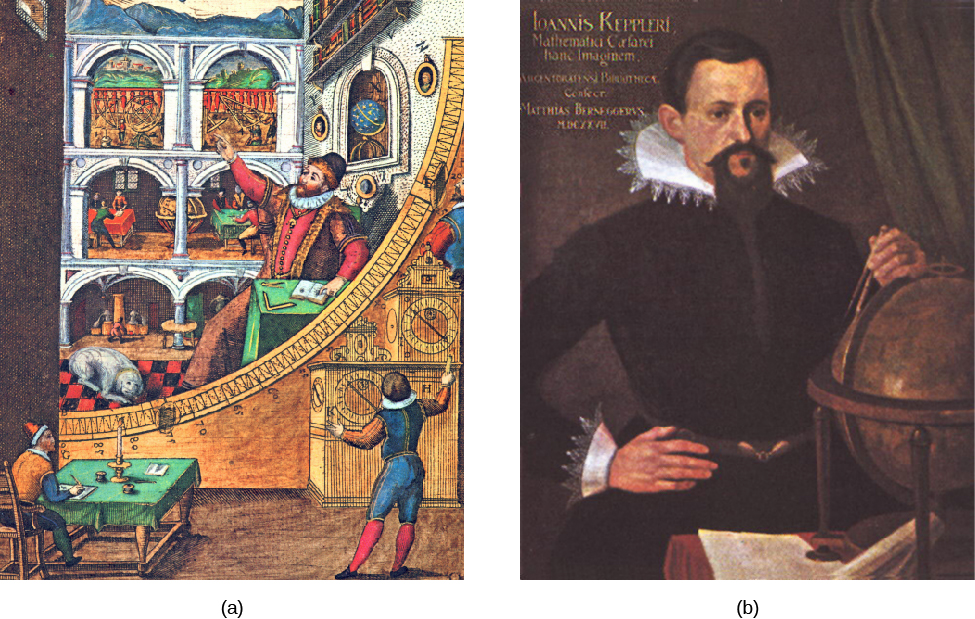
Three years after the publication of Copernicus’ De Revolutionibus, Tycho Brahe was born to a family of Danish nobility. He developed an early interest in astronomy and, as a young man, made significant astronomical observations. Among these was a careful study of what we now know was an exploding star that flared up to great brilliance in the night sky. His growing reputation gained him the patronage of the Danish King Frederick II, and at the age of 30, Brahe was able to establish a fine astronomical observatory on the North Sea island of Hven (Figure 3.2). Brahe was the last and greatest of the pre-telescopic observers in Europe.
英語のヒント
コペルニクスの『天球の回転について』の出版から3年後、ティコ・ブラーエはデンマークの貴族の家に生まれた。早くから天文学に関心を持ち、青年のころには重要な天体観測を行った。その一つが、夜空で非常に明るく輝き出した天体の、注意深い研究である。現在では、それが爆発する恒星だったとわかっている。名声が高まると、デンマーク王フレゼリク2世の後援を得た。そして30歳のとき、北海のヴェン島に立派な天文台を設立できた(図3.2)。ブラーエは、ヨーロッパで望遠鏡以前の時代を締めくくる、最も偉大な観測家であった。
Tycho Brahe (1546–1601) and Johannes Kepler (1571–1630).ティコ・ブラーエ(1546〜1601年)とヨハネス・ケプラー(1571〜1630年)
OpenStax / Rice University · CC BY 4.0
Figure 3.2 (a) A stylized engraving shows Tycho Brahe using his instruments to measure the altitude of celestial objects above the horizon. The large curved instrument in the foreground allowed him to measure precise angles in the sky. Note that the scene includes hints of the grandeur of Brahe’s observatory at Hven. (b) Kepler was a German mathematician and astronomer. His discovery of the basic laws that describe planetary motion placed the heliocentric cosmology of Copernicus on a firm mathematical basis.
図3.2 (a)器具を使って、地平線からの天体の高度を測るティコ・ブラーエを、様式化して描いた版画。手前の大きく湾曲した器具によって、空の角度を正確に測定できた。描かれた情景からは、ヴェン島にあるブラーエの天文台の壮麗さもうかがえる。(b)ケプラーはドイツの数学者・天文学者だった。惑星運動を記述する基本法則を発見し、コペルニクスの太陽中心の宇宙観に、確かな数学的基礎を与えた。
At Hven, Brahe made a continuous record of the positions of the Sun, Moon, and planets for almost 20 years. His extensive and precise observations enabled him to note that the positions of the planets varied from those given in published tables, which were based on the work of Ptolemy. These data were extremely valuable, but Brahe didn’t have the ability to analyze them and develop a better model than what Ptolemy had published. He was further inhibited because he was an extravagant and cantankerous fellow, and he accumulated enemies among government officials. When his patron, Frederick II, died in 1597, Brahe lost his political base and decided to leave Denmark. He took up residence in Prague, where he became court astronomer to Emperor Rudolf of Bohemia. There, in the year before his death, Brahe found a most able young mathematician, Johannes Kepler, to assist him in analyzing his extensive planetary data.
英語のヒント
ヴェン島でブラーエは、太陽、月、惑星の位置をほぼ20年にわたって継続的に記録した。広範かつ精密な観測によって、惑星の位置が、プトレマイオスの仕事に基づく公刊された表の値と異なることに気づいた。これらのデータはきわめて貴重であったが、ブラーエには、それを解析してプトレマイオスが公表したものより良いモデルを作る能力がなかった。さらに、浪費家で気難しい人物でもあり、政府の役人の間で敵を増やしていたことも、足かせとなった。後援者のフレゼリク2世が1597年に死去すると、ブラーエは政治的な基盤を失い、デンマークを離れることにした。プラハに居を移し、ボヘミアの皇帝ルドルフの宮廷天文学者になった。そこで、自分が亡くなる前年、ブラーエは、広範な惑星のデータを解析するのを手伝ってもらうため、きわめて有能な若い数学者、ヨハネス・ケプラーを見いだした。
Johannes Keplerヨハネス・ケプラー
Johannes Kepler was born into a poor family in the German province of Württemberg and lived much of his life amid the turmoil of the Thirty Years’ War (see Figure 3.2). He attended university at Tubingen and studied for a theological career. There, he learned the principles of the Copernican system and became converted to the heliocentric hypothesis. Eventually, Kepler went to Prague to serve as an assistant to Brahe, who set him to work trying to find a satisfactory theory of planetary motion—one that was compatible with the long series of observations made at Hven. Brahe was reluctant to provide Kepler with much material at any one time for fear that Kepler would discover the secrets of the universal motion by himself, thereby robbing Brahe of some of the glory. Only after Brahe’s death in 1601 did Kepler get full possession of the priceless records. Their study occupied most of Kepler’s time for more than 20 years.
英語のヒント
ヨハネス・ケプラーは、ドイツのヴュルテンベルク地方の貧しい家庭に生まれ、生涯の多くを三十年戦争の混乱の中で過ごした(図3.2を参照)。テュービンゲンの大学に通い、聖職に就くために学んだ。そこでコペルニクスの体系の原理を知り、太陽中心の仮説を信じるようになった。やがてケプラーは、ブラーエの助手として働くためプラハへ行った。ブラーエは彼に、惑星運動についての満足のいく理論、すなわち、ヴェン島で長年にわたって行った観測に合致する理論を探す仕事を与えた。ブラーエは、ケプラーが宇宙の運動の秘密を一人で見つけ、自分の栄誉の一部を奪ってしまうのを恐れ、一度に多くの資料を渡すことを渋った。ケプラーが貴重な記録をすべて手にできたのは、1601年にブラーエが死去してからのことである。その研究は、20年以上にわたって、ケプラーの時間の大半を占めた。
Through his analysis of the motions of the planets, Kepler developed a series of principles, now known as Kepler’s three laws, which described the behavior of planets based on their paths through space. The first two laws of planetary motion were published in 1609 in The New Astronomy. Their discovery was a profound step in the development of modern science.
英語のヒント
惑星の運動の解析を通して、ケプラーは、現在「ケプラーの三法則」と呼ばれる、一連の原理を築いた。これらは、宇宙空間の中での経路に基づいて、惑星の振る舞いを記述するものである。惑星運動の最初の二つの法則は、1609年に『新天文学』で公表された。その発見は、近代科学の発展における大きな一歩であった。
The First Two Laws of Planetary Motion惑星運動の最初の二つの法則
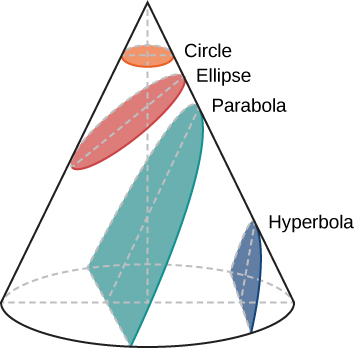
The path of an object through space is called its orbit. Kepler initially assumed that the orbits of planets were circles, but doing so did not allow him to find orbits that were consistent with Brahe’s observations. Working with the data for Mars, he eventually discovered that the orbit of that planet had the shape of a somewhat flattened circle, or ellipse. Next to the circle, the ellipse is the simplest kind of closed curve, belonging to a family of curves known as conic sections (Figure 3.3).
英語のヒント
物体が宇宙空間を通る経路を、その物体の軌道と呼ぶ。ケプラーは当初、惑星の軌道は円だと仮定した。しかし、その仮定では、ブラーエの観測に合う軌道を見つけられなかった。火星のデータに取り組むうちに、その軌道は、円をいくらか押しつぶしたような形、すなわち楕円だと、ついに発見した。楕円は、円に次いで単純な閉じた曲線であり、円錐曲線と呼ばれる曲線の仲間に属す(図3.3)。
Conic Sections.円錐曲線
OpenStax / Rice University · CC BY 4.0
Figure 3.3 The circle, ellipse, parabola, and hyperbola are all formed by the intersection of a plane with a cone. This is why such curves are called conic sections.
図3.3 円、楕円、放物線、双曲線は、いずれも平面と円錐が交わることでできる。このため、これらは円錐曲線と呼ばれる。
You might recall from math classes that in a circle, the center is a special point. The distance from the center to anywhere on the circle is exactly the same. In an ellipse, the sum of the distance from two special points inside the ellipse to any point on the ellipse is always the same. These two points inside the ellipse are called its foci (singular: focus), a word invented for this purpose by Kepler.
英語のヒント
数学の授業で、円の中心が特別な点であることを学んだだろう。中心から円周上のどの点までの距離も、まったく同じである。楕円では、楕円の内部にある二つの特別な点から、楕円上の任意の点までの距離の和が、常に同じになる。この内部の二点を焦点といい、英語では複数形を foci、単数形を focus と呼ぶ。ケプラーがこの意味で使うために導入した言葉である。
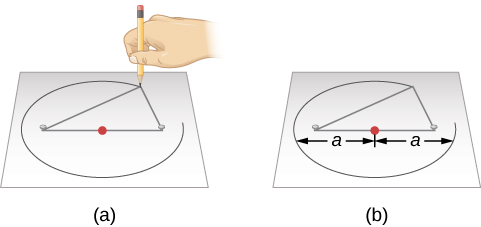
This property suggests a simple way to draw an ellipse (Figure 3.4). We wrap the ends of a loop of string around two tacks pushed through a sheet of paper into a drawing board, so that the string is slack. If we push a pencil against the string, making the string taut, and then slide the pencil against the string all around the tacks, the curve that results is an ellipse. At any point where the pencil may be, the sum of the distances from the pencil to the two tacks is a constant length—the length of the string. The tacks are at the two foci of the ellipse.
英語のヒント
この性質から、楕円を描く簡単な方法がわかる(図3.4)。画板の上に紙を置き、紙を貫いて二つの画びょうを留め、その二点に輪にした糸を掛けて、糸がたるむようにする。鉛筆を糸に押し当て、糸をぴんと張ったまま画びょうのまわりを一周させると、描かれる曲線は楕円になる。鉛筆がどこにあっても、鉛筆から二つの画びょうまでの距離の和は一定で、糸の長さに対応する。二つの画びょうの位置が、楕円の二つの焦点である。
The widest diameter of the ellipse is called its major axis. Half this distance—that is, the distance from the center of the ellipse to one end—is the semimajor axis, which is usually used to specify the size of the ellipse. For example, the semimajor axis of the orbit of Mars, which is also the planet’s average distance from the Sun, is 228 million kilometers.
英語のヒント
楕円の最も長い直径を長軸と呼ぶ。その半分、つまり楕円の中心から長いほうの端までの距離が長半径で、ふつう楕円の大きさを表すのに用いられる。たとえば火星の軌道の長半径は、火星と太陽の平均距離にも相当し、2億2800万キロメートルである。
Drawing an Ellipse.楕円の描き方
OpenStax / Rice University · CC BY 4.0
Figure 3.4 (a) We can construct an ellipse by pushing two tacks (the white objects) into a piece of paper on a drawing board, and then looping a string around the tacks. Each tack represents a focus of the ellipse, with one of the tacks being the Sun. Stretch the string tight using a pencil, and then move the pencil around the tacks. The length of the string remains the same, so that the sum of the distances from any point on the ellipse to the foci is always constant. (b) In this illustration, each semimajor axis is denoted by a. The distance 2a is called the major axis of the ellipse.
図3.4 (a)画板に載せた紙に二つの画びょう(白い物体)を留め、そのまわりに輪にした糸を掛ければ、楕円を描ける。各画びょうは楕円の焦点を表し、一方が太陽に相当する。鉛筆で糸をぴんと張り、画びょうのまわりを動かそう。糸の長さは変わらないため、楕円上の任意の点から二つの焦点までの距離の和は常に一定になる。(b)この図では、各長半径を a と記している。距離 2a を楕円の長軸と呼ぶ。
The shape (roundness) of an ellipse depends on how close together the two foci are, compared with the major axis. The ratio of the distance between the foci to the length of the major axis is called the eccentricity of the ellipse.
英語のヒント
楕円の形、すなわちどれほど丸いかは、長軸に比べて二つの焦点がどれほど近接しているかで決まる。焦点間の距離を長軸の長さで割った比を、楕円の離心率と呼ぶ。
If the foci (or tacks) are moved to the same location, then the distance between the foci would be zero. This means that the eccentricity is zero and the ellipse is just a circle; thus, a circle can be called an ellipse of zero eccentricity. In a circle, the semimajor axis would be the radius.
英語のヒント
二つの焦点、あるいは画びょうを同じ位置に移すと、焦点間の距離はゼロになる。すると離心率もゼロとなり、楕円は円そのものになる。したがって、円は離心率ゼロの楕円と呼べる。円の場合、長半径は円の半径である。
Next, we can make ellipses of various elongations (or extended lengths) by varying the spacing of the tacks (as long as they are not farther apart than the length of the string). The greater the eccentricity, the more elongated is the ellipse, up to a maximum eccentricity of , when the ellipse becomes “flat,” the other extreme from a circle.
英語のヒント
次に、画びょうの間隔を変えれば、さまざまな細長さの楕円を作れる。ただし、画びょうの間隔は糸の長さを超えないものとする。離心率が大きいほど楕円は細長くなり、最大の離心率 では「平ら」になる。これは、円とは反対側の極端な形である。
The size and shape of an ellipse are completely specified by its semimajor axis and its eccentricity. Using Brahe’s data, Kepler found that Mars has an elliptical orbit, with the Sun at one focus (the other focus is empty). The eccentricity of the orbit of Mars is only about ; its orbit, drawn to scale, would be practically indistinguishable from a circle, but the difference turned out to be critical for understanding planetary motions.
英語のヒント
楕円の大きさと形は、その長半径と離心率で完全に定まる。ブラーエのデータを使い、ケプラーは、火星の軌道が楕円で、太陽がその一方の焦点にあることを発見した。もう一方の焦点には何もない。火星の軌道の離心率は、わずか約 である。正しい比率で描けば、円とほとんど見分けがつかないほどであるが、その違いが、惑星の運動を理解するうえで決定的に重要だったのである。
Kepler generalized this result in his first law and said that the orbits of all the planets are ellipses. Here was a decisive moment in the history of human thought: it was not necessary to have only circles in order to have an acceptable cosmos. The universe could be a bit more complex than the Greek philosophers had wanted it to be.
英語のヒント
ケプラーはこの結果を一般化し、第一法則で、すべての惑星の軌道は楕円だと述べた。これは、人間の思考の歴史における決定的な瞬間であった。受け入れられる宇宙の姿を作るために、円だけを使う必要はなかったのである。宇宙は、ギリシャの哲学者が望んでいたより、少し複雑でもよかったのであった。
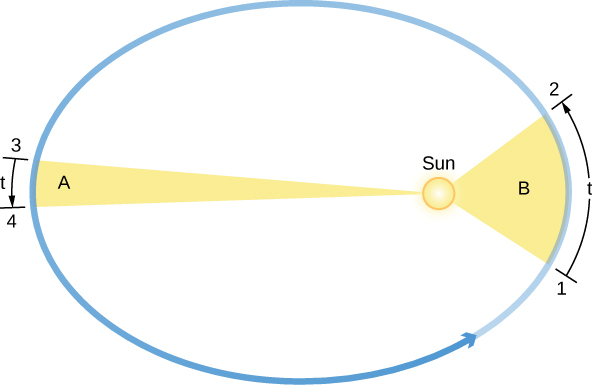
Kepler’s second law deals with the speed with which each planet moves along its ellipse, also known as its orbital speed. Working with Brahe’s observations of Mars, Kepler discovered that the planet speeds up as it comes closer to the Sun and slows down as it pulls away from the Sun. He expressed the precise form of this relationship by imagining that the Sun and Mars are connected by a straight, elastic line. When Mars is closer to the Sun (positions 1 and 2 in Figure 3.5), the elastic line is not stretched as much, and the planet moves rapidly. Farther from the Sun, as in positions 3 and 4, the line is stretched a lot, and the planet does not move so fast. As Mars travels in its elliptical orbit around the Sun, the elastic line sweeps out areas of the ellipse as it moves (the colored regions in our figure). Kepler found that in equal intervals of time (t), the areas swept out in space by this imaginary line are always equal; that is, the area of the region B from 1 to 2 is the same as that of region A from 3 to 4.
英語のヒント
ケプラーの第二法則は、各惑星が楕円に沿って動く速さ、すなわち公転速度を扱う。ブラーエの火星の観測を調べるうちに、ケプラーは、惑星は太陽に近づくと速くなり、遠ざかると遅くなることを発見した。この関係を正確に表すために、太陽と火星が、まっすぐな伸び縮みする線で結ばれていると考えた。火星が太陽に近いとき、図3.5の位置1と2では、線はあまり伸びず、惑星は速く動く。太陽から遠い位置3と4では、線は大きく伸び、惑星の動きはそれほど速くない。火星が太陽のまわりの楕円軌道を進むにつれ、この線は楕円の内部を掃き、面積を描き出す。図の色を付けた領域がそれに当たる。ケプラーは、等しい時間間隔 t の間に、この想像上の線が空間を掃く面積は、常に等しいと見いだした。つまり、位置1から2までの領域Bの面積は、位置3から4までの領域Aの面積と同じである。
If a planet moves in a circular orbit, the elastic line is always stretched the same amount and the planet moves at a constant speed around its orbit. But, as Kepler discovered, in most orbits that speed of a planet orbiting its star (or moon orbiting its planet) tends to vary because the orbit is elliptical.
英語のヒント
惑星が円軌道を動くなら、伸び縮みする線の伸びは常に同じで、惑星は軌道上を一定の速さで動く。しかしケプラーが発見したように、大半の軌道では、恒星を回る惑星、あるいは惑星を回る衛星の速さは、軌道が楕円であるために変化する。
Kepler’s Second Law: The Law of Equal Areas.ケプラーの第二法則:面積速度一定の法則
OpenStax / Rice University · CC BY 4.0
Figure 3.5 The orbital speed of a planet traveling around the Sun (the circular object inside the ellipse) varies in such a way that in equal intervals of time (t), a line between the Sun and a planet sweeps out equal areas (A and B). Note that the eccentricities of the planets’ orbits in our solar system are substantially less than shown here.
図3.5 太陽(楕円の内側の丸い天体)のまわりを動く惑星の公転速度は、等しい時間間隔 t の間に、太陽と惑星を結ぶ線が等しい面積AとBを掃くように変化する。太陽系の惑星の軌道の離心率は、この図で示したものよりずっと小さいことに注意しよう。