第3章軌道と重力Orbits and Gravity
3.4 Orbits in the Solar System3.4 太陽系の軌道
Learning Objectives学習の目標
By the end of this section, you will be able to:
この節を学ぶと、次のことができるようになる。
Compare the orbital characteristics of the planets in the solar system
太陽系の惑星の軌道の特徴を比較する。
Compare the orbital characteristics of asteroids and comets in the solar system
太陽系の小惑星と彗星の軌道の特徴を比較する。
Recall that the path of an object under the influence of gravity through space is called its orbit, whether that object is a spacecraft, planet, star, or galaxy. An orbit, once determined, allows the future positions of the object to be calculated.
英語のヒント
宇宙機、惑星、恒星、銀河のいずれであっても、物体が重力の影響のもとで宇宙空間を進む経路を、軌道と呼ぶことを思い出せ。いったん軌道が決まれば、その物体の将来の位置を計算できる。
Two points in any orbit in our solar system have been given special names. The place where the planet is closest to the Sun (helios in Greek) and moves the fastest is called the perihelion of its orbit, and the place where it is farthest away and moves the most slowly is the aphelion. For the Moon or a satellite orbiting Earth (gee in Greek), the corresponding terms are perigee and apogee. (In this book, we use the word moon for a natural object that goes around a planet and the word satellite to mean a human-made object that revolves around a planet.)
英語のヒント
太陽系のどの軌道でも、二つの点には特別な名前がある。惑星が太陽に最も近づき、最も速く動く場所を近日点、最も遠ざかり、最も遅く動く場所を遠日点と呼ぶ。英語はそれぞれ perihelion と aphelion で、太陽を意味するギリシャ語 helios に由来する。地球を回る月や人工衛星では、対応する語は近地点 perigee と遠地点 apogee である。地球はギリシャ語で gee という。本書では、惑星のまわりを回る自然の物体に moon、惑星のまわりを回る人工の物体に satellite という語を使う。
Orbits of the Planets惑星の軌道
Today, Newton’s work enables us to calculate and predict the orbits of the planets with marvelous precision. We know eight planets, beginning with Mercury closest to the Sun and extending outward to Neptune. The average orbital data for the planets are summarized in Table 3.2. (Ceres is the largest of the asteroids, now considered a dwarf planet.)
英語のヒント
今日、ニュートンの仕事によって、惑星の軌道を驚くほど高い精度で計算し、予測できる。私たちは、太陽に最も近い水星から、外側の海王星まで、八つの惑星を知っている。惑星の平均的な軌道データを表3.2にまとめる。ケレスは最大の小惑星で、現在は準惑星とされている。
According to Kepler’s laws, Mercury must have the shortest orbital period (88 Earth-days); thus, it has the highest orbital speed, averaging 48 kilometers per second. At the opposite extreme, Neptune has a period of 165 years and an average orbital speed of just 5 kilometers per second.
英語のヒント
ケプラーの法則によれば、水星の公転周期は最も短く、地球の88日である。そのため公転速度も最も大きく、平均で毎秒48キロメートルになる。反対の極端にある海王星の周期は165年で、平均公転速度はわずか毎秒5キロメートルである。
All the planets have orbits of rather low eccentricity. The most eccentric orbit is that of Mercury (0.21); the rest have eccentricities smaller than 0.1. It is fortunate that among the rest, Mars has an eccentricity greater than that of many of the other planets. Otherwise the pre-telescopic observations of Brahe would not have been sufficient for Kepler to deduce that its orbit had the shape of an ellipse rather than a circle.
英語のヒント
どの惑星も、軌道の離心率はかなり小さくなっている。最も離心率が大きいのは水星の0.21で、残りはすべて0.1未満である。その残りの中で、火星の離心率がほかの多くの惑星より大きかったことは、幸運であった。そうでなければ、ブラーエの望遠鏡以前の観測から、軌道が円ではなく楕円だとケプラーが推論するには、十分な情報が得られなかっただろう。
The planetary orbits are also confined close to a common plane, which is near the plane of Earth’s orbit (called the ecliptic). The strange orbit of the dwarf planet Pluto is inclined about 17° to the ecliptic, and that of the dwarf planet Eris (orbiting even farther away from the Sun than Pluto) by 44°, but all the major planets lie within 10° of the common plane of the solar system.
英語のヒント
惑星の軌道は、共通する一つの平面の近くにも収まっている。その平面は、黄道面と呼ぶ地球の軌道面に近いものである。準惑星の冥王星の風変わりな軌道は、黄道面に対して約17°傾いており、冥王星よりさらに太陽から遠くを回る準惑星エリスでは44°である。しかし主要な惑星はすべて、太陽系の共通の平面から10°以内にある。
Orbits of Asteroids and Comets小惑星と彗星の軌道
In addition to the eight planets, there are many smaller objects in the solar system. Some of these are moons (natural satellites) that orbit all the planets except Mercury and Venus. In addition, there are two classes of smaller objects in heliocentric orbits: asteroids and comets. Both asteroids and comets are believed to be small chunks of material left over from the formation process of the solar system.
英語のヒント
太陽系には、八つの惑星に加えて、多数の小さな天体がある。その一部は自然の衛星で、水星と金星を除くすべての惑星のまわりを回っている。また、太陽を中心とする軌道を回る小天体には、小惑星と彗星という二つの種類がある。どちらも、太陽系ができる過程から残った、小さな物質の塊だと考えられている。
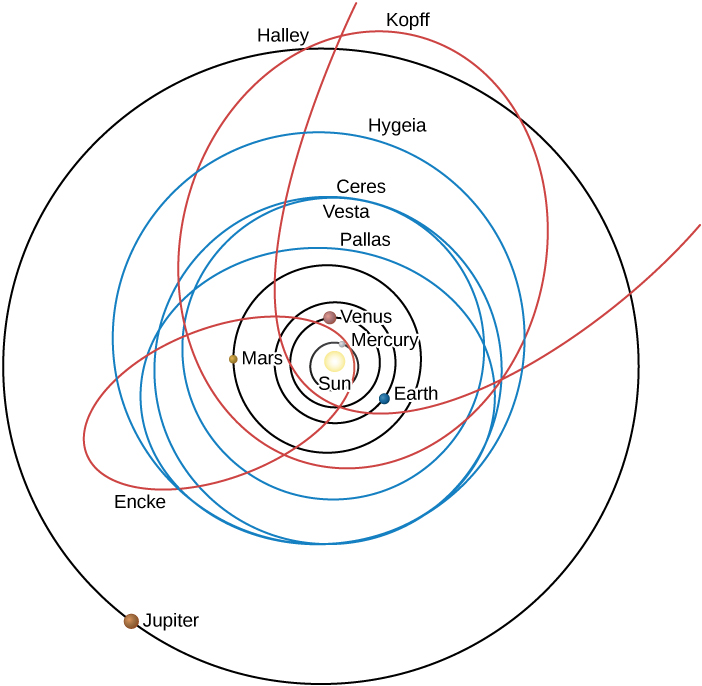
In general, asteroids have orbits with smaller semimajor axes than do comets (Figure 3.10). The majority of them lie between 2.2 and 3.3 AU, in the region known as the asteroid belt (see Comets and Asteroids: Debris of the Solar System). As you can see in Table 3.2, the asteroid belt (represented by its largest member, Ceres) is in the middle of a gap between the orbits of Mars and Jupiter. It is because these two planets are so far apart that stable orbits of small bodies can exist in the region between them.
英語のヒント
一般に、小惑星の軌道は、彗星より長半径が小さくなっている(図3.10)。大半は2.2〜3.3AUにあり、この領域は小惑星帯と呼ばれる(「彗星と小惑星――太陽系に残されたかけら」を参照)。表3.2では、最大の天体ケレスが小惑星帯を代表しており、火星と木星の軌道の間の隙間の中央にあるとわかる。この二つの惑星が大きく離れているからこそ、その間の領域に、小天体の安定した軌道が存在できるのである。
Solar System Orbits.太陽系の軌道
OpenStax / Rice University · CC BY 4.0
Figure 3.10 We see the orbits of typical comets and asteroids compared with those of the planets Mercury, Venus, Earth, Mars, and Jupiter (black circles). Shown in red are three comets: Halley, Kopff, and Encke. In blue are the four largest asteroids: Ceres, Pallas, Vesta, and Hygeia.
図3.10 代表的な彗星と小惑星の軌道を、水星、金星、地球、火星、木星の軌道(黒い円)と比べている。赤で示すのは、ハレー、コプフ、エンケという三つの彗星。青で示すのは、最大級の四つの小惑星、ケレス、パラス、ベスタ、ヒギエアである。
Orbital Data for the Planets 惑星の軌道データ |
|||
|---|---|---|---|
Planet 惑星 |
Semimajor Axis (AU) 長半径(AU) |
Period (y) 周期(年) |
Eccentricity 離心率 |
Mercury 水星 |
0.39 | 0.24 | 0.21 |
Venus 金星 |
0.72 | 0.6 | 0.01 |
Earth 地球 |
1 | 1.00 | 0.02 |
Mars 火星 |
1.52 | 1.88 | 0.09 |
(Ceres) (ケレス) |
2.77 | 4.6 | 0.08 |
Jupiter 木星 |
5.20 | 11.86 | 0.05 |
Saturn 土星 |
9.54 | 29.46 | 0.06 |
Uranus 天王星 |
19.19 | 84.01 | 0.05 |
Neptune 海王星 |
30.06 | 164.82 | 0.01 |
Comets generally have orbits of larger size and greater eccentricity than those of the asteroids. Typically, the eccentricity of their orbits is 0.8 or higher. According to Kepler’s second law, therefore, they spend most of their time far from the Sun, moving very slowly. As they approach perihelion, the comets speed up and whip through the inner parts of their orbits more rapidly.
英語のヒント
彗星の軌道は一般に、小惑星より大きく、離心率も高くなっている。典型的な離心率は0.8以上である。そのため、ケプラーの第二法則によれば、彗星は大半の時間を、太陽から遠く離れた所で、ごくゆっくり動いて過ごす。近日点に近づくと速くなり、軌道の内側の部分を勢いよく通り抜ける。
Key Concepts and Summary重要事項のまとめ
The closest point in a satellite orbit around Earth is its perigee, and the farthest point is its apogee (corresponding to perihelion and aphelion for an orbit around the Sun). The planets follow orbits around the Sun that are nearly circular and in the same plane. Most asteroids are found between Mars and Jupiter in the asteroid belt, whereas comets generally follow orbits of high eccentricity.
地球を回る衛星の軌道で、地球に最も近い点を近地点、最も遠い点を遠地点と呼ぶ。これは、太陽を回る軌道での近日点、遠日点に対応する。惑星は太陽のまわりを、ほぼ円形で、ほぼ同じ平面内の軌道に沿って動く。小惑星の大半は火星と木星の間の小惑星帯にあり、彗星は一般に離心率の高い軌道をたどる。
aphelion
遠日点
the point in its orbit where a planet (or other orbiting object) is farthest from the Sun
惑星やその他の公転する天体が、軌道上で太陽から最も遠くなる点。
apogee
遠地点
the point in its orbit where an Earth satellite is farthest from Earth
地球を回る衛星が、軌道上で地球から最も遠くなる点。
asteroid belt
小惑星帯
the region of the solar system between the orbits of Mars and Jupiter in which most asteroids are located; the main belt, where the orbits are generally the most stable, extends from 2.2 to 3.3 AU from the Sun
太陽系の火星と木星の軌道の間にあり、大半の小惑星が位置する領域。軌道が一般に最も安定している主帯は、太陽から2.2〜3.3AUに広がる。
perigee
近地点
the point in its orbit where an Earth satellite is closest to Earth
地球を回る衛星が、軌道上で地球に最も近くなる点。
perihelion
近日点
the point in its orbit where a planet (or other orbiting object) is nearest to the Sun
惑星やその他の公転する天体が、軌道上で太陽に最も近くなる点。
satellite
衛星
an object that revolves around a planet
惑星のまわりを公転する物体。