第3章軌道と重力Orbits and Gravity
3.5 Motions of Satellites and Spacecraft3.5 人工衛星と宇宙機の運動
Learning Objectives学習の目標
By the end of this section, you will be able to:
この節を学ぶと、次のことができるようになる。
Explain how an object (such as a satellite) can be put into orbit around Earth
人工衛星などの物体を、どのように地球周回軌道へ入れられるかを説明する。
Explain how an object (such as a planetary probe) can escape from orbit
惑星探査機などの物体が、どのように軌道から脱出できるかを説明する。
Newton’s universal law of gravitation and Kepler’s laws describe the motions of Earth satellites and interplanetary spacecraft as well as the planets. Sputnik, the first artificial Earth satellite, was launched by what was then called the Soviet Union on October 4, 1957. Since that time, thousands of satellites have been placed into orbit around Earth, and spacecraft have also orbited the Moon, Venus, Mars, Jupiter, Saturn, and a number of asteroids and comets.
英語のヒント
ニュートンの万有引力の法則とケプラーの法則は、惑星だけでなく、地球の人工衛星や惑星間宇宙機の運動も記述する。地球初の人工衛星スプートニクは、当時ソビエト連邦と呼ばれていた国によって、1957年10月4日に打ち上げられた。それ以来、数千の人工衛星が地球周回軌道に投入され、宇宙機は月、金星、火星、木星、土星、そしていくつもの小惑星や彗星のまわりも周回してきた。
Once an artificial satellite is in orbit, its behavior is no different from that of a natural satellite, such as our Moon. If the satellite is high enough to be free of atmospheric friction, it will remain in orbit forever. However, although there is no difficulty in maintaining a satellite once it is in orbit, a great deal of energy is required to lift the spacecraft off Earth and accelerate it to orbital speed.
英語のヒント
人工衛星がいったん軌道に入れば、その振る舞いは月のような自然の衛星と変わらない。大気の摩擦を受けないほど高い所にあれば、いつまでも軌道にとどまる。しかし、軌道に入った人工衛星をそこに保つのは難しくなくても、宇宙機を地球から持ち上げて、公転速度まで加速するには、大きなエネルギーが必要である。
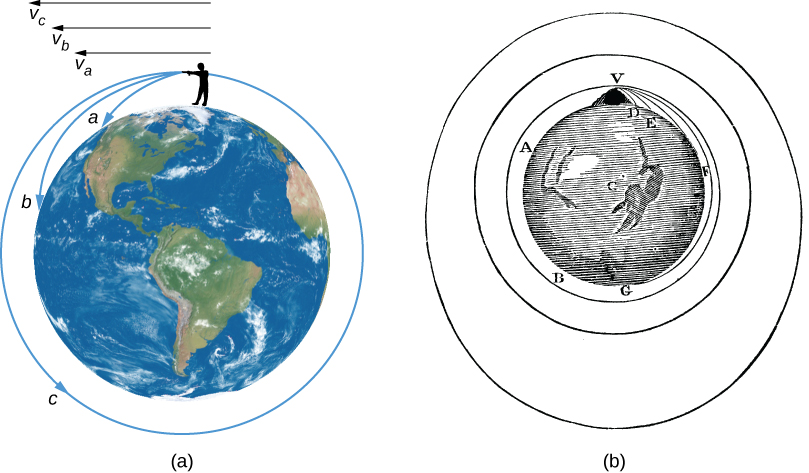
To illustrate how a satellite is launched, imagine a gun firing a bullet horizontally from the top of a high mountain, as in Figure 3.11, which has been adapted from a similar diagram by Newton. Imagine, further, that the friction of the air could be removed and that nothing gets in the bullet’s way. Then the only force that acts on the bullet after it leaves the muzzle is the gravitational force between the bullet and Earth.
英語のヒント
人工衛星を打ち上げる仕組みを説明するため、図3.11のように、高い山の頂上から銃が弾丸を水平に発射するところを想像せよ。この図はニュートンの同様の図をもとにしている。さらに、空気の摩擦を取り除くことができ、弾丸の進路を妨げるものも何もないと考えよう。すると、銃口を出た後に弾丸に働く力は、弾丸と地球の間の重力だけになる。
Firing a Bullet into Orbit.弾丸を軌道へ撃ち出す
OpenStax / Rice University · CC BY 4.0
Figure 3.11 (a) For paths a and b, the velocity is not enough to prevent gravity from pulling the bullet back to Earth; in case c, the velocity allows the bullet to fall completely around Earth. (b) This diagram by Newton in his De Mundi Systemate, 1731 edition, illustrates the same concept shown in (a).
図3.11 (a)経路aとbでは速度が足りず、重力によって弾丸が地上へ引き戻される。cの場合には、速度が十分に大きいため、弾丸は地球のまわりを完全に一周するように落下する。(b)ニュートンの『世界体系論(De Mundi Systemate)』1731年版の図も、(a)と同じ考えを示している。
If the bullet is fired with a velocity we can call va, the gravitational force acting upon it pulls it downward toward Earth, where it strikes the ground at point a. However, if it is given a higher muzzle velocity, vb, its higher speed carries it farther before it hits the ground at point b.
英語のヒント
弾丸を v_a と呼ぶ速度で発射すると、重力が下向きに地球へ引き、弾丸は点aで地面に衝突する。しかし、それより大きい銃口での速度 v_b を与えると、より速く進むため、点bで地面に衝突するまでに、もっと遠くまで届く。
If our bullet is given a high enough muzzle velocity, vc, the curved surface of Earth causes the ground to remain the same distance from the bullet so that the bullet falls around Earth in a complete circle. The speed needed to do this—called the circular satellite velocity—is about 8 kilometers per second, or about 17,500 miles per hour in more familiar units.
英語のヒント
弾丸に十分に大きい初速 v_c を与えると、地球の表面が曲がっているため、地面と弾丸の距離が一定に保たれ、弾丸は地球のまわりへ、完全な円を描いて落ち続ける。このために必要な速さを、円軌道の衛星速度といい、毎秒約8キロメートルである。よりなじみのある単位では、毎時約1万7500マイルになる。
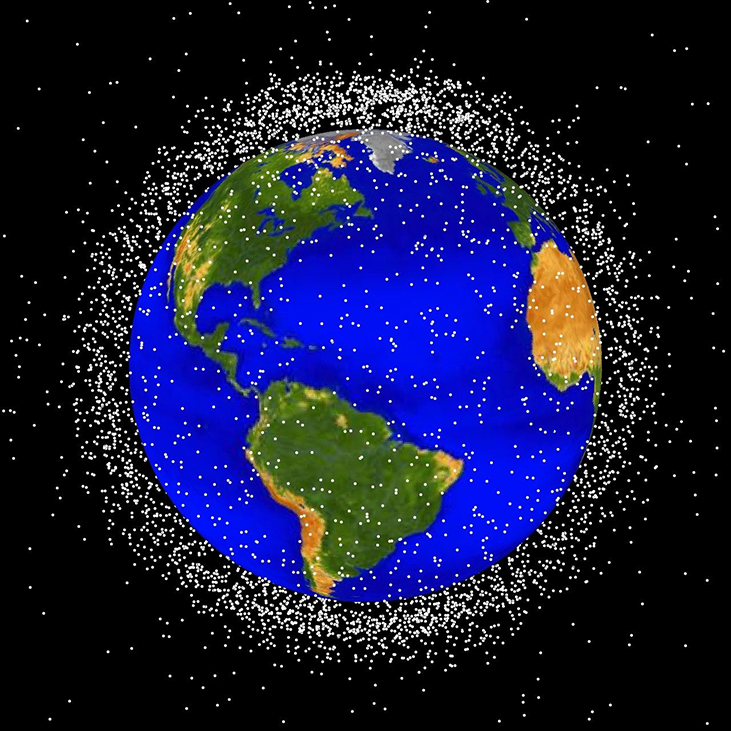
Each year, more than 50 new satellites are launched into orbit by such nations as Russia, the United States, China, Japan, India, and Israel, as well as by the European Space Agency (ESA), a consortium of European nations (Figure 3.12). Today, these satellites are used for weather tracking, ecology, global positioning systems, communications, and military purposes, to name a few uses. Most satellites are launched into low Earth orbit, since this requires the minimum launch energy. At the orbital speed of 8 kilometers per second, they circle the planet in about 90 minutes. Some of the very low Earth orbits are not indefinitely stable because, as Earth’s atmosphere swells from time to time, a frictional drag is generated by the atmosphere on these satellites, eventually leading to a loss of energy and “decay” of the orbit.
英語のヒント
毎年、ロシア、アメリカ、中国、日本、インド、イスラエルなどの国々と、ヨーロッパ諸国が協力する欧州宇宙機関(ESA)によって、50基を超える新しい人工衛星が軌道に打ち上げられる(図3.12)。今日の利用目的には、いくつか挙げるだけでも、気象の監視、生態環境の調査、全地球測位システム、通信、軍事用途がある。大半の人工衛星は、打ち上げに必要なエネルギーが最小になるため、地球低軌道へ投入される。毎秒8キロメートルの公転速度なら、約90分で地球を一周する。ごく低い地球周回軌道の一部は、いつまでも安定しているわけではない。地球の大気はときどき膨張し、衛星に摩擦による抵抗を生じさせ、やがてエネルギーの損失と軌道の「減衰」をもたらすからである。
Satellites in Earth Orbit.地球周回軌道の人工衛星
credit: NASA/JSC · NASA media use guidelines
Figure 3.12 This figure shows the larger pieces of orbital debris that are being tracked by NASA in Earth’s orbit. (credit: NASA/JSC)
図3.12 地球の軌道上でNASAが追跡している、比較的大きな軌道デブリを示す図。(クレジット:NASA/JSC)
Interplanetary Spacecraft惑星間宇宙機
The exploration of the solar system has been carried out largely by robot spacecraft sent to the other planets. To escape Earth, these craft must achieve escape speed, the speed needed to move away from Earth forever, which is about 11 kilometers per second (about 25,000 miles per hour). After escaping Earth, these craft coast to their targets, subject only to minor trajectory adjustments provided by small thruster rockets on board. In interplanetary flight, these spacecraft follow orbits around the Sun that are modified only when they pass near one of the planets.
英語のヒント
太陽系の探査は、主にほかの惑星へ送り出された無人の宇宙機によって行われてきた。地球から脱出するには、これらの宇宙機は脱出速度、すなわち地球を永遠に離れるのに必要な速さに達しなければならない。これは毎秒約11キロメートル、毎時約2万5000マイルである。地球を脱出した後は、搭載された小さな推進用ロケットによるわずかな軌道修正だけを受けながら、目標へ向かって惰性で飛行する。惑星間飛行では、宇宙機は太陽のまわりの軌道をたどり、いずれかの惑星の近くを通過するときにだけ、その軌道が変えられる。
As it comes close to its target, a spacecraft is deflected by the planet’s gravitational force into a modified orbit, either gaining or losing energy in the process. Spacecraft controllers have actually been able to use a planet’s gravity to redirect a flyby spacecraft to a second target. For example, Voyager 2 used a series of gravity-assisted encounters to yield successive flybys of Jupiter (1979), Saturn (1980), Uranus (1986), and Neptune (1989). The Galileo spacecraft, launched in 1989, flew past Venus once and Earth twice to gain the energy required to reach its ultimate goal of orbiting Jupiter.
英語のヒント
目標へ近づくと、宇宙機は惑星の重力で曲げられて新しい軌道へ移り、その過程でエネルギーを得たり失ったりする。運用担当者は実際に、惑星の重力を使って、近くを通過する宇宙機を次の目標へ向け直すことに成功してきた。たとえばボイジャー2号は、連続した重力アシストを使い、木星(1979年)、土星(1980年)、天王星(1986年)、海王星(1989年)を順に接近通過した。1989年に打ち上げられたガリレオ探査機は、最終目標である木星の周回に到達するためのエネルギーを得ようと、金星の近くを一度、地球の近くを二度通過した。
If we wish to orbit a planet, we must slow the spacecraft with a rocket when the spacecraft is near its destination, allowing it to be captured into an elliptical orbit. Additional rocket thrust is required to bring a vehicle down from orbit for a landing on the surface. Finally, if a return trip to Earth is planned, the landed payload must include enough propulsive power to repeat the entire process in reverse.
英語のヒント
惑星のまわりを周回させたいなら、目的地の近くでロケットを使って宇宙機を減速し、楕円軌道に捕らえられるようにしなければならない。さらに、軌道から下ろして表面に着陸させるには、追加のロケットの推力が必要である。最後に、地球への帰還を計画するなら、着陸する機体には、一連の過程を逆向きに繰り返すのに十分な推進能力を備えなければならない。