第3章軌道と重力Orbits and Gravity
3.3 Newton’s Universal Law of Gravitation3.3 ニュートンの万有引力の法則
Learning Objectives学習の目標
By the end of this section, you will be able to:
この節を学ぶと、次のことができるようになる。
Explain what determines the strength of gravity
重力の強さを決めるものを説明する。
Describe how Newton’s universal law of gravitation extends our understanding of Kepler’s laws
ニュートンの万有引力の法則が、ケプラーの法則の理解をどのように広げるかを述べる。
Newton’s laws of motion show that objects at rest will stay at rest and those in motion will continue moving uniformly in a straight line unless acted upon by a force. Thus, it is the straight line that defines the most natural state of motion. But the planets move in ellipses, not straight lines; therefore, some force must be bending their paths. That force, Newton proposed, was gravity.
英語のヒント
ニュートンの運動法則によれば、物体は力を受けないかぎり、静止していれば静止し続け、動いていれば直線に沿って一様に動き続ける。つまり、最も自然な運動状態を定めるのは直線なのである。しかし惑星は、直線ではなく楕円を動く。したがって、何らかの力が経路を曲げているはずである。その力こそ重力だと、ニュートンは提案した。
In Newton’s time, gravity was something associated with Earth alone. Everyday experience shows us that Earth exerts a gravitational force upon objects at its surface. If you drop something, it accelerates toward Earth as it falls. Newton’s insight was that Earth’s gravity might extend as far as the Moon and produce the force required to curve the Moon’s path from a straight line and keep it in its orbit. He further hypothesized that gravity is not limited to Earth, but that there is a general force of attraction between all material bodies. If so, the attractive force between the Sun and each of the planets could keep them in their orbits. (This may seem part of our everyday thinking today, but it was a remarkable insight in Newton’s time.)
英語のヒント
ニュートンの時代、重力は地球だけに結びついたものと考えられていた。地球が地表の物体に重力を及ぼすことは、日常の経験からわかる。何かを落とせば、落下するにつれて地球へ向かって加速する。ニュートンの洞察は、地球の重力が月まで届き、月の経路を直線から曲げ、軌道にとどめるための力を生み出しているかもしれない、というものであった。さらに、重力は地球に限られず、あらゆる物質的な物体の間に働く、一般的な引力があると仮定した。そうであれば、太陽と各惑星の間の引力によって、惑星を軌道にとどめられる。今日では日常的な考え方の一部に思えるかもしれないが、ニュートンの時代には驚くべき洞察であった。
Once Newton boldly hypothesized that there was a universal attraction among all bodies everywhere in space, he had to determine the exact nature of the attraction. The precise mathematical description of that gravitational force had to dictate that the planets move exactly as Kepler had described them to (as expressed in Kepler’s three laws). Also, that gravitational force had to predict the correct behavior of falling bodies on Earth, as observed by Galileo. How must the force of gravity depend on distance in order for these conditions to be met?
英語のヒント
宇宙のどこでも、あらゆる物体の間に普遍的な引力が働くと大胆に仮定すると、ニュートンは、その引力の正確な性質を求めなければならなかった。重力を数学的に正確に記述したものは、惑星が、ケプラーの三法則で表されたとおりに動くことを、必ず導く必要がある。また、その重力は、ガリレオが観測した、地上で落下する物体の正しい振る舞いも予測しなければならない。これらの条件を満たすには、重力は距離にどのように依存していればよいのだろうか。
The answer to this question required mathematical tools that had not yet been developed, but this did not deter Isaac Newton, who invented what we today call calculus to deal with this problem. Eventually he was able to conclude that the magnitude of the force of gravity must decrease with increasing distance between the Sun and a planet (or between any two objects) in proportion to the inverse square of their separation. In other words, if a planet were twice as far from the Sun, the force would be , or as large. Put the planet three times farther away, and the force is , or as large.
英語のヒント
この問いに答えるには、まだ発展していなかった数学的な道具が必要であった。しかし、それでアイザック・ニュートンがひるむことはなかった。この問題に取り組むために、今日私たちが微積分と呼ぶものを発明したのである。やがて、重力の大きさは、太陽と惑星、あるいは任意の二つの物体の間の距離が増すにつれ、その距離の二乗の逆数に比例して小さくならなければならない、と結論できた。言い換えると、惑星が太陽から2倍遠くなれば、力は 、すなわち 倍になる。距離を3倍にすれば、力は 、すなわち 倍である。
Newton also concluded that the gravitational attraction between two bodies must be proportional to their masses. The more mass an object has, the stronger the pull of its gravitational force. The gravitational attraction between any two objects is therefore given by one of the most famous equations in all of science:
英語のヒント
ニュートンはさらに、二つの物体の間の引力は、それらの質量に比例しなければならないと結論した。物体の質量が大きいほど、その重力による引きは強くなる。したがって、任意の二つの物体の間の引力は、科学全体でも最も有名な式の一つで与えられる。
where Fgravity is the gravitational force between two objects, M1 and M2 are the masses of the two objects, and R is their separation. G is a constant number known as the universal gravitational constant, and the equation itself symbolically summarizes Newton’s universal law of gravitation. With such a force and the laws of motion, Newton was able to show mathematically that the only orbits permitted were exactly those described by Kepler’s laws.
英語のヒント
ここで F_gravity は二つの物体間の重力、M₁ と M₂ はそれぞれの物体の質量、R は二物体間の距離である。G は万有引力定数として知られる一定の数値で、この式は、ニュートンの万有引力の法則を記号でまとめたものである。この力と運動法則を使い、ニュートンは、許される軌道が、まさにケプラーの法則で記述されたものになることを、数学的に示せた。
Newton’s universal law of gravitation works for the planets, but is it really universal? The gravitational theory should also predict the observed acceleration of the Moon toward Earth as it orbits Earth, as well as of any object (say, an apple) dropped near Earth’s surface. The falling of an apple is something we can measure quite easily, but can we use it to predict the motions of the Moon?
英語のヒント
ニュートンの万有引力の法則は惑星に当てはまるが、本当に普遍的なのだろうか。重力の理論は、地球を回る月が地球へ向かって受ける、観測された加速度も、地表近くで落とした物体、たとえばリンゴの加速度も、予測するはずである。リンゴの落下はかなり簡単に測れるが、それを使って月の運動を予測できるだろうか。
Recall that according to Newton’s second law, forces cause acceleration. Newton’s universal law of gravitation says that the force acting upon (and therefore the acceleration of) an object toward Earth should be inversely proportional to the square of its distance from the center of Earth. Objects like apples at the surface of Earth, at a distance of one Earth-radius from the center of Earth, are observed to accelerate downward at 9.8 meters per second per second .
英語のヒント
ニュートンの第二法則によれば、力が加速度を生むことを思い出せ。万有引力の法則によれば、物体を地球へ向かわせる力、したがってその加速度は、地球の中心からの距離の二乗に反比例するはずである。地球の中心から地球半径一つ分だけ離れた地表にあるリンゴなどの物体は、下向きに、1秒ごとに毎秒9.8メートルずつ速度を増す、 の加速度で落ちると観測される。
It is this force of gravity on the surface of Earth that gives us our sense of weight. Unlike your mass, which would remain the same on any planet or moon, your weight depends on the local force of gravity. So you would weigh less on Mars and the Moon than on Earth, even though there is no change in your mass. (Which means you would still have to go easy on the desserts in the college cafeteria when you got back!)
英語のヒント
私たちに重さを感じさせるのは、この地表での重力である。どの惑星や衛星でも同じままの質量とは違い、重量はその場所での重力に依存する。したがって、質量が変わらなくても、火星や月では、地球より軽くなる。(つまり、戻ってきたときには、大学の食堂のデザートをやはり控えめにしなければならない!)
The Moon is 60 Earth radii away from the center of Earth. If gravity (and the acceleration it causes) gets weaker with distance squared, the acceleration the Moon experiences should be a lot less than for the apple. The acceleration should be (or 3600 times less—about ). This is precisely the observed acceleration of the Moon in its orbit. (As we shall see, the Moon does not fall to Earth with this acceleration, but falls around Earth.) Imagine the thrill Newton must have felt to realize he had discovered, and verified, a law that holds for Earth, apples, the Moon, and, as far as he knew, everything in the universe.
英語のヒント
月は地球の中心から地球半径の60倍離れている。重力と、それが生む加速度が、距離の二乗に従って弱くなるなら、月が受ける加速度は、リンゴよりずっと小さいはずである。その加速度は、地表の 倍、つまり3600分の1で、およそ になるはずである。これは、軌道上の月について観測される加速度と、ぴったり一致する。この先で見るように、月はこの加速度によって地球へ落ち込むのではなく、地球のまわりへ落ち続けている。地球にも、リンゴにも、月にも、そして知るかぎり宇宙のあらゆるものにも成り立つ法則を発見し、検証できたと気づいたとき、ニュートンがどれほど胸を躍らせたか、想像してみよ。
Calculating Weight重量を計算する
By what factor would a person’s weight at the surface of Earth change if Earth had its present mass but eight times its present volume?
英語のヒント
地球の質量が現在と同じで、体積だけが現在の8倍だったら、地表にいる人の重量は何倍に変わるだろうか。
Solution解き方
With eight times the volume, Earth’s radius would double. This means the gravitational force at the surface would reduce by a factor of , so a person would weigh only one-fourth as much.
体積が8倍になると、地球の半径は2倍になる。すると地表での重力は 倍に減るため、人の重量は4分の1にしかならない。
Check Your Learning理解を確かめよう
By what factor would a person’s weight at the surface of Earth change if Earth had its present size but only one-third its present mass?
地球の大きさが現在と同じで、質量だけが現在の3分の1だったら、地表にいる人の重量は何倍に変わるだろうか。
Gravity is a “built-in” property of mass. Whenever there are masses in the universe, they will interact via the force of gravitational attraction. The more mass there is, the greater the force of attraction. Here on Earth, the largest concentration of mass is, of course, the planet we stand on, and its pull dominates the gravitational interactions we experience. But everything with mass attracts everything else with mass anywhere in the universe.
英語のヒント
重力は、質量に「組み込まれた」性質である。宇宙に質量があれば、それらは引力によって相互に作用する。質量が多いほど、引力は強くなる。地球上の私たちにとって、質量が最も多く集中しているのは、もちろん、足元にあるこの惑星である。その引力が、私たちの経験する重力による相互作用を支配している。しかし宇宙のどこでも、質量を持つものはすべて、質量を持つほかのあらゆるものを引きつける。
Newton’s law also implies that gravity never becomes zero. It quickly gets weaker with distance, but it continues to act to some degree no matter how far away you get. The pull of the Sun is stronger at Mercury than at Pluto, but it can be felt far beyond Pluto, where astronomers have good evidence that it continuously makes enormous numbers of smaller icy bodies move around huge orbits. And the Sun’s gravitational pull joins with the pull of billions of others stars to create the gravitational pull of our Milky Way Galaxy. That force, in turn, can make other smaller galaxies orbit around the Milky Way, and so on.
英語のヒント
ニュートンの法則は、重力が決してゼロにならないことも意味する。距離とともに急速に弱まるが、どれだけ離れても、ある程度は作用し続ける。太陽の引力は、冥王星より水星で強くなる。それでも、冥王星をはるかに越えた所にも及んでいる。そこでは、莫大な数の小さな氷の天体を、太陽の引力が巨大な軌道に沿って回し続けているという、確かな証拠が得られている。太陽の引力は、何十億ものほかの恒星の引力と合わさり、天の川銀河の引力を作る。その力はまた、ほかの小さな銀河を天の川銀河のまわりに回らせることができ、このようにつながっていく。
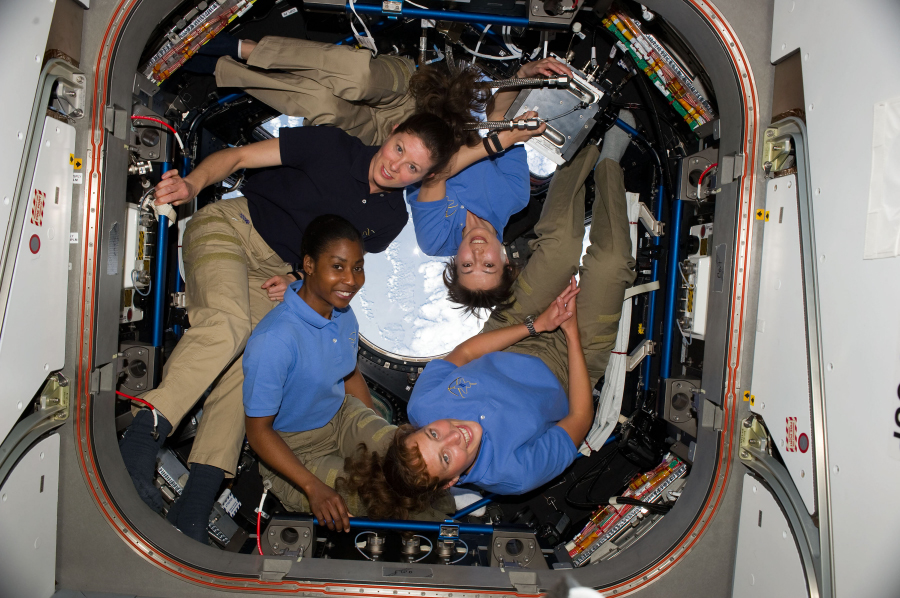
Why is it then, you may ask, that the astronauts aboard the Space Shuttle appear to have no gravitational forces acting on them when we see images on television of the astronauts and objects floating in the spacecraft? After all, the astronauts in the shuttle are only a few hundred kilometers above the surface of Earth, which is not a significant distance compared to the size of Earth, so gravity is certainly not a great deal weaker that much farther away. The astronauts feel “weightless” (meaning that they don’t feel the gravitational force acting on them) for the same reason that passengers in an elevator whose cable has broken feel weightless: they are falling (Figure 3.9).In the film Apollo 13, the scenes in which the astronauts were “weightless” were actually filmed in a falling airplane. As you might imagine, the plane fell for only short periods before the engines engaged again.
英語のヒント
それならなぜ、テレビで宇宙機の中に浮かぶ宇宙飛行士や物体の映像を見ると、スペースシャトルの宇宙飛行士には重力が働いていないように見えるのだろうか。そう疑問に思うかもしれない。そもそも、シャトルの宇宙飛行士は地表から数百キロメートルしか離れていない。地球の大きさに比べればわずかな距離なので、そのくらい遠くなっても、重力が大幅に弱まるわけではない。宇宙飛行士が「無重量」、つまり自分に重力が働いていると感じない状態になる理由は、ケーブルが切れたエレベーターの乗客が無重量を感じるのと同じである。どちらも落下しているのである(図3.9)。(映画『アポロ13』の宇宙飛行士が「無重量」になる場面は、実際に落下する飛行機の中で撮影された。想像できるとおり、飛行機が落下するのは短時間だけで、その後はエンジンが再び働いた。)
Astronauts in Free Fall.自由落下する宇宙飛行士
credit: NASA · NASA media use guidelines
Figure 3.9 While in space, astronauts are falling freely, so they experience “weightlessness.” Clockwise from top left: Tracy Caldwell Dyson (NASA), Naoko Yamazaki (JAXA), Dorothy Metcalf-Lindenburger (NASA), and Stephanie Wilson (NASA). (credit: NASA)
図3.9 宇宙にいる間、宇宙飛行士は自由に落下しているため、「無重量」を経験する。左上から時計回りに、トレーシー・コールドウェル・ダイソン(NASA)、山崎直子(JAXA)、ドロシー・メトカーフ=リンデンバーガー(NASA)、ステファニー・ウィルソン(NASA)。(クレジット:NASA)
When falling, they are in free fall and accelerate at the same rate as everything around them, including their spacecraft or a camera with which they are taking photographs of Earth. When doing so, astronauts experience no additional forces and therefore feel “weightless.” Unlike the falling elevator passengers, however, the astronauts are falling around Earth, not to Earth; as a result they will continue to fall and are said to be “in orbit” around Earth (see the next section for more about orbits).
英語のヒント
落下している宇宙飛行士は自由落下の状態にあり、宇宙機や地球を撮影するカメラも含め、周囲のあらゆるものと同じ割合で加速する。その間、宇宙飛行士は余分な力を受けないため、「無重量」と感じる。しかし、落下するエレベーターの乗客とは違い、宇宙飛行士は地球へ向かって落ち込むのではなく、地球のまわりへ落ち続けている。そのため落下を続け、地球の「軌道上にいる」と言われるのである。軌道について詳しくは、次の節を参照せよ。