第22章恒星の青年期から老年期までStars from Adolescence to Old Age
22.2 Star Clusters22.2 星団
Learning Objectives学習の目標
By the end of this section, you will be able to:
この節を学ぶと、次のことができるようになる。
Explain how star clusters help us understand the stages of stellar evolution
星団が、恒星進化の段階の理解にどう役立つかを説明する。
List the different types of star clusters and describe how they differ in number of stars, structure, and age
星団の種類を挙げ、星の個数、構造、年齢がどう異なるかを説明する。
The preceding description of stellar evolution is based on calculations. However, no star completes its main-sequence lifetime or its evolution to a red giant quickly enough for us to observe these structural changes as they happen. Fortunately, nature has provided us with an indirect way to test our calculations.
英語のヒント
ここまでの恒星進化の説明は、計算に基づくものだ。しかし、主系列の一生や赤色巨星への進化を、その構造変化を実際に見届けられるほど短時間で終える星はない。幸いにも、自然は計算を間接的に検証する方法を用意してくれている。
Instead of observing the evolution of a single star, we can look at a group or cluster of stars. We look for a group of stars that is very close together in space, held together by gravity, often moving around a common center. Then it is reasonable to assume that the individual stars in the group all formed at nearly the same time, from the same cloud, and with the same composition. We expect that these stars will differ only in mass. And their masses determine how quickly they go through each stage of their lives.
英語のヒント
一つの星の進化を観測する代わりに、星の集団、星団を見ることができる。空間的にごく近くに集まり、重力で結びつき、多くは共通の中心の周りを動く星々を探すのだ。そうすれば、各星がほぼ同時に、同じ雲から、同じ組成で生まれたと考えるのは妥当である。違うのは質量だけだと予想できる。そして質量によって、一生の各段階を進む速さが決まる。
Since stars with higher masses evolve more quickly, we can find clusters in which massive stars have already completed their main-sequence phase of evolution and become red giants, while stars of lower mass in the same cluster are still on the main sequence, or even—if the cluster is very young—undergoing pre-main-sequence gravitational contraction. We can see many stages of stellar evolution among the members of a single cluster, and we can see whether our models can explain why the H–R diagrams of clusters of different ages look the way they do.
英語のヒント
大質量星ほど速く進化するので、重い星はすでに主系列を終えて赤色巨星になっているのに、同じ星団の軽い星はまだ主系列にいる、といった星団が見つかる。非常に若い星団なら、軽い星はまだ主系列前の重力収縮の途中にいることさえある。一つの星団のメンバーから、恒星進化の多くの段階を見られる。さらに、年齢の違う星団のHR図が、それぞれなぜそのような姿になるかを、モデルで説明できるか確かめられる。
The three basic types of clusters astronomers have discovered are globular clusters, open clusters, and stellar associations. Their properties are summarized in Table 22.3. As we will see in the next section of this chapter, globular clusters contain only very old stars, whereas open clusters and associations contain young stars.
英語のヒント
天文学者が見つけた星の集団の基本的な三種類は、球状星団、散開星団、アソシエーションである。性質を表22.3にまとめる。この章の次の節で見るように、球状星団には非常に古い星だけがあり、散開星団やアソシエーションには若い星がある。
Characteristics of Star Clusters 星の集団の特徴 |
|||
|---|---|---|---|
Characteristic 特徴 |
Globular Clusters 球状星団 |
Open Clusters 散開星団 |
Associations アソシエーション |
Number in the Galaxy 天の川銀河内の個数 |
150 | Thousands 数千 |
Thousands 数千 |
Location in the Galaxy 天の川銀河内の場所 |
Halo and central bulge ハローと中心バルジ |
Disk (and spiral arms) 円盤(および渦巻腕) |
Spiral arms 渦巻腕 |
Diameter (in light-years) 直径(光年) |
50–450 50〜450 |
<30 30未満 |
100–500 100〜500 |
Mass MSun 質量(MSun) |
104–106 104〜106 |
102–103 102〜103 |
102–103 102〜103 |
Number of stars 星の個数 |
104–106 104〜106 |
50–1000+ 50〜1000以上 |
102–104 102〜104 |
Color of brightest stars 最も明るい星の色 |
Red 赤 |
Red or blue 赤または青 |
Blue 青 |
Luminosity of cluster (LSun) 集団の光度(LSun) |
104–106 104〜106 |
102–106 102〜106 |
104–107 104〜107 |
Typical ages 典型的な年齢 |
Billions of years 数十億年 |
A few hundred million years to, in the case of unusually large clusters, more than a billion years 数億年から、特に大きい星団では10億年超まで |
Up to about 107 years 約107年まで |
Globular Clusters球状星団
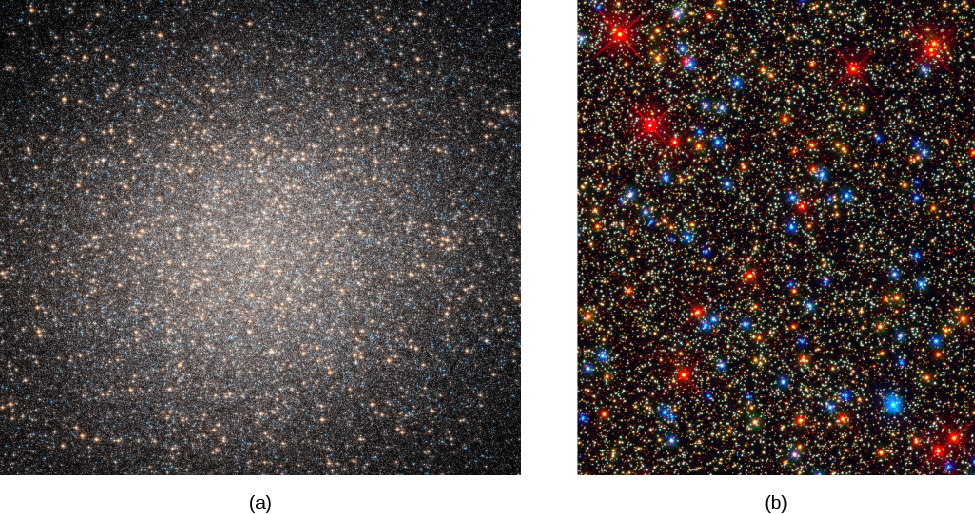
Globular clusters were given this name because they are nearly symmetrical round systems of, typically, hundreds of thousands of stars. The most massive globular cluster in our own Galaxy is Omega Centauri, which is about 16,000 light-years away and contains several million stars (Figure 22.6). Note that the brightest stars in this cluster, which are red giants that have already completed the main-sequence phase of their evolution, are red-orange in color. These stars have typical surface temperatures around 4000 K. As we will see, globular clusters are among the oldest parts of our Milky Way Galaxy.
英語のヒント
球状星団という名は、通常数十万個の星からなる、ほぼ対称な球形の集団であることに由来する。天の川銀河で最も大質量の球状星団はケンタウルス座オメガ星団で、約1万6000光年先にあり、数百万個の星を含む(図22.6)。この星団で最も明るい星は、すでに主系列を終えた赤色巨星であり、赤橙色であることに注目しよう。典型的な表面温度は約4000 Kである。これから見るように、球状星団は天の川銀河の最も古い部分の一つである。
Omega Centauri.ケンタウルス座オメガ星団。
credit a: modification of work by NASA, ESA and the Hubble Heritage Team (STScI/AURA); credit b: modification of work by NASA, ESA, and the Hubble SM4 ERO Team · CC BY 4.0
Figure 22.6 (a) Located at about 16,000 light-years away, Omega Centauri is the most massive globular cluster in our Galaxy. It contains several million stars. (b) This image, taken with the Hubble Space Telescope, zooms in near the center of Omega Centauri. The image is about 6.3 light-years wide. The most numerous stars in the image, which are yellow-white in color, are main-sequence stars similar to our Sun. The brightest stars are red giants that have begun to exhaust their hydrogen fuel and have expanded to about 100 times the diameter of our Sun. The blue stars have started helium fusion. (credit a: modification of work by NASA, ESA and the Hubble Heritage Team (STScI/AURA); credit b: modification of work by NASA, ESA, and the Hubble SM4 ERO Team)
図22.6 (a)約1万6000光年先のケンタウルス座オメガ星団は、天の川銀河で最も大質量の球状星団で、数百万個の星を含む。(b)ハッブル宇宙望遠鏡で中心近くを拡大した画像。幅は約6.3光年である。最も数が多い黄白色の星は、太陽に似た主系列星。最も明るい星は、水素燃料を使い果たし始め、太陽の直径の約100倍へ膨張した赤色巨星である。青い星はヘリウム核融合を始めている。(出典a:NASA、ESA、Hubble Heritage Team〈STScI/AURA〉の作品を改変。出典b:NASA、ESA、Hubble SM4 ERO Teamの作品を改変)
What would it be like to live inside a globular cluster? In the dense central regions, the stars would be roughly a million times closer together than in our own neighborhood. If Earth orbited one of the inner stars in a globular cluster, the nearest stars would be light-months, not light-years, away. They would still appear as points of light, but would be brighter than any of the stars we see in our own sky. The Milky Way would probably be difficult to see through the bright haze of starlight produced by the cluster.
英語のヒント
球状星団の中で暮らすと、どんな様子だろうか。密集した中心領域では、星同士は太陽近傍よりおよそ100万倍も近接しているだろう。地球がその内側の星の一つを回っていれば、最も近い星々までの距離は、光年ではなく光月になる。それでも星は光の点に見えるが、私たちの空で見るどの星よりも明るいだろう。星団が作る明るい星明かりのかすみを通して、天の川を見るのは難しいかもしれない。
About 150 globular clusters are known in our Galaxy. Most of them are in a spherical halo (or cloud) surrounding the flat disk formed by the majority of our Galaxy’s stars. All the globular clusters are very far from the Sun, and some are found at distances of 60,000 light-years or more from the main disk of the Milky Way. The diameters of globular star clusters range from 50 light-years to more than 450 light-years.
英語のヒント
天の川銀河では約150個の球状星団が知られている。多くは、天の川銀河の星の大部分が作る平らな円盤を囲む、球形のハロー、あるいは雲の中にある。すべて太陽から遠く、一部は天の川銀河の主な円盤から6万光年以上も離れている。球状星団の直径は、50光年から450光年超までに及ぶ。
Open Clusters散開星団
Open clusters are found in the disk of the Galaxy. They have a range of ages, some as old as, or even older than, our Sun. The youngest open clusters are still associated with the interstellar matter from which they formed. Open clusters are smaller than globular clusters, usually having diameters of less than 30 light-years, and they typically contain only several dozen to several hundreds of stars (Figure 22.7). The stars in open clusters usually appear well separated from one another, even in the central regions, which explains why they are called “open.” Our Galaxy contains thousands of open clusters, but we can see only a small fraction of them. Interstellar dust, which is also concentrated in the disk, dims the light of more distant clusters so much that they are undetectable.
英語のヒント
散開星団は天の川銀河の円盤内にある。年齢はさまざまで、太陽と同じくらい古いものや、それ以上に古いものもある。最も若い散開星団は、まだ自分たちが生まれた星間物質を伴っている。球状星団より小さく、普通は直径30光年未満で、典型的な星の数は数十〜数百個にすぎない(図22.7)。星は中心領域でも、たいてい互いによく離れて見える。これが英語で「open(開いた)」星団と呼ぶ理由である。天の川銀河には数千個の散開星団があるが、見えるのはごく一部である。同じく円盤に集中する星間塵が、遠い星団の光を検出できないほど弱めるためである。
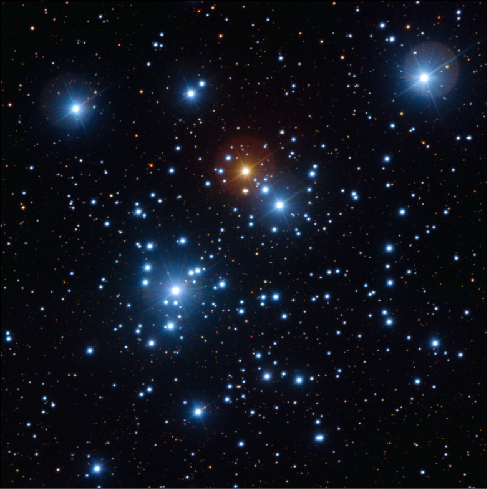
Jewel Box (NGC 4755).宝石箱星団(NGC 4755)。
credit: ESO/Y. Beletsky · CC BY 4.0
Figure 22.7 This open cluster of young, bright stars is about 6400 light-years away from the Sun. Note the contrast in color between the bright yellow supergiant and the hot blue main-sequence stars. The name comes from John Herschel’s nineteenth-century description of it as “a casket of variously colored precious stones.” (credit: ESO/Y. Beletsky)
図22.7 若く明るい星からなるこの散開星団は、太陽から約6400光年先にある。明るい黄色の超巨星と、高温で青い主系列星の色の対比に注目しよう。「宝石箱」という名は、19世紀にジョン・ハーシェルが「さまざまな色の宝石の小箱」と表現したことに由来する。(出典:ESO/Y. Beletsky)
Although the individual stars in an open cluster can survive for billions of years, the typical open cluster remains together as a cluster for only a few million years, or at most, a few hundred million years. There are several reasons for this. In small open clusters, the average speed of the member stars within the cluster may be higher than the cluster’s escape velocity,Escape velocity is the speed needed to overcome the gravity of some object or group of objects. The rockets we send up from Earth, for example, must travel faster than the escape velocity of our planet to be able to get to other worlds. and the stars will gradually “evaporate” from the cluster. Close encounters of member stars may also increase the velocity of one of the members beyond the escape velocity. Every few hundred million years or so, the cluster may have a close encounter with a giant molecular cloud, and the gravitational force exerted by the cloud may tear the cluster apart.
英語のヒント
散開星団の個々の星は何十億年も生きられるが、典型的な散開星団が集団としてまとまっているのは、わずか数百万年、長くても数億年である。これにはいくつかの理由がある。小さな散開星団では、内部の星の平均速度が星団の脱出速度を上回ることがあり、星々は少しずつ星団から「蒸発」していく。脱出速度とは、ある天体や天体集団の重力を振り切るのに必要な速さである。たとえば地球から打ち上げるロケットは、ほかの世界へ行くために地球の脱出速度より速く進む必要がある。メンバー同士の近接遭遇によって、一方の速度が脱出速度を超える場合もある。また数億年ごとには、巨大分子雲と接近する可能性があり、雲の重力が星団を引き裂くこともある。
Several open clusters are visible to the unaided eye. Most famous among them is the Pleiades (Figure 20.13), which appears as a tiny group of six stars (some people can see even more than six, and the Pleiades is sometimes called the Seven Sisters). This cluster is arranged like a small dipping spoon and is seen in the constellation of Taurus, the bull. A good pair of binoculars shows dozens of stars in the cluster, and a telescope reveals hundreds. (A car company, Subaru, takes its name from the Japanese term for this cluster; you can see the star group on the Subaru logo.)
英語のヒント
肉眼で見える散開星団もいくつかある。最も有名なのはプレアデス星団、すばるである(図20.13)。六つの星の小さな集まりに見えるが、六つより多く見える人もおり、「七姉妹」と呼ばれることもある。小さなひしゃくのような形で、おうし座に見える。よい双眼鏡なら数十個、望遠鏡なら数百個の星が見える。自動車会社のスバルの名前は、この星団の日本語名に由来し、ロゴにもこの星の集まりが描かれている。
The Hyades is another famous open cluster in the constellation of Taurus the bull. To the naked eye, it appears as a V-shaped group of faint stars marking the face of the bull. Telescopes show that Hyades actually contains more than 200 stars.
英語のヒント
ヒアデス星団も、おうし座にある有名な散開星団である。肉眼では、雄牛の顔を示す暗い星々がV字形に並んで見える。望遠鏡で調べると、実際には200個以上の星を含むことがわかる。