第22章恒星の青年期から老年期までStars from Adolescence to Old Age
Mass Loss from Red-Giant Stars and the Formation of Planetary Nebulae赤色巨星の質量放出と惑星状星雲の形成
When stars swell up to become red giants, they have very large radii and therefore a low escape velocity.Recall that the force of gravity depends not only on the mass doing the pulling, but also on our distance from the center of gravity. As a red giant star gets a lot bigger, a point on the surface of the star is now farther from the center, and thus has less gravity. That’s why the speed needed to escape the star goes down. Radiation pressure, stellar pulsations, and violent events like the helium flash can all drive atoms in the outer atmosphere away from the star, and cause it to lose a substantial fraction of its mass into space. Astronomers estimate that by the time a star like the Sun reaches the point of the helium flash, for example, it will have lost as much as 25% of its mass. And it can lose still more mass when it ascends the red-giant branch for the second time. As a result, aging stars are surrounded by one or more expanding shells of gas, each containing as much as 10–20% of the Sun’s mass (or 0.1–0.2 MSun).
英語のヒント
星が膨らんで赤色巨星になると、半径が非常に大きくなるため、脱出速度は低くなる。重力の強さは、引き付ける天体の質量だけでなく、重力の中心からの距離にも依存することを思い出してほしい。赤色巨星が大きくなると、星の表面の点は中心から遠ざかるため、そこでの重力は弱くなる。星から脱出するために必要な速度が下がるのは、そのためである。放射圧、星の脈動、ヘリウムフラッシュのような激しい現象は、どれも外側の大気中の原子を星から押し出し、かなりの割合の質量を宇宙空間へ失わせることがある。天文学者の推定では、たとえば太陽のような星は、ヘリウムフラッシュの段階に達するまでに、質量の最大25%を失う。2度目に赤色巨星分枝を上るときには、さらに多くの質量を失うことがある。その結果、年老いた星は、一つまたは複数の膨張するガスの殻に囲まれる。それぞれの殻は、太陽質量の10〜20%、すなわち0.1〜0.2 MSunにもなる質量を含む。
When nuclear energy generation in the carbon-oxygen core ceases, the star’s core begins to shrink again and to heat up as it gets more and more compressed. (Remember that this compression will not be halted by another type of fusion in these low-mass stars.) The whole star follows along, shrinking and also becoming very hot—reaching surface temperatures as high as 100,000 K. Such hot stars are very strong sources of stellar winds and ultraviolet radiation, which sweep outward into the shells of material ejected when the star was a red giant. The winds and the ultraviolet radiation heat the shells, ionize them, and set them aglow (just as ultraviolet radiation from hot, young stars produces H II regions; see Between the Stars: Gas and Dust in Space).
英語のヒント
炭素と酸素の中心核で核エネルギーの生成が止まると、中心核は再び収縮を始め、圧縮されるほど熱くなっていく。(このような低質量星では、別の種類の核融合によって圧縮が止まることはないのだった。)星全体もそれに続いて収縮し、非常に高温になる。表面温度は10万Kにも達する。このような高温の星は、強い恒星風と紫外線の放射源になる。恒星風と紫外線は外へ広がり、赤色巨星だったときに放出した物質の殻に届く。それらが殻を加熱し、電離させて光らせるのだ。高温の若い星の紫外線がH II領域を作るのと同じ仕組みである(「星と星の間――宇宙のガスと塵」を参照)。
The result is the creation of some of the most beautiful objects in the cosmos (see the gallery in Figure 22.18 and Figure 22.1). These objects were given an extremely misleading name when first found in the eighteenth century: planetary nebulae. The name is derived from the fact that a few planetary nebulae, when viewed through a small telescope, have a round shape bearing a superficial resemblance to planets. Actually, they have nothing to do with planets, but once names are put into regular use in astronomy, it is extremely difficult to change them. There are tens of thousands of planetary nebulae in our own Galaxy, although many are hidden from view because their light is absorbed by interstellar dust.
英語のヒント
その結果、宇宙でもとりわけ美しい天体が生まれる(図22.18の写真集と図22.1を見てほしい)。これらの天体には、18世紀に初めて発見されたとき、非常に誤解を招きやすい「惑星状星雲」という名前が付けられた。小さな望遠鏡で見ると、一部の惑星状星雲が丸く見え、見かけだけは惑星に似ていることに由来する名前である。実際には惑星とは何の関係もない。しかし、天文学ではいったん名前が広く使われるようになると、変えるのはきわめて困難である。天の川銀河には数万個の惑星状星雲があるが、多くは光が星間塵に吸収されるため、私たちには見えない。
Gallery of Planetary Nebulae.さまざまな惑星状星雲
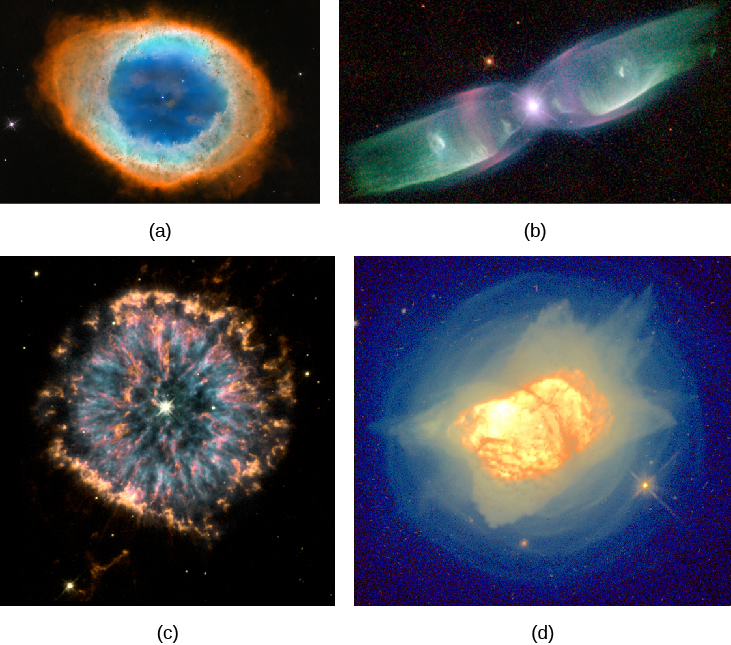
credit a: modification of work by NASA, ESA, and the Hubble Heritage (STScI/AURA)-ESA/Hubble Collaboration; credit b: modification of work by Bruce Balick (University of Washington), Vincent Icke (Leiden University, The Netherlands), Garrelt Mellema (Stockholm University), and NASA; credit c: modification of work by NASA, The Hubble Heritage Team (STScI/AURA); credit d: modification of work by H. Bond (STScI) and NASA · CC BY 4.0
Figure 22.18 This series of beautiful images depicting some intriguing planetary nebulae highlights the capabilities of the Hubble Space Telescope. (a) Perhaps the best known planetary nebula is the Ring Nebula (M57), located about 2000 light-years away in the constellation of Lyra. The ring is about 1 light-year in diameter, and the central star has a temperature of about 120,000 °C. Careful study of this image has shown scientists that, instead of looking at a spherical shell around this dying star, we may be looking down the barrel of a tube or cone. The blue region shows emission from very hot helium, which is located very close to the star; the red region isolates emission from ionized nitrogen, which is radiated by the coolest gas farthest from the star; and the green region represents oxygen emission, which is produced at intermediate temperatures and is at an intermediate distance from the star. (b) This planetary nebula, M2-9, is an example of a butterfly nebula. The central star (which is part of a binary system) has ejected mass preferentially in two opposite directions. In other images, a disk, perpendicular to the two long streams of gas, can be seen around the two stars in the middle. The stellar outburst that resulted in the expulsion of matter occurred about 1200 years ago. Neutral oxygen is shown in red, once-ionized nitrogen in green, and twice-ionized oxygen in blue. The planetary nebula is about 2100 light-years away in the constellation of Ophiuchus. (c) In this image of the planetary nebula NGC 6751, the blue regions mark the hottest gas, which forms a ring around the central star. The orange and red regions show the locations of cooler gas. The origin of these cool streamers is not known, but their shapes indicate that they are affected by radiation and stellar winds from the hot star at the center. The temperature of the star is about 140,000 °C. The diameter of the nebula is about 600 times larger than the diameter of our solar system. The nebula is about 6500 light-years away in the constellation of Aquila. (d) This image of the planetary nebula NGC 7027 shows several stages of mass loss. The faint blue concentric shells surrounding the central region identify the mass that was shed slowly from the surface of the star when it became a red giant. Somewhat later, the remaining outer layers were ejected but not in a spherically symmetric way. The dense clouds formed by this late ejection produce the bright inner regions. The hot central star can be seen faintly near the center of the nebulosity. NGC 7027 is about 3000 light-years away in the direction of the constellation of Cygnus. (credit a: modification of work by NASA, ESA, and the Hubble Heritage (STScI/AURA)-ESA/Hubble Collaboration; credit b: modification of work by Bruce Balick (University of Washington), Vincent Icke (Leiden University, The Netherlands), Garrelt Mellema (Stockholm University), and NASA; credit c: modification of work by NASA, The Hubble Heritage Team (STScI/AURA); credit d: modification of work by H. Bond (STScI) and NASA)
図22.18 興味深い惑星状星雲を写した美しい画像の数々は、ハッブル宇宙望遠鏡の能力をよく示している。(a)おそらく最もよく知られた惑星状星雲は、こと座の方向、約2000光年先にある環状星雲(M57)である。輪の直径は約1光年、中心星の温度は約12万℃。この画像を詳しく調べた結果、最期を迎えつつある星の周りの球殻を見ているのではなく、筒や円錐の内部を軸方向から見ている可能性が示された。青い領域は星のすぐ近くにある非常に高温のヘリウムの放射を示す。赤は、星から最も遠い、最も低温のガスが放つ電離窒素の放射を選び出している。緑は、中間の温度と中間の距離にある酸素の放射を表す。(b)惑星状星雲M2-9は、チョウのような星雲の一例。連星系の一員である中心星が、主に正反対の二方向へ物質を放出した。別の画像では、中央の二つの星の周囲に、長い二本のガスの流れに垂直な円盤が見える。物質を放出した星の突発的な活動は、約1200年前に起きた。中性の酸素を赤、1階電離した窒素を緑、2階電離した酸素を青で示す。この惑星状星雲は、へびつかい座の方向、約2100光年先にある。(c)惑星状星雲NGC 6751の画像では、青い部分が最も高温のガスを示し、中心星の周囲に輪を作っている。オレンジと赤は、より低温のガスの位置を示す。この冷たい筋状のガスの起源は不明だが、その形から、中央の高温の星からの放射と恒星風の影響を受けていることがわかる。星の温度は約14万℃。星雲の直径は太陽系の直径の約600倍である。わし座の方向、約6500光年先にある。(d)惑星状星雲NGC 7027の画像は、質量放出の複数の段階を示す。中心領域を囲む淡い青の同心状の殻は、星が赤色巨星になったときに表面からゆっくり失われた物質である。その少し後に、残っていた外層が、球対称ではない形で放出された。この後期の放出でできた密度の高い雲が、内側の明るい領域を作っている。星雲の中心近くには、高温の中心星がかすかに見える。NGC 7027は、はくちょう座の方向、約3000光年先にある。画像出典:(a)NASA、ESA、Hubble Heritage(STScI/AURA)–ESA/Hubble Collaborationの作品を改変。(b)Bruce Balick(ワシントン大学)、Vincent Icke(オランダ・ライデン大学)、Garrelt Mellema(ストックホルム大学)、NASAの作品を改変。(c)NASA、Hubble Heritage Team(STScI/AURA)の作品を改変。(d)H. Bond(STScI)、NASAの作品を改変。
As Figure 22.18 shows, sometimes a planetary nebula appears to be a simple ring. Others have faint shells surrounding the bright ring, which is evidence that there were multiple episodes of mass loss when the star was a red giant (see image (d) in Figure 22.18). In a few cases, we see two lobes of matter flowing in opposite directions. Many astronomers think that a considerable number of planetary nebulae basically consist of the same structure, but that the shape we see depends on the viewing angle (Figure 22.19). According to this idea, the dying star is surrounded by a very dense, doughnut-shaped disk of gas. (Theorists do not yet have a definite explanation for why the dying star should produce this ring, but many believe that binary stars, which are common, are involved.)
英語のヒント
図22.18のように、惑星状星雲は単純な輪に見えることがある。明るい輪を淡い殻が取り巻いているものもあり、これは赤色巨星時代に何度も質量を放出した証拠である(図22.18の(d))。物質が正反対の方向に流れ出す、二つのふくらみが見える場合もある。多くの天文学者は、かなりの数の惑星状星雲が基本的には同じ構造を持ち、見える形の違いは見る角度によって生じると考えている(図22.19)。この考え方では、最期を迎える星の周囲に、非常に密度の高い、ドーナツ状のガス円盤がある。(なぜそのような輪ができるのか、理論家はまだ明確な説明を持っていないが、多くの研究者は、よく見られる連星が関与していると考えている。)
Model to Explain the Different Shapes of Planetary Nebulae.惑星状星雲の形の違いを説明するモデル
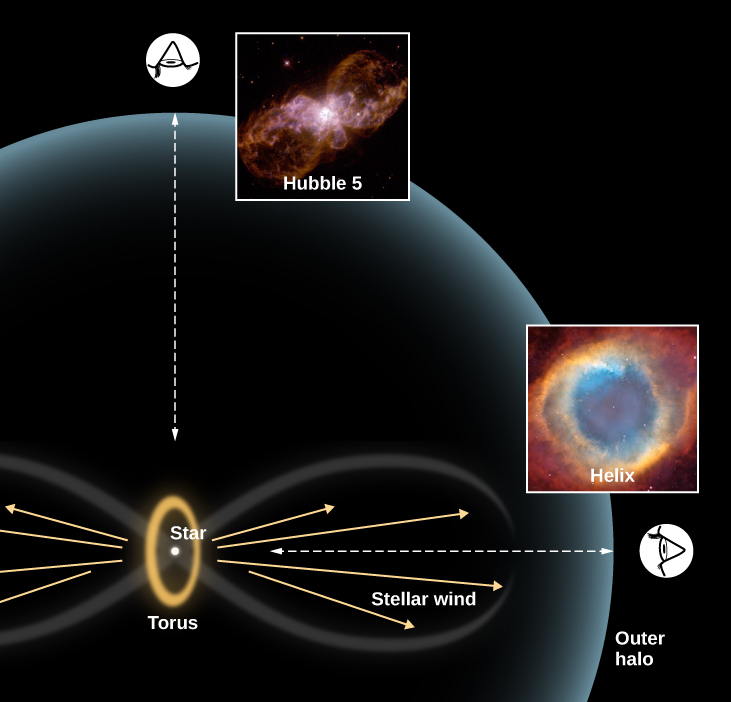
credit “Hubble 5”: modification of work by Bruce Balick (University of Washington), Vincent Icke (Leiden University, The Netherlands), Garrelt Mellema (Stockholm University), and NASA/ESA; credit “Helix”: modification of work by NASA, ESA, C.R. O’Dell (Vanderbilt University), and M. Meixner, P. McCullough · CC BY 4.0
Figure 22.19 The range of different shapes that we see among planetary nebulae may, in many cases, arise from the same geometric shape, but seen from a variety of viewing directions. The basic shape is a hot central star surrounded by a thick torus (or doughnut-shaped disk) of gas. The star’s wind cannot flow out into space very easily in the direction of the torus, but can escape more freely in the two directions perpendicular to it. If we view the nebula along the direction of the flow (Helix Nebula), it will appear nearly circular (like looking directly down into an empty ice-cream cone). If we look along the equator of the torus, we see both outflows and a very elongated shape (Hubble 5). Current research on planetary nebulae focuses on the reasons for having a torus around the star in the first place. Many astronomers suggest that the basic cause may be that many of the central stars are actually close binary stars, rather than single stars. (credit “Hubble 5”: modification of work by Bruce Balick (University of Washington), Vincent Icke (Leiden University, The Netherlands), Garrelt Mellema (Stockholm University), and NASA/ESA; credit “Helix”: modification of work by NASA, ESA, C.R. O’Dell (Vanderbilt University), and M. Meixner, P. McCullough)
図22.19 惑星状星雲に見られるさまざまな形は、多くの場合、同じ幾何学的な構造を異なる方向から見た結果かもしれない。基本構造は、高温の中心星を厚いガスのトーラス、すなわちドーナツ状の円盤が取り巻くというもの。恒星風はトーラスの方向には宇宙空間へ流れ出にくいが、それに垂直な二方向へは、より自由に逃げられる。流れに沿った方向から星雲を見ると、らせん星雲のようにほぼ円形に見える。空のアイスクリームのコーンを、真上からのぞき込むようなものだ。トーラスの赤道面に沿う方向から見ると、両側の流出が見え、ハッブル5のような非常に細長い形になる。現在の惑星状星雲の研究では、そもそもなぜ星の周囲にトーラスがあるのかが焦点になっている。多くの天文学者は、中心星の多くが実際には単独星ではなく近接連星であることが、その基本的な原因かもしれないと考えている。画像出典:「ハッブル5」はBruce Balick(ワシントン大学)、Vincent Icke(オランダ・ライデン大学)、Garrelt Mellema(ストックホルム大学)、NASA/ESAの作品を改変。「らせん星雲」はNASA、ESA、C. R. O’Dell(ヴァンダービルト大学)、M. Meixner、P. McCulloughの作品を改変。
As the star continues to lose mass, any less dense gas that leaves the star cannot penetrate the torus, but the gas can flow outward in directions perpendicular to the disk. If we look perpendicular to the direction of outflow, we see the disk and both of the outward flows. If we look “down the barrel” and into the flows, we see a ring. At intermediate angles, we may see wonderfully complex structures. Compare the viewpoints in Figure 22.19 with the images in Figure 22.18.
英語のヒント
星が質量を失い続けると、そこから出る密度の低いガスはトーラスを突き抜けられないが、円盤に垂直な方向へは流れ出せる。流出方向に対して横から見ると、円盤と両側への流出が見える。流れの内部を「筒の奥をのぞき込む」ように見ると、輪が見える。その中間の角度からは、驚くほど複雑な構造が見えることがある。図22.19の見る方向を、図22.18の画像と比べてみよう。
Planetary nebula shells usually expand at speeds of 20–30 km/s, and a typical planetary nebula has a diameter of about 1 light-year. If we assume that the gas shell has expanded at a constant speed, we can calculate that the shells of all the planetary nebulae visible to us were ejected within the past 5,000 years at most. After this amount of time, the shells have expanded so much that they are too thin and tenuous to be seen. That’s a pretty short time that each planetary nebula can be observed (when compared to the whole lifetime of the star). Given the number of such nebulae we nevertheless see, we must conclude that a large fraction of all stars evolve through the planetary nebula phase. Since we saw that low-mass stars are much more common than high-mass stars, this confirms our view of planetary nebulae as sort of “last gasp” of low-mass star evolution.
英語のヒント
惑星状星雲の殻は普通、秒速20〜30 kmで膨張し、典型的な惑星状星雲の直径は約1光年である。ガスの殻が一定速度で膨張したと仮定すると、私たちに見えるすべての惑星状星雲の殻は、遅くとも過去5000年以内に放出されたと計算できる。それ以上たつと、殻は広がりすぎて、薄く希薄になり、見えなくなってしまう。星の一生全体に比べれば、一つ一つの惑星状星雲を観測できる期間は非常に短いのだ。それにもかかわらず、これほど多くの惑星状星雲が見えることを考えると、星全体の大きな割合が、進化の過程で惑星状星雲の段階を通ると結論しなければならない。低質量星が大質量星よりずっと多いことは、すでに見た。したがって、この観測は、惑星状星雲を低質量星の進化におけるいわば「最期のひと息」とする考えを裏付ける。