第22章恒星の青年期から老年期までStars from Adolescence to Old Age
From Main-Sequence Star to Red Giant主系列星から赤色巨星へ
Eventually, all the hydrogen in a star’s core, where it is hot enough for fusion reactions, is used up. The core then contains only helium, “contaminated” by whatever small percentage of heavier elements the star had to begin with. The helium in the core can be thought of as the accumulated “ash” from the nuclear “burning” of hydrogen during the main-sequence stage.
英語のヒント
やがて、核融合ができるほど高温の中心核では、水素がすべて使い果たされる。中心核に残るのはヘリウムだけで、星が初めから持っていたわずかな割合の重元素が「混じって」う。中心核のヘリウムは、主系列の段階で水素を核反応によって「燃やした」結果たまった「灰」と考えられる。
Energy can no longer be generated by hydrogen fusion in the stellar core because the hydrogen is all gone and, as we will see, the fusion of helium requires much higher temperatures. Since the central temperature is not yet high enough to fuse helium, there is no nuclear energy source to supply heat to the central region of the star. The long period of stability now ends, gravity again takes over, and the core begins to contract. Once more, the star’s energy is partially supplied by gravitational energy, in the way described by Kelvin and Helmholtz (see Sources of Sunshine: Thermal and Gravitational Energy). As the star’s core shrinks, the energy of the inward-falling material is converted to heat.
英語のヒント
水素がなくなったので、中心核の水素核融合によっては、もうエネルギーを作れない。また、これから見るように、ヘリウムの核融合にははるかに高い温度が必要である。中心温度はまだそこまで高くないため、恒星の中心領域に熱を供給する核エネルギー源がなくなる。長い安定期は終わり、重力が再び優勢になって、中心核は収縮し始める。再び、ケルヴィンとヘルムホルツが述べたような重力エネルギーが、星のエネルギーの一部を供給する(「太陽の輝きの源――熱エネルギーと重力エネルギー」参照)。中心核が縮むと、内側へ落ち込む物質のエネルギーが熱へ変わる。
The heat generated in this way, like all heat, flows outward to where it is a bit cooler. In the process, the heat raises the temperature of a layer of hydrogen that spent the whole long main-sequence time just outside the core. Like an understudy waiting in the wings of a hit Broadway show for a chance at fame and glory, this hydrogen was almost (but not quite) hot enough to undergo fusion and take part in the main action that sustains the star. Now, the additional heat produced by the shrinking core puts this hydrogen “over the limit,” and a shell of hydrogen nuclei just outside the core becomes hot enough for hydrogen fusion to begin.
英語のヒント
こうして生じた熱も、ほかの熱と同じく、少し冷たい外側へ流れる。その途中で、長い主系列時代のあいだずっと中心核のすぐ外にあった水素の層を暖める。これは、ブロードウェイの大ヒット舞台で、名声と栄光の出番を舞台袖で待つ代役のようなものだ。この水素は、核融合に参加して恒星を支える主役の仕事を担える温度に、あと少しのところまで近づいていながら、達していなかった。今、収縮する中心核が作る追加の熱が水素を「限界の向こう」へ押し上げ、中心核のすぐ外にある水素原子核の殻が、核融合を始められるほど熱くなる。
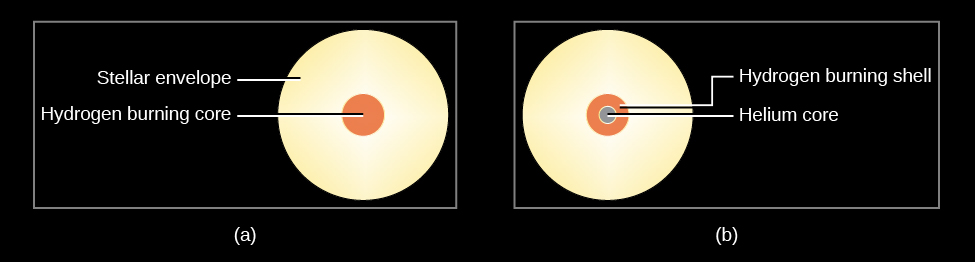
New energy produced by fusion of this hydrogen now pours outward from this shell and begins to heat up layers of the star farther out, causing them to expand. Meanwhile, the helium core continues to contract, producing more heat right around it. This leads to more fusion in the shell of fresh hydrogen outside the core (Figure 22.2). The additional fusion produces still more energy, which also flows out into the upper layer of the star.
英語のヒント
この水素の核融合が作る新しいエネルギーは、殻から外へ流れ、さらに外側の恒星の層を暖めて膨張させ始める。その間もヘリウムの中心核は収縮を続け、すぐ周囲にいっそう多くの熱を作る。それによって、中心核の外にある、まだ使われていない水素の殻で、さらに核融合が進む(図22.2)。増えた核融合はもっと多くのエネルギーを生み、それも恒星の外層へ流れていく。
Star Layers during and after the Main Sequence.主系列期とその後の恒星の層。
OpenStax / Rice University · CC BY 4.0
Figure 22.2 (a) During the main sequence, a star has a core where fusion takes place and a much larger envelope that is too cold for fusion. (b) When the hydrogen in the core is exhausted (made of helium, not hydrogen), the core is compressed by gravity and heats up. The additional heat starts hydrogen fusion in a layer just outside the core. Note that these parts of the Sun are not drawn to scale.
図22.2 (a)主系列期の恒星には、核融合が起こる中心核と、それよりずっと大きく、核融合には温度が低すぎる外層がある。(b)中心核の水素が尽きてヘリウムになると、中心核は重力で圧縮され、高温になる。追加の熱により、中心核のすぐ外の層で水素核融合が始まる。太陽のこれらの部分は、実際の縮尺では描いていない。
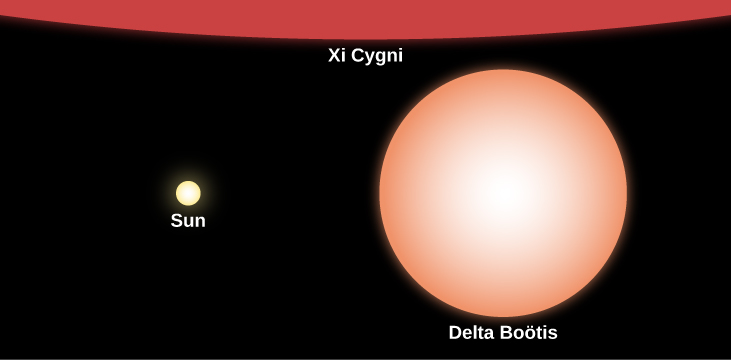
Most stars actually generate more energy each second when they are fusing hydrogen in the shell surrounding the helium core than they did when hydrogen fusion was confined to the central part of the star; thus, they increase in luminosity. With all the new energy pouring outward, the outer layers of the star begin to expand, and the star eventually grows and grows until it reaches enormous proportions (Figure 22.3).
英語のヒント
ほとんどの恒星は、中心部だけで水素を核融合させていたころより、ヘリウム核を囲む殻で水素を核融合させる段階のほうが、毎秒多くのエネルギーを作る。そのため光度は増す。新たなエネルギーが次々に外へ流れ、恒星の外層は膨張し始める。星はどんどん大きくなり、ついには途方もない大きさに達する(図22.3)。
Relative Sizes of Stars.恒星の大きさの比較。
OpenStax / Rice University · CC BY 4.0
Figure 22.3 This image compares the size of the Sun to that of Delta Boötis, a giant star, and Xi Cygni, a supergiant. Note that Xi Cygni is so large in comparison to the other two stars that only a small portion of it is visible at the top of the frame.
図22.3 太陽の大きさを、巨星のうしかい座デルタ星、超巨星のはくちょう座クシー星と比較した図。はくちょう座クシー星はほかの二つより非常に大きく、画面上部にその一部分しか見えない。
When you take the lid off a pot of boiling water, the steam can expand and it cools down. In the same way, the expansion of a star’s outer layers causes the temperature at the surface to decrease. As it cools, the star’s overall color becomes redder. (We saw in Radiation and Spectra that a red color corresponds to cooler temperature.)
英語のヒント
沸騰した水の鍋からふたを外すと、蒸気は膨張して冷える。同じように、恒星の外層が膨張すると表面温度が下がる。冷えるにつれ、星全体の色は赤くなる。「放射とスペクトル」で見たように、赤い色は低い温度に対応する。
So the star becomes simultaneously more luminous and cooler. On the H–R diagram, the star therefore leaves the main-sequence band and moves upward (brighter) and to the right (cooler surface temperature). Over time, massive stars become red supergiants, and lower-mass stars like the Sun become red giants. (We first discussed such giant stars in The Stars: A Celestial Census; here we see how such “swollen” stars originate.) You might also say that these stars have “split personalities”: their cores are contracting while their outer layers are expanding. (Note that red giant stars do not actually look deep red; their colors are more like orange or orange-red.)
英語のヒント
こうして恒星は、光度を増しながら、同時に表面は低温になる。HR図では主系列の帯を離れ、明るくなるため上へ、表面温度が下がるため右へ移動する。やがて大質量星は赤色超巨星、太陽のような低質量星は赤色巨星になる。「恒星――星の世界の実態を調べる」で初めて扱った、このような「膨れた」星がどう生まれるかが、ここでわかるのだ。こうした星は「二重人格」だともいえるだろう。中心核は収縮しているのに、外層は膨張しているからである。なお赤色巨星は、実際に深紅に見えるわけではない。色はむしろオレンジや赤橙色に近いものだ。
Just how different are these red giants and supergiants from a main-sequence star? Table 22.2 compares the Sun with the red supergiant Betelgeuse, which is visible above Orion’s belt as the bright red star that marks the hunter’s armpit. Relative to the Sun, this supergiant has a much larger radius, a much lower average density, a cooler surface, and a much hotter core.
英語のヒント
赤色巨星や赤色超巨星は、主系列星と具体的にどれほど違うのだろうか。表22.2では、太陽と赤色超巨星ベテルギウスを比べている。ベテルギウスは、オリオンのベルトより上で、狩人の脇の位置を示す明るい赤い星である。太陽に比べ、この超巨星は半径がはるかに大きく、平均密度ははるかに低く、表面は低温であるが、中心核はずっと高温である。
Comparing a Supergiant with the Sun 超巨星と太陽の比較 |
||
|---|---|---|
Property 性質 |
Sun 太陽 |
Betelgeuse ベテルギウス |
Mass 質量 |
1 | 16 |
Radius (km) 半径(km) |
700,000 | 500,000,000 |
Surface temperature (K) 表面温度(K) |
5,800 5800 |
3,600 3600 |
Core temperature (K) 中心温度(K) |
15,000,000 | 160,000,000 |
Luminosity 光度 |
1 | 46,000 |
Average density (g/cm3) 平均密度(g/cm3) |
1.4 | |
Age (millions of years) 年齢(百万年) |
4,500 4500 |
10 |
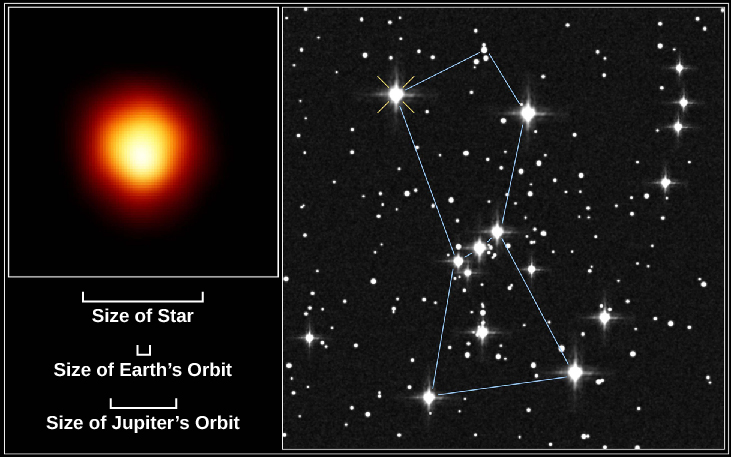
Red giants can become so large that if we were to replace the Sun with one of them, its outer atmosphere would extend to the orbit of Mars or even beyond (Figure 22.4). This is the next stage in the life of a star as it moves (to continue our analogy to human lives) from its long period of “youth” and “adulthood” to “old age.” By considering the relative ages of the Sun and Betelgeuse, we can also see that the idea that “bigger stars die faster” is indeed true here. Betelgeuse is a mere 10 million years old, which is relatively young compared with our Sun’s 4.5 billion years, but it is already nearing its death throes as a red supergiant.
英語のヒント
赤色巨星は非常に大きくなり、もし太陽をその一つに置き換えたら、外側の大気は火星の軌道か、さらにその先へ達するほどになる(図22.4)。人の一生とのたとえを続けるなら、星が長い「青年期」「成人期」から「老年期」へ進む、次の段階である。太陽とベテルギウスの年齢を比べれば、「大きな星ほど早く死ぬ」という考えが、ここでも成り立つとわかる。ベテルギウスはわずか1000万歳で、太陽の45億歳に比べれば若い星である。それでも赤色超巨星となり、すでに最期の苦しみに近づいている。
Betelgeuse.ベテルギウス。
credit: Modification of work by Andrea Dupree (Harvard-Smithsonian CfA), Ronald Gilliland (STScI), NASA and ESA · CC BY 4.0
Figure 22.4 Betelgeuse is in the constellation Orion, the hunter; in the right image, it is marked with a yellow “X” near the top left. In the left image, we see it in ultraviolet with the Hubble Space Telescope, in the first direct image ever made of the surface of another star. As shown by the scale at the bottom, Betelgeuse has an extended atmosphere so large that, if it were at the center of our solar system, it would stretch past the orbit of Jupiter. (credit: Modification of work by Andrea Dupree (Harvard-Smithsonian CfA), Ronald Gilliland (STScI), NASA and ESA)
図22.4 ベテルギウスは狩人のオリオン座にあり、右の画像の左上近くで、黄色い×が位置を示す。左はハッブル宇宙望遠鏡による紫外線像で、太陽以外の恒星の表面を初めて直接撮影した画像である。下の尺度のとおり、ベテルギウスの大気は非常に広く、太陽系の中心に置けば木星の軌道を越える。(出典:Andrea Dupree〈ハーバード・スミソニアンCfA〉、Ronald Gilliland〈STScI〉、NASA、ESAの作品を改変)