第22章恒星の青年期から老年期までStars from Adolescence to Old Age
Becoming a Giant Again再び巨星になる
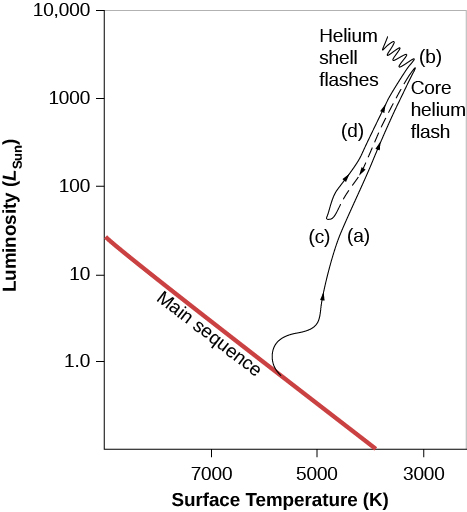
After the helium flash, the star, having survived the “energy crisis” that followed the end of the main-sequence stage and the exhaustion of the hydrogen fuel at its center, finds its balance again. As the star readjusts to the release of energy from the triple-alpha process in its core, its internal structure changes once more: its surface temperature increases and its overall luminosity decreases. The point that represents the star on the H–R diagram thus moves to a new position to the left of and somewhat below its place as a red giant (Figure 22.16). The star then continues to fuse the helium in its core for a while, returning to the kind of equilibrium between pressure and gravity that characterized the main-sequence stage. During this time, a newly formed carbon nucleus at the center of the star can sometimes be joined by another helium nucleus to produce a nucleus of oxygen—another building block of life.
英語のヒント
ヘリウムフラッシュの後、星は再びつり合いを取り戻す。主系列段階が終わって中心の水素燃料を使い切ったことによる「エネルギー危機」を、乗り越えたのだ。中心核のトリプルアルファ反応によるエネルギー放出に合わせて星が調整されると、内部構造もまた変化する。表面温度は上がり、全体の光度は下がる。そのため、HR図で星を表す点は、赤色巨星だった位置より左側で、やや下の新しい位置へ移る(図22.16)。それから星は、しばらくの間、中心核のヘリウムを融合し続ける。圧力と重力がつり合うという、主系列時代に特徴的だった状態へ戻るのだ。この間、星の中心で新しくできた炭素原子核に、さらにもう一つのヘリウム原子核が結び付くことがある。こうして、生命のもう一つの構成要素である酸素の原子核が作られる。
Evolution of a Star Like the Sun on an H–R Diagram.HR図上で見る太陽のような星の進化
OpenStax / Rice University · CC BY 4.0
Figure 22.16 Each stage in the star’s life is labeled. (a) The star evolves from the main sequence to be a red giant, decreasing in surface temperature and increasing in luminosity. (b) A helium flash occurs, leading to a readjustment of the star’s internal structure and to (c) a brief period of stability during which helium is fused to carbon and oxygen in the core (in the process the star becomes hotter and less luminous than it was as a red giant). (d) After the central helium is exhausted, the star becomes a giant again and moves to higher luminosity and lower temperature. By this time, however, the star has exhausted its inner resources and will soon begin to die. Where the evolutionary track becomes a dashed line, the changes are so rapid that they are difficult to model.
図22.16 星の一生の各段階を記号で示している。(a)星は主系列から赤色巨星へ進化し、表面温度が下がるとともに光度が上がる。(b)ヘリウムフラッシュが起こり、内部構造が再調整される。その結果、(c)中心核でヘリウムが炭素や酸素へ融合する、短い安定期に入る。この過程で星は、赤色巨星だったときより高温になり、光度は低くなる。(d)中心のヘリウムを使い切ると、星は再び巨星となり、高光度・低温の方向へ進む。しかし、このころには内部の資源を使い切っており、まもなく最期を迎え始める。進化経路が破線になっているところは、変化が急速で、モデル化が難しい部分である。
However, at a temperature of 100 million K, the inner core is converting its helium fuel to carbon (and a bit of oxygen) at a rapid rate. Thus, the new period of stability cannot last very long: it is far shorter than the main-sequence stage. Soon, all the helium hot enough for fusion will be used up, just like the hot hydrogen that was used up earlier in the star’s evolution. Once again, the inner core will not be able to generate energy via fusion. Once more, gravity will take over, and the core will start to shrink again. We can think of stellar evolution as a story of a constant struggle against gravitational collapse. A star can avoid collapsing as long as it can tap energy sources, but once any particular fuel is used up, it starts to collapse again.
英語のヒント
ところが、温度1億Kの中心核では、ヘリウム燃料が急速に炭素へ、そして少量の酸素へと変換されている。そのため、新たな安定期は長く続かず、主系列段階に比べてはるかに短くなる。やがて、核融合できるほど高温のヘリウムはすべて使い切られる。星の進化の以前の段階で、高温の水素を使い切ったのと同じである。中心核は、またしても核融合でエネルギーを生み出せなくなる。重力が再び優勢になり、中心核はまた収縮し始める。恒星進化は、重力崩壊に抗い続ける物語と考えることができる。星はエネルギー源を利用できる間は崩壊を免れるが、ある燃料を使い切ると、再び崩壊を始めるのだ。
The star’s situation is analogous to the end of the main-sequence stage (when the central hydrogen got used up), but the star now has a somewhat more complicated structure. Again, the star’s core begins to collapse under its own weight. Heat released by the shrinking of the carbon and oxygen core flows into a shell of helium just above the core. This helium, which had not been hot enough for fusion into carbon earlier, is heated just enough for fusion to begin and to generate a new flow of energy.
英語のヒント
星の状況は、中心の水素を使い切って主系列段階が終わったときに似ているが、今度の内部構造は少し複雑である。中心核は、また自らの重さで崩壊し始める。炭素と酸素からなる中心核の収縮で放出された熱は、そのすぐ外側にあるヘリウムの殻へ流れ込む。このヘリウムは、それまでは炭素へ融合するほど高温ではなかった。今度は核融合を始められる温度まで加熱され、新たなエネルギーの流れを生み出す。
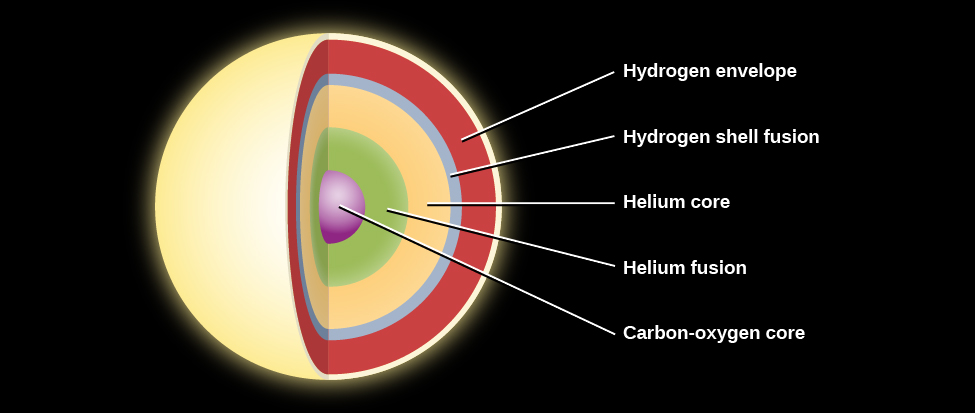
Farther out in the star, there is also a shell where fresh hydrogen has been heated enough to fuse helium. The star now has a multi-layered structure like an onion: a carbon-oxygen core, surrounded by a shell of helium fusion, a layer of helium, a shell of hydrogen fusion, and finally, the extended outer layers of the star (see Figure 22.17). As energy flows outward from the two fusion shells, once again the outer regions of the star begin to expand. Its brief period of stability is over; the star moves back to the red-giant domain on the H–R diagram for a short time (see Figure 22.16). But this is a brief and final burst of glory.
英語のヒント
もっと外側には、まだ使われていない水素が、ヘリウムへ融合できるほど加熱された殻もある。このとき星は、タマネギのような多層構造になっている。中心には炭素と酸素の核があり、その外を、ヘリウム核融合の殻、ヘリウムの層、水素核融合の殻、そして大きく広がった星の外層が順に取り巻く(図22.17)。二つの核融合の殻からエネルギーが外へ流れると、星の外側は再び膨張し始める。短い安定期は終わり、星はHR図の赤色巨星の領域へ、一時的に戻る(図22.16)。しかしこれは、最後の短い輝きである。
Layers inside a Low-Mass Star before Death.最期を迎える前の低質量星の内部の層
OpenStax / Rice University · CC BY 4.0
Figure 22.17 Here we see the layers inside a star with an initial mass that is less than twice the mass of the Sun. These include, from the center outward, the carbon-oxygen core, a layer of helium hot enough to fuse, a layer of cooler helium, a layer of hydrogen hot enough to fuse, and then cooler hydrogen beyond.
図22.17 誕生時の質量が太陽の2倍未満の星の内部の層。中心から外へ向かって、炭素と酸素からなる中心核、核融合できるほど高温のヘリウムの層、より低温のヘリウムの層、核融合できるほど高温の水素の層、その外側のより低温の水素が並ぶ。
Recall that the last time the star was in this predicament, helium fusion came to its rescue. The temperature at the star’s center eventually became hot enough for the product of the previous step of fusion (helium) to become the fuel for the next step (helium fusing into carbon). But the step after the fusion of helium nuclei requires a temperature so hot that the kinds of lower-mass stars (less than 2 solar masses) we are discussing simply cannot compress their cores to reach it. No further types of fusion are possible for such a star.
英語のヒント
星が前にこの窮地に陥ったときには、ヘリウム核融合が救いになったことを思い出してほしい。星の中心温度が最終的に十分高くなり、一つ前の核融合の生成物であるヘリウムが、次の段階、つまりヘリウムを炭素へ融合する反応の燃料になったのだった。しかし、ヘリウム原子核の融合より先の段階には、非常に高い温度が必要である。ここで扱っている太陽の2倍未満の低質量星では、中心核をその温度まで圧縮することはできない。このような星には、それ以上の種類の核融合は起こせないのだ。
In a star with a mass similar to that of the Sun, the formation of a carbon-oxygen core thus marks the end of the generation of nuclear energy at the center of the star. The star must now confront the fact that its death is near. We will discuss how stars like this end their lives in The Death of Stars, but in the meantime, Table 22.4 summarizes the stages discussed so far in the life of a star with the same mass as that of the Sun. One thing that gives us confidence in our calculations of stellar evolution is that when we make H–R diagrams of older clusters, we actually see stars in each of the stages that we have been discussing.
英語のヒント
こうして、太陽に近い質量の星では、炭素と酸素からなる中心核の形成が、星の中心における核エネルギー生成の終わりを告げる。星は今や、自分の最期が近いという事実に向き合わなければならない。このような星がどのように一生を終えるかは「恒星の死」で扱う。ここではひとまず、太陽と同じ質量の星の一生について、これまでに述べた段階を表22.4にまとめておく。恒星進化の計算を信頼できる理由の一つは、古い星団のHR図を作ると、これまでに述べたそれぞれの段階にいる星を、実際に観測できることである。
The Evolution of a Star with the Sun’s Mass 太陽と同じ質量の星の進化 |
||||
|---|---|---|---|---|
Stage 段階 |
Time in This Stage (years) この段階にとどまる時間(年) |
Surface Temperature (K) 表面温度(K) |
Luminosity (LSun) 光度(LSun) |
Diameter 直径(太陽=1) |
Main sequence 主系列 |
11 billion 110億 |
6000 | 1 | 1 |
Becomes red giant 赤色巨星になる |
1.3 billion 13億 |
3100 at minimum 最低3100 |
2300 at maximum 最大2300 |
165 |
Helium fusion ヘリウム核融合 |
100 million 1億 |
4800 | 50 | 10 |
Giant again 再び巨星になる |
20 million 2000万 |
3100 | 5200 | 180 |