第22章恒星の青年期から老年期までStars from Adolescence to Old Age
22.5 The Evolution of More Massive Stars22.5 より大質量の星の進化
Learning Objectives学習の目標
By the end of this section, you will be able to:
この節を学ぶと、次のことができるようになる。
Explain how and why massive stars evolve much more rapidly than lower-mass stars like our Sun
大質量星が太陽のような低質量星よりはるかに速く進化する仕組みと理由を説明する。
Discuss the origin of the elements heavier than carbon within stars
星の内部にある、炭素より重い元素の起源を説明する。
Explain why the chemical composition of globular clusters is different from that of open clusters
球状星団と散開星団で化学組成が異なる理由を説明する。
If what we have described so far were the whole story of the evolution of stars and elements, we would have a big problem on our hands. We will see in later chapters that in our best models of the first few minutes of the universe, everything starts with the two simplest elements—hydrogen and helium (plus a tiny bit of lithium). All the predictions of the models imply that no heavier elements were produced at the beginning of the universe. Yet when we look around us on Earth, we see lots of other elements besides hydrogen and helium. These elements must have been made (fused) somewhere in the universe, and the only place hot enough to make them is inside stars. One of the fundamental discoveries of twentieth-century astronomy is that the stars are the source of most of the chemical richness that characterizes our world and our lives.
英語のヒント
もし、星と元素の進化の物語がここまでの説明だけで終わっていたら、私たちは大きな問題を抱えることになる。後の章で見るように、宇宙最初の数分間についての最も優れたモデルでは、すべては最も単純な二つの元素、水素とヘリウム、そしてごく少量のリチウムから始まる。どのモデルの予測も、宇宙の始まりには、それより重い元素は作られなかったことを示している。それでも、地球上で周りを見れば、水素とヘリウム以外の元素がたくさんある。それらは宇宙のどこかで作られ、つまり核融合で合成されたはずである。それを作れるほど高温の場所は、星の内部しかない。私たちの世界と暮らしを特徴付ける化学的な豊かさの大部分は星に由来する、というのは、20世紀の天文学の基本的な発見の一つである。
We have already seen that carbon, oxygen, and some other elements are made inside lower-mass stars during the red-giant stage. But where do the heavier elements we know and love (such as the silicon and iron inside Earth, and the gold and silver in our jewelry) come from? The kinds of stars we have been discussing so far never get hot enough at their centers to make these elements. It turns out that these heavier elements are formed later in the lives more massive stars, as well as during explosions that can mark the end of the lives of some stars.
英語のヒント
低質量星でも赤色巨星段階には、炭素、酸素、そのほかのいくつかの元素を内部で作ることを、すでに見た。では、地球内部のケイ素や鉄、宝飾品の金や銀など、私たちになじみ深く大切な重い元素は、どこから来たのだろうか。これまで扱ってきた種類の星は、中心がそれらの元素を作れるほど高温にはならない。これらの重い元素は、より大質量の星の一生の後半に作られるほか、一部の星の最期を告げる爆発でも作られることがわかっている。
Making New Elements in Massive Stars大質量星の内部で新しい元素を作る
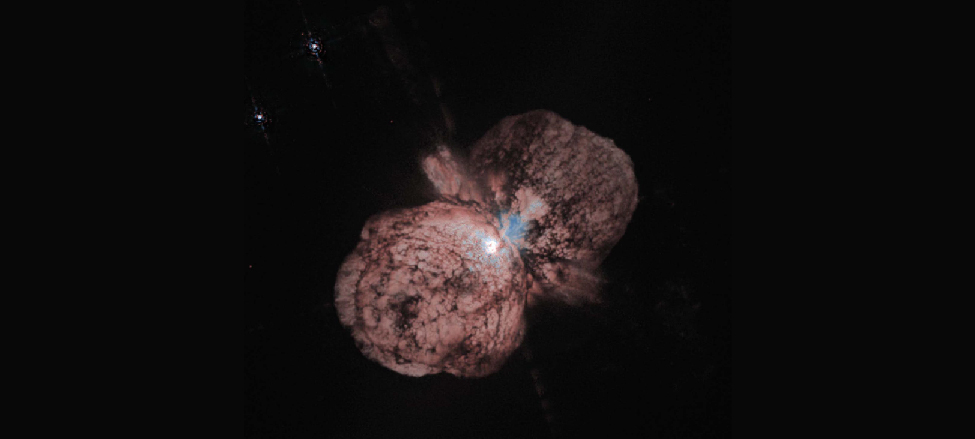
Massive stars evolve in much the same way that the Sun does (but always more quickly)—up to the formation of a carbon-oxygen core. One difference is that for stars with more than about twice the mass of the Sun, helium begins fusion more gradually, rather than with a sudden flash. Also, when more massive stars become red giants, they become so bright and large that we call them supergiants. Such stars can expand until their outer regions become as large as the orbit of Jupiter, which is precisely what the Hubble Space Telescope has shown for the star Betelgeuse (see Figure 22.4). They also lose mass very effectively, producing dramatic winds and outbursts as they age. Figure 22.20 shows a wonderful image of the very massive star Eta Carinae, with a great deal of ejected material clearly visible.
英語のヒント
大質量星も、炭素と酸素からなる中心核を作るまでは、太陽とほぼ同じように進化する。ただし、常に速いペースで進む。一つの違いは、太陽のおよそ2倍を超える質量の星では、突然のフラッシュではなく、より緩やかにヘリウム核融合が始まることである。また、大質量星が赤色巨星になると、非常に明るく大きくなるため、超巨星と呼ぶ。このような星は、外縁が木星の軌道ほどに広がるまで膨張することがある。ベテルギウスについてハッブル宇宙望遠鏡が明らかにしたのも、まさにその姿である(図22.4)。こうした星は質量も非常に効率よく失い、年を取るにつれて激しい風や突発的な放出を生じさせる。図22.20は、非常に大質量の星、りゅうこつ座イータ星の見事な画像である。大量の放出物質がはっきり見えている。
Eta Carinae.りゅうこつ座イータ星
credit: modification of work by Jon Morse (University of Colorado) & NASA · NASA media use guidelines
Figure 22.20 With a mass at least 100 times that of the Sun, the hot supergiant Eta Carinae is one of the most massive stars known. This Hubble Space Telescope image records the two giant lobes and equatorial disk of material it has ejected in the course of its evolution. The pink outer region is material ejected in an outburst seen in 1843, the largest of such mass loss event that any star is known to have survived. Moving away from the star at a speed of about 1000 km/s, the material is rich in nitrogen and other elements formed in the interior of the star. The inner blue-white region is the material ejected at lower speeds and is thus still closer to the star. It appears blue-white because it contains dust and reflects the light of Eta Carinae, whose luminosity is 4 million times that of our Sun. (credit: modification of work by Jon Morse (University of Colorado) & NASA)
図22.20 質量が太陽の少なくとも100倍ある高温の超巨星、りゅうこつ座イータ星は、既知の星でも最も大質量の部類に入る。このハッブル宇宙望遠鏡の画像には、進化の過程で放出した物質が作る二つの巨大なふくらみと、赤道面上の円盤が写っている。ピンクの外側の領域は、1843年に観測された突発的な活動で放出された物質である。星が生き残ったことが知られている質量放出現象としては、最大のものだった。秒速約1000 kmで星から遠ざかるこの物質は、窒素や、星の内部で作られたほかの元素を豊富に含む。青白い内側の領域は、より遅く放出された物質なので、まだ星の近くにある。そこに含まれる塵が、太陽の400万倍の光度を持つりゅうこつ座イータ星の光を反射するため、青白く見える。画像出典:Jon Morse(コロラド大学)、NASAの作品を改変。
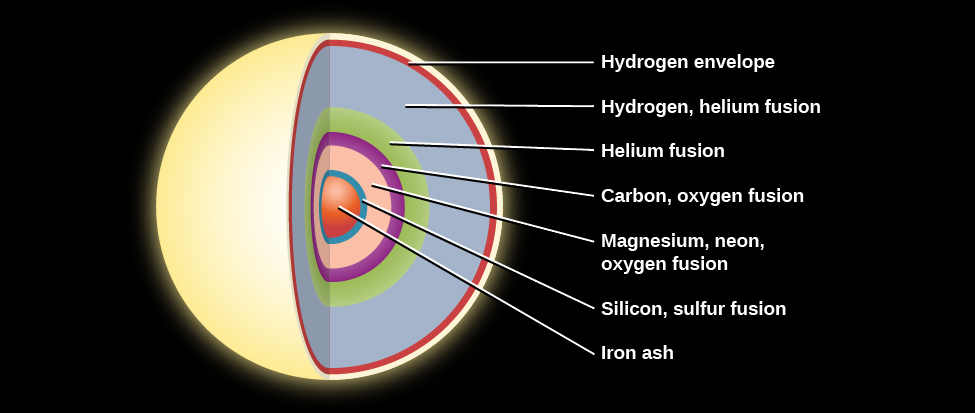
But the crucial way that massive stars diverge from the story we have outlined is that they can start additional kinds of fusion in their centers and in the shells surrounding their central regions. The outer layers of a star with a mass greater than about 8 solar masses have a weight that is enough to compress the carbon-oxygen core until it becomes hot enough to ignite fusion of carbon nuclei. Carbon can fuse into still more oxygen, and at still higher temperatures, oxygen and then neon, magnesium, and finally silicon can build even heavier elements. Iron is, however, the endpoint of this process. The fusion of iron atoms produces products that are more massive than the nuclei that are being fused and therefore the process requires energy, as opposed to releasing energy, which all fusion reactions up to this point have done. This required energy comes at the expense of the star itself, which is now on the brink of death (Figure 22.21). What happens next will be described in the chapter on The Death of Stars.
英語のヒント
しかし、大質量星がこれまでの筋道から分かれる決定的な点は、中心や、その周囲の殻で、さらに別の種類の核融合を始められることである。太陽のおよそ8倍を超える質量の星では、外層の重さが十分大きく、炭素と酸素の中心核を圧縮して、炭素原子核の融合に点火できるほど高温にできる。炭素の融合によってさらに酸素を作ることができ、もっと高温になると、酸素、次いでネオン、マグネシウム、最後にはケイ素から、さらに重い元素を作れる。しかし、この過程の終点は鉄である。鉄原子を融合させると、融合前の原子核より質量の大きい生成物ができるため、反応にはエネルギーが必要になる。ここまでの核融合反応のように、エネルギーを放出することはできない。必要なエネルギーは星そのものの負担となり、星は今や死の淵に立つ(図22.21)。次に何が起こるかは、「恒星の死」の章で説明する。
Interior Structure of a Massive Star Just before It Exhausts Its Nuclear Fuel.核燃料を使い切る直前の大質量星の内部構造
OpenStax / Rice University · CC BY 4.0
Figure 22.21 High-mass stars can fuse elements heavier than carbon. As a massive star nears the end of its evolution, its interior resembles an onion. Hydrogen fusion is taking place in an outer shell, and progressively heavier elements are undergoing fusion in the higher-temperature layers closer to the center. All of these fusion reactions generate energy and enable the star to continue shining. Iron is different. The fusion of iron requires energy, and when iron is finally created in the core, the star has only minutes to live.
図22.21 大質量星では、炭素より重い元素も融合できる。進化の終わりに近づくと、内部はタマネギのような構造になる。外側の殻では水素核融合が進み、中心に近い高温の層ほど、順に重い元素が核融合を起こしている。これらの核融合反応はすべてエネルギーを生み出し、星を輝かせ続ける。しかし鉄は異なる。鉄の核融合にはエネルギーが必要で、ついに中心核に鉄が作られると、星に残された命はわずか数分になる。
Physicists have now found nuclear pathways whereby virtually all chemical elements of atomic weights up to that of iron can be built up by this nucleosynthesis (the making of new atomic nuclei) in the centers of the more massive red giant stars. This still leaves the question of where elements heavier than iron come from. We will see in the next chapter that when massive stars finally exhaust their nuclear fuel, they most often die in a spectacular explosion—a supernova. Heavier elements can be synthesized in the stunning violence of such explosions.
英語のヒント
現在、物理学者は、大質量の赤色巨星の中心で、鉄までの原子量を持つほぼすべての元素を作れる核反応の経路を見いだしている。このように、新しい原子核を作ることを元素合成という。それでも、鉄より重い元素がどこから来るのか、という問題は残る。次の章で見るように、大質量星はついに核燃料を使い切ると、多くの場合、超新星という壮大な爆発によって一生を終える。そのすさまじい爆発のなかで、さらに重い元素が合成されることがある。
Not only can we explain in this way where the elements that make up our world and others come from, but our theories of nucleosynthesis inside stars are even able to predict the relative abundances with which the elements occur in nature. The way stars build up elements during various nuclear reactions really can explain why some elements (oxygen, carbon, and iron) are common and others are quite rare (gold, silver, and uranium).
英語のヒント
このようにして、私たちの世界やほかの世界を形作る元素がどこから来たかを説明できるだけではない。星の内部の元素合成の理論は、自然界に各元素がどの割合で存在するかまで予測できる。さまざまな核反応を通じて星が元素を組み立てる仕組みは、酸素、炭素、鉄のように豊富な元素がある一方で、金、銀、ウランのように非常に珍しい元素がある理由を、実際に説明できるのだ。