第22章恒星の青年期から老年期までStars from Adolescence to Old Age
H–R Diagrams of Older Clusters年を取った星団のHR図
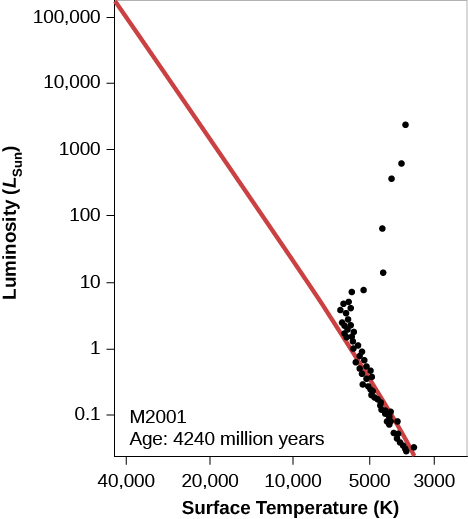
After 4 billion years have passed, many more stars, including stars that are only a few times more massive than the Sun, have left the main sequence (Figure 22.13). This means that no stars are left near the top of the main sequence; only the low-mass stars near the bottom remain. The older the cluster, the lower the point on the main sequence (and the lower the mass of the stars) where stars begin to move toward the red giant region. The location in the H–R diagram where the stars have begun to leave the main sequence is called the main-sequence turnoff.
英語のヒント
40億年が過ぎると、太陽の数倍の質量の星も含め、さらに多くの星が主系列を離れている(図22.13)。主系列の上部にはもう星が残らず、下部の低質量星だけが残ることになる。星団が古いほど、主系列から赤色巨星の領域へ向かい始める位置は低くなり、その星の質量も小さくなる。星が主系列を離れ始めたHR図上の位置を、主系列転向点と呼ぶ。
H–R Diagram for an Older Cluster.年齢を重ねた星団のHR図
OpenStax / Rice University · CC BY 4.0
Figure 22.13 We see the H–R diagram for a hypothetical older cluster at an age of 4.24 billion years. Note that most of the stars on the upper part of the main sequence have turned off toward the red-giant region. And the most massive stars in the cluster have already died and are no longer on the diagram.
図22.13 年齢42億4000万年の、架空の古い星団のHR図。主系列上部の星の大半が主系列を離れ、赤色巨星の領域へ向かっていることに注目しよう。星団中で最も質量の大きい星はすでに一生を終え、この図には現れない。
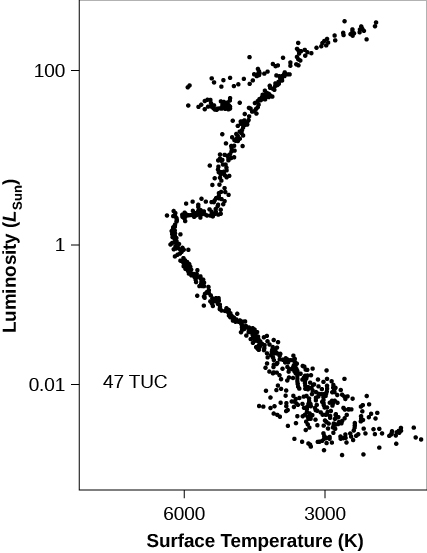
The oldest clusters of all are the globular clusters. Figure 22.14 shows the H–R diagram of globular cluster 47 Tucanae. Notice that the luminosity and temperature scales are different from those of the other H–R diagrams in this chapter. In Figure 22.13, for example, the luminosity scale on the left side of the diagram goes from 0.1 to 100,000 times the Sun’s luminosity. But in Figure 22.14, the luminosity scale has been significantly reduced in extent. So many stars in this old cluster have had time to turn off the main sequence that only the very bottom of the main sequence remains.
英語のヒント
星団のなかで最も古いのは球状星団である。図22.14は、球状星団きょしちょう座47のHR図を示している。光度と温度の目盛りが、この章のほかのHR図とは異なることに注意しよう。たとえば図22.13では、左の光度の目盛りが太陽の0.1倍から10万倍まである。これに対し図22.14では、光度の目盛りの範囲が大幅に狭くなっている。この古い星団では、非常に多くの星が主系列を離れるだけの時間を経ているため、主系列のいちばん下の部分しか残っていないのだ。
Cluster 47 Tucanae.きょしちょう座47星団
OpenStax / Rice University · CC BY 4.0
Figure 22.14 This H–R diagram is for the globular cluster 47. Note that the scale of luminosity differs from that of the other H–R diagrams in this chapter. We are only focusing on the lower portion of the main sequence, the only part where stars still remain in this old cluster.
図22.14 球状星団きょしちょう座47のHR図。光度の目盛りは、この章のほかのHR図とは異なる。この図では主系列の下部だけに注目している。この古い星団では、主系列上に星が残っているのはその部分だけである。
Just how old are the different clusters we have been discussing? To get their actual ages (in years), we must compare the appearances of our calculated H–R diagrams of different ages to observed H–R diagrams of real clusters. In practice, astronomers use the position at the top of the main sequence (that is, the luminosity at which stars begin to move off the main sequence to become red giants) as a measure of the age of a cluster (the main-sequence turnoff we discussed previously). For example, we can compare the luminosities of the brightest stars that are still on the main sequence in Figure 22.10 and Figure 22.13.
英語のヒント
ここまで取り上げたさまざまな星団は、実際には何歳なのだろうか。年を単位とする具体的な年齢を求めるには、計算によって得た各年齢のHR図の形を、実際の星団の観測から得たHR図と比べなければならない。実際に天文学者が星団の年齢の目安として使うのは、主系列の上端の位置である。つまり、星が主系列を離れて赤色巨星になり始める光度であり、先ほど述べた主系列転向点に当たる。たとえば、図22.10と図22.13で、まだ主系列上に残っている最も明るい星の光度を比較できる。
Using this method, some associations and open clusters turn out to be as young as 1 million years old, while others are several hundred million years old. Once all of the interstellar matter surrounding a cluster has been used to form stars or has dispersed and moved away from the cluster, star formation ceases, and stars of progressively lower mass move off the main sequence, as shown in Figure 22.10, Figure 22.12, and Figure 22.13.
英語のヒント
この方法を使うと、アソシエーションや散開星団には、わずか100万歳の若いものもあれば、数億歳のものもあるとわかる。星団の周囲の星間物質がすべて星の形成に使われるか、散り散りになって星団から離れると、星形成は止まる。その後は図22.10、図22.12、図22.13のように、より低質量の星が順々に主系列を離れていく。
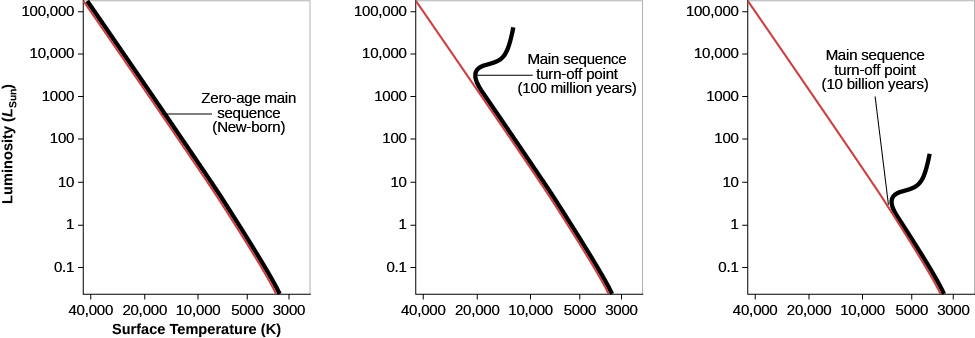
To our surprise, even the youngest of the globular clusters in our Galaxy are found to be older than the oldest open cluster. All of the globular clusters have main sequences that turn off at a luminosity less than that of the Sun. Star formation in these crowded systems ceased billions of years ago, and no new stars are coming on to the main sequence to replace the ones that have turned off (see Figure 22.15).
英語のヒント
驚くことに、天の川銀河の球状星団は、最も若いものでさえ、最も古い散開星団より古いことがわかっている。どの球状星団でも、主系列が転向する位置の光度は太陽の光度より低くなっている。星が密集するこれらの集団では、星形成は何十億年も前に止まっており、主系列を離れた星に代わる新しい星は主系列へ入ってこない(図22.15)。
H–R Diagrams for Clusters of Different Ages.年齢の異なる星団のHR図
OpenStax / Rice University · CC BY 4.0
Figure 22.15 This sketch shows how the turn-off point from the main sequence gets lower as we make H–R diagrams for clusters that are older and older.
図22.15 より年齢の高い星団のHR図ほど、主系列からの転向点が低い位置になることを示す模式図。
Indeed, the globular clusters are the oldest structures in our Galaxy (and in other galaxies as well). The youngest have ages of about 11 billion years and some appear to be even older. Since these are the oldest objects we know of, this estimate is one of the best limits we have on the age of the universe itself—it must be at least 11 billion years old. We will return to the fascinating question of determining the age of the entire universe in the chapter on The Big Bang.
英語のヒント
実際、球状星団は天の川銀河で最も古い構造であり、ほかの銀河でも同様である。最も若いものでも約110億歳で、それより古いとみられるものもある。これらは私たちが知る最古の天体なので、この年齢の推定は、宇宙そのものの年齢に対する最も有力な制限の一つになる。宇宙は少なくとも110億歳でなければならないのだ。宇宙全体の年齢を求めるという興味深い問題には、「ビッグバン」の章で再び取り組む。
Key Concepts and Summary重要事項のまとめ
The H–R diagram of stars in a cluster changes systematically as the cluster grows older. The most massive stars evolve most rapidly. In the youngest clusters and associations, highly luminous blue stars are on the main sequence; the stars with the lowest masses lie to the right of the main sequence and are still contracting toward it. With passing time, stars of progressively lower masses evolve away from (or turn off) the main sequence. In globular clusters, which are all at least 11 billion years old, there are no luminous blue stars at all. Astronomers can use the turnoff point from the main sequence to determine the age of a cluster.
星団を構成する星のHR図は、星団が年齢を重ねるにつれて規則的に変化する。最も質量の大きい星が最も速く進化する。最も若い星団やアソシエーションでは、光度の高い青い星が主系列上にある。一方、最も低質量の星は主系列の右側にあり、まだ収縮しながら主系列に近づいている。時間がたつと、次第に低質量の星まで、進化して主系列を離れるようになる。球状星団はいずれも少なくとも110億歳で、明るい青い星はまったくない。天文学者は、主系列の転向点を使って星団の年齢を求めることができる。
main-sequence turnoff
主系列転向点
location in the H–R diagram where stars begin to leave the main sequence
HR図において、星が主系列を離れ始める位置。