第22章恒星の青年期から老年期までStars from Adolescence to Old Age
Models for Evolution to the Giant Stage巨星段階への進化モデル
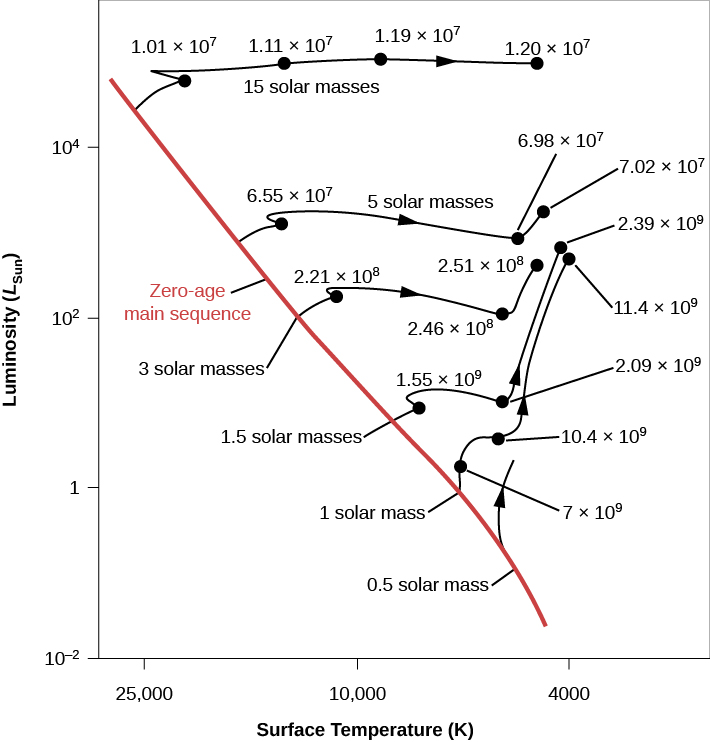
As we discussed earlier, astronomers can construct computer models of stars with different masses and compositions to see how stars change throughout their lives. Figure 22.5, which is based on theoretical calculations by University of Illinois astronomer Icko Iben, shows an H–R diagram with several tracks of evolution from the main sequence to the giant stage. Tracks are shown for stars with different masses (from 0.5 to 15 times the mass of our Sun) and with chemical compositions similar to that of the Sun. The red line is the initial or zero-age main sequence. The numbers along the tracks indicate the time, in years, required for each star to reach those points in their evolution. Once again, you can see that the more massive a star is, the more quickly it goes through each stage in its life.
英語のヒント
先ほど述べたように、天文学者は質量や組成の異なる恒星のコンピューターモデルを作り、一生の変化を調べられる。イリノイ大学の天文学者イッコー・イーベンの理論計算に基づく図22.5は、主系列から巨星段階へ至るいくつかの進化トラックをHR図で示している。トラックは、質量が太陽の0.5〜15倍と異なり、化学組成が太陽に似た星のものだ。赤線は初期の、つまり零歳主系列を示す。トラック沿いの数字は、星がその進化上の点に達するまでの年数である。ここでも、質量が大きい星ほど、一生の各段階を速く通過するとわかる。
Evolutionary Tracks of Stars of Different Masses.質量の異なる恒星の進化トラック。
OpenStax / Rice University · CC BY 4.0
Figure 22.5 The solid black lines show the predicted evolution from the main sequence through the red giant or supergiant stage on the H–R diagram. Each track is labeled with the mass of the star it is describing. The numbers show how many years each star takes to become a giant. The red line is the zero-age main sequence. While theorists debate the exact number of years shown here, our main point should be clear. The more massive the star, the shorter time it takes for each stage in its life.
図22.5 黒い実線は、主系列から赤色巨星・超巨星段階へ至る予測された進化をHR図上に示す。各トラックには、それが表す星の質量が記されている。数字は巨星になるまでの年数、赤線は零歳主系列である。正確な年数については理論家の議論があるが、中心となる点は明らかだろう。質量が大きい星ほど、一生の各段階にかかる時間が短い。
Note that the most massive star in this diagram has a mass similar to that of Betelgeuse, and so its evolutionary track shows approximately the history of Betelgeuse. The track for a 1-solar-mass star shows that the Sun is still in the main-sequence phase of evolution, since it is only about 4.5 billion years old. It will be billions of years before the Sun begins its own “climb” away from the main sequence—the expansion of its outer layers that will make it a red giant.
英語のヒント
この図で最も重い星はベテルギウスに近い質量なので、その進化トラックはベテルギウスの歴史をおおよそ示している。1太陽質量の星のトラックを見ると、まだ約45億歳の太陽は、今も主系列の進化段階にあるとわかる。太陽が主系列を離れて「上り坂」を進み始めるまでには、今後も何十億年とかかる。その上り坂とは、外層が膨張し、赤色巨星になっていく変化である。
Key Concepts and Summary重要事項のまとめ
When stars first begin to fuse hydrogen to helium, they lie on the zero-age main sequence. The amount of time a star spends in the main-sequence stage depends on its mass. More massive stars complete each stage of evolution more quickly than lower-mass stars. The fusion of hydrogen to form helium changes the interior composition of a star, which in turn results in changes in its temperature, luminosity, and radius. Eventually, as stars age, they evolve away from the main sequence to become red giants or supergiants. The core of a red giant is contracting, but the outer layers are expanding as a result of hydrogen fusion in a shell outside the core. The star gets larger, redder, and more luminous as it expands and cools.
水素をヘリウムへ融合させ始めた星は、零歳主系列に位置する。主系列にとどまる時間は質量で決まり、重い星ほど各進化段階を速く終える。水素の核融合は星の内部組成を変え、それによって温度、光度、半径も変わる。やがて年を取った星は主系列を離れ、赤色巨星や超巨星へ進化する。赤色巨星では中心核が収縮する一方、その外の殻で水素が核融合するため、外層は膨張する。膨張して表面が冷えるにつれ、星は大きく、赤く、光度が高くなる。
zero-age main sequence
零歳主系列
a line denoting the main sequence on the H–R diagram for a system of stars that have completed their contraction from interstellar matter and are now deriving all their energy from nuclear reactions, but whose chemical composition has not yet been altered substantially by nuclear reactions
星間物質からの収縮を終え、エネルギーをすべて核反応から得始めたが、核反応によって化学組成がまだ大きく変わっていない恒星の集まりについて、HR図上の主系列を示す線。