第9章独占
9.2 How a Profit-Maximizing Monopoly Chooses Output and Price9.2 利潤を最大化する独占企業は生産量と価格をどう選ぶか
Learning Objectives学習目標
Learning Objectives学習目標
By the end of this section, you will be able to:
英語のヒント
この節を学ぶと、次のことができるようになる。
- Explain the perceived demand curve for a perfect competitor and a monopoly
英語のヒント
完全競争企業と独占企業が認識する需要曲線を説明する - Analyze a demand curve for a monopoly and determine the output that maximizes profit and revenue
英語のヒント
独占企業の需要曲線を分析し、利潤と収入を最大化する生産量を決める - Calculate marginal revenue and marginal cost
英語のヒント
限界収入と限界費用を計算する - Explain allocative efficiency as it pertains to the efficiency of a monopoly
英語のヒント
独占の効率性に関わる配分の効率性を説明する
Consider a monopoly firm, comfortably surrounded by barriers to entry so that it need not fear competition from other producers. How will this monopoly choose its profit-maximizing quantity of output, and what price will it charge? Profits for the monopolist, like any firm, will be equal to total revenues minus total costs. We can analyze the pattern of costs for the monopoly within the same framework as the costs of a perfectly competitive firm—that is, by using total cost, fixed cost, variable cost, marginal cost, average cost, and average variable cost. However, because a monopoly faces no competition, its situation and its decision process will differ from that of a perfectly competitive firm. (The Clear It Up feature discusses how hard it is sometimes to define “market” in a monopoly situation.)
英語のヒント
参入障壁に守られ、他の生産者との競争を恐れる必要がない独占企業を考えよう。この企業は、利潤を最大化する生産量をどう選び、いくらの価格を請求するだろうか。独占企業の利潤も、他の企業と同じく総収入から総費用を引いたものになる。独占企業の費用のパターンは、総費用、固定費用、可変費用、限界費用、平均費用、平均可変費用を用いることで、完全競争企業と同じ枠組みで分析できる。しかし独占企業は競争に直面しないため、その状況と意思決定の過程は完全競争企業と異なる。(「疑問を解こう」では、独占の状況で「市場」を定義することが、時にどれほど難しいかを論じる。)
Demand Curves Perceived by a Perfectly Competitive Firm and by a Monopoly完全競争企業と独占企業が認識する需要曲線
A perfectly competitive firm acts as a price taker, so we calculate total revenue taking the given market price and multiplying it by the quantity of output that the firm chooses. The demand curve as it is perceived by a perfectly competitive firm appears in Figure 9.3 (a). The flat perceived demand curve means that, from the viewpoint of the perfectly competitive firm, it could sell either a relatively low quantity like Ql or a relatively high quantity like Qh at the market price P.
英語のヒント
完全競争企業は価格受容者として行動するため、与えられた市場価格に、企業が選ぶ生産量を掛けて総収入を計算する。完全競争企業が認識する需要曲線は図9.3(a)に示される。認識される需要曲線が水平であることは、その企業から見れば、Qlのような比較的少量でもQhのような比較的多量でも、市場価格Pで販売できることを意味する。
The Perceived Demand Curve for a Perfect Competitor and a Monopolist完全競争企業と独占企業が認識する需要曲線
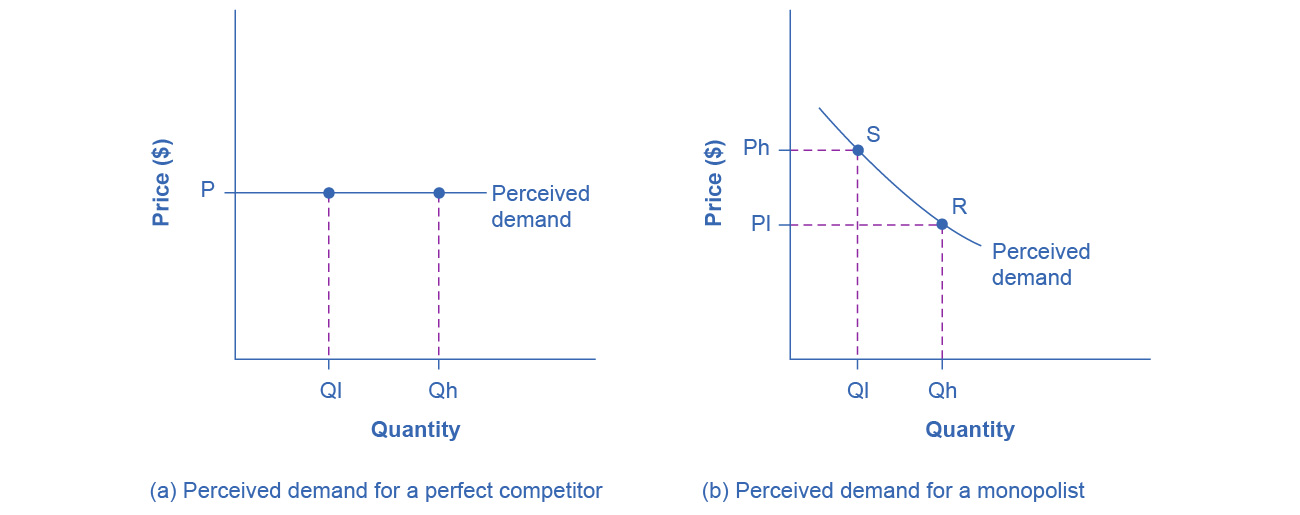

Figure 9.3図 9.3
(a) A perfectly competitive firm perceives the demand curve that it faces to be flat. The flat shape means that the firm can sell either a low quantity (Ql) or a high quantity (Qh) at exactly the same price (P). (b) A monopolist perceives the demand curve that it faces to be the same as the market demand curve, which for most goods is downward-sloping. Thus, if the monopolist chooses a high level of output (Qh), it can charge only a relatively low price (PI). Conversely, if the monopolist chooses a low level of output (Ql), it can then charge a higher price (Ph). The challenge for the monopolist is to choose the combination of price and quantity that maximizes profits.
英語のヒント
(a)完全競争企業は、自らが直面する需要曲線を水平と認識する。水平な形は、少量(Ql)でも多量(Qh)でも、まったく同じ価格(P)で売れることを意味する。(b)独占企業は、自らが直面する需要曲線を市場需要曲線と同じと認識する。大部分の財では、これは右下がりである。したがって、独占企業が高い生産水準(Qh)を選ぶと、比較的低い価格(PI)しか請求できない。逆に、低い生産水準(Ql)を選べば、高い価格(Ph)を請求できる。独占企業の課題は、利潤を最大化する価格と数量の組み合わせを選ぶことである。
While a monopolist can charge any price for its product, nonetheless the demand for the firm’s product constrains the price. No monopolist, even one that is thoroughly protected by high barriers to entry, can require consumers to purchase its product. Because the monopolist is the only firm in the market, its demand curve is the same as the market demand curve, which is, unlike that for a perfectly competitive firm, downward-sloping.
英語のヒント
独占企業は製品にどの価格でも請求できるが、それでも製品への需要が価格を制約する。高い参入障壁で完全に守られた独占企業でさえ、消費者に製品の購入を強制できない。独占企業は市場で唯一の企業なので、その需要曲線は市場需要曲線と同じであり、完全競争企業の曲線と異なって右下がりである。
Figure 9.3 illustrates this situation. The monopolist can either choose a point like R with a low price (Pl) and high quantity (Qh), or a point like S with a high price (Ph) and a low quantity (Ql), or some intermediate point. Setting the price too high will result in a low quantity sold, and will not bring in much revenue. Conversely, setting the price too low may result in a high quantity sold, but because of the low price, it will not bring in much revenue either. The challenge for the monopolist is to strike a profit-maximizing balance between the price it charges and the quantity that it sells. However, why isn’t the perfectly competitive firm’s demand curve also the market demand curve? See the following Clear It Up feature for the answer to this question.
英語のヒント
図9.3はこの状況を示す。独占企業は、価格が低く(Pl)数量が多い(Qh)Rのような点、価格が高く(Ph)数量が少ない(Ql)Sのような点、あるいはその中間の点を選べる。価格を高くしすぎると販売量が少なくなり、多くの収入は得られない。逆に、価格を低くしすぎると販売量は多くなるかもしれないが、価格が低いため、やはり多くの収入は得られない。独占企業の課題は、請求価格と販売量の間で、利潤を最大化する釣り合いを見つけることである。しかし、完全競争企業の需要曲線も市場需要曲線にならないのはなぜか。この問いへの答えは、次の「疑問を解こう」を見よう。