第9章独占
9.1 How Monopolies Form: Barriers to Entry9.1 独占が成立する仕組み――参入障壁
Learning Objectives学習目標
Learning Objectives学習目標
By the end of this section, you will be able to:
英語のヒント
この節を学ぶと、次のことができるようになる。
- Distinguish between a natural monopoly and a legal monopoly.
英語のヒント
自然独占と法的独占を区別する。 - Explain how economies of scale and the control of natural resources led to the necessary formation of legal monopolies
英語のヒント
規模の経済と天然資源の支配が、法的独占の必然的な成立にどうつながったかを説明する - Analyze the importance of trademarks and patents in promoting innovation
英語のヒント
革新を促進するうえでの商標と特許の重要性を分析する - Identify examples of predatory pricing
英語のヒント
略奪的価格設定の例を特定する
Because of the lack of competition, monopolies tend to earn significant economic profits. These profits should attract vigorous competition as we described in Perfect Competition, and yet, because of one particular characteristic of monopoly, they do not. Barriers to entry are the legal, technological, or market forces that discourage or prevent potential competitors from entering a market. Barriers to entry can range from the simple and easily surmountable, such as the cost of renting retail space, to the extremely restrictive. For example, there are a finite number of radio frequencies available for broadcasting. Once an entrepreneur or firm has purchased the rights to all of them, no new competitors can enter the market.
英語のヒント
競争がないため、独占企業は大きな経済的利潤を得る傾向がある。「完全競争」で述べたように、この利潤は活発な競争を引き寄せるはずだが、独占のある特定の特徴によって、そうならない。参入障壁とは、潜在的な競争相手が市場に参入するのを思いとどまらせたり、妨げたりする法律上、技術上、または市場の力である。参入障壁には、店舗を借りる費用のように単純で容易に乗り越えられるものから、極めて制約の強いものまである。たとえば、放送に利用できる無線周波数の数は限られている。ある起業家や企業がそのすべての権利を購入すれば、新たな競争相手は市場に参入できない。
In some cases, barriers to entry may lead to monopoly. In other cases, they may limit competition to a few firms. Barriers may block entry even if the firm or firms currently in the market are earning profits. Thus, in markets with significant barriers to entry, it is not necessarily true that abnormally high profits will attract new firms, and that this entry of new firms will eventually cause the price to decline so that surviving firms earn only a normal level of profit in the long run.
英語のヒント
参入障壁は、独占につながる場合がある。それ以外でも、競争を少数の企業に限定することがある。現在市場にいる企業が利潤を得ていても、障壁が参入を阻むことがある。したがって、参入障壁が大きい市場では、異常に高い利潤が新規企業を引き寄せ、その参入によって最終的に価格が下がり、生き残った企業が長期には正常な水準の利潤だけを得るようになる、とは必ずしもいえない。
There are five types of monopoly, based on the types of barriers to entry they exploit.
英語のヒント
独占には、それが利用する参入障壁の種類に基づいて、五つの型がある。
Natural Monopoly自然独占
Economies of scale can combine with the size of the market to limit competition. (We introduced this theme in Production, Cost and Industry Structure). Figure 9.2 presents a long-run average cost curve for the airplane manufacturing industry. It shows economies of scale up to an output of 8,000 planes per year and a price of P0, then constant returns to scale from 8,000 to 20,000 planes per year, and diseconomies of scale at a quantity of production greater than 20,000 planes per year.
英語のヒント
規模の経済は市場の大きさと組み合わさり、競争を制限することがある。(この主題は「生産、費用、産業構造」で導入した。)図9.2は、航空機製造業の長期平均費用曲線を示す。年間8,000機の生産量、価格P0までは規模の経済、年間8,000~20,000機では規模に関する収穫一定、年間20,000機を超える生産量では規模の不経済を示している。
Now consider the market demand curve in the diagram, which intersects the long-run average cost (LRAC) curve at an output level of 5,000 planes per year and at a price P1, which is higher than P0. In this situation, the market has room for only one producer. If a second firm attempts to enter the market at a smaller size, say by producing a quantity of 4,000 planes, then its average costs will be higher than those of the existing firm, and it will be unable to compete. If the second firm attempts to enter the market at a larger size, like 8,000 planes per year, then it could produce at a lower average cost—but it could not sell all 8,000 planes that it produced because of insufficient demand in the market.
英語のヒント
次に、図の市場需要曲線を考えよう。この曲線は、年間5,000機の生産水準と、P0より高い価格P1で、長期平均費用(LRAC)曲線と交わる。この状況では、市場には生産者1社分の余地しかない。2社目が、たとえば4,000機を生産するという、より小さな規模で参入しようとすると、その平均費用は既存企業より高くなり、競争できない。2社目が年間8,000機のような大きな規模で参入しようとすれば、より低い平均費用で生産できるが、市場の需要が足りないため、生産した8,000機すべてを売ることはできない。
Economies of Scale and Natural Monopoly規模の経済と自然独占
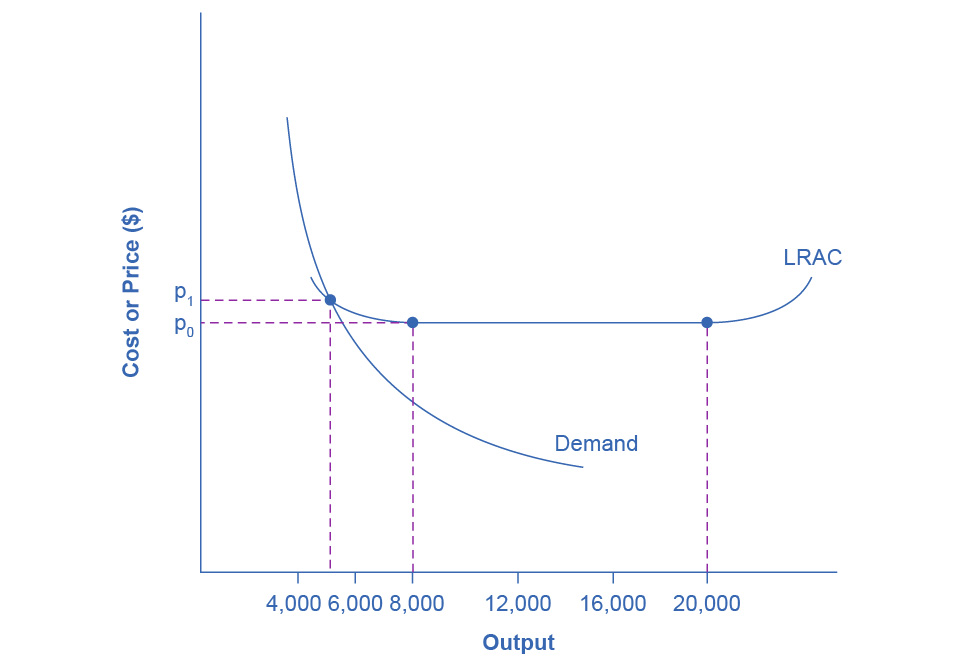

Figure 9.2図 9.2
In this market, the demand curve intersects the long-run average cost (LRAC) curve at its downward-sloping part. A natural monopoly occurs when the quantity demanded is less than the minimum quantity it takes to be at the bottom of the long-run average cost curve.
英語のヒント
この市場では、需要曲線は長期平均費用(LRAC)曲線の右下がり部分で交わる。需要量が、長期平均費用曲線の底に達するのに必要な最小量を下回ると、自然独占が生じる。
Economists call this situation, when economies of scale are large relative to the quantity demanded in the market, a natural monopoly. Natural monopolies often arise in industries where the marginal cost of adding an additional customer is very low, once the fixed costs of the overall system are in place. This results in situations where there are substantial economies of scale. For example, once a water company lays the main water pipes through a neighborhood, the marginal cost of providing water service to another home is fairly low. Once the electric company installs lines in a new subdivision, the marginal cost of providing additional electrical service to one more home is minimal. It would be costly and duplicative for a second water company to enter the market and invest in a whole second set of main water pipes, or for a second electricity company to enter the market and invest in a whole new set of electrical wires. These industries offer an example where, because of economies of scale, one producer can serve the entire market more efficiently than a number of smaller producers that would need to make duplicate physical capital investments.
英語のヒント
経済学者は、市場での需要量に比べて規模の経済が大きいこの状況を、自然独占と呼ぶ。自然独占は、仕組み全体の固定費用を負担した後で、顧客を1人追加する限界費用が非常に低い産業によく生じる。その結果、大きな規模の経済が存在する。たとえば、水道会社がある地区に幹線水道管を敷設すれば、もう1軒の住宅に給水する限界費用はかなり低い。電力会社が新しい分譲地に送電線を設置すれば、もう1軒の住宅に電力を供給する限界費用はごく小さい。2社目の水道会社が市場に参入して別の幹線水道管一式に投資したり、2社目の電力会社が参入して新たな送電線一式に投資したりするのは、費用がかかり重複を生む。これらの産業は、規模の経済のため、物的資本への重複投資が必要となる複数の小規模な生産者よりも、1社の生産者が市場全体に効率よく供給できる例を示している。
A natural monopoly can also arise in smaller local markets for products that are difficult to transport. For example, cement production exhibits economies of scale, and the quantity of cement demanded in a local area may not be much larger than what a single plant can produce. Moreover, the costs of transporting cement over land are high, and so a cement plant in an area without access to water transportation may be a natural monopoly.
英語のヒント
自然独占は、輸送が難しい製品の小規模な地域市場にも生じうる。たとえば、セメントの生産には規模の経済があり、地域で需要されるセメントの量は、単一工場が生産できる量を大きく上回らないことがある。さらに、陸上でセメントを輸送する費用は高いため、水運を利用できない地域のセメント工場は自然独占になりうる。