第24章ブラックホールと曲がった時空Black Holes and Curved Spacetime
24.7 Gravitational Wave Astronomy24.7 重力波天文学
Learning Objectives学習の目標
By the end of this section, you will be able to:
この節を終えると、次のことができるようになる。
Describe what a gravitational wave is, what can produce it, and how fast it propagates
重力波とは何か、何がそれを生み、どれほどの速さで伝わるかを説明する。
Understand the basic mechanisms used to detect gravitational waves
重力波を検出するために使われる基本的な仕組みを理解する。
Another part of Einstein’s ideas about gravity can be tested as a way of checking the theory that underlies black holes. According to general relativity, the geometry of spacetime depends on where matter is located. Any rearrangement of matter—say, two stars being pulled toward each other or two black holes colliding—creates a disturbance in spacetime. This disturbance is called a gravitational wave, and relativity predicts that it should spread outward at the speed of light. The big problem with trying to study such waves is that they are tremendously weaker than electromagnetic waves and correspondingly difficult to detect.
英語のヒント
ブラックホールの基礎となる理論を確かめるために、アインシュタインの重力についての考えの、別の部分も検証できる。一般相対性理論によれば、時空の幾何学は、物質がどこにあるかに依存する。二つの星が引き合ったり、二つのブラックホールが衝突したりするように、物質の配置が変わると、時空に乱れが生じる。この乱れを重力波という。相対性理論は、それが光速で外へ広がるはずだと予測する。この波を調べようとするときの大きな問題は、電磁波よりはるかに弱く、それに応じて検出も難しいことである。
Proof from a Pulsarパルサーから得られた証拠
We’ve had indirect evidence for some time that gravitational waves exist. In 1974, astronomers Joseph Taylor and Russell Hulse discovered a pulsar (with the designation PSR1913+16) orbiting another neutron star. Pulled by the powerful gravity of its companion, the pulsar is moving at a few hundred kilometers per second in its orbit.
英語のヒント
重力波が存在するという間接的な証拠は、以前から得られていた。1974年、天文学者ジョセフ・テイラーとラッセル・ハルスは、別の中性子星を周回するパルサー、PSR1913+16を発見した。伴星の強い重力に引かれ、このパルサーは軌道上を毎秒数百キロメートルほどで動いている。
According to general relativity, this system of stellar corpses should be radiating energy in the form of gravitational waves at a high enough rate to cause the pulsar and its companion to spiral closer together. If this is correct, then the orbital period should decrease (according to Kepler’s third law) by one ten-millionth of a second per orbit. Continuing observations showed that the period is decreasing by precisely this amount. Such a loss of energy in the system can be due only to the radiation of gravitational waves, thus confirming their existence. Taylor and Hulse shared the 1993 Nobel Prize in physics for this work.
英語のヒント
一般相対性理論によれば、この恒星の亡骸どうしの系は、重力波の形でエネルギーを放射するはずである。その放射率は、パルサーと伴星がらせんを描きながら互いに近づくほど大きいはずである。これが正しければ、ケプラーの第3法則に従い、公転周期は1周ごとに1000万分の1秒ずつ短くなるはずだ。観測を続けると、周期はまさにこの量だけ減っていた。このような系のエネルギー損失は、重力波の放射によってしか説明できず、重力波の存在が確かめられた。テイラーとハルスは、この研究により1993年のノーベル物理学賞を共同受賞した。
Direct Observations: The First直接観測――最初の検出
Although such an indirect proof convinced physicists that gravitational waves exist, it is even more satisfying to detect the waves directly. What we need are phenomena that are powerful enough to produce gravitational waves with amplitudes large enough that we can measure them. Theoretical calculations suggest some of the most likely events that would give a burst of gravitational waves strong enough that our equipment on Earth could measure it:
英語のヒント
このような間接的な証拠によって、物理学者は重力波の存在を確信した。それでも、波を直接検出できれば、さらに満足のいくものになる。必要なのは、測定できるほど大きな振幅の重力波を生む、強力な現象である。理論計算によれば、地上の装置で測れるほど強い重力波の突発的な放出を起こしうる有力な現象には、次のようなものがある。
the coalescence of two neutron stars in a binary system that spiral together until they merge
連星系の二つの中性子星が、らせんを描いて近づき、最後に合体すること。
the swallowing of a neutron star by a black hole
ブラックホールが中性子星を飲み込むこと。
the coalescence (merger) of two black holes
二つのブラックホールの合体。
the implosion of a really massive star to form a neutron star or a black hole
非常に大質量の恒星が内向きに崩壊し、中性子星やブラックホールをつくること。
the first “shudder” when space and time came into existence and the universe began
空間と時間が生まれ、宇宙が始まったときの、最初の「震え」。
For the last five decades, scientists have been developing an audacious experiment to try to detect gravitational waves from a source on this list. The US experiment, which was built with collaborators from the UK, Germany, Australia and other countries, is named LIGO (Laser Interferometer Gravitational-Wave Observatory). LIGO currently has two observing stations, one in Louisiana and the other in the state of Washington. The effects of gravitational waves are so small that confirmation of their detection will require simultaneous measurements by two widely separated facilities. Local events that might cause small motions within the observing stations and mimic gravitational waves—such as small earthquakes, ocean tides, and even traffic—should affect the two sites differently.
英語のヒント
過去50年にわたり、科学者たちは、この一覧にある発生源からの重力波を検出しようと、大胆な実験を開発してきた。イギリス、ドイツ、オーストラリアなどの国々の協力者とともに建設されたアメリカの実験施設は、LIGO、レーザー干渉計重力波観測所と名づけられた。現在、LIGOには二つの観測施設があり、一つはルイジアナ州、もう一つはワシントン州にある。重力波の効果は非常に小さいため、検出を確かめるには、遠く離れた二つの施設で同時に測定する必要がある。小さな地震、海の潮汐、さらには交通など、その場で観測施設をわずかに動かし、重力波に似た信号を生む出来事は、二つの場所に異なる影響を及ぼすはずだからである。
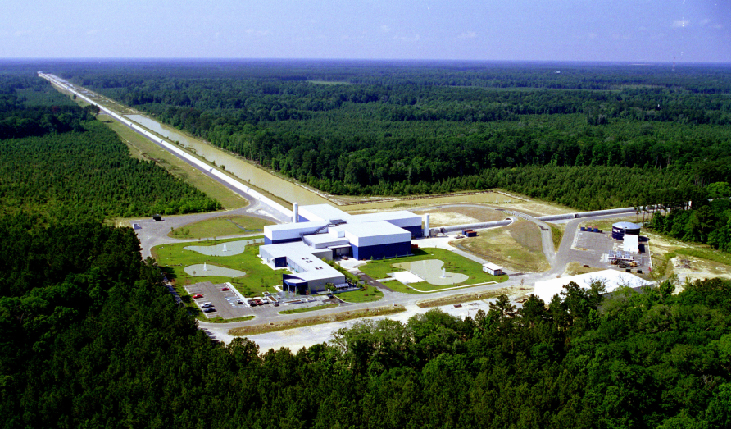
Each of the LIGO stations consists of two 4-kilometer-long, 1.2-meter-diameter vacuum pipes arranged in an L-shape. A test mass with a mirror on it is suspended by wire at each of the four ends of the pipes. Ultra-stable laser light is reflected from the mirrors and travels back and forth along the vacuum pipes (Figure 24.17). If gravitational waves pass through the LIGO instrument, then, according to Einstein’s theory, the waves will affect local spacetime—they will alternately stretch and shrink the distance the laser light must travel between the mirrors ever so slightly. When one arm of the instrument gets longer, the other will get shorter, and vice versa.
英語のヒント
LIGOの各施設は、長さ4キロメートル、直径1.2メートルの真空パイプ2本を、L字形に配置したものである。パイプの四つの端には、それぞれ、鏡を取りつけた試験質量がワイヤーでつるされている。きわめて安定したレーザー光が鏡で反射し、真空パイプ内を往復する(図24.17)。アインシュタインの理論によれば、重力波がLIGOを通過すると、局所的な時空に影響を与える。鏡と鏡の間をレーザー光が進む距離を、交互に、ごくわずかに伸ばしたり縮めたりするのである。装置の一方の腕が長くなると、もう一方は短くなる。逆の場合も同じである。
Gravitational Wave Telescope.重力波望遠鏡
credit: modification of work by Caltech/MIT/LIGO Laboratory · LIGO image use policy
Figure 24.17 An aerial view of the LIGO facility at Livingston, Louisiana. Extending to the upper left and far right of the image are the 4-kilometer-long detectors. (credit: modification of work by Caltech/MIT/LIGO Laboratory)
図24.17 ルイジアナ州リビングストンにあるLIGO施設の航空写真。画像の左上と右端へ延びているのは、長さ4キロメートルの検出器である。(Caltech/MIT/LIGO Laboratoryの作品を改変。)
The challenge of this experiment lies in that phrase “ever so slightly.” In fact, to detect a gravitational wave, the change in the distance to the mirror must be measured with an accuracy of one ten-thousandth the diameter of a proton. In 1972, Rainer Weiss of MIT wrote a paper suggesting how this seemingly impossible task might be accomplished.
英語のヒント
この実験の難しさは、「ごくわずかに」という言葉にある。実際、重力波を検出するには、鏡までの距離の変化を、陽子の直径の1万分の1という精度で測らなければならない。1972年、MITのレイナー・ワイスは、一見不可能なこの課題をどう実現するかを提案する論文を書いた。
A great deal of new technology had to be developed, and work on the laboratory, with funding from the National Science Foundation, began in 1979. A full-scale prototype to demonstrate the technology was built and operated from 2002 to 2010, but the prototype was not expected to have the sensitivity required to actually detect gravitational waves from an astronomical source. Advanced LIGO, built to be more precise with the improved technology developed in the prototype, went into operation in 2015—and almost immediately detected gravitational waves.
英語のヒント
多くの新技術を開発する必要があり、全米科学財団の資金を受けた研究所での仕事は1979年に始まった。技術を実証するための実物大の試作施設が建設され、2002年から2010年まで運転された。しかし、この試作施設には、天体からの重力波を実際に検出するための感度は期待されていなかった。試作施設で開発された改良技術を用い、より精密な測定ができるよう建設されたAdvanced LIGOは、2015年に稼働を始めると、ほとんど直ちに重力波を検出した。
What LIGO found was gravitational waves produced in the final fraction of a second of the merger of two black holes (Figure 24.18). The black holes had masses of 29 and 36 times the mass of the Sun, and the merger took place 1.3 billion years ago—the gravitational waves occurred so far away that it has taken that long for them, traveling at the speed of light, to reach us.
英語のヒント
LIGOが見つけたのは、二つのブラックホールが合体する、最後の1秒にも満たない時間に生じた重力波だった(図24.18)。それぞれの質量は太陽の29倍と36倍で、合体は13億年前に起きた。重力波が生じた場所はそれほど遠く、光速で進んできても、私たちに届くまでにこれだけの時間がかかったのである。
In the cataclysm of the merger, about three times the mass of the Sun was converted to energy (recall E = mc2). During the tiny fraction of a second for the merger to take place, this event produced power about 10 times the power produced by all the stars in the entire visible universe—but the power was all in the form of gravitational waves and hence was invisible to our instruments, except to LIGO. The event was recorded in Louisiana about 7 milliseconds before the detection in Washington—just the right distance given the speed at which gravitational waves travel—and indicates that the source was located somewhere in the southern hemisphere sky. Unfortunately, the merger of two black holes is not expected to produce any light, so this is the only observation we have of the event.
英語のヒント
この激烈な合体で、太陽の約3倍の質量がエネルギーへ変わった。E = mc2を思い出そう。合体が起こる、1秒にも満たないわずかな時間、この出来事は、観測可能な宇宙全体のすべての星が出す出力の約10倍を生み出した。しかし、その出力はすべて重力波の形だったため、LIGO以外の装置には見えなかった。信号は、ワシントン州で検出される約7ミリ秒前に、ルイジアナ州で記録された。この時間差は、重力波の伝わる速さと両施設の距離から見て適切であり、発生源が天球の南半球のどこかにあったことを示す。残念ながら、二つのブラックホールの合体では光は出ないと予想されるため、この出来事について得られた観測は、これだけである。
Signal Produced by a Gravitational Wave.重力波が生んだ信号
Figure 24.18 (a) The top panel shows the signal measured at Hanford, Washington; the middle panel shows the signal measured at Livingston, Louisiana. The smoother thin curve in each panel shows the predicted signal, based on Einstein’s general theory of relativity, produced by the merger of two black holes. The bottom panel shows a superposition of the waves detected at the two LIGO observatories. Note the remarkable agreement of the two independent observations and of the observations with theory. (b) The painting shows an artist’s impression of two massive black holes spiraling inward toward an eventual merger. (credit a, b: modification of work by SXS)
図24.18 (a)上段はワシントン州ハンフォード、中段はルイジアナ州リビングストンで測定された信号を示す。それぞれの滑らかな細い曲線は、アインシュタインの一般相対性理論に基づき、二つのブラックホールの合体が生むと予測される信号である。下段は、二つのLIGO観測所で検出された波を重ねたもの。独立した二つの観測どうし、そして観測と理論の、見事な一致に注目しよう。(b)二つの大質量ブラックホールが、最後の合体へ向けて内向きにらせんを描く様子を示す想像図。(a、b:SXSの作品を改変。)
This detection by LIGO (and another one of a different black hole merger a few months later) opened a whole new window on the universe. One of the experimenters compared the beginning of gravitational wave astronomy to the era when silent films were replaced by movies with sound (comparing the vibration of spacetime during the passing of a gravitational wave to the vibrations that sound makes).
英語のヒント
LIGOによるこの検出と、その数か月後に行われた別のブラックホール合体の検出は、宇宙にまったく新しい窓を開いた。実験者の一人は、重力波天文学の始まりを、無声映画が音声つきの映画へ変わった時代にたとえた。重力波の通過による時空の振動を、音を生む振動になぞらえたのである。