第24章ブラックホールと曲がった時空Black Holes and Curved Spacetime
24.2 Spacetime and Gravity24.2 時空と重力
Learning Objectives学習の目標
By the end of this section, you will be able to:
この節を終えると、次のことができるようになる。
Describe Einstein’s view of gravity as the warping of spacetime in the presence of massive objects
質量のある物体の存在によって時空がゆがむことを重力と捉える、アインシュタインの見方を説明する。
Understand that Newton’s concept of the gravitational force between two massive objects and Einstein’s concept of warped spacetime are different explanations for the same observed accelerations of one massive object in the presence of another massive object
二つの質量のある物体の間に重力が働くというニュートンの考えと、時空がゆがむというアインシュタインの考えは、一方の物体の存在によってもう一方の物体に生じる同じ加速度を、異なる形で説明していることを理解する。
Is light actually bent from its straight-line path by the mass of Earth? How can light, which has no mass, be affected by gravity? Einstein preferred to think that it is space and time that are affected by the presence of a large mass; light beams, and everything else that travels through space and time, then find their paths affected. Light always follows the shortest path—but that path may not always be straight. This idea is true for human travel on the curved surface of planet Earth, as well. Say you want to fly from Chicago to Rome. Since an airplane can’t go through the solid body of the Earth, the shortest distance is not a straight line but the arc of a great circle.
英語のヒント
光は本当に、地球の質量によって直線の経路から曲げられるのだろうか。質量のない光が、どうして重力の影響を受けるのだろうか。アインシュタインが選んだのは、大きな質量の存在によって影響を受けるのは空間と時間であり、その結果、光のビームや空間と時間を通って進むあらゆるものの経路が影響を受ける、という考え方だった。光はつねに最短の経路を進むが、その経路がつねに直線とは限らない。地球の曲がった表面を人間が移動するときにも、同じことがいえる。シカゴからローマまで飛行機で行きたいとしよう。飛行機は地球の固体の内部を通り抜けられないため、最短の道筋は直線ではなく、大円の弧になる。
Linkages: Mass, Space, and Time質量・空間・時間の結びつき
To show what Einstein’s insight really means, let’s first consider how we locate an event in space and time. For example, imagine you have to describe to worried school officials the fire that broke out in your room when your roommate tried cooking shish kebabs in the fireplace. You explain that your dorm is at 6400 College Avenue, a street that runs in the left-right direction on a map of your town; you are on the fifth floor, which tells where you are in the up-down direction; and you are the sixth room back from the elevator, which tells where you are in the forward-backward direction. Then you explain that the fire broke out at 6:23 p.m. (but was soon brought under control), which specifies the event in time. Any event in the universe, whether nearby or far away, can be pinpointed using the three dimensions of space and the one dimension of time.
英語のヒント
アインシュタインの洞察が実際に何を意味するのかを示すために、まず、ある出来事の空間と時間における位置を、どのように指定するかを考えよう。たとえば、ルームメイトが暖炉でシシケバブを焼こうとして部屋で火事を起こし、心配する学校の職員にその火事を説明しなければならないと想像してほしい。学生寮の住所はカレッジ・アベニュー6400番地で、この通りは町の地図上で左右方向に延びている、と説明する。部屋は5階なので、上下方向の位置もわかる。さらに、エレベーターから奥へ数えて6番目の部屋なので、前後方向の位置もわかる。次に、火事は午後6時23分に発生したが、すぐに消し止められた、と説明すれば、出来事を時間の上でも指定できる。宇宙のどんな出来事も、近くであれ遠くであれ、空間の三つの次元と時間の一つの次元を使って、その位置と時刻を特定できる。
Newton considered space and time to be completely independent, and that continued to be the accepted view until the beginning of the twentieth century. But Einstein showed that there is an intimate connection between space and time, and that only by considering the two together—in what we call spacetime—can we build up a correct picture of the physical world. We examine spacetime a bit more closely in the next subsection.
英語のヒント
ニュートンは空間と時間を完全に独立したものと考え、20世紀初頭まで、それが一般に受け入れられた見方だった。しかし、アインシュタインは、空間と時間が密接に結びついていることを示した。物理的な世界を正しく描くには、両者を時空と呼ばれる一体のものとして考えなければならないのである。次の小節で、時空をもう少し詳しく調べよう。
The gist of Einstein’s general theory is that the presence of matter curves or warps the fabric of spacetime. This curving of spacetime is identified with gravity. When something else—a beam of light, an electron, or the starship Enterprise—enters such a region of distorted spacetime, its path will be different from what it would have been in the absence of the matter. As American physicist John Wheeler summarized it: “Matter tells spacetime how to curve; spacetime tells matter how to move.”
英語のヒント
アインシュタインの一般相対性理論の核心は、物質の存在が時空の構造を曲げ、ゆがめるということである。この時空の曲がりが重力にほかならない。光のビーム、電子、宇宙船エンタープライズなど、何か別のものがこのようにゆがんだ時空の領域へ入ると、その経路は、物質が存在しなかった場合の経路とは異なる。アメリカの物理学者ジョン・ホイーラーは、こう要約している。「物質は時空にどう曲がるかを教え、時空は物質にどう動くかを教える。」
The amount of distortion in spacetime depends on the mass of material that is involved and on how concentrated and compact it is. Terrestrial objects, such as the book you are reading, have far too little mass to introduce any significant distortion. Newton’s view of gravity is just fine for building bridges, skyscrapers, or amusement park rides. General relativity does, however, have some practical applications. The GPS (Global Positioning System) in every smartphone can tell you where you are within 5 to 10 meters only because the effects of general and special relativity on the GPS satellites in orbit around the Earth are taken into account.
英語のヒント
時空のゆがみの大きさは、関係する物質の質量と、それがどれほど集中して小さくまとまっているかによって決まる。いま読んでいる本のような地上の物体は、有意なゆがみを生じさせるには質量があまりにも小さい。橋や高層ビル、遊園地の乗り物をつくるなら、ニュートンの重力観で十分に間に合う。それでも、一般相対性理論には実用的な用途がある。スマートフォンに搭載されているGPS(全地球測位システム)が、現在地を5〜10メートルの範囲で示せるのは、地球周回軌道上のGPS衛星に対する一般相対性理論と特殊相対性理論の効果が考慮されているからこそである。
Unlike a book or your roommate, stars produce measurable distortions in spacetime. A white dwarf, with its stronger surface gravity, produces more distortion just above its surface than does a red giant with the same mass. So, you see, we are eventually going to talk about collapsing stars again, but not before discussing Einstein’s ideas (and the evidence for them) in more detail.
英語のヒント
本やルームメイトと違って、恒星は測定可能な時空のゆがみを生じさせる。表面重力の強い白色矮星は、同じ質量の赤色巨星よりも、その表面のすぐ上に大きなゆがみをつくる。というわけで、やがてまた、崩壊する恒星の話に戻る。しかし、その前に、アインシュタインの考えと、それを裏づける証拠について、もう少し詳しく話しておこう。
Spacetime Examples時空を具体例で考える
How can we understand the distortion of spacetime by the presence of some (significant) amount of mass? Let’s try the following analogy. You may have seen maps of New York City that squeeze the full three dimensions of this towering metropolis onto a flat sheet of paper and still have enough information so tourists will not get lost. Let’s do something similar with diagrams of spacetime.
英語のヒント
無視できない量の質量が存在すると時空がゆがむということを、どう理解すればよいだろうか。次のたとえを試してみよう。ニューヨークの地図を見たことがあるかもしれない。高い建物が立ち並ぶこの大都市の三次元を、平らな1枚の紙に押し込んでいる。それでも、観光客が道に迷わないだけの情報は載っている。時空の図でも、同じようなことをしてみよう。
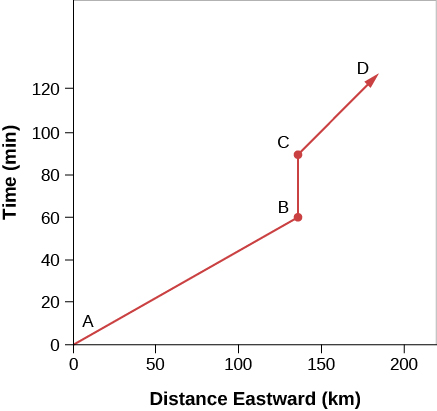
Figure 24.7, for example, shows the progress of a motorist driving east on a stretch of road in Kansas where the countryside is absolutely flat. Since our motorist is traveling only in the east-west direction and the terrain is flat, we can ignore the other two dimensions of space. The amount of time elapsed since he left home is shown on the y-axis, and the distance traveled eastward is shown on the x-axis. From A to B he drove at a uniform speed; unfortunately, it was too fast a uniform speed and a police car spotted him. From B to C he stopped to receive his ticket and made no progress through space, only through time. From C to D he drove more slowly because the police car was behind him.
英語のヒント
たとえば図24.7は、地形がまったく平らなカンザス州の道路を、東へ走る運転手の進み方を示している。この運転手は東西方向にだけ進み、地形も平坦なので、空間のほかの二つの次元は無視できる。家を出てからの経過時間をy軸に、東向きに進んだ距離をx軸に示す。AからBまでは、一定の速さで走った。残念ながら、その一定の速さは速すぎたため、パトカーに見つかってしまった。BからCまでは、交通違反切符を受け取るために停止している。この間、空間の中では進まず、時間の中だけを進んだ。CからDまでは、パトカーが後ろにいるため、もっとゆっくり走った。
Spacetime Diagram.時空図
OpenStax / Rice University · CC BY 4.0
Figure 24.7 This diagram shows the progress of a motorist traveling east across the flat Kansas landscape. Distance traveled is plotted along the horizontal axis. The time elapsed since the motorist left the starting point is plotted along the vertical axis.
図24.7 この図は、平坦なカンザスの風景の中を、東へ車で進む運転手の動きを示す。移動距離を横軸に、出発点を離れてからの経過時間を縦軸にとっている。
Now let’s try illustrating the distortions of spacetime in two dimensions. In this case, we will (in our imaginations) use a rubber sheet that can stretch or warp if we put objects on it.
英語のヒント
次に、時空のゆがみを二次元で描いてみよう。ここでは想像の中で、物を載せると伸びたりゆがんだりするゴム膜を使う。
Let’s imagine stretching our rubber sheet taut on four posts. To complete the analogy, we need something that normally travels in a straight line (as light does). Suppose we have an extremely intelligent ant—a friend of the comic book superhero Ant-Man, perhaps—that has been trained to walk in a straight line.
英語のヒント
4本の支柱の間にゴム膜をぴんと張ると想像しよう。このたとえを完成させるには、光のように、普通は直線を進む何かが必要である。そこで、直線を歩くように訓練された、とびきり賢いアリを用意しよう。漫画のスーパーヒーロー、アントマンの友達かもしれない。
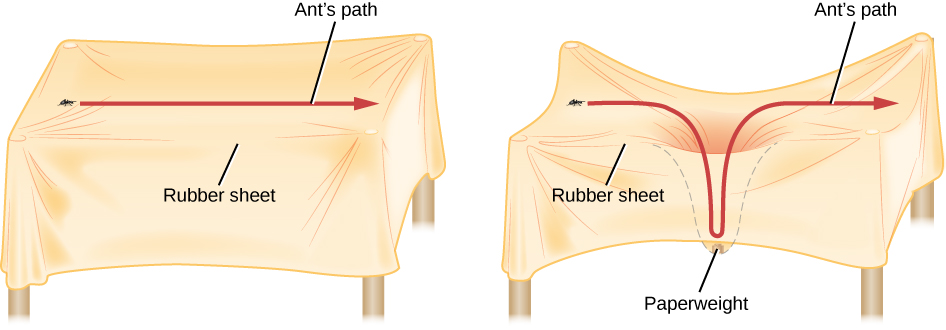
We begin with just the rubber sheet and the ant, simulating empty space with no mass in it. We put the ant on one side of the sheet and it walks in a beautiful straight line over to the other side (Figure 24.8). We next put a small grain of sand on the rubber sheet. The sand does distort the sheet a tiny bit, but this is not a distortion that we or the ant can measure. If we send the ant so it goes close to, but not on top of, the sand grain, it has little trouble continuing to walk in a straight line.
英語のヒント
最初は、ゴム膜とアリだけを用意する。これは、質量がまったく存在しない空の宇宙空間を模したものである。膜の片側にアリを置くと、アリはきれいな直線を描いて反対側まで歩く(図24.8)。次に、小さな砂粒を一つゴム膜に載せる。砂は確かに膜をほんの少しゆがめるが、そのゆがみは、私たちにもアリにも測定できない。アリが砂粒の上には乗らず、すぐ近くを通るように進ませても、ほとんど問題なく直線を歩き続けられる。
Now we grab something with a little more mass—say, a small pebble. It bends or distorts the sheet just a bit around its position. If we send the ant into this region, it finds its path slightly altered by the distortion of the sheet. The distortion is not large, but if we follow the ant’s path carefully, we notice it deviating slightly from a straight line.
英語のヒント
今度は、もう少し質量のある物、たとえば小石を手に取る。それを載せると、膜はその場所の周りで少し曲がり、ゆがむ。この領域へアリを進ませれば、膜のゆがみによって、アリの進路はわずかに変わる。ゆがみは大きくないが、アリの道筋を注意深く追えば、直線から少しずれていることに気づく。
The effect gets more noticeable as we increase the mass of the object that we put on the sheet. Let’s say we now use a massive paperweight. Such a heavy object distorts or warps the rubber sheet very effectively, putting a good sag in it. From our point of view, we can see that the sheet near the paperweight is no longer straight.
英語のヒント
膜に載せる物体の質量を増やすにつれて、この効果は目立つようになる。今度は、ずっしりとした文鎮を使おう。このような重い物体は、ゴム膜を大きくゆがめ、深いたわみをつくる。私たちから見ると、文鎮の近くの膜は、もはやまっすぐではない。
Three-Dimensional Analogy for Spacetime.時空を三次元のたとえで表す
OpenStax / Rice University · CC BY 4.0
Figure 24.8 On a flat rubber sheet, a trained ant has no trouble walking in a straight line. When a massive object creates a big depression in the sheet, the ant, which must walk where the sheet takes it, finds its path changed (warped) dramatically.
図24.8 平らなゴム膜の上では、訓練されたアリは苦もなく直線を歩ける。質量の大きな物体によって膜に深いくぼみができると、膜に沿って歩かざるを得ないアリの経路は、大きく変えられ、曲がる。
Now let’s again send the ant on a journey that takes it close to, but not on top of, the paperweight. Far away from the paperweight, the ant has no trouble doing its walk, which looks straight to us. As it nears the paperweight, however, the ant is forced down into the sag. It must then climb up the other side before it can return to walking on an undistorted part of the sheet. All this while, the ant is following the shortest path it can, but through no fault of its own (after all, ants can’t fly, so it has to stay on the sheet) this path is curved by the distortion of the sheet itself.
英語のヒント
もう一度、アリを歩かせよう。文鎮の上には乗らず、そのすぐ近くを通る経路を進ませる。文鎮から遠いところでは、アリは何の支障もなく歩き、その道筋は私たちには直線に見える。しかし、文鎮に近づくと、アリはくぼみへ下りていかざるを得ない。膜のゆがんでいない部分を再び歩くには、くぼみの反対側を上らなければならない。この間ずっと、アリは進める範囲で最短の経路をたどっている。それでも、アリ自身には何の落ち度もないのに、膜そのもののゆがみによって、その経路は曲げられてしまう。なにしろアリは飛べないので、膜の上にとどまらなければならないのである。
In the same way, according to Einstein’s theory, light always follows the shortest path through spacetime. But the mass associated with large concentrations of matter distorts spacetime, and the shortest, most direct paths are no longer straight lines, but curves.
英語のヒント
同じように、アインシュタインの理論によれば、光はつねに時空の中の最短の経路を進む。しかし、物質が大量に集中したところでは、その質量が時空をゆがめる。そのため、最も短く直接的な経路は、もはや直線ではなく曲線になる。
How large does a mass have to be before we can measure a change in the path followed by light? In 1916, when Einstein first proposed his theory, no distortion had been detected at the surface of Earth (so Earth might have played the role of the grain of sand in our analogy). Something with a mass like our Sun’s was necessary to detect the effect Einstein was describing (we will discuss how this effect was measured using the Sun in the next section).
英語のヒント
光がたどる経路の変化を測定できるようになるには、質量はどれほど大きくなければならないのだろうか。アインシュタインが初めて理論を提案した1916年には、地表でそのようなゆがみは検出されていなかった。したがって、私たちのたとえでは、地球は砂粒に相当するものだったかもしれない。アインシュタインが述べた効果を検出するには、太陽ほどの質量を持つ天体が必要だった。次の節で、太陽を利用してこの効果がどのように測定されたかを扱う。
The paperweight in our analogy might be a white dwarf or a neutron star. The distortion of spacetime is greater near the surfaces of these compact, massive objects than near the surface of the Sun. And when, to return to the situation described at the beginning of the chapter, a star core with more than three times the mass of the Sun collapses forever, the distortions of spacetime very close to it can become truly mind-boggling.
英語のヒント
このたとえで文鎮に相当するのは、白色矮星や中性子星だろう。これらの小さくまとまった大質量の天体の表面付近では、太陽の表面付近よりも時空のゆがみが大きい。そして、章の冒頭で述べた状況に戻れば、太陽の3倍を超える質量を持つ恒星の中心核が際限なく崩壊すると、そのすぐ近くの時空のゆがみは、想像を絶するほどになる可能性がある。