第24章ブラックホールと曲がった時空Black Holes and Curved Spacetime
24.5 Black Holes24.5 ブラックホール
Learning Objectives学習の目標
By the end of this section, you will be able to:
この節を終えると、次のことができるようになる。
Explain the event horizon surrounding a black hole
ブラックホールを取り巻く事象の地平面を説明する。
Discuss why the popular notion of black holes as great sucking monsters that can ingest material at great distances from them is erroneous
ブラックホールは遠くの物質まで吸い込む巨大な怪物だ、という一般的なイメージが誤っている理由を説明する。
Use the concept of warped spacetime near a black hole to track what happens to any object that might fall into a black hole
ブラックホールの近くで時空がゆがむという考えを使い、そこへ落ち込む物体に何が起きるかをたどる。
Recognize why the concept of a singularity—with its infinite density and zero volume—presents major challenges to our understanding of matter
密度が無限大で体積がゼロという特異点の概念が、物質の理解に大きな難題を突きつける理由を理解する。
Let’s now apply what we have learned about gravity and spacetime curvature to the issue we started with: the collapsing core in a very massive star. We saw that if the core’s mass is greater than about 3 MSun, theory says that nothing can stop the core from collapsing forever. We will examine this situation from two perspectives: first from a pre-Einstein point of view, and then with the aid of general relativity.
英語のヒント
重力と時空の曲がりについて学んだことを、出発点だった問題、すなわち非常に大質量の恒星で崩壊する中心核に適用しよう。中心核の質量が約3 MSunを超えるなら、その中心核が際限なく崩壊するのを止めるものはない、と理論が述べることを見た。この状況を、まずアインシュタイン以前の見方から、次に一般相対性理論の助けを借りて、二つの視点で調べる。
Classical Collapse古典的な見方で考える崩壊
Let’s begin with a thought experiment. We want to know what speeds are required to escape from the gravitational pull of different objects. A rocket must be launched from the surface of Earth at a very high speed if it is to escape the pull of Earth’s gravity. In fact, any object—rocket, ball, astronomy book—that is thrown into the air with a velocity less than 11 kilometers per second will soon fall back to Earth’s surface. Only those objects launched with a speed greater than this escape velocity can get away from Earth.
英語のヒント
思考実験から始めよう。さまざまな物体の重力から逃れるには、どれほどの速さが必要なのかを知りたい。地球の重力を振り切るには、ロケットを地表から非常に速い速度で打ち上げなければならない。実際、ロケット、ボール、天文学の本など、どんな物体でも、秒速11キロメートル未満で空へ投げ上げれば、まもなく地表へ戻ってくる。この脱出速度を超える速さで放たれた物体だけが、地球から離れていける。
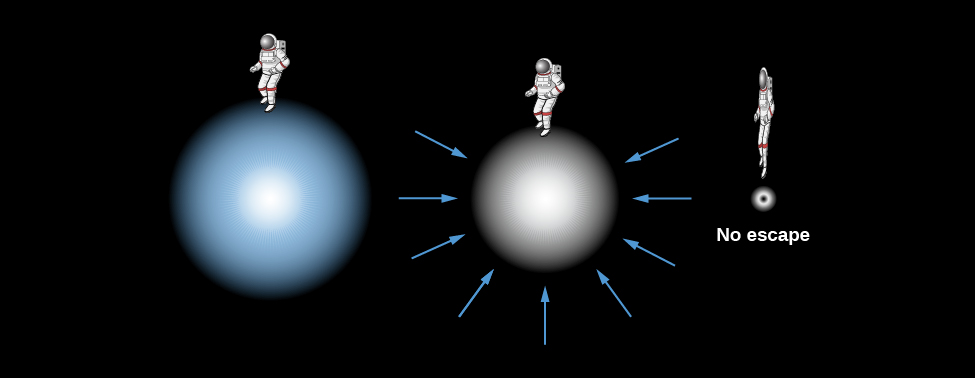
The escape velocity from the surface of the Sun is higher yet—618 kilometers per second. Now imagine that we begin to compress the Sun, forcing it to shrink in diameter. Recall that the pull of gravity depends on both the mass that is pulling you and your distance from the center of gravity of that mass. If the Sun is compressed, its mass will remain the same, but the distance between a point on the Sun’s surface and the center will get smaller and smaller. Thus, as we compress the star, the pull of gravity for an object on the shrinking surface will get stronger and stronger (Figure 24.12).
英語のヒント
太陽表面からの脱出速度はさらに大きく、秒速618キロメートルである。ここで、太陽を圧縮し、直径を縮めていくと想像しよう。重力による引きつけは、引きつける物体の質量と、その質量の重心からの距離の両方で決まることを思い出そう。太陽を圧縮しても質量は変わらないが、表面のある点から中心までの距離は、どんどん小さくなる。したがって、太陽を圧縮するにつれて、縮んでいく表面上の物体に働く重力は、ますます強くなる(図24.12)。
Formation of a Black Hole.ブラックホールの形成
OpenStax / Rice University · CC BY 4.0
Figure 24.12 At left, an imaginary astronaut floats near the surface of a massive star-core about to collapse. As the same mass falls into a smaller sphere, the gravity at its surface goes up, making it harder for anything to escape from the stellar surface. Eventually the mass collapses into so small a sphere that the escape velocity exceeds the speed of light and nothing can get away. Note that the size of the astronaut has been exaggerated. In the last picture, the astronaut is just outside the sphere we will call the event horizon and is stretched and squeezed by the strong gravity.
図24.12 左では、崩壊しようとしている大質量の恒星中心核の表面付近に、想像上の宇宙飛行士が浮かんでいる。同じ質量がより小さな球へ落ち込むにつれて、表面の重力は強まり、そこから脱出するのが難しくなる。やがて質量は非常に小さな球へ崩壊し、脱出速度が光速を超え、何も逃げられなくなる。宇宙飛行士の大きさは誇張してある。最後の図では、宇宙飛行士は、これから事象の地平面と呼ぶ球面のすぐ外側にいて、強い重力によって引き伸ばされ、押し縮められている。
When the shrinking Sun reaches the diameter of a neutron star (about 20 kilometers), the velocity required to escape its gravitational pull will be about half the speed of light. Suppose we continue to compress the Sun to a smaller and smaller diameter. (We saw this can’t happen to a star like our Sun in the real world because of electron degeneracy, i.e., the mutual repulsion between tightly packed electrons; this is just a quick “thought experiment” to get our bearings).
英語のヒント
縮む太陽の直径が、中性子星と同じ約20キロメートルになると、その重力から逃れるのに必要な速度は、光速の約半分になる。そこからさらに太陽を圧縮し、直径をもっと小さくしていこう。現実には、太陽のような恒星でこれは起こらない。前に見たように、電子縮退、すなわち密集した電子どうしの反発があるためである。ここでは、状況をつかむための簡単な「思考実験」をしているだけである。
Ultimately, as the Sun shrinks, the escape velocity near the surface would exceed the speed of light. If the speed you need to get away is faster than the fastest possible speed in the universe, then nothing, not even light, is able to escape. An object with such large escape velocity emits no light, and anything that falls into it can never return.
英語のヒント
最終的に、太陽が縮むにつれて、表面付近の脱出速度は光速を超えることになる。逃れるのに必要な速さが、宇宙で可能な最も速い速度よりも大きいなら、光さえも含め、何一つ逃げられない。このように大きな脱出速度を持つ天体は光を出さず、そこへ落ち込んだものは何であれ、二度と戻れない。
In modern terminology, we call an object from which light cannot escape a black hole, a name popularized by the America scientist John Wheeler starting in the late 1960s (Figure 24.13). The idea that such objects might exist is, however, not a new one. Cambridge professor and amateur astronomer John Michell wrote a paper in 1783 about the possibility that stars with escape velocities exceeding that of light might exist. And in 1796, the French mathematician Pierre-Simon, marquis de Laplace, made similar calculations using Newton’s theory of gravity; he called the resulting objects “dark bodies.”
英語のヒント
現代の用語では、光が逃げ出せない天体をブラックホールという。この呼び名は、アメリカの科学者ジョン・ホイーラーが1960年代後半から広めたものである(図24.13)。しかし、このような天体が存在するかもしれないという考え自体は、新しくない。ケンブリッジ大学の教授でアマチュア天文学者でもあったジョン・ミッチェルは1783年、脱出速度が光速を超える恒星が存在する可能性について論文を書いた。1796年には、フランスの数学者ピエール=シモン・ラプラス侯爵が、ニュートンの重力理論で同様の計算を行い、得られた天体を「暗黒の天体」と呼んだ。
John Wheeler (1911–2008).ジョン・ホイーラー(1911〜2008年)
Figure 24.13 This brilliant physicist did much pioneering work in general relativity theory and popularized the term black hole starting in the late 1960s. (credit: modification of work by Roy Bishop)
図24.13 この優れた物理学者は、一般相対性理論で多くの先駆的な研究を行い、1960年代後半からブラックホールという用語を広めた。(ロイ・ビショップの作品を改変。)
While these early calculations provided strong hints that something strange should be expected if very massive objects collapse under their own gravity, we really need general relativity theory to give an adequate description of what happens in such a situation.
英語のヒント
これらの初期の計算は、非常に質量の大きな天体が自重で崩壊すれば、何か奇妙なことが起きるはずだという強い手がかりを与えた。それでも、そのような状況で何が起きるかを十分に記述するには、やはり一般相対性理論が必要である。
Collapse with Relativity相対性理論で考える崩壊
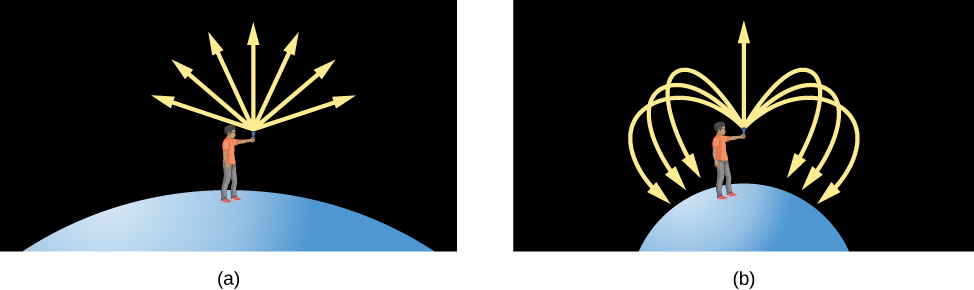
General relativity tells us that gravity is really a curvature of spacetime. As gravity increases (as in the collapsing Sun of our thought experiment), the curvature gets larger and larger. Eventually, if the Sun could shrink down to a diameter of about 6 kilometers, only light beams sent out perpendicular to the surface would escape. All others would fall back onto the star (Figure 24.14). If the Sun could then shrink just a little more, even that one remaining light beam would no longer be able to escape.
英語のヒント
一般相対性理論によれば、重力とは実際には時空の曲がりである。思考実験で崩壊する太陽のように、重力が強くなると、曲がりもますます大きくなる。やがて太陽が直径約6キロメートルまで縮めば、表面に垂直に放たれた光のビームだけが逃げられることになる。それ以外の光はすべて、星へ戻ってしまう(図24.14)。そこからさらに少しでも縮めば、最後に残っていたその光のビームさえも、もはや逃れられなくなる。
Light Paths near a Massive Object.質量の大きな天体の近くでの光の経路
OpenStax / Rice University · CC BY 4.0
Figure 24.14 Suppose a person could stand on the surface of a normal star with a flashlight. The light leaving the flashlight travels in a straight line no matter where the flashlight is pointed. Now consider what happens if the star collapses so that it is just a little larger than a black hole. All the light paths, except the one straight up, curve back to the surface. When the star shrinks inside the event horizon and becomes a black hole, even a beam directed straight up returns.
図24.14 普通の恒星の表面に、懐中電灯を持って立てるとしよう。どの方向へ懐中電灯を向けても、その光は直線を進む。次に、恒星が崩壊し、ブラックホールになる寸前の大きさまで縮んだらどうなるかを考えよう。真上へ向かう光以外は、すべての経路が表面へ戻るように曲がる。星が事象の地平面の内側へ縮んでブラックホールになると、真上へ向けたビームさえ戻ってしまう。
Keep in mind that gravity is not pulling on the light. The concentration of matter has curved spacetime, and light (like the trained ant of our earlier example) is “doing its best” to go in a straight line, yet is now confronted with a world in which straight lines that used to go outward have become curved paths that lead back in. The collapsing star is a black hole in this view, because the very concept of “out” has no geometrical meaning. The star has become trapped in its own little pocket of spacetime, from which there is no escape.
英語のヒント
重力が光を引っ張っているのではない、という点を忘れないでほしい。物質の集中が時空を曲げており、光は、先ほどの訓練されたアリのように、直線を進もうと「精いっぱい努力」している。しかし、かつて外へ通じていた直線が、今では内側へ戻る曲線になってしまった世界に直面しているのである。この見方では、崩壊した恒星がブラックホールなのは、「外」という概念そのものが、幾何学的な意味を持たなくなったためである。星は、自分自身の時空の小さなくぼみに閉じ込められ、そこから抜け出せなくなった。
The star’s geometry cuts off communication with the rest of the universe at precisely the moment when, in our earlier picture, the escape velocity becomes equal to the speed of light. The size of the star at this moment defines a surface that we call the event horizon. It’s a wonderfully descriptive name: just as objects that sink below our horizon cannot be seen on Earth, so anything happening inside the event horizon can no longer interact with the rest of the universe.
英語のヒント
先ほどの見方で脱出速度が光速に等しくなる、まさにその瞬間、星の幾何学的構造によって、宇宙の残りの部分との通信が断たれる。その時点での星の大きさが定める面を、事象の地平面という。これは実に的確な名前である。地球上では、地平線の下へ沈んだ物体は見えなくなる。それと同じように、事象の地平面の内側で起きることは何であれ、宇宙の残りの部分とは、もはや相互作用できなくなるのである。
Imagine a future spacecraft foolish enough to land on the surface of a massive star just as it begins to collapse in the way we have been describing. Perhaps the captain is asleep at the gravity meter, and before the crew can say “Albert Einstein,” they have collapsed with the star inside the event horizon. Frantically, they send an escape pod straight outward. But paths outward twist around to become paths inward, and the pod turns around and falls toward the center of the black hole. They send a radio message to their loved ones, bidding good-bye. But radio waves, like light, must travel through spacetime, and curved spacetime allows nothing to get out. Their final message remains unheard. Events inside the event horizon can never again affect events outside it.
英語のヒント
ここまで述べてきた形で崩壊を始める、まさにそのときの大質量星の表面に、愚かにも着陸してしまう未来の宇宙船を想像しよう。船長は重力計の前で居眠りしていたのかもしれない。乗組員が「アルベルト・アインシュタイン」と言い終わる前に、宇宙船は星と一緒に事象の地平面の内側へ崩れ落ちてしまった。乗組員は必死になって、脱出ポッドをまっすぐ外へ発射する。しかし、外向きの経路はねじれて内向きの経路となり、ポッドは向きを変えてブラックホールの中心へ落ちていく。彼らは愛する人々へ、別れを告げる無線通信を送る。しかし電波も、光と同じように時空を通らなければならず、曲がった時空は何一つ外へ出さない。最後の通信は、誰にも聞かれないままである。事象の地平面の内部の出来事が、その外部の出来事へ再び影響を及ぼすことは決してない。
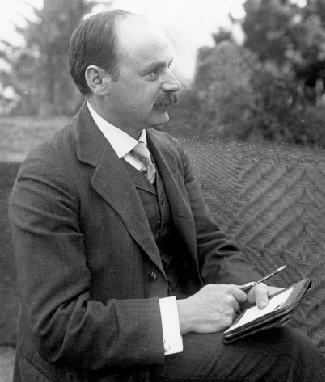
The characteristics of an event horizon were first worked out by astronomer and mathematician Karl Schwarzschild (Figure 24.15). A member of the German army in World War I, he died in 1916 of an illness he contracted while doing artillery shell calculations on the Russian front. His paper on the theory of event horizons was among the last things he finished as he was dying; it was the first exact solution to Einstein’s equations of general relativity. The radius of the event horizon is called the Schwarzschild radius in his memory.
英語のヒント
事象の地平面の性質を最初に明らかにしたのは、天文学者で数学者のカール・シュバルツシルトである(図24.15)。第一次世界大戦でドイツ軍に属していた彼は、ロシア戦線で砲弾の計算に取り組んでいたときにかかった病気で、1916年に亡くなった。事象の地平面の理論に関する論文は、死を迎えようとする時期に仕上げた、最後の仕事の一つだった。それは、アインシュタインの一般相対性理論の方程式に対する最初の厳密解でもあった。彼を記念して、事象の地平面の半径をシュバルツシルト半径と呼ぶ。
Karl Schwarzschild (1873–1916).カール・シュバルツシルト(1873〜1916年)
OpenStax / Rice University · CC BY 4.0
Figure 24.15 This German scientist was the first to demonstrate mathematically that a black hole is possible and to determine the size of a nonrotating black hole’s event horizon.
図24.15 このドイツの科学者は、ブラックホールが可能であることを初めて数学的に示し、回転しないブラックホールの事象の地平面の大きさを求めた。
The event horizon is the boundary of the black hole; calculations show that it does not get smaller once the whole star has collapsed inside it. It is the region that separates the things trapped inside it from the rest of the universe. Anything coming from the outside is also trapped once it comes inside the event horizon. The horizon’s size turns out to depend only on the mass inside it. If the Sun, with its mass of 1 MSun, were to become a black hole (fortunately, it can’t—this is just a thought experiment), the Schwarzschild radius would be about 3 kilometers; thus, the entire black hole would be about one-third the size of a neutron star of that same mass. Feed the black hole some mass, and the horizon will grow—but not very much. Doubling the mass will make the black hole 6 kilometers in radius, still very tiny on the cosmic scale.
英語のヒント
事象の地平面はブラックホールの境界である。計算によれば、星全体がその内側へ崩壊した後も、地平面は小さくならない。これは、内部に閉じ込められたものと、宇宙の残りの部分を分ける領域である。外から来たものも、ひとたび事象の地平面の内側へ入れば閉じ込められる。地平面の大きさは、その内部の質量だけで決まることがわかっている。質量1 MSunの太陽がブラックホールになったとすれば、シュバルツシルト半径は約3キロメートルになる。幸い太陽はそうならず、これは思考実験にすぎない。この場合、ブラックホール全体の大きさは、同じ質量の中性子星の約3分の1である。ブラックホールへ質量を与えれば、地平面は大きくなるが、それほど大きくなるわけではない。質量を2倍にしても半径は6キロメートルであり、宇宙の尺度ではまだ非常に小さい。
The event horizons of more massive black holes have larger radii. For example, if a globular cluster of 100,000 stars (solar masses) could collapse to a black hole, it would be 300,000 kilometers in radius, a little less than half the radius of the Sun. If the entire Galaxy could collapse to a black hole, it would be only about 1012 kilometers in radius—about a tenth of a light year. Smaller masses have correspondingly smaller horizons: for Earth to become a black hole, it would have to be compressed to a radius of only 1 centimeter—less than the size of a grape. A typical asteroid, if crushed to a small enough size to be a black hole, would have the dimensions of an atomic nucleus.
英語のヒント
もっと質量の大きなブラックホールなら、事象の地平面の半径も大きい。たとえば、10万個の星、すなわち10万太陽質量からなる球状星団が崩壊してブラックホールになれば、その半径は30万キロメートルで、太陽半径の半分を少し下回る。天の川銀河全体が崩壊してブラックホールになったとしても、半径は約1012キロメートル、約0.1光年にすぎない。質量が小さければ、地平面もそれに応じて小さい。地球をブラックホールにするには、ブドウの粒より小さい、半径わずか1センチメートルまで圧縮しなければならない。典型的な小惑星を、ブラックホールになるほど小さく押しつぶせば、その大きさは原子核ほどになる。
The Milky Way’s Black Hole天の川銀河のブラックホール
The size of the event horizon of a black hole depends on the mass of the black hole. The greater the mass, the larger the radius of the event horizon. General relativity calculations show that the formula for the Schwarzschild radius (RS) of the event horizon is
ブラックホールの事象の地平面の大きさは、ブラックホールの質量によって決まる。質量が大きいほど、事象の地平面の半径は大きい。一般相対性理論の計算によれば、事象の地平面のシュバルツシルト半径(RS)は、次の式で与えられる。
where c is the speed of light, G is the gravitational constant, and M is the mass of the black hole. Note that in this formula, 2, G, and c are all constant; only the mass changes from black hole to black hole.
ここで、cは光速、Gは重力定数、Mはブラックホールの質量である。この式では2、G、cはすべて定数であり、ブラックホールごとに変わるのは質量だけであることに注意しよう。
As we will see in the chapter on The Milky Way Galaxy, astronomers have traced the paths of several stars near the center of our Galaxy and found that they seem to be orbiting an unseen object—dubbed Sgr A* (pronounced “Sagittarius A-star”)—with a mass of about 4 million solar masses. What is the size of its Schwarzschild radius?
「天の川銀河」の章で見るように、天文学者たちは、私たちの銀河の中心付近にあるいくつかの星の経路を追跡してきた。その結果、これらの星は、約400万太陽質量を持つ、見えない天体を周回しているらしいとわかった。この天体はSgr A*と名づけられ、「サジタリウス・エー・スター」と読む。そのシュバルツシルト半径は、どれほどの大きさだろうか。
Solution解き方
We can substitute data for G, M, and c (from Appendix E) directly into the equation:
付録EにあるG、M、cの値を、式へ直接代入できる。
This distance is about one-fifth of the radius of Mercury’s orbit around the Sun, yet the object contains 4 million solar masses and cannot be seen with our largest telescopes. You can see why astronomers are convinced this object is a black hole.
この距離は、水星が太陽を回る軌道の半径の約5分の1である。それほど小さいのに、この天体は400万太陽質量を含み、最大の望遠鏡でも見えない。天文学者がこの天体をブラックホールだと確信する理由がわかるだろう。
Check Your Learning理解を確かめよう
What would be the size of a black hole that contained only as much mass as a typical pickup truck (about 3000 kg)? (Note that something with so little mass could never actually form a black hole, but it’s interesting to think about the result.)
典型的なピックアップトラックほどの質量、約3000キログラムしか持たないブラックホールは、どれほどの大きさになるだろうか。これほど質量の小さなものは、実際にはブラックホールを形成できないが、その結果を考えるのは興味深い。