第24章ブラックホールと曲がった時空Black Holes and Curved Spacetime
24.3 Tests of General Relativity24.3 一般相対性理論の検証
Learning Objectives学習の目標
By the end of this section, you will be able to:
この節を終えると、次のことができるようになる。
Describe unusual motion of Mercury around the Sun and explain how general relativity explains the observed behavior
太陽の周りを回る水星の特異な運動を述べ、観測された振る舞いを一般相対性理論がどのように説明するかを説明する。
Provide examples of evidence for light rays being bent by massive objects, as predicted by general relativity’s theory about the warping of spacetime
一般相対性理論における時空のゆがみの考え方が予測するとおり、質量の大きな物体によって光線が曲げられることを示す証拠の例を挙げる。
What Einstein proposed was nothing less than a major revolution in our understanding of space and time. It was a new theory of gravity, in which mass determines the curvature of spacetime and that curvature, in turn, controls how objects move. Like all new ideas in science, no matter who advances them, Einstein’s theory had to be tested by comparing its predictions against the experimental evidence. This was quite a challenge because the effects of the new theory were apparent only when the mass was quite large. (For smaller masses, it required measuring techniques that would not become available until decades later.)
英語のヒント
アインシュタインの提案は、空間と時間の理解における大革命にほかならなかった。それは、質量が時空の曲がり方を決め、その曲がり方が今度は物体の運動を支配する、という新しい重力理論だった。科学におけるほかの新しい考えと同じように、誰が提案したものであれ、理論の予測を実験的な証拠と比べて検証しなければならない。これは非常に難しい課題だった。新しい理論による効果がはっきり現れるのは、質量がかなり大きい場合だけだったからである。小さい質量では、数十年後になって初めて使えるようになる測定技術が必要だった。
When the distorting mass is small, the predictions of general relativity must agree with those resulting from Newton’s law of universal gravitation, which, after all, has served us admirably in our technology and in guiding space probes to the other planets. In familiar territory, therefore, the differences between the predictions of the two models are subtle and difficult to detect. Nevertheless, Einstein was able to demonstrate one proof of his theory that could be found in existing data and to suggest another one that would be tested just a few years later.
英語のヒント
時空をゆがめる質量が小さいとき、一般相対性理論の予測は、ニュートンの万有引力の法則から得られる予測と一致しなければならない。ニュートンの法則は、技術の応用でも、探査機をほかの惑星へ導くことでも、これまで見事に役立ってきたからである。したがって、なじみのある領域では、二つのモデルの予測の違いはごくわずかで、検出しにくい。それでも、アインシュタインは、すでに存在するデータから得られる自分の理論の証拠を一つ示すことができた。さらに、わずか数年後に検証されることになる、もう一つの証拠も提案した。
The Motion of Mercury水星の運動
Of the planets in our solar system, Mercury orbits closest to the Sun and is thus most affected by the distortion of spacetime produced by the Sun’s mass. Einstein wondered if the distortion might produce a noticeable difference in the motion of Mercury that was not predicted by Newton’s law. It turned out that the difference was subtle, but it was definitely there. Most importantly, it had already been measured.
英語のヒント
太陽系の惑星のうち、最も太陽の近くを回るのは水星であり、そのため、太陽の質量が生じさせる時空のゆがみの影響を最も強く受ける。アインシュタインは、このゆがみが、水星の運動に、ニュートンの法則では予測されない、測定可能な違いを生むのではないかと考えた。その違いはわずかではあるが、確かに存在するとわかった。とりわけ重要なのは、それがすでに測定されていたことである。
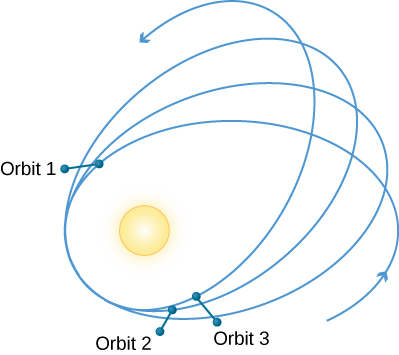
Mercury has a highly elliptical orbit, so that it is only about two-thirds as far from the Sun at perihelion as it is at aphelion. (These terms were defined in the chapter on Orbits and Gravity.) The gravitational effects (perturbations) of the other planets on Mercury produce a calculable advance of Mercury’s perihelion. What this means is that each successive perihelion occurs in a slightly different direction as seen from the Sun (Figure 24.9).
英語のヒント
水星の軌道はかなり細長い楕円なので、近日点での太陽からの距離は、遠日点での距離の約3分の2にすぎない。これらの用語は「軌道と重力」の章で定義した。ほかの惑星が水星に及ぼす重力の効果、すなわち摂動によって、水星の近日点には、計算で求められる前進が生じる。つまり、太陽から見ると、水星が近日点を通過するたびに、その方向が少しずつ変わるのである(図24.9)。
Mercury’s Wobble.水星の軌道の向きの変化
OpenStax / Rice University · CC BY 4.0
Figure 24.9 The major axis of the orbit of a planet, such as Mercury, rotates in space slightly because of various perturbations. In Mercury’s case, the amount of rotation (or orbital precession) is a bit larger than can be accounted for by the gravitational forces exerted by other planets; this difference is precisely explained by the general theory of relativity. Mercury, being the planet closest to the Sun, has its orbit most affected by the warping of spacetime near the Sun. The change from orbit to orbit has been significantly exaggerated on this diagram.
図24.9 水星のような惑星の軌道の長軸は、さまざまな摂動によって、空間内でわずかに回転する。水星の場合、この回転、すなわち軌道の歳差運動は、ほかの惑星の重力で説明できる量よりも少し大きい。この差を、一般相対性理論は正確に説明する。太陽に最も近い惑星である水星は、その近くの時空のゆがみによって、軌道が最も強く影響を受ける。図では、1周ごとの軌道の変化を大幅に誇張してある。
According to Newtonian gravitation, the gravitational forces exerted by the planets will cause Mercury’s perihelion to advance by about 531 seconds of arc (arcsec) per century. In the nineteenth century, however, it was observed that the actual advance is 574 arcsec per century. The discrepancy was first pointed out in 1859 by Urbain Le Verrier, the codiscoverer of Neptune. Just as discrepancies in the motion of Uranus allowed astronomers to discover the presence of Neptune, so it was thought that the discrepancy in the motion of Mercury could mean the presence of an undiscovered inner planet. Astronomers searched for this planet near the Sun, even giving it a name: Vulcan, after the Roman god of fire. (The name would later be used for the home planet of a famous character on a popular television show about future space travel.)
英語のヒント
ニュートンの重力理論によれば、惑星が及ぼす重力によって、水星の近日点は1世紀に約531秒角だけ前進する。しかし19世紀に観測された実際の前進量は、1世紀に574秒角だった。この食い違いを1859年に初めて指摘したのは、海王星の共同発見者であるユルバン・ルヴェリエである。天王星の運動の食い違いから海王星の存在を発見できたのと同じように、水星の運動の食い違いも、未発見の内側の惑星の存在を意味するのではないか、と考えられた。天文学者たちは太陽の近くでこの惑星を探し、ローマ神話の火の神にちなみ、「バルカン」という名前まで与えた。この名前はのちに、未来の宇宙旅行を描く人気テレビ番組の有名な登場人物の故郷の惑星にも使われることになる。
But no planet has ever been found nearer to the Sun than Mercury, and the discrepancy was still bothering astronomers when Einstein was doing his calculations. General relativity, however, predicts that due to the curvature of spacetime around the Sun, the perihelion of Mercury should advance slightly more than is predicted by Newtonian gravity. The result is to make the major axis of Mercury’s orbit rotate slowly in space because of the Sun’s gravity alone. The prediction of general relativity is that the direction of perihelion should change by an additional 43 arcsec per century. This is remarkably close to the observed discrepancy, and it gave Einstein a lot of confidence as he advanced his theory. The relativistic advance of perihelion was later also observed in the orbits of several asteroids that come close to the Sun.
英語のヒント
しかし、水星より太陽に近い惑星は見つからず、アインシュタインが計算していた時点でも、この食い違いは天文学者を悩ませていた。ところが、一般相対性理論によれば、太陽の周りの時空の曲がりによって、水星の近日点はニュートンの重力理論が予測するよりも少し多く前進するはずである。その結果、太陽の重力だけで、水星の軌道の長軸が空間内でゆっくり回転することになる。一般相対性理論は、近日点の方向が、1世紀にさらに43秒角だけ変わると予測する。これは観測された食い違いに驚くほど近く、アインシュタインは理論を提案するうえで大きな自信を得た。その後、太陽に近づくいくつかの小惑星の軌道でも、相対論的な近日点の前進が観測された。
Deflection of Starlight星の光の曲がり
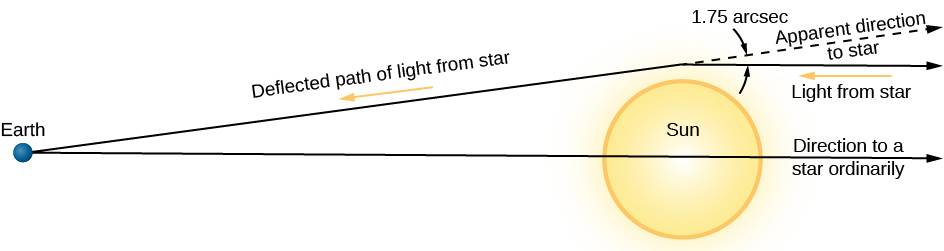
Einstein’s second test was something that had not been observed before and would thus provide an excellent confirmation of his theory. Since spacetime is more curved in regions where the gravitational field is strong, we would expect light passing very near the Sun to appear to follow a curved path (Figure 24.10), just like that of the ant in our analogy. Einstein calculated from general relativity theory that starlight just grazing the Sun’s surface should be deflected by an angle of 1.75 arcsec. Could such a deflection be observed?
英語のヒント
アインシュタインが挙げた二つ目の検証は、それまで観測されたことのない現象に関わるものであり、理論を確かめる格好の機会になるはずだった。重力場の強い領域ほど時空は大きく曲がるので、太陽のすぐ近くを通る光は、先ほどのたとえのアリのように、曲がった経路をたどるように見えるはずである(図24.10)。アインシュタインは一般相対性理論から、太陽の表面すれすれを通る星の光は、1.75秒角だけ向きを変えられるはずだと計算した。このような光の曲がりを観測できるだろうか。
Curvature of Light Paths near the Sun.太陽の近くで曲がる光の経路
OpenStax / Rice University · CC BY 4.0
Figure 24.10 Starlight passing near the Sun is deflected slightly by the “warping” of spacetime. (This deflection of starlight is one small example of a phenomenon called gravitational lensing, which we’ll discuss in more detail in The Evolution and Distribution of Galaxies.) Before passing by the Sun, the light from the star was traveling parallel to the bottom edge of the figure. When it passed near the Sun, the path was altered slightly. When we see the light, we assume the light beam has been traveling in a straight path throughout its journey, and so we measure the position of the star to be slightly different from its true position. If we were to observe the star at another time, when the Sun is not in the way, we would measure its true position.
図24.10 太陽の近くを通る星の光は、時空の「ゆがみ」によってわずかに曲げられる。これは重力レンズという現象の小さな一例であり、「銀河の進化と分布」で詳しく扱う。太陽のそばを通る前、星からの光は図の下辺と平行に進んでいた。太陽の近くを通ると、その経路が少し変わる。私たちはその光を見ると、光のビームが全行程を直線で進んできたと考えるため、星の位置を、本当の位置とは少し違うところに測定する。太陽が途中にない別の時期に観測すれば、その星の本当の位置を測定できる。
We encounter a small “technical problem” when we try to photograph starlight coming very close to the Sun: the Sun is an outrageously bright source of starlight itself. But during a total solar eclipse, much of the Sun’s light is blocked out, allowing the stars near the Sun to be photographed. In a paper published during World War I, Einstein (writing in a German journal) suggested that photographic observations during an eclipse could reveal the deflection of light passing near the Sun.
英語のヒント
太陽のすぐ近くを通って来る星の光を撮影しようとすると、小さな「技術的問題」に出会う。太陽自身が、途方もなく明るい星の光の発生源なのである。しかし皆既日食の間は、太陽光の大部分が遮られるので、太陽の近くに見える星を撮影できる。第一次世界大戦中、アインシュタインはドイツの学術誌に論文を発表し、日食中に写真観測を行えば、太陽の近くを通る光の曲がりを明らかにできる、と提案した。
The technique involves taking a photograph of the stars six months prior to the eclipse and measuring the position of all the stars accurately. Then the same stars are photographed during the eclipse. This is when the starlight has to travel to us by skirting the Sun and moving through measurably warped spacetime. As seen from Earth, the stars closest to the Sun will seem to be “out of place”—slightly away from their regular positions as measured when the Sun is not nearby.
英語のヒント
この手法では、まず日食の半年前に星の写真を撮り、すべての星の位置を正確に測定する。次に、日食中に同じ星を撮影する。このとき星の光は、太陽の縁をかすめ、測定可能なほどゆがんだ時空を通って、私たちに届く。地球から見ると、太陽に最も近い星は、太陽が近くにないときに測定した通常の位置から少し離れた、「本来の位置ではないところ」にあるように見える。
A single copy of that paper, passed through neutral Holland, reached the British astronomer Arthur S. Eddington, who noted that the next suitable eclipse was on May 29, 1919. The British organized two expeditions to observe it: one on the island of Príncipe, off the coast of West Africa, and the other in Sobral, in northern Brazil. Despite some problems with the weather, both expeditions obtained successful photographs. The stars seen near the Sun were indeed displaced, and to the accuracy of the measurements, which was about 20%, the shifts were consistent with the predictions of general relativity. More modern experiments with radio waves traveling close to the Sun have confirmed that the actual displacements are within 1% of what general relativity predicts.
英語のヒント
その論文が1部、中立国オランダを経由して、イギリスの天文学者アーサー・S・エディントンのもとへ届いた。彼は、次の適した日食が1919年5月29日に起こることに注目した。イギリスは二つの観測隊を組織した。一つは西アフリカ沖のプリンシペ島へ、もう一つはブラジル北部のソブラルへ向かった。天候にはいくらか問題があったが、両隊とも写真撮影に成功した。太陽の近くに見える星の位置は、確かにずれていた。そのずれは、約20%という測定精度の範囲内で、一般相対性理論の予測と一致した。その後、太陽の近くを通る電波を使った実験では、実際の位置のずれが一般相対性理論の予測と1%以内で一致することが確かめられている。
The confirmation of the theory by the eclipse expeditions in 1919 was a triumph that made Einstein a world celebrity.
英語のヒント
1919年の日食観測隊が理論を確かめたことは、アインシュタインを世界的な有名人にする大成功となった。