第24章ブラックホールと曲がった時空Black Holes and Curved Spacetime
24.6 Evidence for Black Holes24.6 ブラックホールの証拠
Learning Objectives学習の目標
By the end of this section, you will be able to:
この節を終えると、次のことができるようになる。
Describe what to look for when seeking and confirming the presence of a stellar black hole
恒星質量ブラックホールを探し、その存在を確かめるとき、何を調べればよいかを説明する。
Explain how a black hole is inherently black yet can be associated with luminous matter
ブラックホール自体は本質的に黒いのに、明るく光る物質を伴いうる理由を説明する。
Differentiate between stellar black holes and the black holes in the centers of galaxies
恒星質量ブラックホールと、銀河の中心にあるブラックホールを区別する。
Theory tells us what black holes are like. But do they actually exist? And how do we go about looking for something that is many light years away, only about a few dozen kilometers across (if a stellar black hole), and completely black? It turns out that the trick is not to look for the black hole itself but instead to look for what it does to a nearby companion star.
英語のヒント
理論は、ブラックホールがどのようなものかを教えてくれる。しかし、本当に存在するのだろうか。恒星質量ブラックホールなら、遠く何光年も離れ、直径はわずか数十キロメートルほどで、しかもまったく黒いものを、どうやって探せばよいのだろうか。そのこつは、ブラックホールそのものを探すのではなく、近くの伴星に何をするかを調べることだとわかっている。
As we saw, when very massive stars collapse, they leave behind their gravitational influence. What if a member of a double-star system becomes a black hole, and its companion manages to survive the death of the massive star? While the black hole disappears from our view, we may be able to deduce its presence from the things it does to its companion.
英語のヒント
これまで見たように、非常に大質量の恒星が崩壊しても、その重力の影響は残る。連星系の一方がブラックホールとなり、もう一方が大質量星の死を何とか生き延びたら、どうだろうか。ブラックホールは見えなくなるが、伴星に及ぼす働きから、その存在を推定できるかもしれない。
Requirements for a Black Holeブラックホールと判断するための条件
So, here is a prescription for finding a black hole: start by looking for a star whose motion (determined from the Doppler shift of its spectral lines) shows it to be a member of a binary star system. If both stars are visible, neither can be a black hole, so focus your attention on just those systems where only one star of the pair is visible, even with our most sensitive telescopes.
英語のヒント
では、ブラックホールを見つける手順を示そう。まず、運動から連星系の一員だとわかる星を探す。その運動は、スペクトル線のドップラー偏移で測定する。両方の星が見えるなら、どちらもブラックホールではない。そこで、最も感度の高い望遠鏡を使っても、対の一方しか見えない系だけに注目する。
Being invisible is not enough, however, because a relatively faint star might be hard to see next to the glare of a brilliant companion or if it is shrouded by dust. And even if the star really is invisible, it could be a neutron star. Therefore, we must also have evidence that the unseen star has a mass too high to be a neutron star and that it is a collapsed object—an extremely small stellar remnant.
英語のヒント
しかし、見えないだけでは十分でない。比較的暗い星は、明るい伴星のまぶしい光の隣では見えにくいかもしれないし、塵に包まれているかもしれない。星が本当に見えない場合でも、中性子星の可能性がある。したがって、見えない星の質量が中性子星にしては大きすぎることと、それが崩壊した天体、すなわち極めて小さな恒星の残骸であることの証拠も必要になる。
We can use Kepler’s law (see Orbits and Gravity) and our knowledge of the visible star to measure the mass of the invisible member of the pair. If the mass is greater than about 3 MSun, then we are likely seeing (or, more precisely, not seeing) a black hole—as long as we can make sure the object really is a collapsed star.
英語のヒント
ケプラーの法則(「軌道と重力」参照)と、見えるほうの星についての知識を使えば、見えない相手の質量を測定できる。約3 MSunを超える質量であれば、私たちが見ている、より正確には見えていないものは、おそらくブラックホールである。ただし、それが本当に崩壊した星であると確かめられることが条件になる。
If matter falls toward a compact object of high gravity, the material is accelerated to high speed. Near the event horizon of a black hole, matter is moving at velocities that approach the speed of light. As the atoms whirl chaotically toward the event horizon, they rub against each other; internal friction can heat them to temperatures of 100 million K or more. Such hot matter emits radiation in the form of flickering X-rays. The last part of our prescription, then, is to look for a source of X-rays associated with the binary system. Since X-rays do not penetrate Earth’s atmosphere, such sources must be found using X-ray telescopes in space.
英語のヒント
物質が強い重力を持つ小さな天体へ落ちると、その物質は加速され、高速になる。ブラックホールの事象の地平面の近くでは、物質は光速に近い速度で動く。原子が乱雑に渦を巻いて事象の地平面へ向かうと、互いにこすれ合い、内部摩擦で1億K以上にまで加熱されることがある。このような高温の物質は、明るさが細かく変動するX線として放射を出す。そこで、手順の最後は、連星系に伴うX線源を探すことである。X線は地球の大気を通り抜けないため、このような発生源は宇宙にあるX線望遠鏡で見つけなければならない。
In our example, the infalling gas that produces the X-ray emission comes from the black hole’s companion star. As we saw in The Death of Stars, stars in close binary systems can exchange mass, especially as one of the members expands into a red giant. Suppose that one star in a double-star system has evolved to a black hole and that the second star begins to expand. If the two stars are not too far apart, the outer layers of the expanding star may reach the point where the black hole exerts more gravitational force on them than do the inner layers of the red giant to which the atmosphere belongs. The outer atmosphere then passes through the point of no return between the stars and falls toward the black hole.
英語のヒント
この例でX線を出す、落下してくるガスは、ブラックホールの伴星から来る。「恒星の死」で見たように、近接連星系では星どうしが質量をやり取りできる。とくに、一方が膨張して赤色巨星になるときに起こりやすい。連星系の一方が進化してブラックホールになり、もう一方が膨張し始めたとしよう。二つがそれほど遠く離れていなければ、膨張する星の外層は、その外層が属する赤色巨星の内側の層よりも、ブラックホールから強い重力を受ける地点まで達するかもしれない。すると外側の大気は、二つの星の間の、もう後戻りできない地点を通り、ブラックホールへ落ちていく。
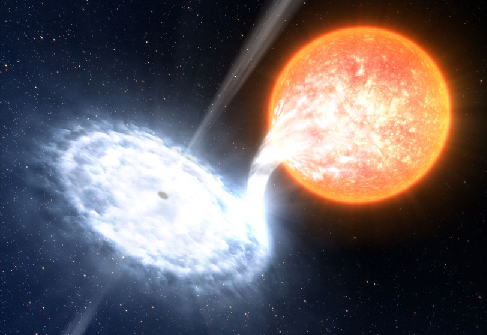
The mutual revolution of the giant star and the black hole causes the material falling toward the black hole to spiral around it rather than flow directly into it. The infalling gas whirls around the black hole in a pancake of matter called an accretion disk. It is within the inner part of this disk that matter is revolving about the black hole so fast that internal friction heats it up to X-ray–emitting temperatures (see Figure 24.1).
英語のヒント
巨星とブラックホールが互いの周りを公転しているため、ブラックホールへ落ちる物質は、直接流れ込むのではなく、その周りでらせんを描く。落下するガスは、降着円盤と呼ばれるパンケーキ状の物質の集まりとなって、ブラックホールの周りを渦巻く。この円盤の内側では、物質が非常に速く周回するため、内部摩擦によってX線を放つ温度まで加熱される(図24.1)。
Another way to form an accretion disk in a binary star system is to have a powerful stellar wind come from the black hole’s companion. Such winds are a characteristic of several stages in a star’s life. Some of the ejected gas in the wind will then flow close enough to the black hole to be captured by it into the disk (Figure 24.16).
英語のヒント
連星系で降着円盤ができる別の方法は、ブラックホールの伴星から強力な恒星風が吹くことである。このような風は、恒星の一生のいくつかの段階に特徴的である。風として放出されたガスの一部は、ブラックホールに捕らえられるほど近くを流れ、円盤へ取り込まれる(図24.16)。
Binary Black Hole.連星系のブラックホール
credit: modification of work by ESO/L. Calçada · CC BY 4.0
Figure 24.16 This artist’s rendition shows a black hole and star (red). As matter streams from the star, it forms a disk around the black hole. Some of the swirling material close to the black hole is pushed outward perpendicular to the disk in two narrow jets. (credit: modification of work by ESO/L. Calçada)
図24.16 ブラックホールと赤い星を描いた想像図。星から流れ出した物質は、ブラックホールの周りに円盤をつくる。ブラックホールの近くで渦巻く物質の一部は、円盤に垂直な方向へ押し出され、2本の細いジェットとなる。(ESO/L. Calçadaの作品を改変。)
We should point out that, as often happens, the measurements we have been discussing are not quite as simple as they are described in introductory textbooks. In real life, Kepler’s law allows us to calculate only the combined mass of the two stars in the binary system. We must learn more about the visible star of the pair and its history to ascertain the distance to the binary pair, the true size of the visible star’s orbit, and how the orbit of the two stars is tilted toward Earth, something we can rarely measure. And neutron stars can also have accretion disks that produce X-rays, so astronomers must study the properties of these X-rays carefully when trying to determine what kind of object is at the center of the disk. Nevertheless, a number of systems that clearly contain black holes have now been found.
英語のヒント
よくあることだが、ここまで述べてきた測定は、入門書に書かれるほど単純ではないことを指摘しておこう。実際には、ケプラーの法則から計算できるのは、連星系の二つの星を合わせた質量だけである。連星までの距離、見える星の軌道の本当の大きさ、そして二つの星の軌道が地球に対してどう傾いているかを確かめるには、見えるほうの星とその来歴について、もっと知る必要がある。最後の傾きは、直接測れることが少ない。さらに、中性子星もX線を出す降着円盤を持つことがある。そのため、円盤の中心にあるのがどんな天体かを調べるときは、X線の性質を注意深く調べなければならない。それでも、ブラックホールを明らかに含む系が、今ではいくつも見つかっている。