第24章ブラックホールと曲がった時空Black Holes and Curved Spacetime
24.4 Time in General Relativity24.4 一般相対性理論における時間
Learning Objectives学習の目標
By the end of this section, you will be able to:
この節を終えると、次のことができるようになる。
Describe how Einsteinian gravity slows clocks and can decrease a light wave’s frequency of oscillation
アインシュタインの重力が時計を遅らせ、光の振動数を下げる仕組みを説明する。
Recognize that the gravitational decrease in a light wave’s frequency is compensated by an increase in the light wave’s wavelength—the so-called gravitational redshift—so that the light continues to travel at constant speed
重力によって光の振動数が低くなると、波長が長くなることでそれが補われることを理解する。これが重力赤方偏移であり、そのため光は一定の速さで進み続ける。
General relativity theory makes various predictions about the behavior of space and time. One of these predictions, put in everyday terms, is that the stronger the gravity, the slower the pace of time. Such a statement goes very much counter to our intuitive sense of time as a flow that we all share. Time has always seemed the most democratic of concepts: all of us, regardless of wealth or status, appear to move together from the cradle to the grave in the great current of time.
英語のヒント
一般相対性理論は、空間と時間の振る舞いについてさまざまな予測をする。その一つを日常の言葉で表せば、重力が強いほど時間の進み方は遅くなる、ということである。この主張は、時間とは私たち全員が共有する流れである、という直観的な感覚に大きく反する。時間はこれまで、最も民主的な概念に思えてきた。富や地位にかかわらず、私たちは皆、時間という大きな流れに乗り、ゆりかごから墓場まで一緒に進むように見えるからである。
But Einstein argued that it only seems this way to us because all humans so far have lived and died in the gravitational environment of Earth. We have had no chance to test the idea that the pace of time might depend on the strength of gravity, because we have not experienced radically different gravities. Moreover, the differences in the flow of time are extremely small until truly large masses are involved. Nevertheless, Einstein’s prediction has now been tested, both on Earth and in space.
英語のヒント
しかしアインシュタインは、そう見えるのは、これまでの人間が皆、地球の重力環境の中で生まれ、死んできたからにすぎない、と論じた。私たちは、根本的に異なる重力を経験していない。そのため、時間の進み方が重力の強さに依存するかもしれない、という考えを試す機会がなかったのである。さらに、本当に大きな質量が関わらない限り、時間の流れの違いは極めて小さい。それでも、アインシュタインの予測は今や、地上と宇宙の両方で検証されている。
The Tests of Time時間についての検証
An ingenious experiment in 1959 used the most accurate atomic clock known to compare time measurements on the ground floor and the top floor of the physics building at Harvard University. For a clock, the experimenters used the frequency (the number of cycles per second) of gamma rays emitted by radioactive cobalt. Einstein’s theory predicts that such a cobalt clock on the ground floor, being a bit closer to Earth’s center of gravity, should run very slightly slower than the same clock on the top floor. This is precisely what the experiments observed. Later, atomic clocks were taken up in high-flying aircraft and even on one of the Gemini space flights. In each case, the clocks farther from Earth ran a bit faster. While in 1959 it didn’t matter much if the clock at the top of the building ran faster than the clock in the basement, today that effect is highly relevant. Every smartphone or device that synchronizes with a GPS must correct for this (as we will see in the next section) since the clocks on satellites will run faster than clocks on Earth.
英語のヒント
1959年、当時最も正確な原子時計を用い、ハーバード大学の物理学棟の1階と最上階での時間測定を比べる、巧妙な実験が行われた。実験者たちは、放射性コバルトが放つガンマ線の振動数、すなわち1秒あたりの振動回数を、時計として利用した。アインシュタインの理論によれば、1階のコバルト時計は、地球の重力の中心に少し近いため、最上階の同じ時計よりも、ごくわずかに遅く進むはずである。実験は、まさにそのとおりの結果を示した。その後、原子時計は高空を飛ぶ飛行機に載せられ、さらにジェミニ宇宙船の飛行でも運ばれた。どの場合も、地球から遠い時計のほうが少し速く進んだ。1959年には、建物の最上階の時計が地下室の時計より速く進んでも、それほど重要ではなかった。しかし今日では、この効果は大いに関係する。後で見るように、GPSと同期するすべてのスマートフォンや装置は、この効果を補正しなければならない。衛星の時計は、地上の時計より速く進むからである。
The effect is more pronounced if the gravity involved is the Sun’s and not Earth’s. If stronger gravity slows the pace of time, then it will take longer for a light or radio wave that passes very near the edge of the Sun to reach Earth than we would expect on the basis of Newton’s law of gravity. (It takes longer because spacetime is curved in the vicinity of the Sun.) The smaller the distance between the ray of light and the edge of the Sun at closest approach, the longer will be the delay in the arrival time.
英語のヒント
関係するのが地球の重力ではなく太陽の重力なら、この効果はもっと顕著になる。強い重力が時間の進み方を遅くするなら、太陽の縁のすぐ近くを通る光や電波が地球に届くまでには、ニュートンの重力の法則から予想するよりも長い時間がかかるはずである。太陽の近くでは時空が曲がっているために、時間が余計にかかるのである。光線が最も近づいたときの、光線と太陽の縁との距離が小さいほど、到着時刻の遅れは大きくなる。
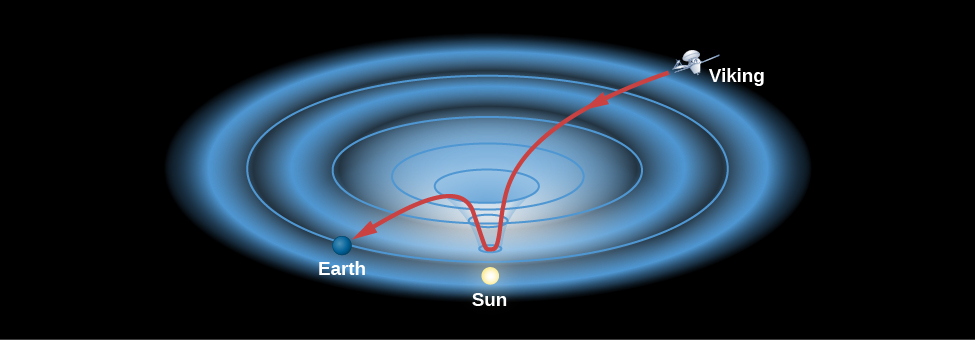
In November 1976, when the two Viking spacecraft were operating on the surface of Mars, the planet went behind the Sun as seen from Earth (Figure 24.11). Scientists had preprogrammed Viking to send a radio wave toward Earth that would go extremely close to the outer regions of the Sun. According to general relativity, there would be a delay because the radio wave would be passing through a region where time ran more slowly. The experiment was able to confirm Einstein’s theory to within 0.1%.
英語のヒント
1976年11月、2機のバイキング探査機が火星表面で活動していたとき、火星は地球から見て太陽の向こう側へ回った(図24.11)。科学者たちは、太陽の外側の領域のすぐ近くを通って地球へ向かう電波を送るよう、バイキングをあらかじめプログラムしていた。一般相対性理論によれば、電波は時間が遅く進む領域を通るため、到着に遅れが生じるはずである。この実験によって、アインシュタインの理論は0.1%以内の精度で確かめられた。
Time Delays for Radio Waves near the Sun.太陽の近くを通る電波の時間の遅れ
OpenStax / Rice University · CC BY 4.0
Figure 24.11 Radio signals from the Viking lander on Mars were delayed when they passed near the Sun, where spacetime is curved relatively strongly. In this picture, spacetime is pictured as a two-dimensional rubber sheet.
図24.11 火星のバイキング着陸機から送られた電波信号は、時空の曲がりが比較的強い太陽の近くを通ったとき、遅れて届いた。この図では、時空を二次元のゴム膜として表している。
Gravitational Redshift重力赤方偏移
What does it mean to say that time runs more slowly? When light emerges from a region of strong gravity where time slows down, the light experiences a change in its frequency and wavelength. To understand what happens, let’s recall that a wave of light is a repeating phenomenon—crest follows crest with great regularity. In this sense, each light wave is a little clock, keeping time with its wave cycle. If stronger gravity slows down the pace of time (relative to an outside observer), then the rate at which crest follows crest must be correspondingly slower—that is, the waves become less frequent.
英語のヒント
時間が遅く進むとは、どういう意味なのだろうか。時間の進み方が遅くなる強い重力の領域から光が出てくると、その光の振動数と波長が変わる。何が起きるのかを理解するために、光の波は繰り返し起こる現象であることを思い出そう。波の山の後には、きわめて規則正しく次の山が続く。この意味で、一つ一つの光の波は、その周期で時を刻む小さな時計である。重力が強いほど、外部の観測者に比べて時間の進み方が遅くなるなら、山から次の山が来るまでの進み方も、それに応じて遅くならなければならない。つまり、波が到来する頻度が低くなるのである。
To maintain constant light speed (the key postulate in Einstein’s theories of special and general relativity), the lower frequency must be compensated by a longer wavelength. This kind of increase in wavelength (when caused by the motion of the source) is what we called a redshift in Radiation and Spectra. Here, because it is gravity and not motion that produces the longer wavelengths, we call the effect a gravitational redshift.
英語のヒント
光速を一定に保つには、低下した振動数を、長くなった波長で補わなければならない。光速一定は、アインシュタインの特殊相対性理論と一般相対性理論の重要な前提である。このような波長の伸びが光源の運動によって生じる場合については、「放射とスペクトル」で赤方偏移と呼んだ。ここでは、波長を長くするのは運動ではなく重力なので、この効果を重力赤方偏移と呼ぶ。
The advent of space-age technology made it possible to measure gravitational redshift with very high accuracy. In the mid-1970s, a hydrogen maser, a device akin to a laser that produces a microwave radio signal at a particular wavelength, was carried by a rocket to an altitude of 10,000 kilometers. Instruments on the ground were used to compare the frequency of the signal emitted by the rocket-borne maser with that from a similar maser on Earth. The experiment showed that the stronger gravitational field at Earth’s surface really did slow the flow of time relative to that measured by the maser in the rocket. The observed effect matched the predictions of general relativity to within a few parts in 100,000.
英語のヒント
宇宙時代の技術の登場によって、重力赤方偏移を非常に高い精度で測定できるようになった。1970年代半ば、水素メーザーがロケットで高度1万キロメートルまで運ばれた。メーザーはレーザーに似た装置で、特定の波長のマイクロ波信号を発生させる。地上の装置を使い、ロケットに載せたメーザーが出す信号の振動数と、地上の同様のメーザーが出す信号の振動数を比較した。実験の結果、地表のより強い重力場では、ロケット内のメーザーで測る場合に比べて、時間の流れが確かに遅くなるとわかった。観測された効果は、一般相対性理論の予測と10万分の数以内で一致した。
These are only a few examples of tests that have confirmed the predictions of general relativity. Today, general relativity is accepted as our best description of gravity and is used by astronomers and physicists to understand the behavior of the centers of galaxies, the beginning of the universe, and the subject with which we began this chapter—the death of truly massive stars.
英語のヒント
これらは、一般相対性理論の予測を確かめた検証の、ほんの数例にすぎない。現在、一般相対性理論は重力を記述する最も優れた理論として受け入れられている。天文学者や物理学者は、銀河の中心部の振る舞い、宇宙の始まり、そして、この章の出発点だった、非常に大質量の恒星の死を理解するために、この理論を使っている。