第24章ブラックホールと曲がった時空Black Holes and Curved Spacetime
Gravity or Acceleration?重力か、加速か
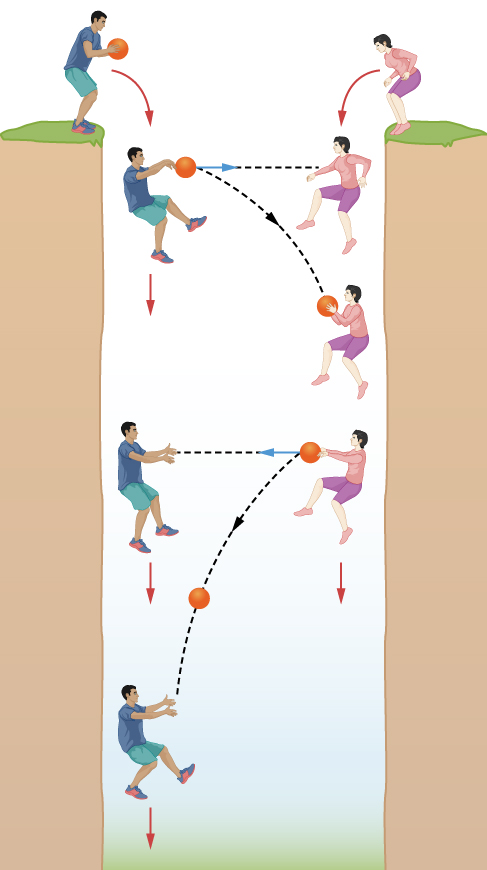
Einstein’s simple idea has big consequences. Let’s begin by considering what happens if two foolhardy people jump from opposite banks into a bottomless chasm (Figure 24.4). If we ignore air friction, then we can say that while they freely fall, they both accelerate downward at the same rate and feel no external force acting on them. They can throw a ball back and forth, always aiming it straight at each other, as if there were no gravity. The ball falls at the same rate that they do, so it always remains in a line between them.
英語のヒント
アインシュタインの単純な考えには、大きな帰結がある。まず、向こう見ずな二人が、底なしの裂け目の両岸から飛び降りるとどうなるかを考えよう(図24.4)。空気との摩擦を無視すれば、自由落下中の二人は同じ加速度で下向きに加速し、外力が作用しているとは感じない。二人は、まるで重力がないかのように、いつも相手へまっすぐ狙いを定めてボールを投げ合える。ボールも二人と同じように落下するので、つねに二人を結ぶ直線上にとどまる。
Free Fall.自由落下
OpenStax / Rice University · CC BY 4.0
Figure 24.4 Two people play catch as they descend into a bottomless abyss. Since the people and ball all fall at the same speed, it appears to them that they can play catch by throwing the ball in a straight line between them. Within their frame of reference, there appears to be no gravity.
図24.4 底なしの深淵へ落下しながら、二人がキャッチボールをしている。人もボールも同じ速さで落下するため、二人には、互いを結ぶ直線に沿ってボールを投げればキャッチボールができるように見える。二人の基準系の内部では、重力がないように見える。
Such a game of catch is very different on the surface of Earth. Everyone who grows up feeling gravity knows that a ball, once thrown, falls to the ground. Thus, in order to play catch with someone, you must aim the ball upward so that it follows an arc—rising and then falling as it moves forward—until it is caught at the other end.
英語のヒント
地表でのキャッチボールは、これとは大きく異なる。重力を感じながら育った人なら誰でも、いったん投げられたボールは地面へ落ちることを知っている。そのため、相手とキャッチボールをするには、ボールを上向きに投げなければならない。前へ進みながら上昇し、その後下降する弧を描かせ、反対側で受け取ってもらうのである。
Now suppose we isolate our falling people and ball inside a large box that is falling with them. No one inside the box is aware of any gravitational force. If they let go of the ball, it doesn’t fall to the bottom of the box or anywhere else but merely stays there or moves in a straight line, depending on whether it is given any motion.
英語のヒント
次に、落下する二人とボールを、それらと一緒に落下する大きな箱の中へ閉じ込めよう。箱の中では、誰も重力に気づかない。手を離しても、ボールは箱の底やほかのどこかへ落ちていかない。動きを与えたかどうかに応じて、その場にとどまるか、まっすぐ進むだけである。
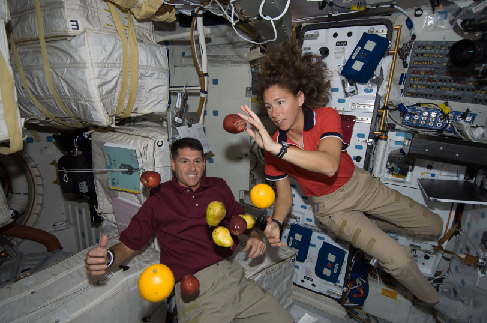
Astronauts in the International Space Station (ISS) that is orbiting Earth live in an environment just like that of the people sealed in a freely falling box (Figure 24.5). The orbiting ISS is actually “falling” freely around Earth. While in free fall, the astronauts live in a strange world where there seems to be no gravitational force. One can give a wrench a shove, and it moves at constant speed across the orbiting laboratory. A pencil set in midair remains there as if no force were acting on it.
英語のヒント
地球を周回する国際宇宙ステーション(ISS)の宇宙飛行士は、自由落下する箱に閉じ込められた人々と、ちょうど同じような環境で生活している(図24.5)。軌道上のISSは、実際には地球の周りを自由に「落下」し続けている。自由落下中、宇宙飛行士は重力がないように見える奇妙な世界で暮らす。レンチを軽く押せば、軌道上の実験室を一定の速さで横切っていく。空中に置いた鉛筆は、何の力も働いていないかのように、その場にとどまる。
Astronauts aboard the Space Shuttle.スペースシャトルの宇宙飛行士
credit: NASA · NASA media use guidelines
Figure 24.5 Shane Kimbrough and Sandra Magnus are shown aboard the Endeavour in 2008 with various fruit floating freely. Because the shuttle is in free fall as it orbits Earth, everything—including astronauts—stays put or moves uniformly relative to the walls of the spacecraft. This free-falling state produces a lack of apparent gravity inside the spacecraft. (credit: NASA)
図24.5 2008年、エンデバーに搭乗するシェーン・キンブローとサンドラ・マグナス。さまざまな果物が自由に浮かんでいる。シャトルは地球を周回しながら自由落下しているので、宇宙飛行士を含め、すべてのものが、宇宙船の壁に対して静止するか、一定の速度で動く。この自由落下状態によって、宇宙船の中では見かけ上、重力がなくなる。(提供:NASA)
Appearances are misleading, however. There is a force in this situation. Both the ISS and the astronauts continually fall around Earth, pulled by its gravity. But since all fall together—shuttle, astronauts, wrench, and pencil—inside the ISS all gravitational forces appear to be absent.
英語のヒント
しかし、見かけは当てにならない。この状況でも力は存在する。ISSも宇宙飛行士も、地球の重力に引かれて、地球の周りを落下し続けている。それでも、宇宙船、宇宙飛行士、レンチ、鉛筆がすべて一緒に落下するため、ISSの中では重力がまったく存在しないように見える。
Thus, the orbiting ISS provides an excellent example of the principle of equivalence—how local effects of gravity can be completely compensated by the right acceleration. To the astronauts, falling around Earth creates the same effects as being far off in space, remote from all gravitational influences.
英語のヒント
このように、軌道上のISSは等価原理の格好の例である。適切な加速度によって、重力の局所的な効果を完全に相殺できることを示している。宇宙飛行士にとって、地球の周りを落下することは、重力のあらゆる影響から離れた宇宙のかなたにいるのと同じ効果をもたらす。
The Paths of Light and Matter光と物質の進む経路
Einstein postulated that the equivalence principle is a fundamental fact of nature, and that there is no experiment inside any spacecraft by which an astronaut can ever distinguish between being weightless in remote space and being in free fall near a planet like Earth. This would apply to experiments done with beams of light as well. But the minute we use light in our experiments, we are led to some very disturbing conclusions—and it is these conclusions that lead us to general relativity and a new view of gravity.
英語のヒント
アインシュタインは、等価原理は自然の根本的な事実であると仮定した。どのような宇宙船であっても、その内部の実験だけでは、遠い宇宙空間で無重量状態にあるのか、それとも地球のような惑星の近くで自由落下しているのかを、宇宙飛行士が区別することはできない、と考えたのである。このことは、光のビームを使う実験にも当てはまるはずである。しかし、実験に光を使った途端に、私たちは非常に落ち着かない気持ちにさせられる結論へ導かれる。そして、まさにその結論が、一般相対性理論と新たな重力観へ私たちを導く。
It seems apparent to us, from everyday observations, that beams of light travel in straight lines. Imagine that a spaceship is moving through empty space far from any gravity. Send a laser beam from the back of the ship to the front, and it will travel in a nice straight line and land on the front wall exactly opposite the point from which it left the rear wall. If the equivalence principle really applies universally, then this same experiment performed in free fall around Earth should give us the same result.
英語のヒント
日常の観察から、光のビームが直線に沿って進むことは、私たちには明らかに思える。あらゆる重力源から遠く離れた空の宇宙空間を、宇宙船が進んでいると想像しよう。船の後部から前部へレーザー光を送れば、光はきれいな直線を進み、後ろの壁を出た点のちょうど向かい側にある、前の壁の点へ届くはずである。等価原理が本当に普遍的に成り立つなら、地球の周りを自由落下しながら同じ実験をしても、同じ結果が得られるはずである。
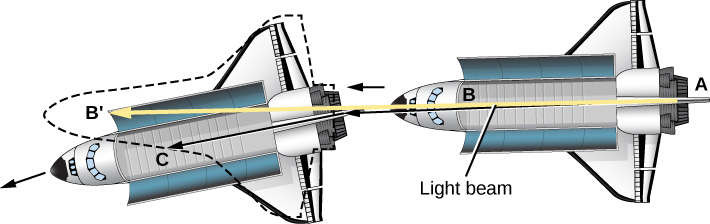
Now imagine that the astronauts again shine a beam of light along the length of their ship. But, as shown in Figure 24.6, this time the orbiting space station falls a bit between the time the light leaves the back wall and the time it hits the front wall. (The amount of the fall is grossly exaggerated in Figure 24.6 to illustrate the effect.) Therefore, if the beam of light follows a straight line but the ship’s path curves downward, then the light should strike the front wall at a point higher than the point from which it left.
英語のヒント
宇宙飛行士がもう一度、宇宙船の長さ方向に光のビームを照らすと想像しよう。しかし、図24.6に示すように、今度は、光が後ろの壁を出てから前の壁に届くまでの間に、軌道上の宇宙ステーションが少し落下する。図24.6では、この効果を示すために、落下の大きさを極端に誇張してある。したがって、光のビームが直線を進む一方で、宇宙船の経路が下向きに曲がるなら、光は出発した点よりも高い点で前の壁に当たるはずである。
Curved Light Path.曲がる光の経路
OpenStax / Rice University · CC BY 4.0
Figure 24.6 In a spaceship moving to the left (in this figure) in its orbit about a planet, light is beamed from the rear, A, toward the front, B. Meanwhile, the ship is falling out of its straight path (exaggerated here). We might therefore expect the light to strike at B′, above the target in the ship. Instead, the light follows a curved path and strikes at C. In order for the principle of equivalence to be correct, gravity must be able to curve the path of a light beam just as it curves the path of the spaceship.
図24.6 ある惑星を周回し、この図では左向きに進む宇宙船の中で、後部Aから前部Bへ向けて光を放つ。その間に、宇宙船は直線の経路から外れ、下向きに落下する。図ではその落下を誇張してある。そのため、光は船内の目標より上のB′に当たると予想するかもしれない。しかし、実際には光は曲がった経路を進み、Cに当たる。等価原理が正しいためには、重力は、宇宙船の経路を曲げるのと同じように、光のビームの経路も曲げられなければならない。
However, this would violate the principle of equivalence—the two experiments would give different results. We are thus faced with giving up one of our two assumptions. Either the principle of equivalence is not correct, or light does not always travel in straight lines. Instead of dropping what probably seemed at the time like a ridiculous idea, Einstein worked out what happens if light sometimes does not follow a straight path.
英語のヒント
ところが、もし光が高い点に当たるなら、等価原理に反してしまう。二つの実験で異なる結果が出るからである。そこで私たちは、二つの前提のどちらかを捨てなければならなくなる。等価原理が正しくないか、光はつねに直線を進むとは限らないか、どちらかである。アインシュタインは、当時ならおそらくばかげていると思われたこの考えを捨てる代わりに、光が直線を進まない場合には何が起きるのかを突き詰めて考えた。
Let’s suppose the principle of equivalence is right. Then the light beam must arrive directly opposite the point from which it started in the ship. The light, like the ball thrown back and forth, must fall with the ship that is in orbit around Earth (see Figure 24.6). This would make its path curve downward, like the path of the ball, and thus the light would hit the front wall exactly opposite the spot from which it came.
英語のヒント
等価原理が正しいと仮定しよう。すると、光のビームは、宇宙船の中で出発点のちょうど向かい側へ到達しなければならない。投げ合うボールと同じように、光も地球を周回する宇宙船と一緒に落下しなければならないのである(図24.6)。そのため、光の経路はボールの経路のように下向きに曲がり、出発した場所のちょうど向かい側で前の壁に当たることになる。
Thinking this over, you might well conclude that it doesn’t seem like such a big problem: why can’t light fall the way balls do? But, as discussed in Radiation and Spectra, light is profoundly different from balls. Balls have mass, while light does not.
英語のヒント
この話を考え直してみると、それほど大きな問題には思えない、と感じても不思議ではない。ボールと同じように光が落ちてはいけない理由があるのだろうか。しかし、「放射とスペクトル」で述べたように、光はボールとは根本的に異なる。ボールには質量があるが、光にはない。
Here is where Einstein’s intuition and genius allowed him to make a profound leap. He gave physical meaning to the strange result of our thought experiment. Einstein suggested that the light curves down to meet the front of the shuttle because Earth’s gravity actually bends the fabric of space and time. This radical idea—which we will explain next—keeps the behavior of light the same in both empty space and free fall, but it changes some of our most basic and cherished ideas about space and time. The reason we take Einstein’s suggestion seriously is that, as we will see, experiments now clearly show his intuitive leap was correct.
英語のヒント
ここで、アインシュタインの直観と才能が、大きな飛躍を可能にした。彼はこの思考実験の奇妙な結果に、物理的な意味を与えたのである。地球の重力が空間と時間の構造そのものを曲げるために、光は下向きに曲がり、シャトルの前部に到達する、と考えた。次に説明するこの大胆な考えなら、空の宇宙空間でも自由落下中でも、光の振る舞いを同じに保てる。その代わり、空間と時間について私たちが最も基本的で大切だと思ってきた考えの一部を変えなければならない。私たちがアインシュタインの提案を真剣に受け止めるのは、これから見るように、その直観の飛躍が正しかったことを、実験が今や明確に示しているからである。