第24章ブラックホールと曲がった時空Black Holes and Curved Spacetime
24.1 Introducing General Relativity24.1 一般相対性理論への入り口
Learning Objectives学習の目標
By the end of this section, you will be able to:
この節を終えると、次のことができるようになる。
Discuss some of the key ideas of the general theory of relativity
一般相対性理論の主要な考え方のいくつかを説明する。
Recognize that one’s experiences of gravity and acceleration are interchangeable and indistinguishable
重力による体験と加速による体験は、互いに置き換えられ、区別できないことを理解する。
Distinguish between Newtonian ideas of gravity and Einsteinian ideas of gravity
ニュートンの重力観とアインシュタインの重力観を区別する。
Recognize why the general theory of relativity is necessary for understanding the nature of black holes
ブラックホールの性質を理解するために一般相対性理論が必要な理由を理解する。
Most stars end their lives as white dwarfs or neutron stars. When a very massive star collapses at the end of its life, however, not even the mutual repulsion between densely packed neutrons can support the core against its own weight. If the remaining mass of the star’s core is more than about three times that of the Sun (MSun), our theories predict that no known force can stop it from collapsing forever! Gravity simply overwhelms all other forces and crushes the core until it occupies an infinitely small volume. A star in which this occurs may become one of the strangest objects ever predicted by theory—a black hole.
英語のヒント
大半の恒星は、白色矮星か中性子星として一生を終える。しかし、非常に大質量の恒星が一生の終わりに崩壊すると、密集した中性子どうしの反発さえも、中心核をその自重に抗して支えられなくなる。恒星の中心核に残る質量が太陽質量(MSun)の約3倍を超える場合、既知のどのような力も、その中心核が際限なく崩壊し続けるのを止められない、と理論は予測する。重力はほかのあらゆる力を圧倒し、中心核の体積が無限に小さくなるまで押しつぶす。このようなことが起きた恒星は、これまで理論が予測したなかでも、とりわけ奇妙な天体であるブラックホールになる可能性がある。
To understand what a black hole is like and how it influences its surroundings, we need a theory that can describe the action of gravity under such extreme circumstances. To date, our best theory of gravity is the general theory of relativity, which was put forward in 1916 by Albert Einstein.
英語のヒント
ブラックホールがどのようなもので、周囲にどのような影響を及ぼすのかを理解するには、このような極端な状況での重力の働きを記述できる理論が必要である。現在、重力について最も優れた理論は、アルベルト・アインシュタインが1916年に提唱した一般相対性理論である。
General relativity was one of the major intellectual achievements of the twentieth century; if it were music, we would compare it to the great symphonies of Beethoven or Mahler. Until recently, however, scientists had little need for a better theory of gravity; Isaac Newton’s ideas that led to his law of universal gravitation (see Orbits and Gravity) are perfectly sufficient for most of the objects we deal with in everyday life. In the past half century, however, general relativity has become more than just a beautiful idea; it is now essential in understanding pulsars, quasars (which will be discussed in Active Galaxies, Quasars, and Supermassive Black Holes), and many other astronomical objects and events, including the black holes we will discuss here.
英語のヒント
一般相対性理論は、20世紀を代表する知的成果の一つである。音楽であれば、ベートーヴェンやマーラーの偉大な交響曲にたとえるだろう。しかし、最近まで、科学者がより優れた重力理論を必要とすることはあまりなかった。アイザック・ニュートンを万有引力の法則へ導いた考え方(「軌道と重力」参照)で、日常生活で扱う大半の物体については十分だったのである。ところが、この半世紀の間に、一般相対性理論は単に美しい考え方という以上のものになった。パルサーやクエーサー(「活動銀河・クエーサー・超大質量ブラックホール」で扱う)、さらに、ここで取り上げるブラックホールを含め、多くの天体や天文現象を理解するうえで、今では欠かせない理論となっている。
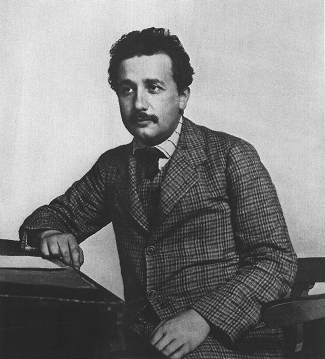
We should perhaps mention that this is the point in an astronomy course when many students start to feel a little nervous (and perhaps wish they had taken botany or some other earthbound course to satisfy the science requirement). This is because in popular culture, Einstein has become a symbol for mathematical brilliance that is simply beyond the reach of most people (Figure 24.2).
英語のヒント
天文学の授業でこのあたりまで来ると、少し不安になり始める学生が多いことに触れておこう。科学科目の単位を取るなら、植物学など、もっと地上に近い分野を選べばよかった、と思うかもしれない。一般に広まっているイメージのなかで、アインシュタインは、大半の人にはとても手の届かない数学的才能の象徴になっているからである(図24.2)。
Albert Einstein (1879–1955).アルベルト・アインシュタイン(1879〜1955年)
credit: NASA · NASA media use guidelines
Figure 24.2 This famous scientist, seen here younger than in the usual photos, has become a symbol for high intellect in popular culture. (credit: NASA)
図24.2 この有名な科学者は、一般に非常に高い知性の象徴となっている。ここでは、よく見かける写真よりも若い姿を写している。(提供:NASA)
So, when we wrote that the general theory of relativity was Einstein’s work, you may have worried just a bit, convinced that anything Einstein did must be beyond your understanding. This popular view is unfortunate and mistaken. Although the detailed calculations of general relativity do involve a good deal of higher mathematics, the basic ideas are not difficult to understand (and are, in fact, almost poetic in the way they give us a new perspective on the world). Moreover, general relativity goes beyond Newton’s famous “inverse-square” law of gravity; it helps explain how matter interacts with other matter in space and time. This explanatory power is one of the requirements that any successful scientific theory must meet.
英語のヒント
一般相対性理論はアインシュタインの仕事だと書いたのを見て、少し心配になったかもしれない。アインシュタインのやったことなら何でも自分には理解できないに違いない、と考えたのかもしれない。しかし、この広く流布した見方は、残念ながら誤っている。一般相対性理論の詳しい計算には、確かにかなりの高等数学が必要である。それでも、基本的な考え方を理解することは難しくない。実際、世界を新しい視点から眺めさせてくれるその考え方は、ほとんど詩的ですらある。さらに、一般相対性理論はニュートンの有名な重力の「逆二乗則」を越えて、空間と時間のなかで物質がほかの物質とどのように相互作用するのかを説明する力を持つ。このような説明能力は、科学理論が成功を収めるために満たさなければならない条件の一つである。
The Principle of Equivalence等価原理
The fundamental insight that led to the formulation of the general theory of relativity starts with a very simple thought: if you were able to jump off a high building and fall freely, you would not feel your own weight. In this chapter, we will describe how Einstein built on this idea to reach sweeping conclusions about the very fabric of space and time itself. He called it the “happiest thought of my life.”
英語のヒント
一般相対性理論の定式化につながった根本的な洞察は、ごく単純な考えから始まる。もし高い建物から飛び降り、自由落下できたなら、自分の重さを感じないだろう、という考えである。この章では、アインシュタインがこの考えをどう発展させ、空間と時間そのものの成り立ちについて広範な結論に到達したかを説明する。彼はこれを「人生で最も幸福な考え」と呼んだ。
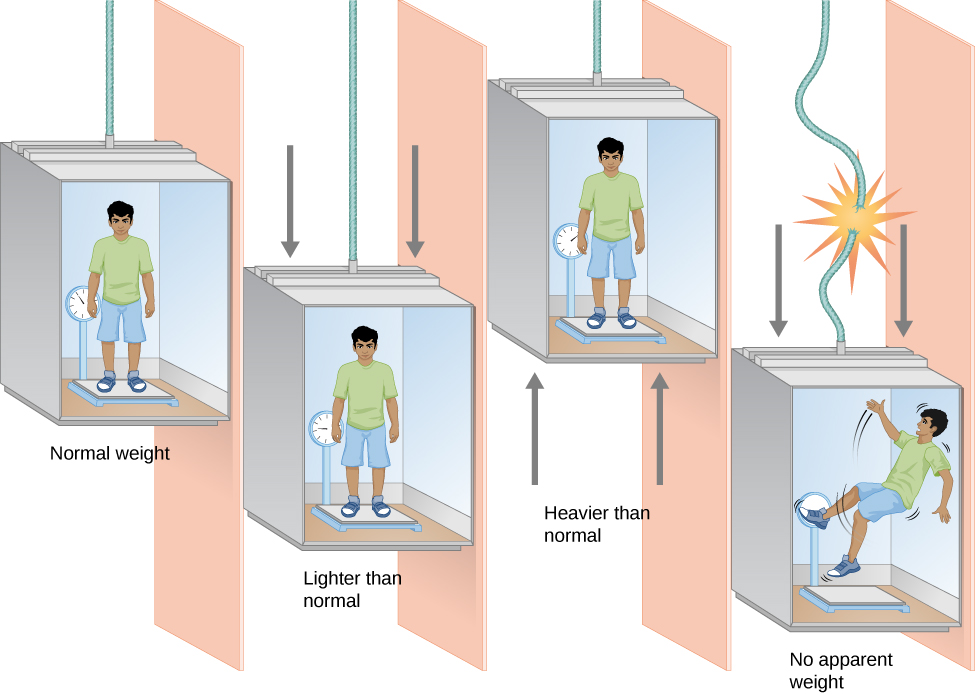
Einstein himself pointed out an everyday example that illustrates this effect (see Figure 24.3). Notice how your weight seems to be reduced in a high-speed elevator when it accelerates from a stop to a rapid descent. Similarly, your weight seems to increase in an elevator that starts to move quickly upward. This effect is not just a feeling you have: if you stood on a scale in such an elevator, you could measure your weight changing (you can actually perform this experiment in some science museums).
英語のヒント
アインシュタイン自身、この効果を示す日常の例を挙げている(図24.3)。高速エレベーターが停止状態から急速な下降へと加速するとき、自分が軽くなったように感じることに注目しよう。同様に、エレベーターが上向きに勢いよく動き始めると、自分が重くなったように感じる。この効果は単なる感覚ではない。そのエレベーターの中で体重計に乗れば、重さの変化を測定できる。実際、この実験を体験できる科学館もある。
Your Weight in an Elevator.エレベーターの中での重さ
OpenStax / Rice University · CC BY 4.0
Figure 24.3 In an elevator at rest, you feel your normal weight. In an elevator that accelerates as it descends, you would feel lighter than normal. In an elevator that accelerates as it ascends, you would feel heavier than normal. If an evil villain cut the elevator cable, you would feel weightless as you fell to your doom.
図24.3 停止したエレベーターの中では、通常どおりの重さを感じる。下降しながら下向きに加速するエレベーターでは、通常より軽く感じる。上昇しながら上向きに加速するエレベーターでは、通常より重く感じる。もし悪党がエレベーターのケーブルを切れば、最期に向かって落下する間、重さを感じなくなるだろう。
In a freely falling elevator, with no air friction, you would lose your weight altogether. We generally don’t like to cut the cables holding elevators to try this experiment, but near-weightlessness can be achieved by taking an airplane to high altitude and then dropping rapidly for a while. This is how NASA trains its astronauts for the experience of free fall in space; the scenes of weightlessness in the 1995 movie Apollo 13 were filmed in the same way. (Moviemakers have since devised other methods using underwater filming, wire stunts, and computer graphics to create the appearance of weightlessness seen in such movies as Gravity and The Martian.)
英語のヒント
空気との摩擦がなく、エレベーターが自由落下していれば、重さはまったく感じられなくなる。この実験のためにエレベーターを支えるケーブルを切りたいとは、普通は思わない。しかし、飛行機を高い高度まで上げ、その後しばらく急降下させれば、ほぼ無重量の状態を実現できる。NASAはこの方法で、宇宙での自由落下を体験する訓練を宇宙飛行士に行っている。1995年の映画『アポロ13』の無重力場面も、同じ方法で撮影された。その後、映画製作者は水中撮影、ワイヤーを使うスタント、コンピューター・グラフィックスによる別の手法も考案している。『ゼロ・グラビティ』や『オデッセイ』などの映画で見られる、無重力らしい映像はこうしてつくられている。
Another way to state Einstein’s idea is this: suppose we have a spaceship that contains a windowless laboratory equipped with all the tools needed to perform scientific experiments. Now, imagine that an astronomer wakes up after a long night celebrating some scientific breakthrough and finds herself sealed into this laboratory. She has no idea how it happened but notices that she is weightless. This could be because she and the laboratory are far away from any source of gravity, and both are either at rest or moving at some steady speed through space (in which case she has plenty of time to wake up). But it could also be because she and the laboratory are falling freely toward a planet like Earth (in which case she might first want to check her distance from the surface before making coffee).
英語のヒント
アインシュタインの考えを別の形で説明しよう。科学実験に必要な道具をすべて備えた、窓のない実験室を積んだ宇宙船を考える。ある女性天文学者が科学上の大発見を祝って長い夜を過ごし、目覚めたところ、その実験室に閉じ込められていたと想像してほしい。どうしてそうなったかはわからないが、自分が無重量状態であることには気づく。彼女と実験室が、あらゆる重力源から遠く離れ、ともに静止しているか、一定の速さで宇宙を進んでいるからかもしれない。この場合なら、ゆっくり目を覚ます時間は十分にある。しかし、彼女と実験室が地球のような惑星へ向かって自由落下しているからかもしれない。その場合、コーヒーをいれる前に、まず地表までの距離を確認したくなるだろう。
What Einstein postulated is that there is no experiment she can perform inside the sealed laboratory to determine whether she is floating in space or falling freely in a gravitational field.Strictly speaking, this is true only if the laboratory is infinitesimally small. Different locations in a real laboratory that is falling freely due to gravity cannot all be at identical distances from the object(s) responsible for producing the gravitational force. In this case, objects in different locations will experience slightly different accelerations. But this point does not invalidate the principle of equivalence that Einstein derived from this line of thinking. As far as she is concerned, the two situations are completely equivalent. This idea that free fall is indistinguishable from, and hence equivalent to, zero gravity is called the equivalence principle.
英語のヒント
アインシュタインが仮定したのは、密閉された実験室の内部でどんな実験をしても、自分が宇宙空間を漂っているのか、それとも重力場の中を自由落下しているのかを判定することはできない、ということである。厳密にいえば、これは実験室が無限小であるときにのみ成り立つ。重力によって自由落下している現実の実験室では、内部のすべての場所が、重力を生む天体から等しい距離にあるわけではない。その場合、異なる場所にある物体は、わずかに異なる加速度を受ける。しかし、この点によって、アインシュタインがこの考え方から導いた等価原理が無効になるわけではない。彼女自身にとっては、二つの状況はまったく等価である。自由落下は重力がない状態と区別できず、したがって両者は等価である、というこの考えを等価原理という。