第18章恒星――星の世界の実態を調べるThe Stars: A Celestial Census
Masses from the Orbits of Binary Stars連星の軌道から質量を求める
We can estimate the masses of binary star systems using Newton’s reformulation of Kepler’s third law (discussed in Newton’s Universal Law of Gravitation). Kepler found that the time a planet takes to go around the Sun is related by a specific mathematical formula to its distance from the Sun. In our binary star situation, if two objects are in mutual revolution, then the period (P) with which they go around each other is related to the semimajor axis (D) of the orbit of one with respect to the other, according to this equation
英語のヒント
「ニュートンの万有引力の法則」で扱った、ニュートンが書き直したケプラーの第3法則を使うと、連星系の質量を推定できる。ケプラーは、惑星が太陽を1周するのにかかる時間が、太陽までの距離と、ある特定の数式で結びつくことを発見した。連星の場合、二つの天体が互いのまわりを回っていれば、その周期Pと、一方を基準にした他方の軌道の長半径Dは、次の式で結ばれる。
where D is in astronomical units, P is measured in years, and M1 + M2 is the sum of the masses of the two stars in units of the Sun’s mass. This is a very useful formula for astronomers; it says that if we can observe the size of the orbit and the period of mutual revolution of the stars in a binary system, we can calculate the sum of their masses.
英語のヒント
ここでDの単位は天文単位、Pの単位は年、M₁ + M₂は太陽質量を単位として表した、二つの星の質量の合計である。この式は天文学者にとって非常に有用だ。連星系で軌道の大きさと、星が互いのまわりを回る周期を観測できれば、質量の合計を計算できることを示している。
Most spectroscopic binaries have periods ranging from a few days to a few months, with separations of usually less than 1 AU between their member stars. Recall that an AU is the distance from Earth to the Sun, so this is a small separation and very hard to see at the distances of stars. This is why many of these systems are known to be double only through careful study of their spectra.
英語のヒント
ほとんどの分光連星の周期は数日から数か月で、成分星どうしの間隔は通常1 AU未満である。1 AUは地球から太陽までの距離だと思い出そう。したがって間隔は小さく、恒星の距離では見分けるのが非常に難しい。このため、多くの系は、スペクトルを注意深く調べて初めて、二つの星からなるとわかる。
We can analyze a radial velocity curve (such as the one in Figure 18.7) to determine the masses of the stars in a spectroscopic binary. This is complex in practice but not hard in principle. We measure the speeds of the stars from the Doppler effect. We then determine the period—how long the stars take to go through an orbital cycle—from the velocity curve. Knowing how fast the stars are moving and how long they take to go around tells us the circumference of the orbit and, hence, the separation of the stars in kilometers or astronomical units. From Kepler’s law, the period and the separation allow us to calculate the sum of the stars’ masses.
英語のヒント
図18.7のような視線速度曲線を分析すれば、分光連星の恒星の質量を求められる。実際の作業は複雑だが、原理は難しくない。ドップラー効果から星の速さを測り、速度曲線から、軌道を1周するのにかかる時間、すなわち周期を決める。どれほど速く動き、1周にどれほどかかるかがわかれば、軌道の周長、したがって星どうしの間隔が、キロメートルや天文単位でわかる。ケプラーの法則により、周期と間隔から星の質量の合計を計算できる。
Of course, knowing the sum of the masses is not as useful as knowing the mass of each star separately. But the relative orbital speeds of the two stars can tell us how much of the total mass each star has. As we saw in our seesaw analogy, the more massive star is closer to the center of mass and therefore has a smaller orbit. Therefore, it moves more slowly to get around in the same time compared to the more distant, lower-mass star. If we sort out the speeds relative to each other, we can sort out the masses relative to each other. In practice, we also need to know how the binary system is oriented in the sky to our line of sight, but if we do, and the just-described steps are carried out carefully, the result is a calculation of the masses of each of the two stars in the system.
英語のヒント
もちろん、質量の合計がわかるだけでは、それぞれの星の質量が別々にわかるほど役立つわけではない。しかし、二つの星の相対的な軌道速度から、全質量のうち各星がどれだけを占めるかを知ることができる。シーソーのたとえで見たように、質量の大きい星は重心に近く、軌道も小さい。そのため、遠くを回る小質量の星と同じ時間で1周するには、ゆっくり動くことになる。互いに対する速度を求めれば、質量の比も求められる。実際には、空の連星系が私たちの視線に対してどの向きにあるかも知る必要がある。しかし、それがわかり、ここまで述べた手順を慎重に実行すれば、その系をなす二つの星それぞれの質量を計算できる。
To summarize, a good measurement of the motion of two stars around a common center of mass, combined with the laws of gravity, allows us to determine the masses of stars in such systems. These mass measurements are absolutely crucial to developing a theory of how stars evolve. One of the best things about this method is that it is independent of the location of the binary system. It works as well for stars 100 light-years away from us as for those in our immediate neighborhood.
英語のヒント
まとめると、共通の重心のまわりを動く二つの星の運動を正確に測り、重力の法則と組み合わせることで、そのような系の星の質量を求められる。こうした質量の測定は、恒星がどう進化するかという理論を組み立てるうえで極めて重要である。この方法の特に優れた点は、連星系の場所によらないことだ。すぐ近所の星にも、100光年離れた星にも、同じように使える。
To take a specific example, Sirius is one of the few binary stars in Appendix J for which we have enough information to apply Kepler’s third law:
英語のヒント
具体例を挙げると、シリウスは、付録Jにある連星のうち、ケプラーの第3法則を適用できるだけの情報がある数少ないものの一つである。
In this case, the two stars, the one we usually call Sirius and its very faint companion, are separated by about 20 AU and have an orbital period of about 50 years. If we place these values in the formula we would have
英語のヒント
この場合、普通シリウスと呼ぶ星と、その非常に暗い伴星は、約20 AU離れ、公転周期は約50年である。これらの値を式に代入すると、次のようになる。
This can be solved for the sum of the masses:
これを、質量の合計について解ける。
Therefore, the sum of masses of the two stars in the Sirius binary system is 3.2 times the Sun’s mass. In order to determine the individual mass of each star, we would need the velocities of the two stars and the orientation of the orbit relative to our line of sight.
英語のヒント
したがって、シリウス連星系の二つの星の質量の合計は、太陽質量の3.2倍である。各星の質量を個別に求めるには、両者の速度と、視線に対する軌道の向きが必要になる。
The Range of Stellar Masses恒星の質量の範囲
How large can the mass of a star be? Stars more massive than the Sun are rare. None of the stars within 30 light-years of the Sun has a mass greater than four times that of the Sun. Searches at large distances from the Sun have led to the discovery of a few stars with masses up to about 100 times that of the Sun, and a handful of stars (a few out of several billion) may have masses as large as 250 solar masses. However, most stars have less mass than the Sun.
英語のヒント
恒星の質量は、どこまで大きくなれるのだろうか。太陽より質量の大きい星は少ない。太陽から30光年以内には、太陽の4倍を超える質量の星はない。太陽から遠く離れた領域の探索で、最大約100太陽質量の星が少数見つかっている。数十億個のうち数個という、ほんの一握りの星は、250太陽質量にもなるかもしれない。しかし、ほとんどの恒星の質量は太陽より小さい。
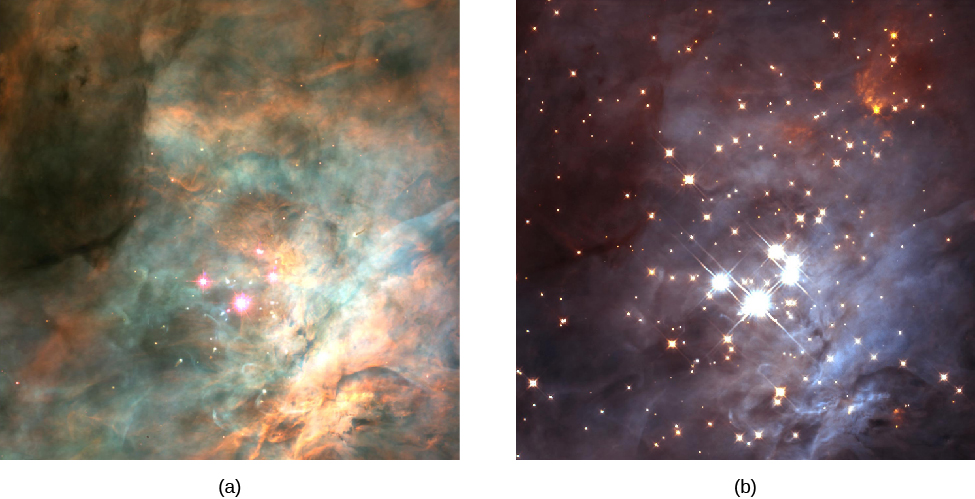
According to theoretical calculations, the smallest mass that a true star can have is about 1/12 that of the Sun. By a “true” star, astronomers mean one that becomes hot enough to fuse protons to form helium (as discussed in The Sun: A Nuclear Powerhouse). Objects with masses between roughly 1/100 and 1/12 that of the Sun may produce energy for a brief time by means of nuclear reactions involving deuterium, but they do not become hot enough to fuse protons. Such objects are intermediate in mass between stars and planets and have been given the name brown dwarfs (Figure 18.8). Brown dwarfs are similar to Jupiter in radius but have masses from approximately 13 to 80 times larger than the mass of Jupiter.Exactly where to put the dividing line between planets and brown dwarfs is a subject of some debate among astronomers as we write this book (as is, in fact, the exact definition of each of these objects). Even those who accept deuterium fusion (see The Birth of Stars and the Discovery of Planets outside the Solar System) as the crucial issue for brown dwarfs concede that, depending on the composition of the star and other factors, the lowest mass for such a dwarf could be anywhere from 11 to 16 Jupiter masses.
英語のヒント
理論計算によると、本当の恒星がもちうる最小質量は、太陽の約12分の1である。「本当の」恒星とは、「太陽――核エネルギーの源」で述べたように、陽子を融合させてヘリウムを作れるほど高温になる天体を指す。質量がおよそ太陽の100分の1から12分の1の天体は、重水素が関わる核反応によって短期間エネルギーを生むことはあるが、陽子を融合させるほど高温にはならない。このような天体は、恒星と惑星の中間の質量をもち、褐色矮星と名づけられている(図18.8)。半径は木星と同程度だが、質量は木星の約13〜80倍である。惑星と褐色矮星を分ける線を正確にどこに置くかは、本書の執筆時点でも、天文学者の間で議論されている。実際、それぞれの天体の厳密な定義自体もそうである。重水素核融合を褐色矮星の決定的な基準とする立場の人々でさえ、組成などの要因によって、最小質量は木星の11〜16倍のどこかになりうると認めている。重水素核融合については、「星の誕生と太陽系外惑星の発見」を参照してほしい。
Brown Dwarfs in Orion.オリオン座の褐色矮星
credit a: NASA, C.R. O’Dell and S.K. Wong (Rice University); credit b: NASA; K.L. Luhman (Harvard-Smithsonian Center for Astrophysics) and G. Schneider, E. Young, G. Rieke, A. Cotera, H. Chen, M. Rieke, R. Thompson (Steward Observatory) · NASA media use guidelines
Figure 18.8 These images, taken with the Hubble Space Telescope, show the region surrounding the Trapezium star cluster inside the star-forming region called the Orion Nebula. (a) No brown dwarfs are seen in the visible light image, both because they put out very little light in the visible and because they are hidden within the clouds of dust in this region. (b) This image was taken in infrared light, which can make its way to us through the dust. The faintest objects in this image are brown dwarfs with masses between 13 and 80 times the mass of Jupiter. (credit a: NASA, C.R. O’Dell and S.K. Wong (Rice University); credit b: NASA; K.L. Luhman (Harvard-Smithsonian Center for Astrophysics) and G. Schneider, E. Young, G. Rieke, A. Cotera, H. Chen, M. Rieke, R. Thompson (Steward Observatory))
図18.8 ハッブル宇宙望遠鏡で撮影した、オリオン大星雲という星形成領域の内部にある、トラペジウム星団の周囲の画像。(a)の可視光画像では褐色矮星が見えない。可視光をほとんど放たないことと、この領域の塵の雲の中に隠れていることの両方が理由である。(b)は、塵を通り抜けて私たちに届く赤外線で撮影したもの。画像で最も暗い天体は、木星の13〜80倍の質量をもつ褐色矮星である。(a提供:NASA、C.R. O’Dell、S.K. Wong〔ライス大学〕。b提供:NASA、K.L. Luhman〔ハーバード・スミソニアン天体物理学センター〕、G. Schneider、E. Young、G. Rieke、A. Cotera、H. Chen、M. Rieke、R. Thompson〔スチュワード天文台〕)
Still-smaller objects with masses less than about 1/100 the mass of the Sun (or 10 Jupiter masses) are called planets. They may radiate energy produced by the radioactive elements that they contain, and they may also radiate heat generated by slowly compressing under their own weight (a process called gravitational contraction). However, their interiors will never reach temperatures high enough for any nuclear reactions, to take place. Jupiter, whose mass is about 1/1000 the mass of the Sun, is unquestionably a planet, for example. Until the 1990s, we could only detect planets in our own solar system, but now we have thousands of them elsewhere as well. (We will discuss these exciting observations in The Birth of Stars and the Discovery of Planets outside the Solar System.)
英語のヒント
さらに小さく、質量が太陽の約100分の1、または木星の10倍未満の天体は、惑星と呼ばれる。内部に含む放射性元素が生み出すエネルギーを放射する場合も、自分の重さでゆっくり圧縮される重力収縮という過程で生じた熱を放射する場合もある。しかし、内部の温度が、何らかの核反応を起こせるほど高くなることはない。たとえば質量が太陽の約1000分の1の木星は、間違いなく惑星である。1990年代までは、惑星を検出できるのは太陽系内だけだったが、今では太陽系外でも数千個が見つかっている。これらの興味深い観測については、「星の誕生と太陽系外惑星の発見」で扱う。