第18章恒星――星の世界の実態を調べるThe Stars: A Celestial Census
18.3 Diameters of Stars18.3 恒星の直径
Learning Objectives学習の目標
By the end of this section, you will be able to:
この節を読み終えたら、次のことができるようになる。
Describe the methods used to determine star diameters
恒星の直径を求める方法を説明する。
Identify the parts of an eclipsing binary star light curve that correspond to the diameters of the individual components
食連星の光度曲線のどの部分が、各成分星の直径に対応するかを見分ける。
It is easy to measure the diameter of the Sun. Its angular diameter—that is, its apparent size on the sky—is about 1/2°. If we know the angle the Sun takes up in the sky and how far away it is, we can calculate its true (linear) diameter, which is 1.39 million kilometers, or about 109 times the diameter of Earth.
英語のヒント
太陽の直径を測るのは簡単である。角直径、つまり空での見かけの大きさは約1/2°だ。太陽が空で占める角度と、太陽までの距離がわかれば、本当の直径を長さとして計算できる。その値は139万キロメートル、地球の直径の約109倍である。
Unfortunately, the Sun is the only star whose angular diameter is easily measured. All the other stars are so far away that they look like pinpoints of light through even the largest ground-based telescopes. (They often seem to be bigger, but that is merely distortion introduced by turbulence in Earth’s atmosphere.) Luckily, there are several techniques that astronomers can use to estimate the sizes of stars.
英語のヒント
残念ながら、角直径を簡単に測れる恒星は太陽だけである。ほかの恒星はどれも非常に遠く、地上最大の望遠鏡を通しても、針先ほどの光の点に見える。もっと大きく見えることも多いが、それは地球大気の乱流による像のゆがみにすぎない。幸い、恒星の大きさを推定するために使える方法がいくつかある。
Stars Blocked by the Moon月に隠される恒星
One technique, which gives very precise diameters but can be used for only a few stars, is to observe the dimming of light that occurs when the Moon passes in front of a star. What astronomers measure (with great precision) is the time required for the star’s brightness to drop to zero as the edge of the Moon moves across the star’s disk. Since we know how rapidly the Moon moves in its orbit around Earth, it is possible to calculate the angular diameter of the star. If the distance to the star is also known, we can calculate its diameter in kilometers. This method works only for fairly bright stars that happen to lie along the zodiac, where the Moon (or, much more rarely, a planet) can pass in front of them as seen from Earth.
英語のヒント
非常に正確な直径が得られるが、ごく少数の星にしか使えない方法の一つが、月が星の前を通る際の減光の観測である。天文学者が高い精度で測るのは、月の縁が星の円盤を横切り、星の明るさがゼロまで下がるのに必要な時間だ。月が地球のまわりの軌道を動く速さはわかっているため、星の角直径を計算できる。星までの距離もわかっていれば、直径をキロメートル単位で計算できる。この方法を使えるのは、たまたま黄道帯に沿って位置する、かなり明るい星だけである。その位置なら、地球から見て、月や、ずっとまれには惑星が、星の前を通れるからだ。
Eclipsing Binary Stars食連星
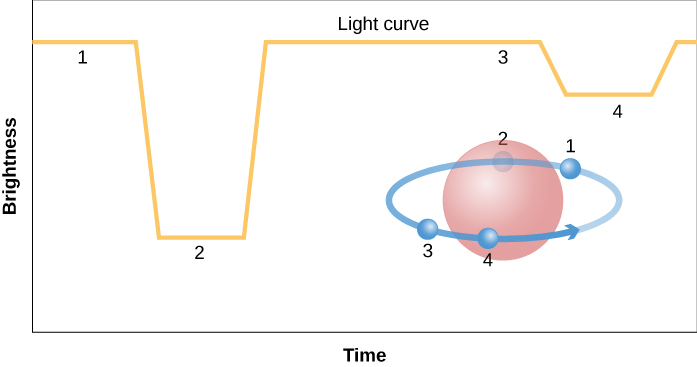
Accurate sizes for a large number of stars come from measurements of eclipsing binary star systems, and so we must make a brief detour from our main story to examine this type of star system. Some binary stars are lined up in such a way that, when viewed from Earth, each star passes in front of the other during every revolution (Figure 18.10). When one star blocks the light of the other, preventing it from reaching Earth, the brightness of the system decreases, and astronomers say that an eclipse has occurred.
英語のヒント
多数の恒星の正確な大きさは、食連星系の測定から得られる。そのため、少し本筋から寄り道し、この種の星の系を調べよう。連星の中には、地球から見ると、1周するたびにそれぞれの星が他方の前を通る向きに並んだものがある(図18.10)。一方の星が他方の光を遮り、地球まで届かなくすると、系の明るさが下がる。天文学者はこれを、食が起きたという。
Light Curve of an Eclipsing Binary.食連星の光度曲線
OpenStax / Rice University · CC BY 4.0
Figure 18.10 The light curve of an eclipsing binary star system shows how the combined light from both stars changes due to eclipses over the time span of an orbit. This light curve shows the behavior of a hypothetical eclipsing binary star with total eclipses (one star passes directly in front of and behind the other). The numbers indicate parts of the light curve corresponding to various positions of the smaller star in its orbit. In this diagram, we have assumed that the smaller star is also the hotter one so that it emits more flux (energy per second per square meter) than the larger one. When the smaller, hotter star goes behind the larger one, its light is completely blocked, and so there is a strong dip in the light curve. When the smaller star goes in front of the bigger one, a small amount of light from the bigger star is blocked, so there is a smaller dip in the light curve.
図18.10 食連星系の光度曲線は、1公転の間に、二つの星を合わせた光が食によってどう変わるかを示す。この曲線は、一方が他方の正面と真後ろを通る、皆既食を伴う仮想的な食連星の振る舞いである。数字は、小さい星の軌道上の各位置に対応する、光度曲線の部分を示す。ここでは、小さい星のほうが高温でもあり、大きい星より大きな放射流束、すなわち1秒・1平方メートルあたりの放射エネルギーを放つと仮定した。小さく高温の星が大きい星の後ろへ行くと、その光は完全に遮られ、光度曲線は大きく落ち込む。小さい星が大きい星の前へ来ると、大きい星からの光の一部が遮られるだけなので、落ち込みは小さい。
The discovery of the first eclipsing binary helped solve a long-standing puzzle in astronomy. The star Algol, in the constellation of Perseus, changes its brightness in an odd but regular way. Normally, Algol is a fairly bright star, but at intervals of 2 days, 20 hours, 49 minutes, it fades to one-third of its regular brightness. After a few hours, it brightens to normal again. This effect is easily seen, even without a telescope, if you know what to look for.
英語のヒント
最初の食連星の発見は、天文学の長年の謎を解く助けになった。ペルセウス座のアルゴルは、奇妙だが規則的に明るさを変える。通常はかなり明るい星だが、2日20時間49分ごとに、普段の3分の1の明るさまで暗くなる。数時間後には、再び元の明るさに戻る。何に注目すればよいかがわかれば、この変化は望遠鏡なしでも容易に見られる。
In 1783, a young English astronomer named John Goodricke (1764–1786) made a careful study of Algol (see the feature on John Goodricke for a discussion of his life and work). Even though Goodricke could neither hear nor speak, he made a number of major discoveries in the 21 years of his brief life. He suggested that Algol’s unusual brightness variations might be due to an invisible companion that regularly passes in front of the brighter star and blocks its light. Unfortunately, Goodricke had no way to test this idea, since it was not until about a century later that equipment became good enough to measure Algol’s spectrum.
英語のヒント
1783年、ジョン・グッドリック(1764–1786年)という若いイギリスの天文学者が、アルゴルを綿密に研究した。生涯と仕事は、特集「ジョン・グッドリック」を参照してほしい。グッドリックは聞くことも話すこともできなかったが、21年という短い生涯に、多くの重要な発見をした。アルゴルの特異な明るさの変化は、見えない伴星が規則的に明るい星の前を通り、光を遮るためではないかと提案した。残念ながら、その考えを確かめる方法はなかった。アルゴルのスペクトルを測れるほど装置がよくなるには、その後約1世紀を要したためである。
In 1889, the German astronomer Hermann Vogel (1841–1907) demonstrated that, like Mizar, Algol is a spectroscopic binary. The spectral lines of Algol were not observed to be double because the fainter star of the pair gives off too-little light compared with the brighter star for its lines to be conspicuous in the composite spectrum. Nevertheless, the periodic shifting back and forth of the brighter star’s lines gave evidence that it was revolving about an unseen companion. (The lines of both components need not be visible for a star to be recognized as a spectroscopic binary.)
英語のヒント
1889年、ドイツの天文学者ヘルマン・フォーゲル(1841–1907年)は、アルゴルもミザールと同じく分光連星であることを示した。アルゴルのスペクトル線は二重には見えなかった。暗い星が放つ光が明るい星に比べて少なすぎ、合成スペクトルの中で、その線が目立たないためである。それでも、明るい星の線が周期的に往復してずれることが、見えない伴星のまわりを回っている証拠になった。分光連星と認めるために、両成分星の線が見える必要はない。
The discovery that Algol is a spectroscopic binary verified Goodricke’s hypothesis. The plane in which the stars revolve is turned nearly edgewise to our line of sight, and each star passes in front of the other during every revolution. (The eclipse of the fainter star in the Algol system is not very noticeable because the part of it that is covered contributes little to the total light of the system. This second eclipse can, however, be detected by careful measurements.)
英語のヒント
アルゴルが分光連星であるという発見で、グッドリックの仮説は確かめられた。星が公転する面は、私たちの視線に対してほぼ真横から見る向きになっており、1公転の間に各星が他方の前を通る。アルゴル系で暗い星が隠される食は、あまり目立たない。隠される部分が系全体の光に占める割合が、小さいためである。それでも、注意深く測定すれば、この2回目の食も検出できる。
Any binary star produces eclipses if viewed from the proper direction, near the plane of its orbit, so that one star passes in front of the other (see Figure 18.10). But from our vantage point on Earth, only a small percentage of binary star systems are oriented in this way.
英語のヒント
どの連星でも、軌道面に近い適切な方向から見れば、一方の星が他方の前を通るので食が起きる(図18.10)。しかし地球上の私たちの観測地点から見ると、その向きに並んでいる連星系は、ごく一部である。