第18章恒星――星の世界の実態を調べるThe Stars: A Celestial Census
18.1 A Stellar Census18.1 恒星の実態を調べる
Learning Objectives学習の目標
By the end of this section, you will be able to:
この節を読み終えたら、次のことができるようになる。
Explain why the stars visible to the unaided eye are not typical
肉眼で見える恒星が典型的な恒星ではない理由を説明する。
Describe the distribution of stellar masses found close to the Sun
太陽の近くに見られる恒星の質量分布を説明する。
Before we can make our own survey, we need to agree on a unit of distance appropriate to the objects we are studying. The stars are all so far away that kilometers (and even astronomical units) would be very cumbersome to use; so—as discussed in Science and the Universe: A Brief Tour—astronomers use a much larger “measuring stick” called the light-year. A light-year is the distance that light (the fastest signal we know) travels in 1 year. Since light covers an astounding 300,000 kilometers per second, and since there are a lot of seconds in 1 year, a light-year is a very large quantity: 9.5 trillion kilometers to be exact. (Bear in mind that the light-year is a unit of distance even though the term year appears in it.) If you drove at the legal US speed limit without stopping for food or rest, you would not arrive at the end of a light-year in space until roughly 12 million years had passed. And the closest star is more than 4 light-years away.
英語のヒント
自分たちの調査を始める前に、調べる天体に適した距離の単位を決める必要がある。恒星はどれも非常に遠いため、キロメートル、さらには天文単位でさえ、使うには大変扱いにくい。そこで「科学と宇宙――ひとめぐり」で述べたように、天文学者は光年という、ずっと大きな「物差し」を使う。光年とは、知られている中で最も速い信号である光が、1年間に進む距離である。光は毎秒30万キロメートルという驚くべき距離を進み、1年は非常に多くの秒からなる。そのため1光年は極めて大きく、具体的には9兆5000億キロメートルに相当する。「年」という語が入っていても、光年は距離の単位であることを覚えておこう。食事も休憩もせず、アメリカの法定最高速度で車を走らせても、宇宙で1光年先に着くまでには、およそ1200万年かかる。そして、最も近い恒星でも4光年以上離れている。
Notice that we have not yet said much about how such enormous distances can be measured. That is a complicated question, to which we will return in Celestial Distances. For now, let us assume that distances have been measured for stars in our cosmic vicinity so that we can proceed with our census.
英語のヒント
これほど膨大な距離をどう測るのかについては、まだほとんど述べていないことに注意しよう。これは複雑な問題なので、「天体までの距離」で戻る。今は、宇宙の近所にある星までの距離は測定済みだと仮定し、実態調査を進めよう。
Small Is Beautiful—Or at Least More Common小さいことは美しい――少なくとも、数は多い
When we do a census of people in the United States, we count the inhabitants by neighborhood. We can try the same approach for our stellar census and begin with our own immediate neighborhood. As we shall see, we run into two problems—just as we do with a census of human beings. First, it is hard to be sure we have counted all the inhabitants; second, our local neighborhood may not contain all possible types of people.
英語のヒント
アメリカで人口調査をするときは、地域ごとに住民を数える。恒星の調査でも同じ方法を試し、まず身近な近所から始められる。これから見るように、人間の人口調査と同じく、二つの問題にぶつかる。第一に、すべての住民を数えたと確信するのは難しい。第二に、近所だけでは、あらゆる種類の人がそろわないかもしれない。
Table 18.1 shows an estimate of the number of stars of each spectral typeThe spectral types of stars were defined and discussed in Analyzing Starlight. in our own local neighborhood—within 21 light-years of the Sun. (The Milky Way Galaxy, in which we live, is about 100,000 light-years in diameter, so this figure really applies to a very local neighborhood, one that contains a tiny fraction of all the billions of stars in the Milky Way.) You can see that there are many more low-luminosity (and hence low mass) stars than high-luminosity ones. Only three of the stars in our local neighborhood (one F type and two A types) are significantly more luminous and more massive than the Sun. This is truly a case where small triumphs over large—at least in terms of numbers. The Sun is more massive than the vast majority of stars in our vicinity.
英語のヒント
表18.1は、太陽から21光年以内という身近な範囲で、スペクトル型ごとの恒星の数を推定したものである。私たちが住む天の川銀河の直径は約10万光年なので、この数値はまさにごく近所だけに当てはまり、天の川銀河の何十億もの星のうち、ほんの一部しか含まない。光度が低く、したがって質量も小さい恒星は、光度が高い星より、はるかに多いことがわかる。近所の恒星のうち、太陽より明らかに光度も質量も大きいのは、F型1個とA型2個の計3個だけである。少なくとも数のうえでは、小さいものが大きいものに勝つ、まさにそのような例だ。太陽は、近所の恒星の大多数よりも質量が大きい。恒星のスペクトル型の定義と説明は、「星の光を分析する」で扱った。
Stars within 21 Light-Years of the Sun 太陽から21光年以内の恒星 |
|
|---|---|
Spectral Type スペクトル型 |
Number of Stars 恒星の数 |
| A | 2 |
| F | 1 |
| G | 7 |
| K | 17 |
| M | 94 |
White dwarfs 白色矮星 |
8 |
Brown dwarfs 褐色矮星 |
33 |
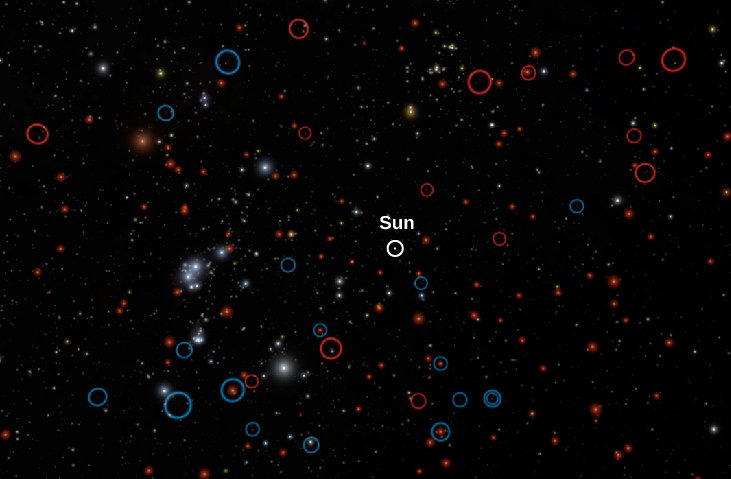
This table is based on data published through 2015, and it is likely that more faint objects remain to be discovered (see Figure 18.2). Along with the L and T brown dwarfs already observed in our neighborhood, astronomers expect to find perhaps hundreds of additional T dwarfs and Y dwarfs. Many of these are likely to be even cooler than the coolest currently known T dwarf. The reason the lowest-mass dwarfs are so hard to find is that they put out very little light—ten thousand to a million times less light than the Sun. Only recently has our technology progressed to the point that we can detect these dim, cool objects.
英語のヒント
この表は2015年までに公表されたデータに基づき、さらに暗い天体がまだ発見を待っていると考えられる(図18.2)。近所ですでに観測されているL型・T型褐色矮星に加え、おそらく数百個ものT型・Y型矮星が見つかると、天文学者は予想している。その多くは、現在知られる最も低温のT型矮星より、さらに低温だろう。最小質量の矮星を見つけるのがこれほど難しいのは、太陽の1万分の1から100万分の1という、ごくわずかな光しか放たないためである。こうした暗く低温の天体を検出できるまで技術が進んだのは、ごく最近のことだ。
Dwarf Simulation.矮星のシミュレーション
credit: modification of work by NASA/ JPL-Caltech · JPL image use policy
Figure 18.2 This computer simulation shows the stars in our neighborhood as they would be seen from a distance of 30 light-years away. The Sun is in the center. All the brown dwarfs are circled; those found earlier are circled in blue, the ones found recently with the WISE infrared telescope in space (whose scientists put this diagram together) are circled in red. The common M stars, which are red and faint, are made to look brighter than they really would be so that you can see them in the simulation. Note that luminous hot stars like our Sun are very rare. (credit: modification of work by NASA/ JPL-Caltech)
図18.2 このコンピューターシミュレーションは、私たちの近所の恒星が30光年の距離からどう見えるかを示す。中央が太陽である。褐色矮星はすべて丸で囲み、以前に見つかったものは青、宇宙のWISE赤外線望遠鏡で最近見つかったものは赤にしてある。この図をまとめたのは、WISEの科学者たちである。数の多いM型星は赤く暗いため、シミュレーションで見えるよう、実際より明るく描いてある。太陽のように光度が高く高温の恒星が、非常に少ないことに注目しよう。(提供:NASA/JPL-Caltechの画像を改変)
To put all this in perspective, we note that even though the stars counted in the table are our closest neighbors, you can’t just look up at the night sky and see them without a telescope; stars fainter than the Sun cannot be seen with the unaided eye unless they are very nearby. For example, stars with luminosities ranging from 1/100 to 1/10,000 the luminosity of the Sun (LSun) are very common, but a star with a luminosity of 1/100 LSun would have to be within 5 light-years to be visible to the naked eye—and only three stars (all in one system) are this close to us. The nearest of these three stars, Proxima Centauri, still cannot be seen without a telescope because it has such a low luminosity.
英語のヒント
これらを正しく捉えるために、表で数えた恒星は最も近い隣人なのに、ただ夜空を見上げるだけでは、望遠鏡なしに見えないことに注意しよう。太陽より光度の低い恒星は、ごく近くにないかぎり肉眼では見えない。たとえば、光度が太陽の100分の1から1万分の1の恒星は非常に多い。太陽の光度をL☉とすると、光度が1/100 L☉の恒星を肉眼で見るには、5光年以内にある必要がある。これほど近い星は、すべて同じ一つの系に属する3個だけだ。その3個で最も近いプロキシマ・ケンタウリでさえ、光度が非常に低いため、望遠鏡なしでは見えない。
Astronomers are working hard these days to complete the census of our local neighborhood by finding our faintest neighbors. Recent discoveries of nearby stars have relied heavily upon infrared telescopes that are able to find these many cool, low-mass stars. You should expect the number of known stars within 21 light-years of the Sun to keep increasing as more and better surveys are undertaken.
英語のヒント
近年、天文学者は、最も暗い隣人を見つけて近所の実態調査を完成させようと懸命に取り組んでいる。近くの恒星の最近の発見では、多数の低温・小質量星を見つけられる赤外線望遠鏡が大きな役割を果たしてきた。より多くの、より優れたサーベイが行われるにつれ、太陽から21光年以内で知られる恒星の数は増え続けると予想される。