第18章恒星――星の世界の実態を調べるThe Stars: A Celestial Census
18.2 Measuring Stellar Masses18.2 恒星の質量を測る
Learning Objectives学習の目標
By the end of this section, you will be able to:
この節を読み終えたら、次のことができるようになる。
Distinguish the different types of binary star systems
連星系のさまざまな種類を区別する。
Understand how we can apply Newton’s version of Kepler’s third law to derive the sum of star masses in a binary star system
ニュートンによるケプラーの第3法則の形を使い、連星系の恒星の質量の合計を求める方法を理解する。
Apply the relationship between stellar mass and stellar luminosity to determine the physical characteristics of a star
恒星の質量と光度の関係を使い、星の物理的性質を求める。
The mass of a star—how much material it contains—is one of its most important characteristics. If we know a star’s mass, as we shall see, we can estimate how long it will shine and what its ultimate fate will be. Yet the mass of a star is very difficult to measure directly. Somehow, we need to put a star on the cosmic equivalent of a scale.
英語のヒント
恒星の質量、すなわち含まれる物質の量は、最も重要な性質の一つである。これから見るように、質量がわかれば、その星がいつまで輝くか、最終的にどんな運命をたどるかを推定できる。しかし、恒星の質量を直接測ることは非常に難しい。何とかして、宇宙のはかりに相当するものへ、星を載せる必要がある。
Luckily, not all stars live like the Sun, in isolation from other stars. About half the stars are binary stars—two stars that orbit each other, bound together by gravity. Masses of binary stars can be calculated from measurements of their orbits, just as the mass of the Sun can be derived by measuring the orbits of the planets around it (see Orbits and Gravity).
英語のヒント
幸い、すべての星が太陽のように、ほかの星から孤立しているわけではない。恒星のおよそ半分は、重力で結びつき、互いのまわりを回る二つの星、すなわち連星である。連星の質量は、その軌道の測定から計算できる。太陽の質量を、太陽のまわりを回る惑星の軌道から求められるのと同じである。「軌道と重力」を参照してほしい。
Binary Stars連星
Before we discuss in more detail how mass can be measured, we will take a closer look at stars that come in pairs. The first binary star was discovered in 1650, less than half a century after Galileo began to observe the sky with a telescope. Giovanni Battista Riccioli (1598–1671), an Italian astronomer, noted that the star Mizar, in the middle of the Big Dipper’s handle, appeared through his telescope as two stars. Since that discovery, thousands of binary stars have been cataloged. (Astronomers call any pair of stars that appear to be close to each other in the sky double stars, but not all of these form a true binary, that is, not all of them are physically associated. Some are just chance alignments of stars that are actually at different distances from us.) Although stars most commonly come in pairs, there are also triple and quadruple systems.
英語のヒント
質量の測定方法を詳しく説明する前に、対になった星をもう少しよく見てみよう。最初の連星は、ガリレオが望遠鏡で空を観測し始めてから半世紀もたたない1650年に発見された。イタリアの天文学者ジョヴァンニ・バッティスタ・リッチョーリ(1598–1671年)は、北斗七星の柄の中央にあるミザールを望遠鏡で見ると、二つの星に見えることに気づいた。その発見以来、数千組の連星がカタログに記録された。天文学者は、空で互いに近くに見える星の対をすべて二重星と呼ぶ。しかし、どれも本当の連星をなすわけではなく、すべてが物理的に結びついているのではない。実際には私たちからの距離が違い、たまたま並んで見えるだけのものもある。星は対になることが最も多いが、三重星系や四重星系もある。
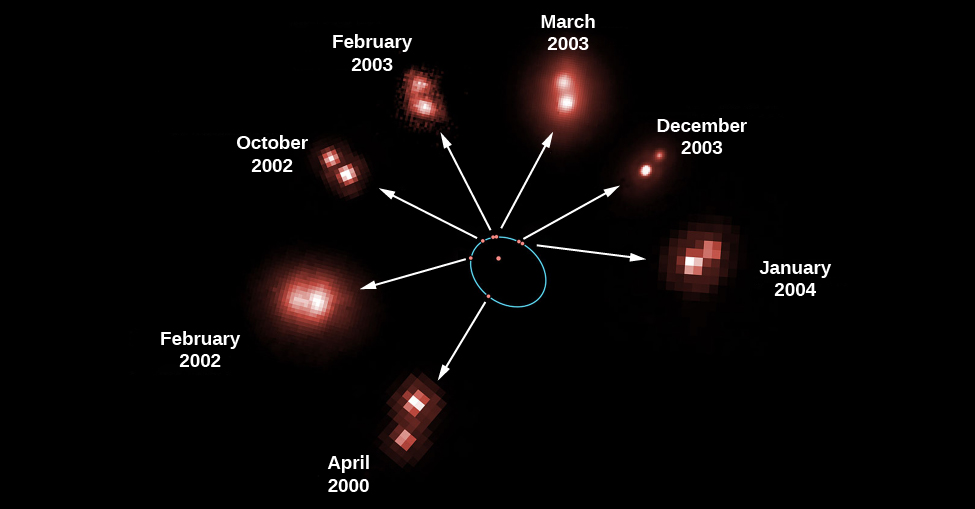
One well-known binary star is Castor, located in the constellation of Gemini. By 1804, astronomer William Herschel, who also discovered the planet Uranus, had noted that the fainter component of Castor had slightly changed its position relative to the brighter component. (We use the term “component” to mean a member of a star system.) Here was evidence that one star was moving around another. It was actually the first evidence that gravitational influences exist outside the solar system. The orbital motion of a binary star is shown in Figure 18.4. A binary star system in which both of the stars can be seen with a telescope is called a visual binary.
英語のヒント
有名な連星の一つが、ふたご座のカストルである。天王星の発見者でもあるウィリアム・ハーシェルは、1804年までに、カストルの暗いほうの星が、明るいほうに対する位置をわずかに変えたと気づいていた。ここで「成分星」とは、星の系を構成する星のことである。これは、一つの星が別の星のまわりを動く証拠だった。実際、太陽系の外でも重力の作用が存在する、初めての証拠だった。連星の軌道運動を図18.4に示す。両方の恒星を望遠鏡で見られる連星系を、実視連星という。
Revolution of a Binary Star.連星の公転
credit: modification of work by ESA/NASA and Herve Bouy (Max-Planck-Institut für Extraterrestrische Physik/ESO, Germany) · CC BY 4.0
Figure 18.4 This figure shows seven observations of the mutual revolution of two stars, one a brown dwarf and one an ultra-cool L dwarf. Each red dot on the orbit, which is shown by the blue ellipse, corresponds to the position of one of the dwarfs relative to the other. The reason that the pair of stars looks different on the different dates is that some images were taken with the Hubble Space Telescope and others were taken from the ground. The arrows point to the actual observations that correspond to the positions of each red dot. From these observations, an international team of astronomers directly measured the mass of an ultra-cool brown dwarf star for the first time. Barely the size of the planet Jupiter, the dwarf star weighs in at just 8.5% of the mass of our Sun. (credit: modification of work by ESA/NASA and Herve Bouy (Max-Planck-Institut für Extraterrestrische Physik/ESO, Germany))
図18.4 この図は、褐色矮星と超低温L型矮星という二つの星の、互いのまわりを回る運動を7回観測したもの。青い楕円で示す軌道上の各赤点は、片方の矮星を基準とした、もう一方の位置に対応する。日付によって星の対の見え方が異なるのは、一部の画像はハッブル宇宙望遠鏡で、ほかは地上から撮影したためである。矢印は各赤点の位置に対応する実際の観測画像を指す。この観測から、国際研究チームは超低温の褐色矮星の質量を初めて直接測定した。木星ほどの大きさしかないのに、その質量は太陽の8.5%に当たる。(提供:ESA/NASA、Herve Bouy〔マックス・プランク地球外物理学研究所/ESO、ドイツ〕の画像を改変)
Edward C. Pickering (1846–1919), at Harvard, discovered a second class of binary stars in 1889—a class in which only one of the stars is actually seen directly. He was examining the spectrum of Mizar and found that the dark absorption lines in the brighter star’s spectrum were usually double. Not only were there two lines where astronomers normally saw only one, but the spacing of the lines was constantly changing. At times, the lines even became single. Pickering correctly deduced that the brighter component of Mizar, called Mizar A, is itself really two stars that revolve about each other in a period of 20.54 days. A star like Mizar A, which appears as a single star when photographed or observed visually through the telescope, but which spectroscopy shows really to be a double star, is called a spectroscopic binary.
英語のヒント
ハーバードのエドワード・C・ピカリング(1846–1919年)は、1889年に、実際には片方の恒星しか直接見えないという、第2の種類の連星を発見した。ミザールのスペクトルを調べたところ、明るいほうの星の暗い吸収線が、通常は二重になっていた。普通なら1本しか見えないところに2本の線があるだけでなく、線の間隔も絶えず変わっていた。時には、線が1本に重なることさえあった。ピカリングは、ミザールAと呼ばれる明るい成分星自体が、実際には20.54日の周期で互いのまわりを回る二つの星だと、正しく推論した。ミザールAのように、望遠鏡で写真を撮ったり目で観測したりすると一つの星に見えるのに、分光法では実際に二重の星だとわかるものを、分光連星という。
Mizar, by the way, is a good example of just how complex such star systems can be. Mizar has been known for centuries to have a faint companion called Alcor, which can be seen without a telescope. Mizar and Alcor form an optical double—a pair of stars that appear close together in the sky but do not orbit each other. Through a telescope, as Riccioli discovered in 1650, Mizar can be seen to have another, closer companion that does orbit it; Mizar is thus a visual binary. The two components that make up this visual binary, known as Mizar A and Mizar B, are both spectroscopic binaries. So, Mizar is really a quadruple system of stars.
英語のヒント
ちなみにミザールは、このような星の系がどれほど複雑になりうるかを示すよい例である。ミザールには、望遠鏡なしでも見えるアルコルという暗い伴星があることが、何世紀も前から知られていた。ミザールとアルコルは、空で近くに見えるが互いのまわりを回らない星の対、すなわち見かけの二重星をなす。1650年にリッチョーリが発見したように、望遠鏡で見ると、ミザールにはさらに近く、実際にそのまわりを回る別の伴星があるとわかる。そのためミザールは実視連星である。この実視連星を作るミザールAとBは、どちらも分光連星だ。したがってミザールは、実際には四重星系である。
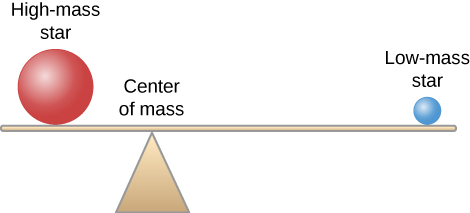
Strictly speaking, it is not correct to describe the motion of a binary star system by saying that one star orbits the other. Gravity is a mutual attraction. Each star exerts a gravitational force on the other, with the result that both stars orbit a point between them called the center of mass. Imagine that the two stars are seated at either end of a seesaw. The point at which the fulcrum would have to be located in order for the seesaw to balance is the center of mass, and it is always closer to the more massive star (Figure 18.5).
英語のヒント
厳密にいえば、連星系の運動を、一方の星が他方のまわりを回ると説明するのは正しくない。重力は互いに引き合う力である。それぞれの星が他方に重力を及ぼすため、両方の星が、その間にある重心という点のまわりを回る。二つの星がシーソーの両端に座っていると想像しよう。シーソーが釣り合うように支点を置くべき位置が重心であり、それは必ず、質量の大きい星の近くにある(図18.5)。
Binary Star System.連星系
OpenStax / Rice University · CC BY 4.0
Figure 18.5 In a binary star system, both stars orbit their center of mass. The image shows the relative positions of two, different-mass stars from their center of mass, similar to how two masses would have to be located on a seesaw in order to keep it level. The star with the higher mass will be found closer to the center of mass, while the star with the lower mass will be farther from it.
図18.5 連星系では、両方の星が重心のまわりを回る。図は、質量の異なる二つの星の重心に対する位置関係を示す。二つのおもりでシーソーを水平に保つときの置き方と同じである。質量の大きい星は重心に近く、小さい星は重心から遠くなる。
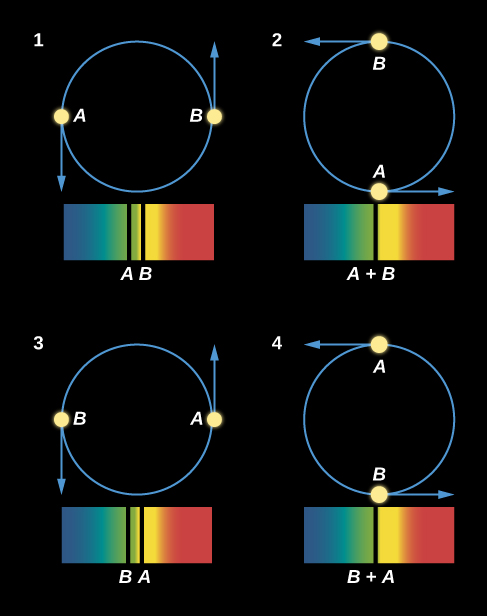
Figure 18.6 shows two stars (A and B) moving around their center of mass, along with one line in the spectrum of each star that we observe from the system at different times. When one star is approaching us relative to the center of mass, the other star is receding from us. In the top left illustration, star A is moving toward us, so the line in its spectrum is Doppler-shifted toward the blue end of the spectrum. Star B is moving away from us, so its line shows a redshift. When we observe the composite spectrum of the two stars, the line appears double. When the two stars are both moving across our line of sight (neither away from nor toward us), they both have the same radial velocity (that of the pair’s center of mass); hence, the spectral lines of the two stars come together. This is shown in the two bottom illustrations in Figure 18.6.
英語のヒント
図18.6は、重心のまわりを動く二つの星AとB、および異なる時刻に観測される各星のスペクトル線1本ずつを示す。重心を基準として、一方がこちらへ近づくとき、他方は遠ざかる。左上の図では、星Aはこちらへ動いているので、そのスペクトル線はドップラー効果で青い側へずれる。星Bは遠ざかっているため、赤方偏移を示す。二つの星の合成スペクトルを観測すると、線は二重に見える。二つの星がともに視線を横切る向きに動き、こちらから遠ざかる向きにも近づく向きにも動いていないとき、両者の視線速度は等しく、連星の重心の視線速度と同じになる。そのため、二つの星のスペクトル線は重なる。図18.6の下側の二つの図が、その状態を示す。
Motions of Two Stars Orbiting Each Other and What the Spectrum Shows.互いのまわりを回る二つの星の運動と、スペクトルに現れる変化
OpenStax / Rice University · CC BY 4.0
Figure 18.6 We see changes in velocity because when one star is moving toward Earth, the other is moving away; half a cycle later, the situation is reversed. Doppler shifts cause the spectral lines to move back and forth. In diagrams 1 and 3, lines from both stars can be seen well separated from each other. When the two stars are moving perpendicular to our line of sight (that is, they are not moving either toward or away from us), the two lines are exactly superimposed, and so in diagrams 2 and 4, we see only a single spectral line. Note that in the diagrams, the orbit of the star pair is tipped slightly with respect to the viewer (or if the viewer were looking at it in the sky, the orbit would be tilted with respect to the viewer’s line of sight). If the orbit were exactly in the plane of the page or screen (or the sky), then it would look nearly circular, but we would see no change in radial velocity (no part of the motion would be toward us or away from us.) If the orbit were perpendicular to the plane of the page or screen, then the stars would appear to move back and forth in a straight line, and we would see the largest-possible radial velocity variations. This diagram has been simplified for clarity. For more realistic situations, see the animation in the following Link to Learning feature box.
図18.6 一方の星が地球へ近づくとき他方は遠ざかり、半周期後には逆になるため、速度の変化が見られる。ドップラーシフトによって、スペクトル線は往復して動く。図1と3では、両方の星の線が互いに十分離れて見える。二つの星が視線と垂直に動くとき、つまりこちらへ近づく向きにも遠ざかる向きにも動かないとき、二つの線は完全に重なる。そのため図2と4では、スペクトル線は1本だけ見える。この図では、星の対の軌道が見る人に対して少し傾いていることに注意しよう。空で観測するなら、軌道が観測者の視線に対して傾いているということになる。軌道が紙面や画面、あるいは空の面と完全に一致していれば、ほぼ円形に見える。しかし運動には、こちらへ近づいたり遠ざかったりする成分がないため、視線速度の変化は見られない。軌道が紙面や画面に垂直なら、星は直線上を往復して見え、視線速度の変動は可能な限り最大になる。この図は、わかりやすさのために単純化している。より現実に近い状況は、続く「学びを広げるリンク」のアニメーションを見てほしい。
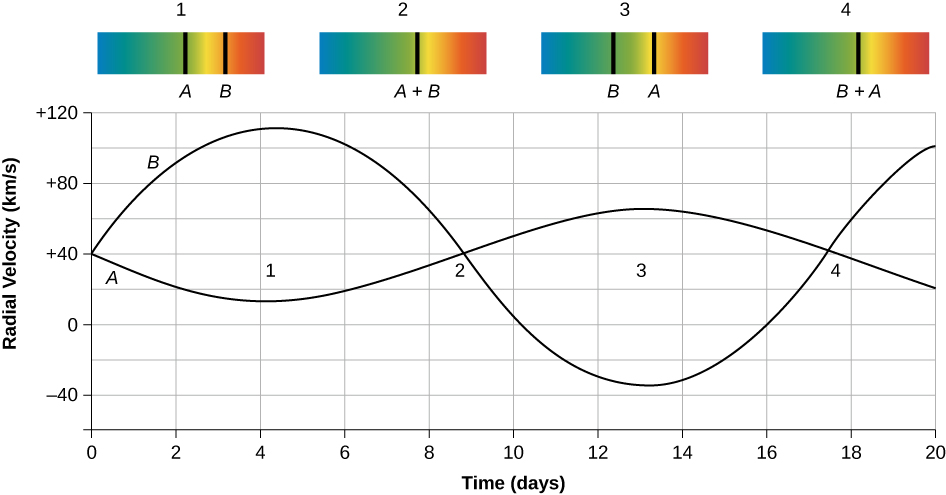
A plot showing how the velocities of the stars change with time is called a radial velocity curve; the curve for the binary system in Figure 18.6 is shown in Figure 18.7.
英語のヒント
Radial Velocities in a Spectroscopic Binary System.分光連星系の視線速度
OpenStax / Rice University · CC BY 4.0
Figure 18.7 These curves plot the radial velocities of two stars in a spectroscopic binary system, showing how the stars alternately approach and recede from Earth. Note that positive velocity means the star is moving away from us, and negative velocity means the star is moving toward us. The center of mass of the system itself is also moving away from us, indicated by the positive velocity of 40 kilometers per second. The positions on the curve corresponding to the illustrations in Figure 18.6 are marked with the diagram number (1–4).
図18.7 分光連星系の二つの星の視線速度を描いた曲線で、星が交互に地球へ近づき、遠ざかる様子を示す。正の速度は遠ざかること、負の速度は近づくことを意味する。重心自体も、正の40 km/sという速度が示すように、私たちから遠ざかっている。曲線上で図18.6の各図に対応する位置には、図の番号1〜4が記されている。