第18章恒星――星の世界の実態を調べるThe Stars: A Celestial Census
Diameters of Eclipsing Binary Stars食連星の直径
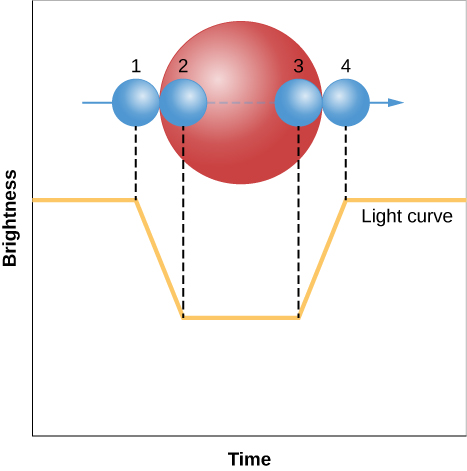
We now turn back to the main thread of our story to discuss how all this can be used to measure the sizes of stars. The technique involves making a light curve of an eclipsing binary, a graph that plots how the brightness changes with time. Let us consider a hypothetical binary system in which the stars are very different in size, like those illustrated in Figure 18.11. To make life easy, we will assume that the orbit is viewed exactly edge-on.
英語のヒント
では話の本筋へ戻り、これらをどう使えば星の大きさを測れるかを考えよう。この方法では、時間とともに明るさがどう変わるかを描く、食連星の光度曲線を作る。図18.11のように、二つの星の大きさが大きく異なる仮想的な連星系を考えよう。話を簡単にするため、軌道をちょうど真横から見ていると仮定する。
Even though we cannot see the two stars separately in such a system, the light curve can tell us what is happening. When the smaller star just starts to pass behind the larger star (a point we call first contact), the brightness begins to drop. The eclipse becomes total (the smaller star is completely hidden) at the point called second contact. At the end of the total eclipse (third contact), the smaller star begins to emerge. When the smaller star has reached last contact, the eclipse is completely over.
英語のヒント
そのような系で二つの星を別々に見られなくても、光度曲線は何が起きているかを教えてくれる。小さい星が大きい星の後ろへ入り始める第1接触で、明るさが下がり始める。第2接触で、小さい星は完全に隠れ、皆既食になる。皆既食の終わりである第3接触で、小さい星は姿を現し始める。最後の接触に達すると、食は完全に終わる。
To see how this allows us to measure diameters, look carefully at Figure 18.11. During the time interval between the first and second contacts, the smaller star has moved a distance equal to its own diameter. During the time interval from the first to third contacts, the smaller star has moved a distance equal to the diameter of the larger star. If the spectral lines of both stars are visible in the spectrum of the binary, then the speed of the smaller star with respect to the larger one can be measured from the Doppler shift. But knowing the speed with which the smaller star is moving and how long it took to cover some distance can tell the span of that distance—in this case, the diameters of the stars. The speed multiplied by the time interval from the first to second contact gives the diameter of the smaller star. We multiply the speed by the time between the first and third contacts to get the diameter of the larger star.
英語のヒント
これで直径を測れる理由を理解するため、図18.11をよく見よう。第1接触から第2接触までの時間に、小さい星は自分の直径に等しい距離だけ進む。第1接触から第3接触までには、大きい星の直径に等しい距離だけ進む。両方の星のスペクトル線が連星のスペクトルに見えていれば、大きい星に対する小さい星の速さを、ドップラーシフトから測れる。動く速さと、ある距離を進むのにかかった時間がわかれば、その距離の長さ、ここでは星の直径がわかる。速さに、第1接触から第2接触までの時間を掛ければ、小さい星の直径になる。速さに、第1接触から第3接触までの時間を掛ければ、大きい星の直径が得られる。
Light Curve of an Edge-On Eclipsing Binary.軌道を真横から見た食連星の光度曲線
OpenStax / Rice University · CC BY 4.0
Figure 18.11 Here we see the light curve of a hypothetical eclipsing binary star whose orbit we view exactly edge-on, in which the two stars fully eclipse each other. From the time intervals between contacts, it is possible to estimate the diameters of the two stars.
図18.11 軌道をちょうど真横から見て、二つの星が互いを完全に覆い隠す、仮想的な食連星の光度曲線。接触どうしの間の時間から、二つの星の直径を推定できる。
In actuality, the situation with eclipsing binaries is often a bit more complicated: orbits are generally not seen exactly edge-on, and the light from each star may be only partially blocked by the other. Furthermore, binary star orbits, just like the orbits of the planets, are ellipses, not circles. However, all these effects can be sorted out from very careful measurements of the light curve.
英語のヒント
実際の食連星は、もう少し複雑なことが多い。一般には軌道をちょうど真横から見ておらず、各星の光は他方によって一部しか遮られないこともある。さらに、連星の軌道も惑星の軌道と同じく、円ではなく楕円である。それでも、光度曲線を非常に注意深く測れば、これらの効果をすべて切り分けられる。
Using the Radiation Law to Get the Diameter放射の法則から直径を求める
Another method for measuring star diameters makes use of the Stefan-Boltzmann law for the relationship between energy radiated and temperature (see Radiation and Spectra). In this method, the energy flux (energy emitted per second per square meter by a blackbody, like the Sun) is given by
英語のヒント
恒星の直径を測る別の方法は、放射されるエネルギーと温度の関係を表す、シュテファン–ボルツマンの法則を使うものである。「放射とスペクトル」を参照してほしい。この方法で使うエネルギー流束は、太陽のような黒体が1秒・1平方メートルあたりに放つエネルギーであり、次のように与えられる。
where σ is a constant and T is the temperature. The surface area of a sphere (like a star) is given by
ここでσは定数、Tは温度である。恒星のような球の表面積は、次のようになる。
The luminosity (L) of a star is then given by its surface area in square meters times the energy flux:
したがって、恒星の光度Lは、平方メートル単位の表面積にエネルギー流束を掛けて求められる。
Previously, we determined the masses of the two stars in the Sirius binary system. Sirius gives off 8200 times more energy than its fainter companion star, although both stars have nearly identical temperatures. The extremely large difference in luminosity is due to the difference in radius, since the temperatures and hence the energy fluxes for the two stars are nearly the same. To determine the relative sizes of the two stars, we take the ratio of the corresponding luminosities:
英語のヒント
前に、シリウス連星系の二つの星の質量を求めた。両星の温度はほぼ等しいが、シリウスは暗い伴星の8200倍のエネルギーを放っている。温度、したがってエネルギー流束はほぼ等しいため、この極めて大きい光度の差は、半径の違いによる。二つの星の大きさの比を求めるため、それぞれの光度の比を取る。
Therefore, the relative sizes of the two stars can be found by taking the square root of the relative luminosity. Since , the radius of Sirius is 91 times larger than the radius of its faint companion.
したがって、光度の比の平方根を取れば、二つの星の大きさの比が求まる。なので、シリウスの半径は、暗い伴星の半径の91倍である。
The method for determining the radius shown here requires both stars be visible, which is not always the case.
英語のヒント
ここで示した半径の求め方では、両方の星が見える必要があるが、常にそうなるわけではない。
Stellar Diameters恒星の直径
The results of many stellar size measurements over the years have shown that most nearby stars are roughly the size of the Sun, with typical diameters of a million kilometers or so. Faint stars, as we might have expected, are generally smaller than more luminous stars. However, there are some dramatic exceptions to this simple generalization.
英語のヒント
長年にわたる多数の恒星の大きさの測定から、近くの恒星の大部分は太陽くらいの大きさで、典型的な直径が約100万キロメートルだとわかった。予想されるように、暗い星は一般に、光度の高い星より小さい。しかし、この単純な一般化には、著しい例外がある。
A few of the very luminous stars, those that are also red (indicating relatively low surface temperatures), turn out to be truly enormous. These stars are called, appropriately enough, giant stars or supergiant stars. An example is Betelgeuse (see Figure 22.4), the second brightest star in the constellation of Orion and one of the dozen brightest stars in our sky. Its diameter, remarkably, is greater than 10 AU (1.5 billion kilometers!), large enough to fill the entire inner solar system almost as far out as Jupiter. In Stars from Adolescence to Old Age, we will look in detail at the evolutionary process that leads to the formation of such giant and supergiant stars.
英語のヒント
非常に光度の高い星のうち、赤く、したがって表面温度が比較的低いものの一部は、とてつもなく大きい。そのような恒星は、ふさわしいことに、巨星または超巨星と呼ばれる。例として、図22.4のベテルギウスがある。オリオン座で2番目に明るく、空で最も明るい12個ほどの恒星にも入る。驚くことに、その直径は10 AU、すなわち15億キロメートルを超える。太陽系の内側全体を満たし、ほぼ木星まで届くほど大きい。「恒星の青年期から老年期まで」では、このような巨星や超巨星ができる進化の過程を、詳しく見ていく。