第18章恒星――星の世界の実態を調べるThe Stars: A Celestial Census
Bright Does Not Necessarily Mean Close明るいからといって近いとは限らない
If we confine our census to the local neighborhood, we will miss many of the most interesting kinds of stars. After all, the neighborhood in which you live does not contain all the types of people—distinguished according to age, education, income, race, and so on—that live in the entire country. For example, a few people do live to be over 100 years old, but there may be no such individual within several miles of where you live. In order to sample the full range of the human population, you would have to extend your census to a much larger area. Similarly, some types of stars simply are not found nearby.
英語のヒント
調査を近所に限ると、最も興味深い種類の恒星を多く見落とすことになる。結局、自分の住む近所だけでは、年齢、教育、所得、人種などで区別した、国全体にいるあらゆる種類の人がそろうわけではない。たとえば、確かに100歳を超えて生きる人は少数いるが、自分の家から数マイル以内には、そのような人が一人もいないかもしれない。人間の集団の全範囲から標本を取るには、調査をはるかに広い範囲へ広げる必要がある。同じように、恒星の中にも、近くでは単に見つからない種類がある。
A clue that we are missing something in our stellar census comes from the fact that only six of the 20 stars that appear brightest in our sky—Sirius, Vega, Altair, Alpha Centauri, Fomalhaut, and Procyon—are found within 26 light-years of the Sun (Figure 18.3). Why are we missing most of the brightest stars when we take our census of the local neighborhood?
英語のヒント
恒星の実態調査で何かを見落としているという手がかりは、空で最も明るく見える20個の恒星のうち、太陽から26光年以内にあるのが、シリウス、ベガ、アルタイル、ケンタウルス座α星、フォーマルハウト、プロキオンの6個だけであることから得られる(図18.3)。近所を調べるとき、最も明るい恒星の大部分を見落としてしまうのはなぜだろうか。
The Closest Stars.最も近い恒星
credit: modification of work by ESO · CC BY 4.0
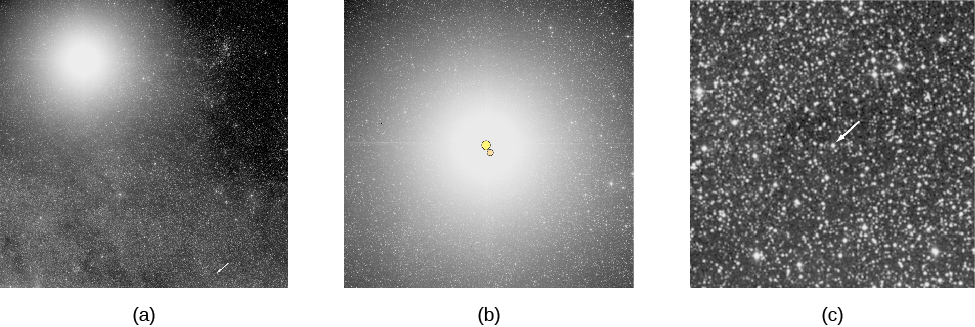
Figure 18.3 (a) This image, taken with a wide-angle telescope at the European Southern Observatory in Chile, shows the system of three stars that is our nearest neighbor. (b) Two bright stars that are close to each other (Alpha Centauri A and B) blend their light together. (c) Indicated with an arrow (since you’d hardly notice it otherwise) is the much fainter Proxima Centauri star, which is spectral type M. (credit: modification of work by ESO)
図18.3 (a)チリの欧州南天天文台の広視野望遠鏡で撮影した、私たちの最も近い隣人である3個の星の系。(b)互いに近い二つの明るい星、ケンタウルス座α星AとBの光は混ざって見える。(c)矢印が、ずっと暗いM型星プロキシマ・ケンタウリを指している。矢印がなければ、ほとんど気づかないだろう。(提供:ESOの画像を改変)
The answer, interestingly enough, is that the stars that appear brightest are not the ones closest to us. The brightest stars look the way they do because they emit a very large amount of energy—so much, in fact, that they do not have to be nearby to look brilliant. You can confirm this by looking at Appendix J, which gives distances for the 20 stars that appear brightest from Earth. The most distant of these stars is more than 1000 light-years from us. In fact, it turns out that most of the stars visible without a telescope are hundreds of light-years away and many times more luminous than the Sun. Among the 9000 stars visible to the unaided eye, only about 50 are intrinsically fainter than the Sun. Note also that several of the stars in Appendix J are spectral type B, a type that is completely missing from Table 18.1.
英語のヒント
興味深いことに、その答えは、最も明るく見える星が最も近い星ではないから、ということだ。非常に大量のエネルギーを放つため、明るく見えるのである。実際、放出量があまりに大きいので、近くになくても輝いて見える。地球から最も明るく見える20個の恒星の距離を示した付録Jを見ると、確かめられる。最も遠いものは、1000光年以上離れている。実際、望遠鏡なしで見える恒星の大部分は、数百光年離れ、太陽の何倍もの光度をもつ。肉眼で見える9000個の恒星のうち、太陽より本来の光度が低いものは、約50個しかない。また、付録JにはB型の恒星がいくつかあるが、表18.1にはB型が一つもないことにも注意しよう。
The most luminous of the bright stars listed in Appendix J emit more than 50,000 times more energy than does the Sun. These highly luminous stars are missing from the solar neighborhood because they are very rare. None of them happens to be in the tiny volume of space immediately surrounding the Sun, and only this small volume was surveyed to get the data shown in Table 18.1.
英語のヒント
付録Jに載る明るい星のうち、光度が最大のものは、太陽の5万倍を超えるエネルギーを放つ。これほど光度の高い星が太陽の近所にないのは、非常にまれだからである。太陽のすぐまわりの小さな空間に、たまたま一つもないのだ。そして、表18.1のデータは、この小さい体積だけを調べて得たものである。
For example, let’s consider the most luminous stars—those 100 or more times as luminous as the Sun. Although such stars are rare, they are visible to the unaided eye, even when hundreds to thousands of light-years away. A star with a luminosity 10,000 times greater than that of the Sun can be seen without a telescope out to a distance of 5000 light-years. The volume of space included within a distance of 5000 light-years, however, is enormous; so even though highly luminous stars are intrinsically rare, many of them are readily visible to our unaided eye.
英語のヒント
たとえば、太陽の100倍以上の光度をもつ、特に光度の高い恒星を考えよう。そのような星は少ないが、数百〜数千光年離れていても、肉眼で見える。太陽の1万倍の光度をもつ恒星は、5000光年までなら望遠鏡なしでも見られる。しかし、5000光年以内に含まれる空間の体積は膨大である。そのため、高光度の星はもともと少なくても、肉眼では数多く、容易に見えるのである。
The contrast between these two samples of stars, those that are close to us and those that can be seen with the unaided eye, is an example of a selection effect. When a population of objects (stars in this example) includes a great variety of different types, we must be careful what conclusions we draw from an examination of any particular subgroup. Certainly we would be fooling ourselves if we assumed that the stars visible to the unaided eye are characteristic of the general stellar population; this subgroup is heavily weighted to the most luminous stars. It requires much more effort to assemble a complete data set for the nearest stars, since most are so faint that they can be observed only with a telescope. However, it is only by doing so that astronomers are able to know about the properties of the vast majority of the stars, which are actually much smaller and fainter than our own Sun. In the next section, we will look at how we measure some of these properties.
英語のヒント
近くにある恒星と、肉眼で見える恒星という、この二つの標本集団の違いは、選択効果の一例である。天体などの集団に多様な種類が含まれる場合、その一部だけを調べてどのような結論を出すかには、注意が必要になる。肉眼で見える星が恒星全体の典型だと仮定すれば、確実に自分を誤らせてしまう。この部分集団は、光度が最も高い星に大きく偏っているからである。最も近い恒星の完全なデータ一式を集めるには、はるかに大きな労力がかかる。大部分が非常に暗く、望遠鏡でしか観測できないためだ。それでも、そうして初めて、実際には太陽よりはるかに小さく暗い、恒星の大多数の性質を知ることができる。次の節では、それらの性質の一部をどう測るかを見ていこう。
Key Concepts and Summary重要事項のまとめ
To understand the properties of stars, we must make wide-ranging surveys. We find the stars that appear brightest to our eyes are bright primarily because they are intrinsically very luminous, not because they are the closest to us. Most of the nearest stars are intrinsically so faint that they can be seen only with the aid of a telescope. Stars with low mass and low luminosity are much more common than stars with high mass and high luminosity. Most of the brown dwarfs in the local neighborhood have not yet been discovered.
恒星の性質を理解するには、広範囲のサーベイが必要である。肉眼で最も明るく見える恒星は、最も近いからではなく、主に本来の光度が非常に高いから明るく見える。最も近い恒星の大部分は、本来の光度が非常に低く、望遠鏡の助けがなければ見えない。小質量・低光度の恒星は、大質量・高光度の恒星より、はるかに多い。近所にある褐色矮星の大部分は、まだ発見されていない。
selection effect
選択効果
the selection of sample data in a nonrandom way, causing the sample data to be unrepresentative of the entire data set
標本データを無作為ではない方法で選ぶことで、その標本がデータ全体を代表しなくなること。