第18章恒星――星の世界の実態を調べるThe Stars: A Celestial Census
Extremes of Stellar Luminosities, Diameters, and Densities恒星の光度・直径・密度の両極端
We can use the H–R diagram to explore the extremes in size, luminosity, and density found among the stars. Such extreme stars are not only interesting to fans of the Guinness Book of World Records; they can teach us a lot about how stars work. For example, we saw that the most massive main-sequence stars are the most luminous ones. We know of a few extreme stars that are a million times more luminous than the Sun, with masses that exceed 100 times the Sun’s mass. These superluminous stars, which are at the upper left of the H–R diagram, are exceedingly hot, very blue stars of spectral type O. These are the stars that would be the most conspicuous at vast distances in space.
英語のヒント
H–R図を使えば、恒星に見られる大きさ、光度、密度の両極端を調べられる。このような極端な星が興味深いのは、『ギネス世界記録』のファンにとってだけではない。恒星の仕組みについても、多くを教えてくれる。たとえば、最も大質量の主系列星は、最も光度が高いことを見た。太陽の100倍を超える質量で、光度が太陽の100万倍という極端な星が、少数知られている。H–R図の左上にある、この超高光度の星は、極めて高温で非常に青いO型星である。宇宙の遠大な距離から最も目立つのは、このような恒星だろう。
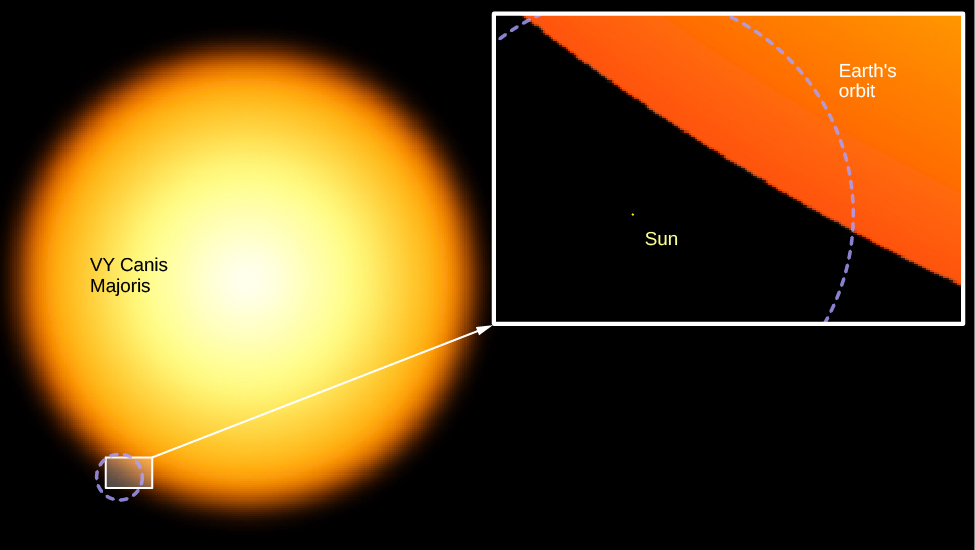
The cool supergiants in the upper corner of the H–R diagram are as much as 10,000 times as luminous as the Sun. In addition, these stars have diameters very much larger than that of the Sun. As discussed above, some supergiants are so large that if the solar system could be centered in one, the star’s surface would lie beyond the orbit of Mars (see Figure 18.16). We will have to ask, in coming chapters, what process can make a star swell up to such an enormous size, and how long these “swollen” stars can last in their distended state.
英語のヒント
H–R図の上方の隅にある低温の超巨星は、太陽の1万倍もの光度をもつ。また、直径も太陽よりはるかに大きい。前に述べたように、超巨星の中には、中心に太陽系を置けたとしたら、その表面が火星軌道より外に来るほど大きいものもある(図18.16)。今後の章では、どんな過程が星をそれほど巨大に膨らませるのか、また「膨れた」星はその状態でどのくらい続けられるのかを考える必要がある。
The Sun and a Supergiant.太陽と超巨星
OpenStax / Rice University · CC BY 4.0
Figure 18.16 Here you see how small the Sun looks in comparison to one of the largest known stars: VY Canis Majoris, a supergiant.
図18.16 既知の最大級の恒星の一つ、おおいぬ座VY星という超巨星に比べ、太陽がどれほど小さく見えるかを示す。
In contrast, the very common red, cool, low-luminosity stars at the lower end of the main sequence are much smaller and more compact than the Sun. An example of such a red dwarf is Ross 614B, with a surface temperature of 2700 K and only 1/2000 of the Sun’s luminosity. We call such a star a dwarf because its diameter is only 1/10 that of the Sun. A star with such a low luminosity also has a low mass (about 1/12 that of the Sun). This combination of mass and diameter means that it is so compressed that the star has an average density about 80 times that of the Sun. Its density must be higher, in fact, than that of any known solid found on the surface of Earth. (Despite this, the star is made of gas throughout because its center is so hot.)
英語のヒント
対照的に、主系列の下端にある、数の多い赤く低温・低光度の星は、太陽よりはるかに小さく、ぎゅっと詰まっている。そのような赤色矮星の例がロス614Bで、表面温度は2700 K、光度は太陽のわずか2000分の1である。直径が太陽の10分の1しかないため、矮星と呼ぶ。これほど低光度の星の質量も小さく、太陽の約12分の1である。この質量と直径の組み合わせから、星は非常に圧縮され、平均密度は太陽の約80倍だとわかる。実際、その密度は、地表で知られているどの固体よりも高いはずだ。それでも中心が非常に高温であるため、星は全体にわたり気体からできている。
The faint, red, main-sequence stars are not the stars of the most extreme densities, however. The white dwarfs, at the lower-left corner of the H–R diagram, have densities many times greater still.
英語のヒント
しかし、暗く赤い主系列星が、最も極端な密度の恒星というわけではない。H–R図の左下にある白色矮星の密度は、さらにその何倍も高い。
The White Dwarfs白色矮星
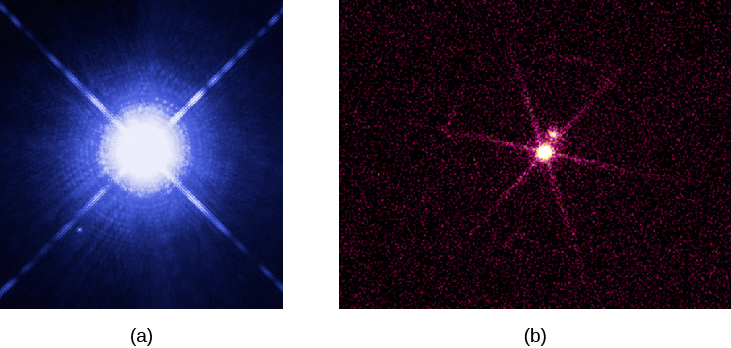
The best-known white dwarf star was detected in 1862. Called Sirius B, it forms a binary system with Sirius A, the brightest-appearing star in the sky. It eluded discovery and analysis for a long time because its faint light tends to be lost in the glare of nearby Sirius A (Figure 18.17). (Since Sirius is often called the Dog Star—being the brightest star in the constellation of Canis Major, the big dog—Sirius B is sometimes nicknamed the Pup.)
英語のヒント
最もよく知られた白色矮星は、1862年に検出された。シリウスBと呼ばれ、空で最も明るく見えるシリウスAと連星系をなす。長い間、発見や分析を免れたのは、その弱い光が、近くのシリウスAのまぶしい光に埋もれがちだったためである(図18.17)。シリウスは、おおいぬ座で最も明るい星なので、しばしばDog Star、つまり「犬の星」と呼ばれる。そのためシリウスBは、Pup(子犬)という愛称で呼ばれることもある。
Two Views of Sirius and Its White Dwarf Companion.シリウスと、その白色矮星の伴星の二つの見え方
credit a: modification of work by NASA, H.E. Bond and E. Nelan (Space Telescope Science Institute), M. Barstow and M. Burleigh (University of Leicester) and J.B. Holberg (University of Arizona); credit b: modification of work by NASA/SAO/CXC · CC BY 4.0
Figure 18.17 (a) The (visible light) image, taken with the Hubble Space Telescope, shows bright Sirius A, and, below it and off to its left, faint Sirius B. (b) This image of the Sirius star system was taken with the Chandra X-Ray Telescope. Now, the bright object is the white dwarf companion, Sirius B. Sirius A is the faint object above it; what we are seeing from Sirius is probably not actually X-ray radiation but rather ultraviolet light that has leaked into the detector. Note that the ultraviolet intensities of these two objects are completely reversed from the situation in visible light because Sirius B is hotter and emits more higher-frequency radiation. (credit a: modification of work by NASA, H.E. Bond and E. Nelan (Space Telescope Science Institute), M. Barstow and M. Burleigh (University of Leicester) and J.B. Holberg (University of Arizona); credit b: modification of work by NASA/SAO/CXC)
図18.17 (a)ハッブル宇宙望遠鏡で撮影した可視光画像。明るいシリウスAと、その左下の暗いシリウスBが見える。(b)チャンドラX線望遠鏡で撮影したシリウス系。今度は白色矮星の伴星シリウスBが明るく、シリウスAはその上の暗い天体である。シリウスAから見えているのは、実際にはX線ではなく、検出器へ漏れ込んだ紫外線だろう。二つの天体の紫外線の強さが可視光の状況と完全に逆になるのは、シリウスBのほうが高温で、高周波数の放射を多く放つためである。(a提供:NASA、H.E. Bond、E. Nelan〔宇宙望遠鏡科学研究所〕、M. Barstow、M. Burleigh〔レスター大学〕、J.B. Holberg〔アリゾナ大学〕の画像を改変。b提供:NASA/SAO/CXCの画像を改変)
We have now found thousands of white dwarfs. Table 18.1 shows that about 7% of the true stars (spectral types O–M) in our local neighborhood are white dwarfs. A good example of a typical white dwarf is the nearby star 40 Eridani B. Its surface temperature is a relatively hot 12,000 K, but its luminosity is only 1/275 LSun. Calculations show that its radius is only 1.4% of the Sun’s, or about the same as that of Earth, and its volume is 2.5 × 10⁻⁶ that of the Sun. Its mass, however, is 0.57 times the Sun’s mass, just a little more than half. To fit such a substantial mass into so tiny a volume, the star’s density must be about 210,000 times the density of the Sun, or more than 300,000 g/cm3. A teaspoonful of this material would have a mass of some 1.6 tons! At such enormous densities, matter cannot exist in its usual state; we will examine the particular behavior of this type of matter in The Death of Stars. For now, we just note that white dwarfs are dying stars, reaching the end of their productive lives and ready for their stories to be over.
英語のヒント
現在では、数千個の白色矮星が見つかっている。表18.1によると、近所の本当の恒星、すなわちスペクトル型O〜Mの星の約7%が白色矮星である。典型的な白色矮星のよい例は、近くにあるエリダヌス座40番星Bだ。表面温度は12,000 Kと比較的高いのに、光度はわずか1/275 L☉である。計算によると、半径は太陽のわずか1.4%で、地球とほぼ同じ。体積は太陽の2.5×10⁻⁶倍しかない。しかし質量は、太陽の半分を少し上回る0.57倍である。これほどの質量を小さい体積に詰め込むには、密度は太陽の約21万倍、30万g/cm³以上でなければならない。この物質を小さじ1杯取ると、質量は約1.6トンにもなる。これほど膨大な密度では、物質は普段の状態では存在できない。この種類の物質の特有の振る舞いは、「恒星の死」で調べる。今は、白色矮星は死へ向かう恒星で、エネルギーを生み出してきた一生の終わりに達し、物語を閉じようとしているとだけ述べておこう。
The British astrophysicist (and science popularizer) Arthur Eddington (1882–1944) described the first known white dwarf this way:
英語のヒント
イギリスの天体物理学者で、科学を広く伝える役割も果たしたアーサー・エディントン(1882–1944年)は、最初に知られた白色矮星を次のように説明した。
The message of the companion of Sirius, when decoded, ran: “I am composed of material three thousand times denser than anything you’ve ever come across. A ton of my material would be a little nugget you could put in a matchbox.” What reply could one make to something like that? Well, the reply most of us made in 1914 was, “Shut up; don’t talk nonsense.”
シリウスの伴星からのメッセージを解読すると、こう書いてあった。「私は、あなたが出会ったことのある何よりも3000倍密な物質でできている。私の物質は、1トンでもマッチ箱に入る小さな塊になるだろう。」こんな話に、どう答えられるだろうか。さて、1914年に私たちの大部分がした返事は、こうだった。「黙れ。ばかなことを言うな。」
Today, however, astronomers not only accept that stars as dense as white dwarfs exist but (as we will see) have found even denser and stranger objects in their quest to understand the evolution of different types of stars.
英語のヒント
しかし今日、天文学者は白色矮星ほど高密度の恒星の存在を受け入れるだけでなく、さまざまな種類の恒星の進化を理解する探究の中で、これから見るような、さらに高密度で奇妙な天体も発見している。