第18章恒星――星の世界の実態を調べるThe Stars: A Celestial Census
The Mass-Luminosity Relation質量–光度関係
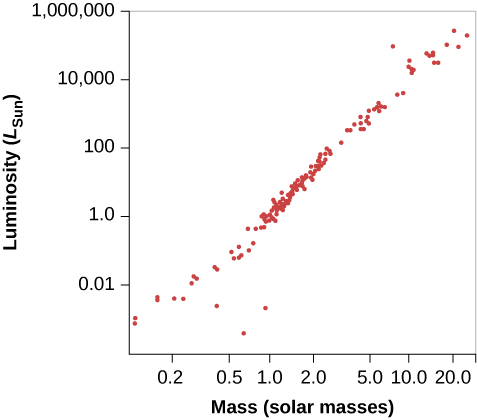
Now that we have measurements of the characteristics of many different types of stars, we can search for relationships among the characteristics. For example, we can ask whether the mass and luminosity of a star are related. It turns out that for most stars, they are: The more massive stars are generally also the more luminous. This relationship, known as the mass-luminosity relation, is shown graphically in Figure 18.9. Each point represents a star whose mass and luminosity are both known. The horizontal position on the graph shows the star’s mass, given in units of the Sun’s mass, and the vertical position shows its luminosity in units of the Sun’s luminosity.
英語のヒント
多様な種類の恒星の性質を測れるようになったので、性質どうしの関係を探せる。たとえば、恒星の質量と光度は関係するだろうか。ほとんどの恒星では関係があり、質量が大きい星は一般に光度も高い。この質量–光度関係を、図18.9のグラフに示す。各点は、質量と光度の両方がわかっている恒星である。横方向の位置は太陽質量を単位とした質量、縦方向の位置は太陽光度を単位とした光度を示す。
Mass-Luminosity Relation.質量–光度関係
OpenStax / Rice University · CC BY 4.0
Figure 18.9 The plotted points show the masses and luminosities of stars. The three points lying below the sequence of points are all white dwarf stars.
図18.9 描かれた各点が、恒星の質量と光度を示す。点の列より下にある3個の点は、すべて白色矮星である。
We can also say this in mathematical terms.
これは、数式でも表せる。
It’s a reasonably good approximation to say that luminosity (expressed in units of the Sun’s luminosity) varies as the fourth power of the mass (in units of the Sun’s mass). (The symbol ~ means the two quantities are proportional.) If two stars differ in mass by a factor of 2, then the more massive one will be 24, or about 16 times brighter; if one star is 1/3 the mass of another, it will be approximately 81 times less luminous.
英語のヒント
太陽光度を単位として表した光度は、太陽質量を単位として表した質量の4乗に比例するといえば、かなりよい近似になる。記号~は、二つの量が比例することを意味する。2個の恒星の質量が2倍違えば、大きいほうは2⁴、つまり約16倍明るい。一方の質量が他方の3分の1なら、光度はおよそ81分の1になる。
Calculating the Mass from the Luminosity of a Star恒星の光度から質量を計算する
The mass-luminosity formula can be rewritten so that a value of mass can be determined if the luminosity is known.
質量–光度の式は、光度がわかれば質量の値を求められるように書き換えられる。
Solution解き方
First, we must get our units right by expressing both the mass and the luminosity of a star in units of the Sun’s mass and luminosity:
まず、質量も光度も、太陽の質量と光度をそれぞれ単位として表し、単位を正しくそろえなければならない。
Now we can take the 4th root of both sides, which is equivalent to taking both sides to the 1/4 = 0.25 power. The formula in this case would be:
英語のヒント
次に両辺の4乗根を取る。これは両辺を1/4乗、すなわち0.25乗するのと同じである。その場合、式は次のようになる。
Check Your Learning理解を確かめよう
In the previous section, we determined the sum of the masses of the two stars in the Sirius binary system (Sirius and its faint companion) using Kepler’s third law to be 3.2 solar masses. Using the mass-luminosity relationship, calculate the mass of each individual star.
前の節では、ケプラーの第3法則を使い、シリウスとその暗い伴星からなる連星系の質量の合計を、3.2太陽質量と求めた。質量–光度関係を使って、各星の質量を計算しよう。
Notice how good this mass-luminosity relationship is. Most stars (see Figure 18.9) fall along a line running from the lower-left (low mass, low luminosity) corner of the diagram to the upper-right (high mass, high luminosity) corner. About 90% of all stars obey the mass-luminosity relation. Later, we will explore why such a relationship exists and what we can learn from the roughly 10% of stars that “disobey” it.
英語のヒント
質量–光度関係がどれほどよく成り立つかに注目しよう。ほとんどの恒星は、図18.9で、左下の低質量・低光度の隅から、右上の高質量・高光度の隅へ向かう線に沿っている。全恒星の約90%が、この関係に従う。後で、なぜこのような関係があるのか、そして関係に「従わない」約10%の恒星から何を学べるかを調べていく。
Key Concepts and Summary重要事項のまとめ
The masses of stars can be determined by analysis of the orbit of binary stars—two stars that orbit a common center of mass. In visual binaries, the two stars can be seen separately in a telescope, whereas in a spectroscopic binary, only the spectrum reveals the presence of two stars. Stellar masses range from about 1/12 to more than 100 times the mass of the Sun (in rare cases, going to 250 times the Sun’s mass). Objects with masses between 1/12 and 1/100 that of the Sun are called brown dwarfs. Objects in which no nuclear reactions can take place are planets. The most massive stars are, in most cases, also the most luminous, and this correlation is known as the mass-luminosity relation.
恒星の質量は、共通の重心のまわりを回る二つの星である連星の軌道を分析することで求められる。実視連星では、望遠鏡で二つの星を別々に見られるが、分光連星では、スペクトルだけが二つの星の存在を明らかにする。恒星の質量は太陽の約12分の1から100倍以上までで、まれには250倍に達する。太陽の12分の1から100分の1の質量をもつ天体は褐色矮星と呼ばれる。核反応が起きえない天体は惑星である。質量が最も大きい星は、多くの場合、光度も最も高い。この相関を質量–光度関係という。
binary stars
連星
two stars that revolve about each other
互いのまわりを公転する二つの恒星。
brown dwarf
褐色矮星
an object intermediate in size between a planet and a star; the approximate mass range is from about 1/100 of the mass of the Sun up to the lower mass limit for self-sustaining nuclear reactions, which is about 1/12 the mass of the Sun
惑星と恒星の中間の大きさをもつ天体。質量のおおよその範囲は、太陽の約100分の1から、核反応を自力で持続できる下限である太陽の約12分の1まで。
mass-luminosity relation
質量–光度関係
the observed relation between the masses and luminosities of many (90% of all) stars
多くの恒星、すなわち全恒星の90%について観測される、質量と光度の関係。
spectroscopic binary
分光連星
a binary star in which the components are not resolved but whose binary nature is indicated by periodic variations in radial velocity, indicating orbital motion
二つの成分星を分離して見られないが、軌道運動を示す視線速度の周期的な変化によって、連星であることがわかるもの。
visual binary
実視連星
a binary star in which the two components are telescopically resolved
望遠鏡で二つの成分星を分離して見られる連星。