第19章天体までの距離Celestial Distances
The Period-Luminosity Relation周期–光度関係
The importance of cepheid variables lies in the fact that their periods and average luminosities turn out to be directly related. The longer the period (the longer the star takes to vary), the greater the luminosity. This period-luminosity relation was a remarkable discovery, one for which astronomers still (pardon the expression) thank their lucky stars. The period of such a star is easy to measure: a good telescope and a good clock are all you need. Once you have the period, the relationship (which can be put into precise mathematical terms) will give you the luminosity of the star.
英語のヒント
セファイド変光星が重要なのは、その周期と平均光度が直接結び付いているからだ。周期が長いほど、つまり明るさの変化に時間がかかる星ほど、光度は大きい。この周期–光度関係は、驚くべき発見だった。天文学者が今でも、文字どおり「幸運の星に感謝する」発見なのである。このような星の周期は測りやすく、よい望遠鏡と正確な時計さえあればよい。周期が分かれば、正確な数式で表せるこの関係から、星の光度が得られる。
Let’s be clear on what that means. The relation allows you to essentially “read off” how bright the star really is (how much energy it puts out). Astronomers can then compare this intrinsic brightness with the apparent brightness of the star. As we saw, the difference between the two allows them to calculate the distance.
英語のヒント
それが何を意味するか、はっきりさせよう。この関係を使うと、星が本当はどれほど明るいか、どれほどのエネルギーを放出しているかを、いわば「読み取れる」。天文学者は、この本来の明るさを、星の見かけの明るさと比べられる。すでに見たように、その違いから距離を計算できる。
The relation between period and luminosity was discovered in 1908 by Henrietta Leavitt (Figure 19.10), a staff member at the Harvard College Observatory (and one of a number of women working for low wages assisting Edward Pickering, the observatory’s director; see Annie Cannon: Classifier of the Stars). Leavitt discovered hundreds of variable stars in the Large Magellanic Cloud and Small Magellanic Cloud, two great star systems that are actually neighboring galaxies (although they were not known to be galaxies then). A small fraction of these variables were cepheids (Figure 19.11).
英語のヒント
周期と光度の関係を発見したのは、1908年、ハーバード大学天文台の職員ヘンリエッタ・リービット(図19.10)だった。所長エドワード・ピッカリングを低賃金で補佐していた、多くの女性の一人である(「アニー・キャノン――星を分類した人」を参照)。リービットは、大マゼラン雲と小マゼラン雲で、数百個の変光星を発見した。これらは二つの大きな恒星系で、実は近隣の銀河だが、当時はまだ銀河だとは知られていなかった。見つけた変光星の一部が、セファイドだった(図19.11)。
Henrietta Swan Leavitt (1868–1921).ヘンリエッタ・スワン・リービット(1868〜1921年)
Figure 19.10 Leavitt worked as an astronomer at the Harvard College Observatory. While studying photographs of the Magellanic Clouds, she found over 1700 variable stars, including 20 cepheids. Since all the cepheids in these systems were at roughly the same distance, she was able to compare their luminosities and periods of variation. She thus discovered a fundamental relationship between these characteristics that led to a new and much better way of estimating cosmic distances. (credit: modification of work by AIP)
図19.10 リービットは、ハーバード大学天文台で天文学者として働いた。マゼラン雲の写真を調べる中で、20個のセファイドを含む、1700個以上の変光星を見つけた。これらの恒星系のセファイドは、ほぼ同じ距離にあったため、光度と変光周期を比較できた。こうして見いだした二つの性質の基本的な関係は、宇宙の距離を見積もる、新しく、はるかに優れた方法へとつながった。(画像提供:AIPの作品を改変)
These systems presented a wonderful opportunity to study the behavior of variable stars independent of their distance. For all practical purposes, the Magellanic Clouds are so far away that astronomers can assume that all the stars in them are at roughly the same distance from us. (In the same way, all the suburbs of Los Angeles are roughly the same distance from New York City. Of course, if you are in Los Angeles, you will notice annoying distances between the suburbs, but compared to how far away New York City is, the differences seem small.) If all the variable stars in the Magellanic Clouds are at roughly the same distance, then any difference in their apparent brightnesses must be caused by differences in their intrinsic luminosities.
英語のヒント
この二つの恒星系は、距離の違いに左右されずに変光星のふるまいを調べる、絶好の機会を与えた。実用上、マゼラン雲は十分に遠いので、それぞれの中にある星は、すべて私たちからほぼ同じ距離にあると仮定できる。ニューヨークから見れば、ロサンゼルスの郊外は、どこもだいたい同じ距離にあるのと同じだ。ロサンゼルスにいれば、郊外の地域どうしを隔てる距離を面倒に感じるだろう。それでも、ニューヨークまでの距離と比べると、その違いは小さい。マゼラン雲内の変光星がほぼ同じ距離にあるなら、見かけの明るさの違いは、本来の光度の違いによるはずである。
Large Magellanic Cloud.大マゼラン雲
credit: ESO · CC BY 4.0
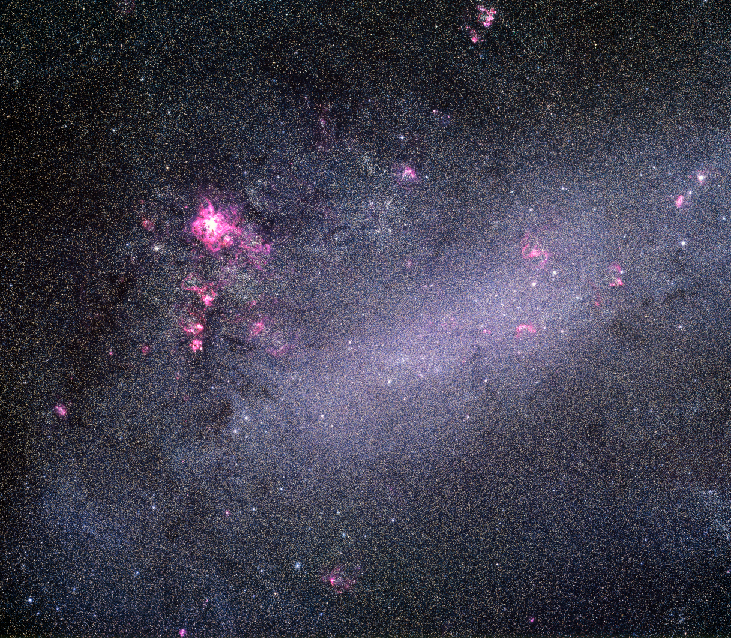
Figure 19.11 The Large Magellanic Cloud (so named because Magellan’s crew were the first Europeans to record it) is a small, irregularly shaped galaxy near our own Milky Way. It was in the Small Magellanic Cloud that Henrietta Leavitt discovered the cepheid period-luminosity relation. (credit: ESO)
図19.11 大マゼラン雲は、天の川銀河の近くにある、小さく不規則な形の銀河である。ヨーロッパ人として初めて記録したのがマゼランの船員だったことから、そう呼ばれる。小マゼラン雲で、ヘンリエッタ・リービットはセファイドの周期–光度関係を発見した。(画像提供:ESO)
Leavitt found that the brighter-appearing cepheids always have the longer periods of light variation. Thus, she reasoned, the period must be related to the luminosity of the stars. When Leavitt did this work, the distance to the Magellanic Clouds was not known, so she was only able to show that luminosity was related to period. She could not determine exactly what the relationship is.
英語のヒント
リービットは、明るく見えるセファイドほど、必ず変光周期が長いことを見つけた。そこで、周期は星の光度と関係しているはずだと考えた。この研究を行った当時、マゼラン雲までの距離は知られていなかった。そのため示せたのは、光度が周期と関係しているということまでであり、その関係を正確な数値で定めることはできなかった。
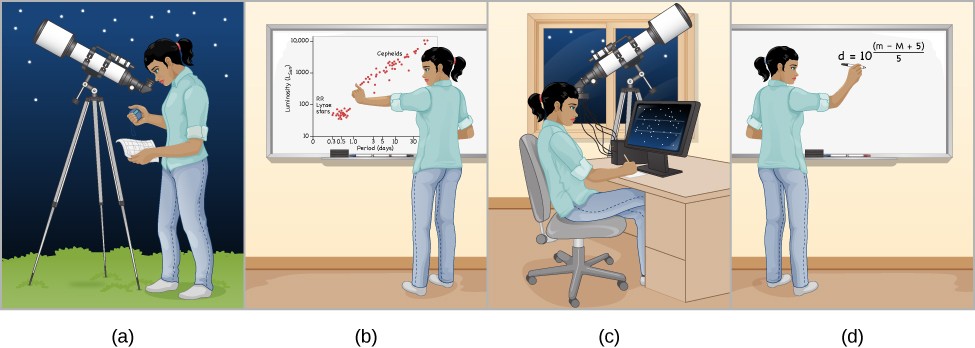
To define the period-luminosity relation with actual numbers (to calibrate it), astronomers first had to measure the actual distances to a few nearby cepheids in another way. (This was accomplished by finding cepheids associated in clusters with other stars whose distances could be estimated from their spectra, as discussed in the next section of this chapter.) But once the relation was thus defined, it could give us the distance to any cepheid, wherever it might be located (Figure 19.12).
英語のヒント
周期–光度関係を実際の数値で定める、つまり較正するには、まず近くのセファイド数個までの距離を、別の方法で測らなければならなかった。これは、スペクトルから距離を見積もれるほかの星と、同じ星団に属するセファイドを見つけることで達成された。詳しくは、この章の次の節で説明する。いったん関係を数値で定めてしまえば、どこにあるセファイドであっても、それまでの距離を求められるようになる(図19.12)。
How to Use a Cepheid to Measure Distance.セファイドを使って距離を測る方法
OpenStax / Rice University · CC BY 4.0
Figure 19.12 (a) Find a cepheid variable star and measure its period. (b) Use the period-luminosity relation to calculate the star’s luminosity. (c) Measure the star’s apparent brightness. (d) Compare the luminosity with the apparent brightness to calculate the distance.
図19.12 (a)セファイド変光星を見つけ、周期を測る。(b)周期–光度関係から、星の光度を計算する。(c)星の見かけの明るさを測る。(d)光度と見かけの明るさを比べて、距離を計算する。
Here at last was the technique astronomers had been searching for to break the confines of distance that parallax imposed on them. Cepheids can be observed and monitored, it turns out, in many parts of our own Galaxy and in other nearby galaxies as well. Astronomers, including Ejnar Hertzsprung and Harvard’s Harlow Shapley, immediately saw the potential of the new technique; they and many others set to work exploring more distant reaches of space using cepheids as signposts. In the 1920s, Edwin Hubble made one of the most significant astronomical discoveries of all time using cepheids, when he observed them in nearby galaxies and discovered the expansion of the universe. As we will see, this work still continues, as the Hubble Space Telescope and other modern instruments try to identify and measure individual cepheids in galaxies farther and farther away. The most distant known variable stars are all cepheids, with some about 60 million light-years away.
英語のヒント
ついに、天文学者が探していた方法が見つかった。視差測定によって課されていた、測れる距離の限界を破る方法である。セファイドは、天の川銀河の多くの場所だけでなく、近隣のほかの銀河でも観測し、追跡できると分かった。アイナー・ヘルツシュプルングや、ハーバードのハーロー・シャプレーらは、すぐにこの方法の可能性に気付いた。彼らと多くの研究者は、セファイドを道しるべとして、さらに遠い宇宙の領域を調べ始めた。1920年代にはエドウィン・ハッブルが、近くの銀河でセファイドを観測し、宇宙の膨張を発見して、天文学史上とりわけ重要な発見の一つを成し遂げた。後で見るように、この研究は今も続いている。ハッブル宇宙望遠鏡などの現代の装置が、ますます遠くの銀河で、個々のセファイドを特定し、測定しようとしているのだ。知られている最遠の変光星は、いずれもセファイドで、中には約6000万光年先のものもある。