第19章天体までの距離Celestial Distances
19.1 Fundamental Units of Distance19.1 距離の基本単位
Learning Objectives学習の目標
By the end of this section, you will be able to:
この節を読み終えると、次のことができるようになる。
Understand the importance of defining a standard distance unit
標準となる距離の単位を定義する重要性を理解する。
Explain how the meter was originally defined and how it has changed over time
メートルが最初にどう定義され、その定義が時代とともにどう変わったかを説明する。
Discuss how radar is used to measure distances to the other members of the solar system
太陽系のほかの天体までの距離を測るため、レーダーをどう使うかを論じる。
The first measures of distances were based on human dimensions—the inch as the distance between knuckles on the finger, or the yard as the span from the extended index finger to the nose of the British king. Later, the requirements of commerce led to some standardization of such units, but each nation tended to set up its own definitions. It was not until the middle of the eighteenth century that any real efforts were made to establish a uniform, international set of standards.
英語のヒント
初期の距離のものさしには、人体の寸法が使われた。インチは指の関節どうしの間隔、ヤードは英国王の伸ばした人差し指から鼻までの長さ、といった具合である。のちに商取引の必要から、こうした単位の標準化がある程度進んだが、各国はそれぞれ独自の定義を設けがちだった。統一された国際的な基準を作ろうという本格的な努力が始まったのは、18世紀半ばになってからである。
The Metric Systemメートル法
One of the enduring legacies of the era of the French emperor Napoleon is the establishment of the metric system of units, officially adopted in France in 1799 and now used in most countries around the world. The fundamental metric unit of length is the meter, originally defined as one ten-millionth of the distance along Earth’s surface from the equator to the pole. French astronomers of the seventeenth and eighteenth centuries were pioneers in determining the dimensions of Earth, so it was logical to use their information as the foundation of the new system.
英語のヒント
フランス皇帝ナポレオンの時代が後世に残したものの一つが、メートル法の確立である。1799年にフランスで正式に採用され、今では世界の大半の国で使われている。メートル法の基本的な長さの単位はメートルで、もともとは、赤道から極まで地表に沿って測った距離の1000万分の1と定義された。17〜18世紀のフランスの天文学者は、地球の大きさを測る先駆者だった。その情報を新しい単位系の土台に使うのは、理にかなっていた。
Practical problems exist with a definition expressed in terms of the size of Earth, since anyone wishing to determine the distance from one place to another can hardly be expected to go out and re-measure the planet. Therefore, an intermediate standard meter consisting of a bar of platinum-iridium metal was set up in Paris. In 1889, by international agreement, this bar was defined to be exactly one meter in length, and precise copies of the original meter bar were made to serve as standards for other nations.
英語のヒント
しかし、地球の大きさを使う定義には、実用上の問題がある。ある場所から別の場所までの距離を知りたい人が、そのたびに地球を測り直すとは考えにくい。そこで、白金・イリジウム合金の棒でできた、仲立ちとなるメートル原器がパリに設けられた。1889年、国際的な合意によって、この棒の長さをちょうど1メートルと定義した。ほかの国の標準とするため、原器の精密な複製も作られた。
Other units of length are derived from the meter. Thus, 1 kilometer (km) equals 1000 meters, 1 centimeter (cm) equals 1/100 meter, and so on. Even the old British and American units, such as the inch and the mile, are now defined in terms of the metric system.
英語のヒント
ほかの長さの単位は、メートルから導かれる。例えば、1キロメートル(km)は1000メートル、1センチメートル(cm)は100分の1メートルである。インチやマイルといった、英国や米国の古い単位も、今ではメートル法を使って定義されている。
Modern Redefinitions of the Meter近代のメートルの再定義
In 1960, the official definition of the meter was changed again. As a result of improved technology for generating spectral lines of precisely known wavelengths (see the chapter on Radiation and Spectra), the meter was redefined to equal 1,650,763.73 wavelengths of a particular atomic transition in the element krypton-86. The advantage of this redefinition is that anyone with a suitably equipped laboratory can reproduce a standard meter, without reference to any particular metal bar.
英語のヒント
1960年、メートルの公式な定義は再び変更された。波長が精密に分かっているスペクトル線を作る技術が進歩したため(「放射とスペクトル」参照)、クリプトン86の特定の原子遷移に対応する波長の1,650,763.73倍として、メートルを定義し直した。この再定義の利点は、必要な設備を持つ実験室なら、特定の金属棒を基準にしなくても、標準の1メートルを再現できることだった。
In 1983, the meter was defined once more, this time in terms of the velocity of light. Light in a vacuum can travel a distance of one meter in 1/299,792,458 second. Today, therefore, light travel time provides our basic unit of length. Put another way, a distance of one light-second (the amount of space light covers in one second) is defined to be 299,792,458 meters. That’s almost 300 million meters that light covers in just one second; light really is very fast! We could just as well use the light-second as the fundamental unit of length, but for practical reasons (and to respect tradition), we have defined the meter as a small fraction of the light-second.
英語のヒント
1983年、メートルはもう一度定義し直された。今度の基準は光の速さである。真空中の光は、2億9979万2458分の1秒で、1メートル進む。したがって現在は、光の移動時間が長さの基本単位を与えている。言い換えると、1光秒、つまり光が1秒間に進む距離は、2億9979万2458メートルと定義される。光はたった1秒で、ほぼ3億メートルも進む。実に速い。1光秒をそのまま長さの基本単位にしてもよいのだが、実用上の理由と伝統への配慮から、1光秒のごく小さな部分を、1メートルと定義している。
Distance within the Solar System太陽系内の距離
The work of Copernicus and Kepler established the relative distances of the planets—that is, how far from the Sun one planet is compared to another (see Observing the Sky: The Birth of Astronomy and Orbits and Gravity). But their work could not establish the absolute distances (in light-seconds or meters or other standard units of length). This is like knowing the height of all the students in your class only as compared to the height of your astronomy instructor, but not in inches or centimeters. Somebody’s height has to be measured directly.
英語のヒント
コペルニクスとケプラーの研究によって、惑星の相対的な距離が分かった。つまり、ある惑星が、別の惑星に比べて太陽からどれほど遠いかである(「空を観測する――天文学の誕生」「軌道と重力」参照)。しかし、その研究では、光秒やメートルなどの標準単位で表した、絶対的な距離までは求められなかった。これは、クラス全員の身長を天文学の先生の身長との比だけで知っていて、インチやセンチメートルでは知らないようなものだ。誰か一人の身長を、直接測る必要がある。
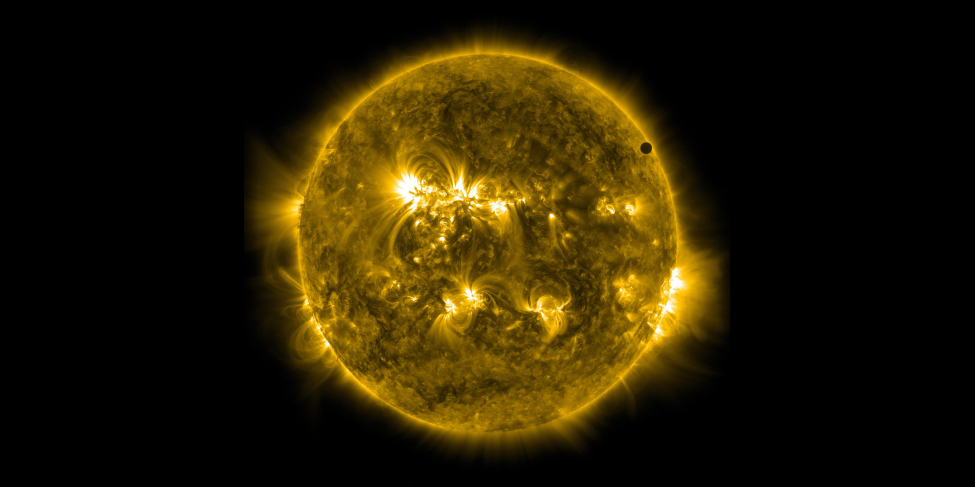
Similarly, to establish absolute distances, astronomers had to measure one distance in the solar system directly. Generally, the closer to us the object is, the easier such a measurement would be. Estimates of the distance to Venus were made as Venus crossed the face of the Sun in 1761 and 1769, and an international campaign was organized to estimate the distance to the asteroid Eros in the early 1930s, when its orbit brought it close to Earth. More recently, Venus crossed (or transited) the surface of the Sun in 2004 and 2012, and allowed us to make a modern distance estimate, although, as we will see below, by then it wasn’t needed (Figure 19.2).
英語のヒント
同じように絶対的な距離を定めるため、天文学者は、太陽系の中のどこか一つの距離を直接測らなければならなかった。一般に、天体が近いほど、その測定は容易になる。1761年と1769年には、金星が太陽の手前を横切る際に、金星までの距離が見積もられた。1930年代初めには、小惑星エロスが軌道上で地球へ近づく機会に、その距離を見積もる国際的な観測計画が組まれた。近年では、2004年と2012年にも金星が太陽面を横切る「日面通過」を起こし、現代の距離測定を行う機会となった。ただし後で見るように、そのころには、この方法が必須ではなくなっていた(図19.2)。
Venus Transits the Sun, 2012.2012年の金星の日面通過
credit: modification of work by NASA/SDO, AIA · NASA media use guidelines
Figure 19.2 This striking “picture” of Venus crossing the face of the Sun (it’s the black dot at about 2 o’clock) is more than just an impressive image. Taken with the Solar Dynamics Observatory spacecraft and special filters, it shows a modern transit of Venus. Such events allowed astronomers in the 1800s to estimate the distance to Venus. They measured the time it took Venus to cross the face of the Sun from different latitudes on Earth. The differences in times can be used to estimate the distance to the planet. Today, radar is used for much more precise distance estimates. (credit: modification of work by NASA/SDO, AIA)
英語のヒント
図19.2 太陽の手前を横切る金星の印象的な「写真」には、きれいな画像である以上の意味がある。金星は2時の方向の黒い点だ。太陽観測衛星SDOと特殊なフィルターで撮影した、現代の金星の日面通過を示している。19世紀の天文学者は、このような現象を使って金星までの距離を見積もった。地球の異なる緯度から、金星が太陽面を横切るのにかかる時間を測ったのである。その時間の差を使うと、惑星までの距離を見積もれる。今ではレーダーによって、はるかに精密な距離測定ができる。(クレジット:NASA/SDO, AIAの作品を改変)
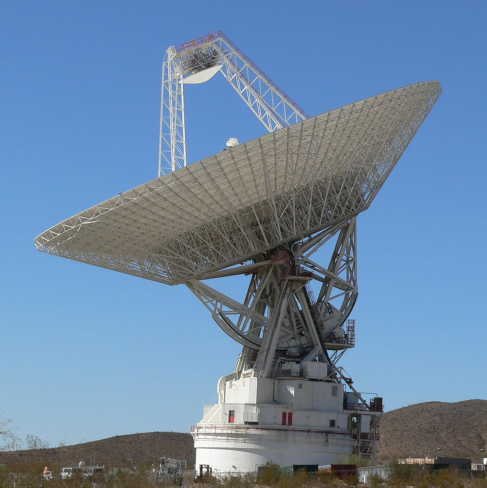
The key to our modern determination of solar system dimensions is radar, a type of radio wave that can bounce off solid objects (Figure 19.3). As discussed in several earlier chapters, by timing how long a radar beam (traveling at the speed of light) takes to reach another world and return, we can measure the distance involved very accurately. In 1961, radar signals were bounced off Venus for the first time, providing a direct measurement of the distance from Earth to Venus in terms of light-seconds (from the roundtrip travel time of the radar signal).
英語のヒント
現代の太陽系の大きさの測定で鍵となるのが、固体に当たって戻ってくる電波を使うレーダーである(図19.3)。以前のいくつかの章で説明したように、光速で進むレーダーの電波が別の天体へ届き、戻ってくるまでの時間を測れば、その距離を非常に正確に求められる。1961年、初めて金星からレーダー信号が反射して戻ってきた。往復にかかった時間から、地球と金星の間の距離を、光秒の単位で直接測れたのである。
Subsequently, radar has been used to determine the distances to Mercury, Mars, the satellites of Jupiter, the rings of Saturn, and several asteroids. Note, by the way, that it is not possible to use radar to measure the distance to the Sun directly because the Sun does not reflect radar very efficiently. But we can measure the distance to many other solar system objects and use Kepler’s laws to give us the distance to the Sun.
英語のヒント
その後、レーダーは水星、火星、木星の衛星、土星の環、いくつかの小惑星までの距離を測るためにも使われてきた。太陽はレーダーの電波を効率よく反射しないため、太陽までの距離をレーダーで直接測ることはできない。しかし、太陽系のほかの多くの天体までの距離を測り、ケプラーの法則を使えば、太陽までの距離を求められる。
Radar Telescope.レーダー望遠鏡
credit: NASA/JPL-Caltech · JPL image use policy
Figure 19.3 This dish-shaped antenna, part of the NASA Deep Space Network in California’s Mojave Desert, is 70 meters wide. Nicknamed the “Mars antenna,” this radar telescope can send and receive radar waves, and thus measure the distances to planets, satellites, and asteroids. (credit: NASA/JPL-Caltech)
図19.3 カリフォルニア州モハーヴェ砂漠にある、NASA深宇宙通信網の一部をなす皿形アンテナで、直径は70メートル。「火星アンテナ」の愛称を持つこのレーダー望遠鏡は、電波を送受信し、惑星・衛星・小惑星までの距離を測れる。(クレジット:NASA/JPL-Caltech)
From the various (related) solar system distances, astronomers selected the average distance from Earth to the Sun as our standard “measuring stick” within the solar system. When Earth and the Sun are closest, they are about 147.1 million kilometers apart; when Earth and the Sun are farthest, they are about 152.1 million kilometers apart. The average of these two distances is called the astronomical unit (AU). We then express all the other distances in the solar system in terms of the AU. Years of painstaking analyses of radar measurements have led to a determination of the length of the AU to a precision of about one part in a billion. The length of 1 AU can be expressed in light travel time as 499.004854 light-seconds, or about 8.3 light-minutes. If we use the definition of the meter given previously, this is equivalent to 1 AU = 149,597,870,700 meters.
英語のヒント
互いに関係する太陽系内のさまざまな距離の中から、天文学者は、地球と太陽の平均距離を太陽系の標準の「ものさし」に選んだ。両者が最も近いときの距離は約1億4710万キロメートル、最も遠いときは約1億5210万キロメートルである。この二つの距離の平均を、天文単位(AU)という。太陽系内のほかの距離も、AUを使って表す。長年にわたる入念なレーダー測定の解析によって、AUの長さは約10億分の1の精度で求められた。1 AUの長さを光の移動時間で表すと、499.004854光秒、約8.3光分となる。先ほどのメートルの定義を使えば、1 AU=149,597,870,700メートルに相当する。
These distances are, of course, given here to a much higher level of precision than is normally needed. In this text, we are usually content to express numbers to a couple of significant places and leave it at that. For our purposes, it will be sufficient to round off these numbers:
英語のヒント
ここに示した距離は、普通に必要となるより、はるかに高い精度で記されている。この本では通常、有効数字を数桁示せば十分とする。目的に応じて、これらを次のように丸めればよい。
We now know the absolute distance scale within our own solar system with fantastic accuracy. This is the first link in the chain of cosmic distances.
私たちは今、太陽系内の絶対的な距離の尺度を、驚くほど正確に知っている。これが、宇宙の距離をたどる連鎖の、最初のつながりとなる。