第19章天体までの距離Celestial Distances
19.3 Variable Stars: One Key to Cosmic Distances19.3 変光星――宇宙の距離を知る鍵
Learning Objectives学習の目標
By the end of this section, you will be able to:
この節を学ぶと、次のことができるようになる。
Describe how some stars vary their light output and why such stars are important
一部の恒星で光の放出量がどのように変化するかと、そうした恒星の重要性を説明する。
Explain the importance of pulsating variable stars, such as cepheids and RR Lyrae-type stars, to our study of the universe
セファイドやこと座RR型星などの脈動変光星が、宇宙の研究で果たす重要な役割を説明する。
Let’s briefly review the key reasons that measuring distances to the stars is such a struggle. As discussed in The Brightness of Stars, our problem is that stars come in a bewildering variety of intrinsic luminosities. (If stars were light bulbs, we’d say they come in a wide range of wattages.) Suppose, instead, that all stars had the same “wattage” or luminosity. In that case, the more distant ones would always look dimmer, and we could tell how far away a star is simply by how dim it appeared. In the real universe, however, when we look at a star in our sky (with eye or telescope) and measure its apparent brightness, we cannot know whether it looks dim because it’s a low-wattage bulb or because it is far away, or perhaps some of each.
英語のヒント
星までの距離の測定が、なぜこれほど難しいのか、要点を手短に振り返ろう。「恒星の明るさ」で述べたように、問題は、星そのものの光度が、戸惑うほど多種多様なことにある。星を電球にたとえれば、さまざまなワット数の製品があるようなものだ。もしすべての星の「ワット数」、つまり光度が同じなら、遠い星ほど必ず暗く見える。見かけの暗さだけで、どれほど遠いか分かるはずだ。ところが現実の宇宙では、空の星を肉眼や望遠鏡で見て、見かけの明るさを測っても、暗いのが、ワット数の小さい電球だからなのか、遠くにあるからなのか、あるいは両方が少しずつ効いているのか、分からない。
Astronomers need to discover something else about the star that allows us to “read off” its intrinsic luminosity—in effect, to know what the star’s true wattage is. With this information, we can then attribute how dim it looks from Earth to its distance. Recall that the apparent brightness of an object decreases with the square of the distance to that object. If two objects have the same luminosity but one is three times farther than the other, the more distant one will look nine times fainter. Therefore, if we know the luminosity of a star and its apparent brightness, we can calculate how far away it is. Astronomers have long searched for techniques that would somehow allow us to determine the luminosity of a star—and it is to these techniques that we turn next.
英語のヒント
そこで天文学者は、本来の光度を「読み取る」ために、星の別の性質を知る必要がある。言い換えると、星の本当のワット数を知りたいのだ。その情報があれば、地球から見た暗さを、距離によるものとして扱える。天体の見かけの明るさは、距離の2乗に反比例して小さくなることを思い出そう。光度が同じ二つの天体のうち、一方が他方の3倍遠ければ、遠いほうは9分の1の明るさに見える。したがって、星の光度と見かけの明るさが分かれば、その距離を計算できる。天文学者は長い間、星の光度をどうにかして求められる方法を探してきた。次は、その方法に目を向けよう。
Variable Stars変光星
The breakthrough in measuring distances to remote parts of our Galaxy, and to other galaxies as well, came from the study of variable stars. Most stars are constant in their luminosity, at least to within a percent or two. Like the Sun, they generate a steady flow of energy from their interiors. However, some stars are seen to vary in brightness and, for this reason, are called variable stars. Many such stars vary on a regular cycle, like the flashing bulbs that decorate stores and homes during the winter holidays.
英語のヒント
天の川銀河の遠い領域、さらには別の銀河までの距離測定を大きく前進させたのは、変光星の研究だった。大半の星の光度は一定であり、変わったとしても1〜2%以内に収まる。太陽と同じく、内部から安定したエネルギーを送り出しているのだ。しかし一部の星では、明るさが変化する様子が見られる。このため変光星と呼ばれる。そうした星の多くは、冬の祝祭期に店や家を飾る点滅電球のように、規則的な周期で変化する。
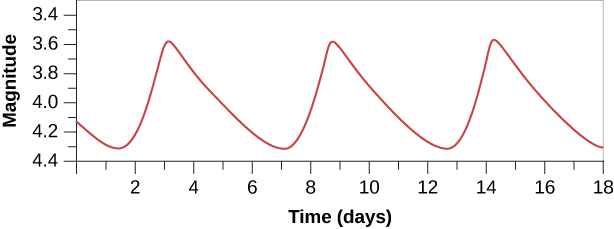
Let’s define some tools to help us keep track of how a star varies. A graph that shows how the brightness of a variable star changes with time is called a light curve (Figure 19.9). The maximum is the point of the light curve where the star has its greatest brightness; the minimum is the point where it is faintest. If the light variations repeat themselves periodically, the interval between the two maxima is called the period of the star. (If this kind of graph looks familiar, it is because we introduced it in Diameters of Stars.)
英語のヒント
星の変化を記録するための道具を、いくつか定義しよう。変光星の明るさが時間とともにどう変わるかを示すグラフを、光度曲線という(図19.9)。星が最も明るい点が極大、最も暗い点が極小である。明るさの変化が周期的に繰り返される場合、連続する二つの極大の間の時間を、その星の周期という。この種のグラフに見覚えがあるなら、「恒星の直径」で紹介したためだ。
Cepheid Light Curve.セファイドの光度曲線
OpenStax / Rice University · CC BY 4.0
Figure 19.9 This light curve shows how the brightness changes with time for a typical cepheid variable, with a period of about 6 days.
図19.9 典型的なセファイド変光星の明るさが、時間とともに変わる様子を示した光度曲線。周期は約6日である。
Pulsating Variables脈動変光星
There are two special types of variable stars for which—as we will see—measurements of the light curve give us accurate distances. These are called cepheid and RR Lyrae variables, both of which are pulsating variable stars. Such a star actually changes its diameter with time—periodically expanding and contracting, as your chest does when you breathe. We now understand that these stars are going through a brief unstable stage late in their lives.
英語のヒント
これから見るように、光度曲線の測定から正確な距離が分かる、特別な変光星が2種類ある。セファイド変光星と、こと座RR型変光星で、どちらも脈動変光星に属する。これらの星は、呼吸するときの胸のように、周期的に膨らんだり縮んだりし、実際に直径が変化する。今では、星の生涯の後半にある、短い不安定な段階を通過していると分かっている。
The expansion and contraction of pulsating variables can be measured by using the Doppler effect. The lines in the spectrum shift toward the blue as the surface of the star moves toward us and then shift to the red as the surface shrinks back. As the star pulsates, it also changes its overall color, indicating that its temperature is also varying. And, most important for our purposes, the luminosity of the pulsating variable also changes in a regular way as it expands and contracts.
英語のヒント
脈動変光星の膨張と収縮は、ドップラー効果で測定できる。星の表面がこちらへ近づくと、スペクトル線は青い側へずれ、表面が縮んで遠ざかると、赤い側へずれる。脈動するにつれ、星全体の色も変わる。温度も変化しているということだ。そして今回の目的にとって最も大事なのは、膨張と収縮に伴って、光度も規則的に変わることである。
Cepheid Variablesセファイド変光星
Cepheids are large, yellow, pulsating stars named for the first-known star of the group, Delta Cephei. This, by the way, is another example of how confusing naming conventions get in astronomy; here, a whole class of stars is named after the constellation in which the first one happened to be found. (We textbook authors can only apologize to our readers for the whole mess!)
英語のヒント
セファイドは、大きく、黄色い、脈動する恒星で、この仲間で最初に知られたケフェウス座δ星にちなんで名付けられた。ちなみに、これも天文学の命名慣習のややこしさを示す一例である。最初の星がたまたま見つかった星座にちなんで、一群の星全体に名前を付けているのだ。この混乱ぶりについては、教科書の著者として、読者におわびするしかない。
The variability of Delta Cephei was discovered in 1784 by the young English astronomer John Goodricke (see John Goodricke). The star rises rather rapidly to maximum light and then falls more slowly to minimum light, taking a total of 5.4 days for one cycle. The curve in Figure 19.9 represents a simplified version of the light curve of Delta Cephei.
英語のヒント
ケフェウス座δ星が変光することは、1784年、若いイギリスの天文学者ジョン・グッドリックが発見した(囲み記事「ジョン・グッドリック」を参照)。比較的速く極大光度まで明るくなり、その後はゆっくり極小光度へと暗くなる。1周期は合計5.4日である。図19.9は、ケフェウス座δ星の光度曲線を単純化したものである。
Several hundred cepheid variables are known in our Galaxy. Most cepheids have periods in the range of 3 to 50 days and luminosities that are about 1000 to 10,000 times greater than that of the Sun. Their variations in luminosity range from a few percent to a factor of 10.
英語のヒント
天の川銀河では、数百個のセファイド変光星が知られている。大半のセファイドの周期は3〜50日で、光度は太陽の約1000〜1万倍である。光度の変化幅は、数%から10倍に達するものまである。
Polaris, the North Star, is a cepheid variable that, for a long time, varied by one tenth of a magnitude, or by about 10% in visual luminosity, in a period of just under 4 days. Recent measurements indicate that the amount by which the brightness of Polaris changes is decreasing and that, sometime in the future, this star will no longer be a pulsating variable. This is just one more piece of evidence that stars really do evolve and change in fundamental ways as they age, and that being a cepheid variable represents a stage in the life of the star.
英語のヒント
北極星ポラリスもセファイド変光星で、長い間、4日弱の周期で0.1等級、可視光での光度にして約10%、変化していた。最近の測定では、明るさの変化幅が小さくなっており、いつかは脈動変光星ではなくなると考えられる。これもまた、星が年齢を重ねると本当に進化し、根本的に変わること、そしてセファイド変光星であることが、星の一生の一段階を表すことを示す証拠である。