第19章天体までの距離Celestial Distances
Distances to Stars恒星までの距離
As Earth travels from one side of its orbit to the other, it graciously provides us with a baseline of 2 AU, or about 300 million kilometers. Although this is a much bigger baseline than the diameter of Earth, the stars are so far away that the resulting parallax shift is still not visible to the naked eye—not even for the closest stars.
英語のヒント
地球は軌道の片側から反対側へ進むことで、ありがたいことに、2 AU、約3億キロメートルという基線を提供してくれる。これは地球の直径よりずっと大きいが、恒星はあまりにも遠いため、生じる視差によるずれは、最も近い星でさえ肉眼では見えない。
In the chapter on Observing the Sky: The Birth of Astronomy, we discussed how this dilemma perplexed the ancient Greeks, some of whom had actually suggested that the Sun might be the center of the solar system, with Earth in motion around it. Aristotle and others argued, however, that Earth could not be revolving about the Sun. If it were, they said, we would surely observe the parallax of the nearer stars against the background of more distant objects as we viewed the sky from different parts of Earth’s orbit (Figure 19.6). Tycho Brahe (1546–1601) advanced the same faulty argument nearly 2000 years later, when his careful measurements of stellar positions with the unaided eye revealed no such shift.
英語のヒント
「空を観測する――天文学の誕生」の章では、この問題が古代ギリシャの人々をどう悩ませたかを取り上げた。彼らの中には、太陽が太陽系の中心にあり、地球がその周囲を動いているのではないかと、実際に提案した人もいた。しかしアリストテレスらは、地球が太陽を回っているはずはないと論じた。もし回っているなら、地球軌道の異なる場所から空を見る際、遠い天体を背景に、近い星の視差が必ず見えるはずだというのである(図19.6)。それから約2000年後、ティコ・ブラーエ(1546〜1601年)も、同じ誤った議論を持ち出した。肉眼による注意深い恒星の位置測定でも、そのようなずれが見つからなかったからだ。
These early observers did not realize how truly distant the stars were and how small the change in their positions therefore was, even with the entire orbit of Earth as a baseline. The problem was that they did not have tools to measure parallax shifts too small to be seen with the human eye. By the eighteenth century, when there was no longer serious doubt about Earth’s revolution, it became clear that the stars must be extremely distant. Astronomers equipped with telescopes began to devise instruments capable of measuring the tiny shifts of nearby stars relative to the background of more distant (and thus unshifting) celestial objects.
英語のヒント
これらの初期の観測者は、恒星が本当はどれほど遠く、したがって地球の軌道全体を基線にしても、位置の変化がどれほど小さいかを理解していなかった。問題は、人の目では見えないほど小さな視差のずれを測る道具がなかったことにある。地球の公転への本格的な疑いがなくなった18世紀には、恒星は極端に遠くにあるはずだと分かってきた。望遠鏡を手にした天文学者は、遠くて位置が動いて見えない天体を背景に、近い星のごく小さなずれを測れる装置を考案し始めた。
This was a significant technical challenge, since, even for the nearest stars, parallax angles are usually only a fraction of a second of arc. Recall that one second of arc (arcsec) is an angle of only 1/3600 of a degree. A coin the size of a US quarter would appear to have a diameter of 1 arcsecond if you were viewing it from a distance of about 5 kilometers (3 miles). Think about how small an angle that is. No wonder it took astronomers a long time before they could measure such tiny shifts.
英語のヒント
これは大きな技術上の挑戦だった。最も近い恒星でも、視差角は普通、1秒角の一部分しかない。1秒角(arcsec)は、1度の3600分の1という角度である。米国の25セント硬貨ほどの大きさのものは、約5キロメートル、3マイル離れて見ると、直径が1秒角に見える。その角度の小ささを考えてみてほしい。天文学者がそのような微小なずれを測れるまで、長い時間がかかったのも無理はない。
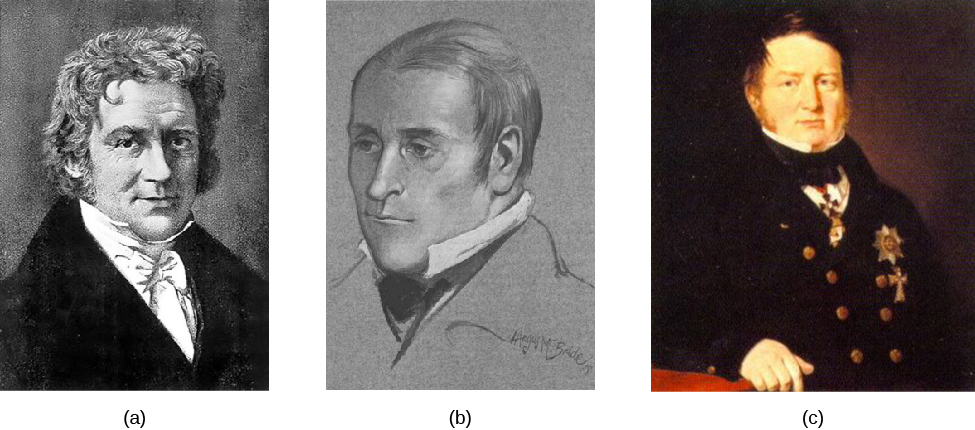
The first successful detections of stellar parallax were in the year 1838, when Friedrich Bessel in Germany (Figure 19.5), Thomas Henderson, a Scottish astronomer working at the Cape of Good Hope, and Friedrich Struve in Russia independently measured the parallaxes of the stars 61 Cygni, Alpha Centauri, and Vega, respectively. Even the closest star, Alpha Centauri, showed a total displacement of only about 1.5 arcseconds during the course of a year.
英語のヒント
恒星の視差の検出が初めて成功したのは1838年である。ドイツのフリードリヒ・ベッセル(図19.5)、喜望峰で活動したスコットランドの天文学者トマス・ヘンダーソン、ロシアのフリードリヒ・シュトルーヴェが、それぞれ独立に、はくちょう座61番星、ケンタウルス座α星、ベガの視差を測った。最も近いケンタウルス座α星でさえ、1年の間の位置のずれの全幅は、約1.5秒角にすぎなかった。
Friedrich Wilhelm Bessel (1784–1846), Thomas J. Henderson (1798–1844), and Friedrich Struve (1793–1864).フリードリヒ・ヴィルヘルム・ベッセル(1784〜1846年)、トマス・J・ヘンダーソン(1798〜1844年)、フリードリヒ・シュトルーヴェ(1793〜1864年)
OpenStax / Rice University · CC BY 4.0
Figure 19.5 (a) Bessel made the first authenticated measurement of the distance to a star (61 Cygni) in 1838, a feat that had eluded many dedicated astronomers for almost a century. But two others, (b) Scottish astronomer Thomas J. Henderson and (c) Friedrich Struve, in Russia, were close on his heels.
英語のヒント
図19.5 (a)ベッセルは1838年、恒星であるはくちょう座61番星までの距離を、初めて確かな形で測った。それまでほぼ1世紀にわたり、多くの熱心な天文学者が達成できずにいた偉業である。しかし、(b)スコットランドのトマス・J・ヘンダーソンと、(c)ロシアのフリードリヒ・シュトルーヴェも、そのすぐ後に続いていた。
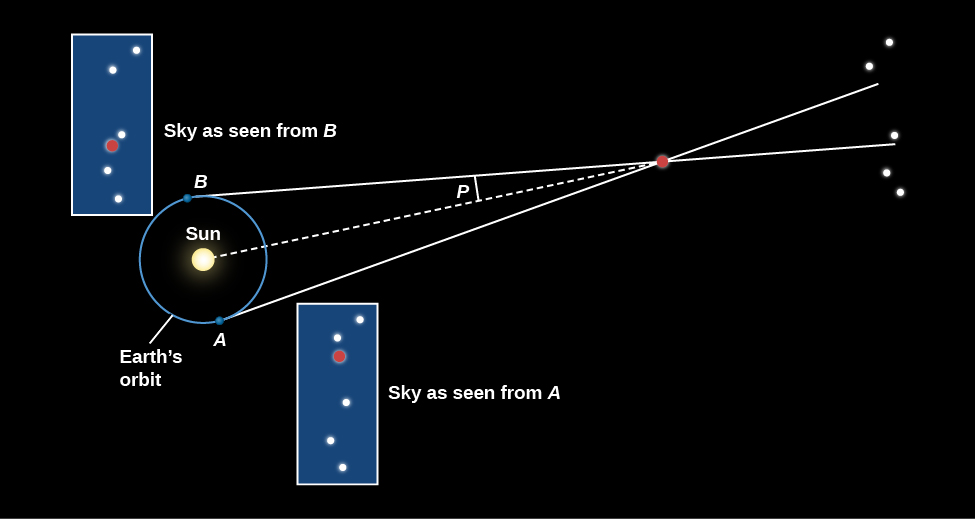
Figure 19.6 shows how such measurements work. Seen from opposite sides of Earth’s orbit, a nearby star shifts position when compared to a pattern of more distant stars. Astronomers actually define parallax to be one-half the angle that a star shifts when seen from opposite sides of Earth’s orbit (the angle labeled P in Figure 19.6). The reason for this definition is just that they prefer to deal with a baseline of 1 AU instead of 2 AU.
英語のヒント
図19.6は、この測定の仕組みを示す。地球軌道の反対側どうしから見ると、近い星は、遠い星の並びに対して位置を変える。天文学者が実際に視差と定義するのは、地球軌道の反対側から見た位置のずれの角度の半分である。図19.6でPと記した角度だ。こう定義する理由は、2 AUではなく、1 AUの基線を使うほうが都合がよいからである。
Parallax.視差
OpenStax / Rice University · CC BY 4.0
Figure 19.6 As Earth revolves around the Sun, the direction in which we see a nearby star varies with respect to distant stars. We define the parallax of the nearby star to be one half of the total change in direction, and we usually measure it in arcseconds.
図19.6 地球が太陽を公転すると、近くの星が見える方向は、遠くの星に対して変わる。近い星の視差は、方向の変化の全幅の半分と定義し、普通は秒角で測る。
Units of Stellar Distance恒星までの距離の単位
With a baseline of one AU, how far away would a star have to be to have a parallax of 1 arcsecond? The answer turns out to be 206,265 AU, or 3.26 light-years. This is equal to kilometers (in other words, 31 trillion kilometers). We give this unit a special name, the parsec (pc)—derived from “the distance at which we have a parallax of one arcsecond.” The distance (D) of a star in parsecs is just the reciprocal of its parallax (p) in arcseconds; that is,
英語のヒント
基線が1 AUのとき、視差が1秒角となる星は、どれほど遠くにあるのだろう。答えは206,265 AU、3.26光年である。これはキロメートル、つまり31兆キロメートルに等しい。この距離の単位には、パーセク(pc)という特別な名前がある。「視差が1秒角となる距離」という表現の、parallaxのparとarcsecondのsecから作った言葉だ。星までの距離Dをパーセクで表すと、視差pを秒角で表した値の、ちょうど逆数になる。すなわち、
Thus, a star with a parallax of 0.1 arcsecond would be found at a distance of 10 parsecs, and one with a parallax of 0.05 arcsecond would be 20 parsecs away.
したがって、視差が0.1秒角の星は10パーセク、0.05秒角の星は20パーセクの距離にある。
Back in the days when most of our distances came from parallax measurements, a parsec was a useful unit of distance, but it is not as intuitive as the light-year. One advantage of the light-year as a unit is that it emphasizes the fact that, as we look out into space, we are also looking back into time. The light that we see from a star 100 light-years away left that star 100 years ago. What we study is not the star as it is now, but rather as it was in the past. The light that reaches our telescopes today from distant galaxies left them before Earth even existed.
英語のヒント
距離の測定の多くが視差によっていたころ、パーセクは便利な単位だったが、光年ほど直感的ではない。光年という単位のよさの一つは、宇宙の遠くを見ることが、過去を見ることでもあると、はっきり伝えてくれる点にある。100光年先の星から私たちに届く光は、100年前にその星を出た。調べているのは今の星ではなく、過去の姿である。遠方の銀河から今日、望遠鏡へ届く光は、地球が存在するより前に、その銀河を出発した。
In this text, we will use light-years as our unit of distance, but many astronomers still use parsecs when they write technical papers or talk with each other at meetings. To convert between the two distance units, just bear in mind: 1 parsec = 3.26 light-year, and 1 light-year = 0.31 parsec.
英語のヒント
この本では距離の単位に光年を使うが、専門論文を書くときや研究会で話すときには、多くの天文学者が今でもパーセクを使う。二つを換算するときは、1パーセク=3.26光年、1光年=0.31パーセクと覚えておこう。
How Far Is a Light-Year?1光年はどれほど遠いか
A light-year is the distance light travels in 1 year. Given that light travels at a speed of 300,000 km/s, how many kilometers are there in a light-year?
1光年は、光が1年間に進む距離である。光の速さを毎秒30万kmとして、1光年が何キロメートルかを求めなさい。
Solution解き方
We learned earlier that speed = distance/time. We can rearrange this equation so that distance = velocity × time. Now, we need to determine the number of seconds in a year.
英語のヒント
先ほど、速さ=距離/時間と学んだ。この式を並べ替えると、距離=速さ×時間となる。そこで、1年が何秒あるかを求める必要がある。
There are approximately 365 days in 1 year. To determine the number of seconds, we must estimate the number of seconds in 1 day.
1年は約365日である。秒数を求めるには、1日が何秒あるかを見積もる。
We can change units as follows (notice how the units of time cancel out):
英語のヒント
次のように単位を換算できる。時間の単位が約分される様子に注目しよう。
Next, to get the number of seconds per year:
次に、1年あたりの秒数を求める。
Now we can multiply the speed of light by the number of seconds per year to get the distance traveled by light in 1 year:
光の速さに1年の秒数を掛ければ、光が1年間に進む距離が求められる。
That’s almost 10,000,000,000,000 km that light covers in a year. To help you imagine how long this distance is, we’ll mention that a string 1 light-year long could fit around the circumference of Earth 236 million times.
英語のヒント
光は1年で、ほぼ10,000,000,000,000 km、10兆kmも進む。この長さを思い描く助けとしていうと、1光年のひもがあれば、地球の周囲に2億3600万回巻き付けられる。
Check Your Learning理解を確かめよう
The number above is really large. What happens if we put it in terms that might be a little more understandable, like the diameter of Earth? Earth’s diameter is about 12,700 km.
英語のヒント
上で求めた値は、実に大きい。もう少し分かりやすそうな、例えば地球の直径を使って表すと、どうなるだろう。地球の直径は約1万2700 kmである。