第19章天体までの距離Celestial Distances
The Nearest Stars最も近い恒星
No known star (other than the Sun) is within 1 light-year or even 1 parsec of Earth. The stellar neighbors nearest the Sun are three stars in the constellation of Centaurus. To the unaided eye, the brightest of these three stars is Alpha Centauri, which is only 30○ from the south celestial pole and hence not visible from the mainland United States. Alpha Centauri itself is a binary star—two stars in mutual revolution—too close together to be distinguished without a telescope. These two stars are 4.4 light-years from us. Nearby is a third faint star, known as Proxima Centauri. Proxima, with a distance of 4.25 light-years, is slightly closer to us than the other two stars. If Proxima Centauri is part of a triple star system with the binary Alpha Centauri, as seems likely, then its orbital period may be longer than 500,000 years.
英語のヒント
太陽以外で、地球から1光年以内、あるいは1パーセク以内にさえある恒星は、知られていない。太陽に最も近い隣人は、ケンタウルス座の三つの星である。肉眼で見ると、この中で最も明るいのはケンタウルス座α星だ。天の南極からわずか30度の位置にあるため、アメリカ本土からは見えない。ケンタウルス座α星自体が、互いの周りを回る二つの星からなる連星である。二つの星は近接しており、望遠鏡なしでは見分けられない。私たちからの距離は4.4光年である。その近くには、プロキシマ・ケンタウリという、3番目の暗い星がある。距離は4.25光年で、ほかの二つより少し近い。プロキシマが、考えられているとおり、ケンタウルス座α星の連星とともに三重星系をなしているなら、公転周期は50万年を超えるかもしれない。
Proxima Centauri is an example of the most common type of star, and our most common type of stellar neighbor (as we saw in Stars: A Celestial Census.) Low-mass red M dwarfs make up about 70% of all stars and dominate the census of stars within 10 parsecs (33 light-years) of the Sun. For example, a recent survey of the solar neighborhood counted 357 stars and brown dwarfs within 10 parsecs, and 248 of these are red dwarfs. Yet, if you wanted to see an M dwarf with your naked eye, you would be out of luck. These stars only produce a fraction of the Sun’s light, and nearly all of them require a telescope to be detected.
英語のヒント
プロキシマ・ケンタウリは、最もありふれた種類の恒星の一例であり、太陽の近所でも最もよく見かける種類である。「恒星――星の世界の実態を調べる」で見たように、低質量で赤いM型矮星は、全恒星の約70%を占め、太陽から10パーセク、33光年以内の星の調査でも多数を占める。例えば、近年の太陽近傍の調査では、10パーセク以内の恒星と褐色矮星357個のうち、248個が赤色矮星だった。それなのに、M型矮星を肉眼で見たいと思っても、運がない。これらの星が出す光は太陽のほんの一部にすぎず、ほぼどれも、見つけるには望遠鏡が必要だからだ。
The nearest star visible without a telescope from most of the United States is the brightest appearing of all the stars, Sirius, which has a distance of a little more than 8 light-years. It too is a binary system, composed of a faint white dwarf orbiting a bluish-white, main-sequence star. It is an interesting coincidence of numbers that light reaches us from the Sun in about 8 minutes and from the next brightest star in the sky in about 8 years.
英語のヒント
アメリカの大半の地域から、望遠鏡なしで見える最も近い恒星は、夜空の恒星の中で最も明るく見えるシリウスである。距離は8光年余りだ。これも連星系で、青白い主系列星の周りを、暗い白色矮星が回っている。光が太陽から私たちへ届くまで約8分、空でその次に明るい恒星からは約8年かかるというのは、面白い数字の一致である。
Calculating the Diameter of the Sun太陽の直径を計算する
For nearby stars, we can measure the apparent shift in their positions as Earth orbits the Sun. We wrote earlier that an object must be 206,265 AU distant to have a parallax of one second of arc. This must seem like a very strange number, but you can figure out why this is the right value. We will start by estimating the diameter of the Sun and then apply the same idea to a star with a parallax of 1 arcsecond. Make a sketch that has a round circle to represent the Sun, place Earth some distance away, and put an observer on it. Draw two lines from the point where the observer is standing, one to each side of the Sun. Sketch a circle centered at Earth with its circumference passing through the center of the Sun. Now think about proportions. The Sun spans about half a degree on the sky. A full circle has 360○. The circumference of the circle centered on Earth and passing through the Sun is given by:
英語のヒント
近くの恒星なら、地球が太陽を公転するとき、その位置が見かけ上ずれる様子を測れる。先ほど、視差が1秒角となる天体は、206,265 AUの距離になければならないと書いた。ずいぶん妙な数に思えるだろうが、この値になる理由は、自分でも確かめられる。まず太陽の直径を見積もり、それから同じ考えを、視差1秒角の恒星に当てはめよう。太陽を表す円を描き、そこから離れた所に地球、その上に観測者を置く。観測者の立つ点から、太陽の両端へ1本ずつ、計2本の線を引く。さらに、地球を中心とし、太陽の中心を通る円を描く。ここで比を考えよう。太陽が空で占める角度は約0.5度で、一周は360度である。地球を中心として太陽を通る円の円周は、次のようになる。
Then, the following two ratios are equal:
このとき、次の二つの比は等しい。
Calculate the diameter of the Sun. How does your answer compare to the actual diameter?
太陽の直径を計算しなさい。答えは実際の直径と比べてどうなるか。
Solution解き方
To solve for the diameter of the Sun, we can evaluate the expression above.
上の式を計算すれば、太陽の直径を求められる。
This is very close to the true value of about 865,000 miles.
これは、実際の値である約86万5000マイルに、とても近い。
Check Your Learning理解を確かめよう
Now apply this idea to calculating the distance to a star that has a parallax of 1 arcsec. Draw a picture similar to the one we suggested above and calculate the distance in AU. (Hint: Remember that the parallax angle is defined by 1 AU, not 2 AU, and that 3600 arcseconds = 1 degree.)
次に、この考えを使い、視差が1秒角となる恒星までの距離を計算しよう。上で示したものと同様の図を描き、距離をAUで求めなさい。(ヒント:視差の角度は2 AUではなく1 AUを基準に定めること、3600秒角=1度であることを思い出そう。)
Measuring Parallaxes in Space宇宙で視差を測る
The measurements of stellar parallax were revolutionized by the launch of the spacecraft Hipparcos in 1989, which measured distances for thousands of stars out to about 300 light-years with an accuracy of 10 to 20% (see Figure 19.8 and the feature on Parallax and Space Astronomy). However, even 300 light-years are less than 1% the size of our Galaxy’s main disk.
英語のヒント
恒星の視差測定は、1989年のヒッパルコス衛星の打ち上げで一変した。この衛星は、約300光年先までの数千個の恒星について、10〜20%の精度で距離を測った(図19.8と、囲み記事「視差と宇宙からの天文学」を参照)。それでも300光年は、天の川銀河の主要な円盤の大きさの1%にも満たない。
In December 2013, the successor to Hipparcos, named Gaia, was launched by the European Space Agency. Gaia is measuring the position and distances to almost one billion stars with an accuracy of a few millionths of an arcsecond. Gaia’s distance limit extends well beyond Hipparcos, studying stars out to 30,000 light-years (100 times farther than Hipparcos, covering nearly 1/3 of the galactic disk). Gaia is also able to measure proper motionsProper motion (as discussed in Analyzing Starlight, is the motion of a star across the sky (perpendicular to our line of sight.) for thousands of stars in the halo of the Milky Way—something that can only be done for the brightest stars right now. At the end of Gaia’s mission, we will not only have a three-dimensional map of a large fraction of our own Milky Way Galaxy, but we will also have a strong link in the chain of cosmic distances that we are discussing in this chapter. Yet, to extend this chain beyond Gaia’s reach and explore distances to nearby galaxies, we need some completely new techniques.
英語のヒント
2013年12月、ヨーロッパ宇宙機関は、ヒッパルコスの後継となるガイアを打ち上げた。ガイアは、約10億個の星の位置と距離を、数百万分の1秒角という精度で測定している。距離測定の範囲はヒッパルコスを大きく超え、3万光年先まで届く。ヒッパルコスの100倍遠く、銀河円盤のほぼ3分の1に及ぶ。ガイアはまた、天の川銀河のハローにある数千個の星についても、固有運動を測定できる。「星の光を分析する」で取り上げた固有運動とは、視線に垂直な方向に、星が空を横切って動くことである。それまでは、最も明るい星でしかできなかった測定だ。ガイアの計画が終わるころには、天の川銀河の広い範囲について、3次元の地図が得られるだけでなく、この章で扱う宇宙の距離を測る連鎖にも、強力な一つのつながりが加わる。それでも、ガイアの届く範囲を超えて、近くの銀河まで距離測定を延ばすには、まったく新しい方法が必要になる。
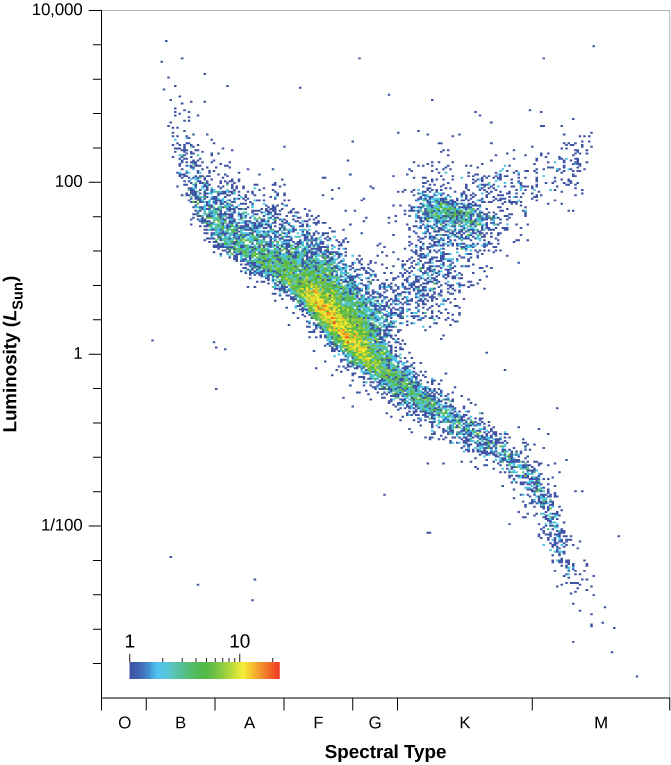
H–R Diagram of Stars Measured by Gaia and Hipparcos.ガイアとヒッパルコスが測定した恒星のH–R図
credit: modification of work by the European Space Agency · ESA educational/informational image permission
Figure 19.8 This plot includes 16,631 stars for which the parallaxes have an accuracy of 10% or better. The colors indicate the numbers of stars at each point of the diagram, with red corresponding to the largest number and blue to the lowest. Luminosity is plotted along the vertical axis, with luminosity increasing upward. An infrared color is plotted as a proxy for temperature, with temperature decreasing to the right. Most of the data points are distributed along the diagonal running from the top left corner (high luminosity, high temperature) to the bottom right (low temperature, low luminosity). These are main sequence stars. The large clump of data points above the main sequence on the right side of the diagram is composed of red giant stars. (credit: modification of work by the European Space Agency)
英語のヒント
図19.8 この図には、視差を10%以内の精度で測れた16,631個の星が含まれる。色は図上の各位置にある星の数を表し、赤が最も多く、青が最も少ない。縦軸は光度で、上ほど大きい。温度の目安として赤外線の色指数を横軸に使い、右へ行くほど温度が低くなる。大半の点は、左上の高光度・高温の側から、右下の低温・低光度の側へ延びる斜めの帯に分布する。これが主系列星である。図の右側、主系列より上にある大きな集まりは、赤色巨星である。(画像提供:ヨーロッパ宇宙機関の作品を改変)