第19章天体までの距離Celestial Distances
19.2 Surveying the Stars19.2 星までの距離を測る
Learning Objectives学習の目標
By the end of this section, you will be able to:
この節を読み終えると、次のことができるようになる。
Understand the concept of triangulating distances to distant objects, including stars
恒星を含む遠方の天体までの距離を、三角測量で求める考え方を理解する。
Explain why space-based satellites deliver more precise distances than ground-based methods
宇宙の衛星による測定が、地上の方法より精密な距離を与える理由を説明する。
Discuss astronomers’ efforts to determine the distance of the stars closest to the Sun
太陽に最も近い星々までの距離を求めるため、天文学者が重ねてきた努力を論じる。
It is an enormous step to go from the planets to the stars. For example, our Voyager 1 probe, which was launched in 1977, has now traveled farther from Earth than any other spacecraft. As of 2021, Voyager 1 is 152 AU from the Sun.To have some basis for comparison, the dwarf planet Pluto orbits at an average distance of 40 AU from the Sun, and the dwarf planet Eris is currently roughly 96 AU from the Sun. The nearest star, however, is hundreds of thousands of AU from Earth. Even so, we can, in principle, survey distances to the stars using the same technique that a civil engineer employs to survey the distance to an inaccessible mountain or tree—the method of triangulation.
英語のヒント
惑星から恒星へ測定の範囲を広げるには、途方もない飛躍が必要になる。例えば、1977年に打ち上げられたボイジャー1号は、ほかのどの宇宙機よりも地球から遠くへ進んでいる。2021年の時点で、太陽から152 AUの距離にあった。比較すると、準惑星の冥王星は太陽から平均40 AUの軌道を回り、準惑星エリスは当時、太陽からおよそ96 AUの距離にあった。ところが最も近い恒星でさえ、地球から数十万AUも離れている。それでも原理的には、土木技師が近づけない山や木までの距離を測るのと同じ方法、三角測量を使えば、恒星までの距離を測れる。
Triangulation in Space宇宙での三角測量
A practical example of triangulation is your own depth perception. As you are pleased to discover every morning when you look in the mirror, your two eyes are located some distance apart. You therefore view the world from two different vantage points, and it is this dual perspective that allows you to get a general sense of how far away objects are.
英語のヒント
三角測量の身近な例は、自分の奥行き知覚である。毎朝、鏡を見てうれしく確認しているとおり、二つの目はある程度離れて付いている。そのため私たちは、二つの異なる地点から世界を見ている。この二つの視点があるから、ものまでのおおよその距離感をつかめる。
To see what we mean, take a pen and hold it a few inches in front of your face. Look at it first with one eye (closing the other) and then switch eyes. Note how the pen seems to shift relative to objects across the room. Now hold the pen at arm’s length: the shift is less. If you play with moving the pen for a while, you will notice that the farther away you hold it, the less it seems to shift. Your brain automatically performs such comparisons and gives you a pretty good sense of how far away things in your immediate neighborhood are.
英語のヒント
試しにペンを持ち、顔の数インチ手前に置いてみよう。まず片目で見て、もう片方は閉じる。それから見る目を替える。ペンが部屋の向こうのものに対して、ずれて見えることに注目してほしい。次に腕をいっぱいに伸ばすと、ずれは小さくなる。しばらくペンを動かしてみれば、遠くへ持っていくほど、ずれが小さく見えると分かるだろう。脳はこのような比較を自動的に行い、身の回りのものがどれほど遠くにあるか、かなりよい距離感を与えてくれる。
If your arms were made of rubber, you could stretch the pen far enough away from your eyes that the shift would become imperceptible. This is because our depth perception fails for objects more than a few tens of meters away. In order to see the shift of an object a city block or more from you, your eyes would need to be spread apart a lot farther.
英語のヒント
もし腕がゴムでできていたら、ペンを目から十分遠くへ伸ばし、ずれが分からなくなるところまで持っていけるだろう。私たちの奥行き知覚は、数十メートル以上離れたものでは働かなくなるからだ。街の一区画分以上離れたもののずれを見るには、二つの目の間隔を、はるかに大きくする必要がある。
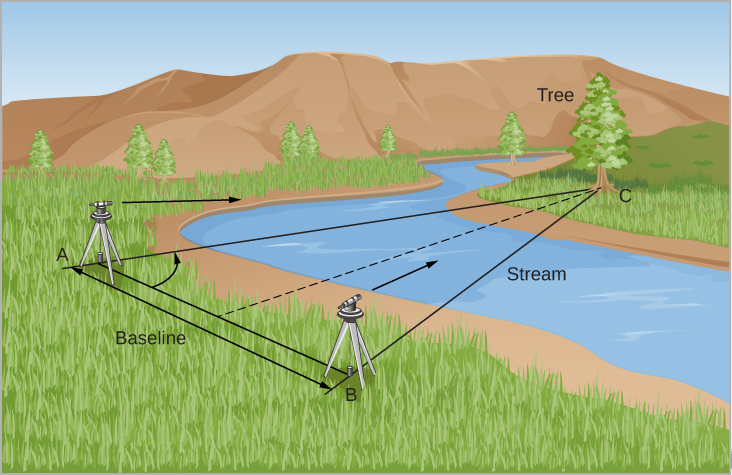
Let’s see how surveyors take advantage of the same idea. Suppose you are trying to measure the distance to a tree across a deep river (Figure 19.4). You set up two observing stations some distance apart. That distance (line AB in Figure 19.4) is called the baseline. Now the direction to the tree (C in the figure) in relation to the baseline is observed from each station. Note that C appears in different directions from the two stations. This apparent change in direction of the remote object due to a change in vantage point of the observer is called parallax.
英語のヒント
測量士が同じ考えをどう使うか見てみよう。深い川の向こう側にある木までの距離を測りたいとする(図19.4)。ある程度離れた二か所に、観測地点を設ける。この間隔、図19.4の線分ABを、基線という。それぞれの観測地点から、基線に対して木がどの方向にあるかを測る。木は図のCである。二つの地点からでは、Cが違う方向に見える。観測者の視点が変わることで、遠方の対象がある方向が見かけ上変わることを、視差という。
Triangulation.三角測量
OpenStax / Rice University · CC BY 4.0
Figure 19.4 Triangulation allows us to measure distances to inaccessible objects. By getting the angle to a tree from two different vantage points, we can calculate the properties of the triangle they make and thus the distance to the tree.
図19.4 三角測量を使えば、近づけないものまでの距離を測れる。二つの異なる視点から木への角度を測り、それらが作る三角形の性質を計算すれば、木までの距離が分かる。
The parallax is also the angle that lines AC and BC make—in mathematical terms, the angle subtended by the baseline. A knowledge of the angles at A and B and the length of the baseline, AB, allows the triangle ABC to be solved for any of its dimensions—say, the distance AC or BC. The solution could be reached by constructing a scale drawing or by using trigonometry to make a numerical calculation. If the tree were farther away, the whole triangle would be longer and skinnier, and the parallax angle would be smaller. Thus, we have the general rule that the smaller the parallax, the more distant the object we are measuring must be.
英語のヒント
視差は、線分ACとBCが作る角度でもある。数学的にいえば、基線を見込む角度だ。AとBの角度と、基線ABの長さが分かれば、三角形ABCのどの辺の長さも求められる。例えば、距離ACやBCを求められる。縮尺を合わせた図を描いてもよいし、三角法で数値を計算してもよい。木がもっと遠くにあれば、三角形全体は細長くなり、視差の角度は小さくなる。したがって、視差が小さいほど、測定している対象は遠い、という一般則が得られる。
In practice, the kinds of baselines surveyors use for measuring distances on Earth are completely useless when we try to gauge distances in space. The farther away an astronomical object lies, the longer the baseline has to be to give us a reasonable chance of making a measurement. Unfortunately, nearly all astronomical objects are very far away. To measure their distances requires a very large baseline and highly precise angular measurements. The Moon is the only object near enough that its distance can be found fairly accurately with measurements made without a telescope. Ptolemy determined the distance to the Moon correctly to within a few percent. He used the turning Earth itself as a baseline, measuring the position of the Moon relative to the stars at two different times of night.
英語のヒント
実際のところ、地上の測量で使う程度の基線は、宇宙の距離を測ろうとすると、まったく役に立たない。天体が遠いほど、測定できる見込みを得るための基線も長くなければならない。残念ながら、ほとんどの天体は非常に遠い。距離の測定には、とても長い基線と、非常に精密な角度の測定が必要になる。望遠鏡を使わずにかなり正確な距離を求められるほど近い天体は、月だけである。プトレマイオスは月までの距離を、数%以内の誤差で正しく求めた。自転する地球そのものを基線に使い、一晩の異なる二つの時刻に、恒星に対する月の位置を測ったのである。
With the aid of telescopes, later astronomers were able to measure the distances to the nearer planets and asteroids using Earth’s diameter as a baseline. This is how the AU was first established. To reach for the stars, however, requires a much longer baseline for triangulation and extremely sensitive measurements. Such a baseline is provided by Earth’s annual trip around the Sun.
英語のヒント
のちの天文学者は、望遠鏡の助けを借り、地球の直径を基線にして、近くの惑星や小惑星までの距離を測れた。このようにして、AUが初めて定められた。恒星へ手を伸ばすには、三角測量の基線をさらに長くし、きわめて微妙な変化を測る必要がある。そのような基線を与えてくれるのが、地球の1年かけた太陽の周回である。