第15章太陽――ありふれた恒星The Sun: A Garden-Variety Star
The Layers of the Sun beneath the Visible Surface見える表面の下にある太陽の層
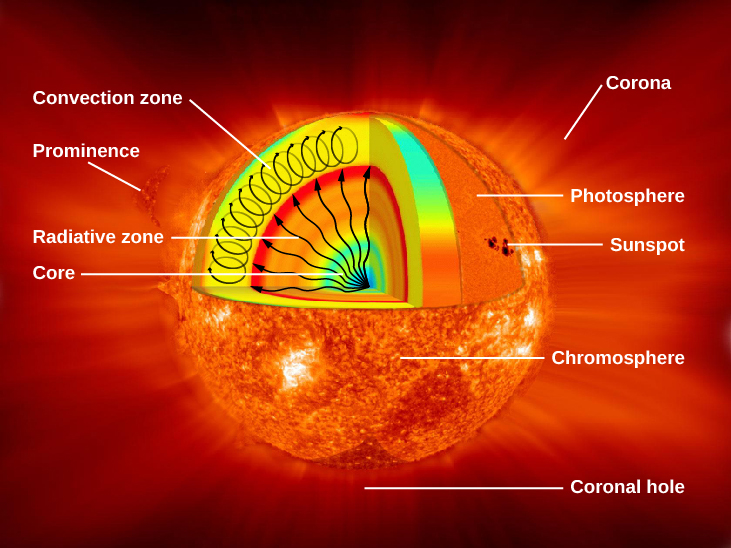
Figure 15.4 shows what the Sun would look like if we could see all parts of it from the center to its outer atmosphere; the terms in the figure will become familiar to you as you read on.
英語のヒント
図15.4は、中心から外側の大気まで、太陽のあらゆる部分が見えたとしたら、どのような姿になるかを示す。図にある用語は、読み進めるうちになじみのあるものになるだろう。
Parts of the Sun.太陽の各部分。
credit: modification of work by NASA/Goddard · NASA media use guidelines
Figure 15.4 This illustration shows the different parts of the Sun, from the hot core where the energy is generated through regions where energy is transported outward, first by radiation, then by convection, and then out through the solar atmosphere. The parts of the atmosphere are also labeled the photosphere, chromosphere, and corona. Some typical features in the atmosphere are shown, such as coronal holes and prominences. (credit: modification of work by NASA/Goddard)
図15.4 この図は、エネルギーが生じる高温の中心核から、まず放射、次に対流でエネルギーが外へ運ばれる領域を経て、太陽大気へ抜け出すまでの、太陽の各部分を示す。大気の各層には、光球、彩層、コロナという名前も付いている。コロナホールやプロミネンスなど、大気に見られる代表的な構造も描かれている。(クレジット:NASA/Goddardの作品を改変)
The Sun’s layers are different from each other, and each plays a part in producing the energy that the Sun ultimately emits. We will begin with the core and work our way out through the layers. The Sun’s core is extremely dense and is the source of all of its energy. Inside the core, nuclear energy is being released (in ways we will discuss in The Sun: A Nuclear Powerhouse). The core is approximately 20% of the size of the solar interior and is thought to have a temperature of approximately 15 million K, making it the hottest part of the Sun.
英語のヒント
太陽の各層は互いに異なり、太陽が最終的に放出するエネルギーを生み出すうえで、それぞれ役割を果たす。中心核から始め、各層を通って外へ進んでいこう。太陽の中心核はきわめて高密度で、太陽のすべてのエネルギーの源である。その中では核エネルギーが放出されている。仕組みは「太陽――核エネルギーの源」で論じる。中心核の大きさは太陽内部の約20%で、温度は約1500万Kと考えられ、太陽で最も高温の部分である。
Above the core is a region known as the radiative zone—named for the primary mode of transporting energy across it. This region starts at about 25% of the distance to the solar surface and extends up to about 70% of the way to the surface. The light generated in the core is transported through the radiative zone very slowly, since the high density of matter in this region means a photon cannot travel too far without encountering a particle, causing it to change direction and lose some energy.
英語のヒント
中心核の上には放射層と呼ばれる領域がある。名称は、そこを通してエネルギーを運ぶ主な方法に由来する。この領域は、中心から太陽表面までの距離の約25%の位置に始まり、約70%の位置まで広がる。核で生じた光は、放射層を非常にゆっくり進む。この領域の物質密度が高く、光子は少し進むと粒子に出会い、向きを変え、エネルギーの一部を失うためだ。
The convective zone is the outermost layer of the solar interior. It is a thick layer approximately 200,000 kilometers deep that transports energy from the edge of the radiative zone to the surface through giant convection cells, similar to a pot of boiling oatmeal. The plasma at the bottom of the convective zone is extremely hot, and it bubbles to the surface where it loses its heat to space. Once the plasma cools, it sinks back to the bottom of the convective zone.
英語のヒント
対流層は、太陽内部で最も外側の層である。深さ約20万kmの厚い層で、放射層の端から表面まで、巨大な対流セルによってエネルギーを運ぶ。鍋の中で煮立つオートミールに似ている。対流層の底のプラズマは非常に高温で、湧き上がるように表面へ昇り、そこで熱を宇宙へ失う。プラズマが冷えると、対流層の底へ再び沈む。
Now that we have given a quick overview of the structure of the whole Sun, in this section, we will embark on a journey through the visible layers of the Sun, beginning with the photosphere—the visible surface.
英語のヒント
太陽全体の構造を簡単に見渡したところで、この節では、目に見える太陽の層を巡る旅に出よう。出発点は、見える表面である光球だ。
The Solar Photosphere太陽の光球
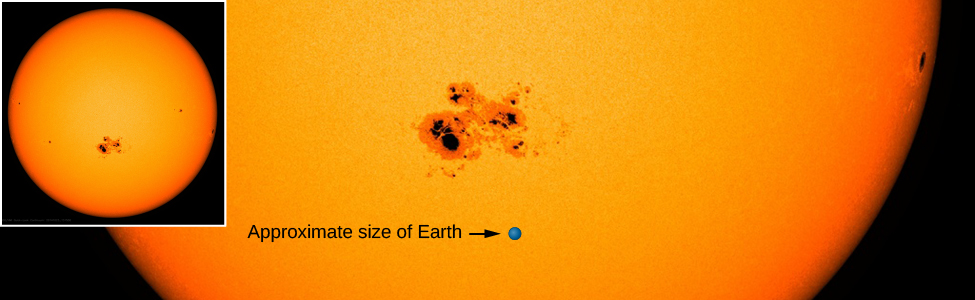
Earth’s air is generally transparent. But on a smoggy day in many cities, it can become opaque, which prevents us from seeing through it past a certain point. Something similar happens in the Sun. Its outer atmosphere is transparent, allowing us to look a short distance through it. But when we try to look through the atmosphere deeper into the Sun, our view is blocked. The photosphere is the layer where the Sun becomes opaque and marks the boundary past which we cannot see (Figure 15.5).
英語のヒント
地球の空気は通常、透明である。しかし多くの都市では、スモッグのある日は不透明になることがあり、ある距離より先を見通せなくなる。太陽でも似たことが起こる。外側の大気は透明なので、少しだけ中まで見通せる。しかし、大気を通して太陽のより深い部分を見ようとすると、視界が遮られる。光球は太陽が不透明になる層であり、それより奥を見られない境界に当たる(図15.5)。
Solar Photosphere plus Sunspots.太陽の光球と黒点。
credit: modification of work by NASA/SDO · NASA media use guidelines
Figure 15.5 This photograph shows the photosphere—the visible surface of the Sun. Also shown is an enlarged image of a group of sunspots; the size of Earth is shown for comparison. Sunspots appear darker because they are cooler than their surroundings. The typical temperature at the center of a large sunspot is about 3800 K, whereas the photosphere has a temperature of about 5800 K. (credit: modification of work by NASA/SDO)
図15.5 この写真は、目に見える太陽の表面である光球を示す。黒点群の拡大画像もあり、大きさの比較のため地球が示されている。黒点が暗く見えるのは、周囲より低温だからである。大きな黒点の中心の典型的な温度は約3800Kで、光球の温度は約5800Kである。(クレジット:NASA/SDOの作品を改変)
As we saw, the energy that emerges from the photosphere was originally generated deep inside the Sun (more on this in The Sun: A Nuclear Powerhouse). This energy is in the form of photons, which make their way slowly toward the solar surface. Outside the Sun, we can observe only those photons that are emitted into the solar photosphere, where the density of atoms is sufficiently low and the photons can finally escape from the Sun without colliding with another atom or ion.
英語のヒント
すでに見たように、光球から出てくるエネルギーは、もともと太陽の深い内部で生じた。「太陽――核エネルギーの源」で詳しく述べる。このエネルギーは光子の形で、太陽表面へ向かってゆっくり進む。太陽の外にいる私たちが観測できるのは、太陽の光球へ放出された光子だけである。光球では原子の密度が十分低く、光子はようやく、別の原子やイオンにぶつからず太陽から抜け出せる。
As an analogy, imagine that you are attending a big campus rally and have found a prime spot near the center of the action. Your friend arrives late and calls you on your cell phone to ask you to join her at the edge of the crowd. You decide that friendship is worth more than a prime spot, and so you work your way out through the dense crowd to meet her. You can move only a short distance before bumping into someone, changing direction, and trying again, making your way slowly to the outside edge of the crowd. All this while, your efforts are not visible to your waiting friend at the edge. Your friend can’t see you until you get very close to the edge because of all the bodies in the way. So too photons making their way through the Sun are constantly bumping into atoms, changing direction, working their way slowly outward, and becoming visible only when they reach the atmosphere of the Sun where the density of atoms is too low to block their outward progress.
英語のヒント
たとえとして、大学構内の大きな集会に参加し、催しの中心に近い、とても良い場所を確保したと想像しよう。遅れて来た友人が携帯電話に連絡してきて、人混みの端で合流してほしいと言う。良い場所より友情のほうが大切だと考え、密集した人混みを抜けて会いに行くことにした。少し進むと誰かにぶつかり、向きを変えてやり直す。それを繰り返しながら、人混みの外縁へゆっくり進む。その間、端で待つ友人には、あなたの努力は見えない。間に大勢の人がいるので、あなたが端のすぐ近くまで来なければ、姿を見られないのだ。同じように、太陽の中を進む光子も絶えず原子にぶつかり、向きを変え、少しずつ外へ進む。そして、原子の密度が低く、外へ進むのを妨げられなくなる太陽大気に達して初めて、見えるようになる。
Astronomers have found that the solar atmosphere changes from almost perfectly transparent to almost completely opaque in a distance of just over 400 kilometers; it is this thin region that we call the photosphere, a word that comes from the Greek for “light sphere.” When astronomers speak of the “diameter” of the Sun, they mean the size of the region surrounded by the photosphere.
英語のヒント
天文学者は、太陽大気がわずか400km余りの距離で、ほぼ完全に透明な状態から、ほぼ完全に不透明な状態へ変わることを見いだした。この薄い領域こそが光球と呼ばれ、photosphereという語は、ギリシャ語の「光の球」に由来する。天文学者が太陽の「直径」と言うとき、それは光球に囲まれた領域の大きさを意味する。
The photosphere looks sharp only from a distance. If you were falling into the Sun, you would not feel any surface but would just sense a gradual increase in the density of the gas surrounding you. It is much the same as falling through a cloud while skydiving. From far away, the cloud looks as if it has a sharp surface, but you do not feel a surface as you fall into it. (One big difference between these two scenarios, however, is temperature. The Sun is so hot that you would be vaporized long before you reached the photosphere. Skydiving in Earth’s atmosphere is much safer.)
英語のヒント
光球の境界がくっきり見えるのは、遠くからだけである。もし太陽へ落ち込んでいたなら、表面に触れた感覚はなく、周囲のガスの密度が徐々に増すのを感じるだけだろう。スカイダイビングで雲を通り抜けるのと、よく似ている。遠くから見る雲にははっきりした表面があるようだが、中へ落ち込んでも表面を感じない。ただし、この二つの状況の大きな違いは温度だ。太陽はあまりに高温で、光球に達するずっと前に蒸発してしまう。地球の大気中でのスカイダイビングのほうが、はるかに安全である。
We might note that the atmosphere of the Sun is not a very dense layer compared to the air in the room where you are reading this text. At a typical point in the photosphere, the pressure is less than 10% of Earth’s pressure at sea level, and the density is about one ten-thousandth of Earth’s atmospheric density at sea level.
英語のヒント
太陽の大気は、この文章を読んでいる部屋の空気に比べ、あまり密度の高い層ではないことも指摘しておこう。光球の典型的な場所では、圧力は地球の海面気圧の10%未満で、密度は海面での地球大気の約1万分の1である。
Observations with telescopes show that the photosphere has a mottled appearance, resembling grains of rice spilled on a dark tablecloth or a pot of boiling oatmeal. This structure of the photosphere is called granulation (see Figure 15.6). Granules, which are typically 700 to 1000 kilometers in diameter (about the width of Texas), appear as bright areas surrounded by narrow, darker (cooler) regions. The lifetime of an individual granule is only 5 to 10 minutes. Even larger are supergranules, which are about 35,000 kilometers across (about the size of two Earths) and last about 24 hours.
英語のヒント
望遠鏡で観測すると、光球は、暗いテーブルクロスにこぼした米粒や、煮立つ鍋のオートミールに似た、まだら模様に見える。この光球の構造は粒状斑と呼ばれる(図15.6参照)。個々の粒状斑は通常、直径700〜1000kmで、テキサス州の幅ほどある。明るい領域の周囲を、幅の狭い、より暗く低温の領域が取り巻いている。一つの粒状斑の寿命はわずか5〜10分である。さらに大きい超粒状斑は幅約3万5000km、地球2個分ほどの大きさで、約24時間続く。
Granulation Pattern.粒状斑の模様。
Figure 15.6 The surface markings of the convection cells create a granulation pattern on this dramatic image (left) taken from the Japanese Hinode spacecraft. You can see the same pattern when you heat up miso soup. The right image shows an irregular-shaped sunspot and granules on the Sun’s surface, seen with the Swedish Solar Telescope on August 22, 2003. (credit left: modification of work by Hinode JAXA/NASA/PPARC; credit right: ISP/SST/Oddbjorn Engvold, Jun Elin Wiik, Luc Rouppe van der Voort)
図15.6 日本の「ひので」衛星が撮影した左の鮮明な画像では、対流セルの表面の特徴が粒状斑の模様を作っている。味噌汁を温めると、同じ模様を見ることができる。右の画像は、スウェーデン太陽望遠鏡が2003年8月22日に捉えた、不規則な形の黒点と太陽表面の粒状斑である。(左のクレジット:Hinode JAXA/NASA/PPARCの作品を改変。右のクレジット:ISP/SST/Oddbjorn Engvold、Jun Elin Wiik、Luc Rouppe van der Voort)
The motions of the granules can be studied by examining the Doppler shifts in the spectra of gases just above them (see The Doppler Effect). The bright granules are columns of hotter gases rising at speeds of 2 to 3 kilometers per second from below the photosphere. As this rising gas reaches the photosphere, it spreads out, cools, and sinks down again into the darker regions between the granules. Measurements show that the centers of the granules are hotter than the intergranular regions by 50 to 100 K.
英語のヒント
粒状斑の運動は、そのすぐ上にあるガスのスペクトルのドップラー偏移を調べて研究できる。「ドップラー効果」を参照してほしい。明るい粒状斑は、光球の下から秒速2〜3kmで上昇する、より高温のガスの柱である。上昇したガスは光球に達すると広がり、冷え、粒状斑の間の暗い領域へ再び沈む。測定によれば、粒状斑の中心は、その間の領域より50〜100K高温である。