第15章太陽――ありふれた恒星The Sun: A Garden-Variety Star
15.3 Solar Activity above the Photosphere15.3 光球の上で起こる太陽活動
Learning Objectives学習の目標
By the end of this section, you will be able to:
この節を読み終えると、次のことができるようになる。
Describe the various ways in which the solar activity cycle manifests itself, including flares, coronal mass ejections, prominences, and plages
フレア、コロナ質量放出、プロミネンス、プラージュを含め、太陽活動の周期がさまざまな現象にどう表れるかを説明する。
Sunspots are not the only features that vary during a solar cycle. There are dramatic changes in the chromosphere and corona as well. To see what happens in the chromosphere, we must observe the emission lines from elements such as hydrogen and calcium, which emit useful spectral lines at the temperatures in that layer. The hot corona, on the other hand, can be studied by observations of X-rays and of extreme ultraviolet and other wavelengths at high energies.
英語のヒント
太陽周期に伴って変化するのは黒点だけではない。彩層やコロナにも劇的な変化がある。彩層で何が起きているかを知るには、水素やカルシウムなどの元素の輝線を観測しなければならない。これらの元素は、彩層の温度で観測に役立つスペクトル線を放つ。一方、高温のコロナは、X線や極端紫外線、そのほかの高エネルギーの波長で観測することによって調べられる。
Plages and Prominencesプラージュとプロミネンス
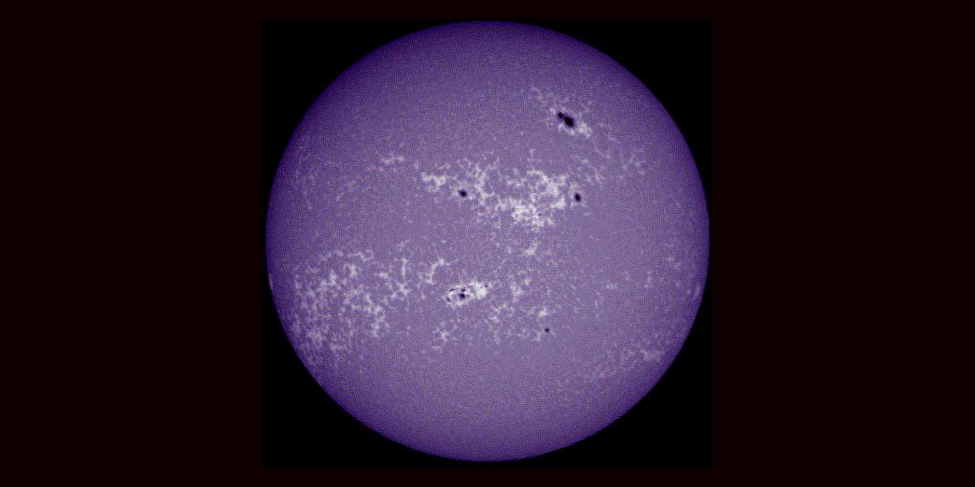
As we saw, emission lines of hydrogen and calcium are produced in the hot gases of the chromosphere. Astronomers routinely photograph the Sun through filters that transmit light only at the wavelengths that correspond to these emission lines. Pictures taken through these special filters show bright “clouds” in the chromosphere around sunspots; these bright regions are known as plages (Figure 15.18). These are regions within the chromosphere that have higher temperature and density than their surroundings. The plages actually contain all of the elements in the Sun, not just hydrogen and calcium. It just happens that the spectral lines of hydrogen and calcium produced by these clouds are bright and easy to observe.
英語のヒント
すでに見たように、水素やカルシウムの輝線は、彩層の高温のガスの中で生じる。天文学者は、これらの輝線に対応する波長の光だけを通すフィルターを使って、日常的に太陽を撮影している。この特別なフィルターを通して撮った写真には、黒点の周囲の彩層に明るい「雲」が写る。この明るい領域をプラージュという(図15.18)。周囲より温度と密度の高い、彩層内の領域である。プラージュには実際には水素やカルシウムだけでなく、太陽にあるすべての元素が含まれる。ただ、これらの雲が生み出す水素とカルシウムのスペクトル線が明るく、観測しやすいのである。
Plages on the Sun.太陽のプラージュ。
credit: modification of work by NASA · NASA media use guidelines
Figure 15.18 This image of the Sun was taken with a filter that transmits only the light of the spectral line produced by singly ionized calcium. The bright cloud-like regions are the plages. (credit: modification of work by NASA)
図15.18 1価に電離したカルシウムが生み出すスペクトル線の光だけを通すフィルターで撮影した太陽。明るい雲のような領域がプラージュである。(クレジット:NASAの作品を改変)
Moving higher into the Sun’s atmosphere, we come to the spectacular phenomena called prominences (Figure 15.19), which usually originate near sunspots. Eclipse observers often see prominences as red features rising above the eclipsed Sun and reaching high into the corona. Some, the quiescent prominences, are graceful loops of plasma (ionized gas) that can remain nearly stable for many hours or even days. The relatively rare eruptive prominences appear to send matter upward into the corona at high speeds, and the most active surge prominences may move as fast as 1300 kilometers per second (almost 3 million miles per hour). Some eruptive prominences have reached heights of more than 1 million kilometers above the photosphere; Earth would be completely lost inside one of those awesome displays (Figure 15.19).
英語のヒント
太陽大気をさらに上へ進むと、プロミネンス(紅炎)と呼ばれる壮観な現象に行き当たる(図15.19)。ふつうは黒点の近くで発生する。日食の観測者には、隠された太陽から立ち上がり、コロナの高いところまで伸びる赤い構造として見えることが多い。静穏型プロミネンスは、プラズマ(電離したガス)が優美な輪を描いたもので、何時間も、ときには何日も、ほぼ安定した状態を保つ。比較的まれな噴出型プロミネンスでは、物質がコロナの上方へ高速で送り出されているように見える。最も活発なサージ型プロミネンスは、秒速1,300キロメートル(時速約300万マイル)もの速さで動くことがある。噴出型プロミネンスの中には、光球の上100万キロメートルを超える高さに達したものもある。このような驚くべき光景の中に地球を置いたら、完全に埋もれて見えなくなってしまうだろう(図15.19)。
Prominences.プロミネンス。
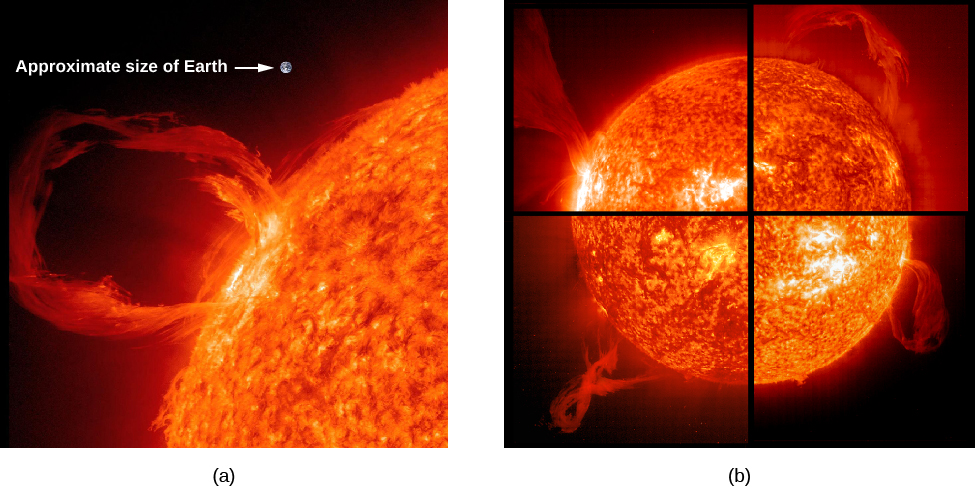
credit a: modification of work by NASA/SOHO; credit b: modification of work by NASA/SDO · NASA media use guidelines
Figure 15.19 (a) This image of an eruptive prominence was taken in the light of singly ionized helium in the extreme ultraviolet part of the spectrum. The prominence is a particularly large one. An image of Earth is shown at the same scale for comparison. (b) A prominence is a huge cloud of relatively cool (about 60,000 K in this case), fairly dense gas suspended in the much hotter corona. These pictures, taken in ultraviolet, are color coded so that white corresponds to the hottest temperatures and dark red to cooler ones. The four images were taken, moving clockwise from the upper left, on May 15, 2001; March 28, 2000; January 18, 2000; and February 2, 2001. (credit a: modification of work by NASA/SOHO; credit b: modification of work by NASA/SDO)
図15.19 (a)極端紫外線の領域にある、1価に電離したヘリウムの光で撮影した噴出型プロミネンス。特に大きなプロミネンスである。比較のため、同じ縮尺の地球の画像を示している。(b)プロミネンスは、はるかに高温のコロナの中に浮かぶ、比較的低温で(この例では約60,000 K)、かなり密度の高いガスの巨大な雲である。紫外線で撮ったこれらの画像では、温度が最も高い部分を白、低い部分を暗赤色として色分けしている。4枚の撮影日は、左上から時計回りに、2001年5月15日、2000年3月28日、2000年1月18日、2001年2月2日である。(クレジットa:NASA/SOHOの作品を改変、b:NASA/SDOの作品を改変)
Flares and Coronal Mass Ejectionsフレアとコロナ質量放出
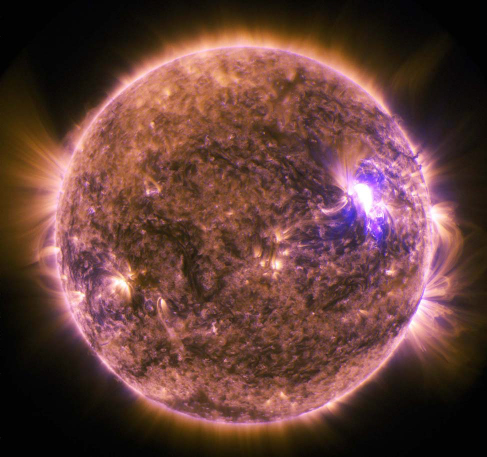
The most violent event on the surface of the Sun is a rapid eruption called a solar flare (Figure 15.20). A typical flare lasts for 5 to 10 minutes and releases a total amount of energy equivalent to that of perhaps a million hydrogen bombs. The largest flares last for several hours and emit enough energy to power the entire United States at its current rate of electrical consumption for 100,000 years. Near sunspot maximum, small flares occur several times per day, and major ones may occur every few weeks.
英語のヒント
太陽の表面で起きる最も激しい現象は、太陽フレアと呼ばれる急激な爆発である(図15.20)。典型的なフレアは5〜10分間続き、放出するエネルギーの総量は、およそ100万個の水素爆弾に匹敵する。最大級のフレアは数時間続き、米国全体の現在の電力消費を10万年間賄えるほどのエネルギーを放出する。黒点の極大期近くには、小さなフレアは1日に数回、大きなものは数週間に1回ほど起こることがある。
Solar Flare.太陽フレア。
credit: NASA/SDO · NASA media use guidelines
Figure 15.20 The bright white area seen on the right side of the Sun in this image from the Solar Dynamics Observatory spacecraft is a solar flare that was observed on June 25, 2015. (credit: NASA/SDO)
図15.20 太陽観測衛星ソーラー・ダイナミクス・オブザーバトリー(SDO)が撮影したこの画像で、太陽の右側に見える明るい白い領域は、2015年6月25日に観測された太陽フレアである。(クレジット:NASA/SDO)
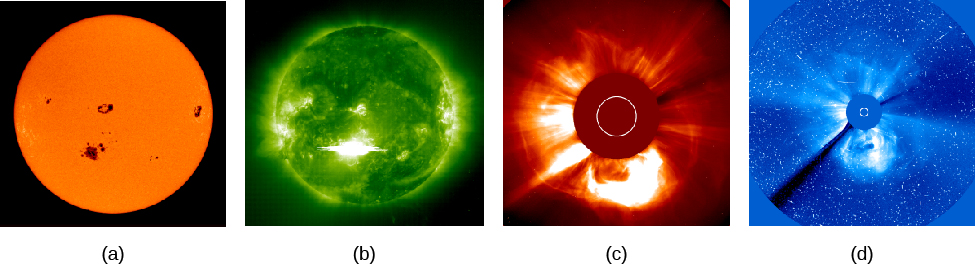
Flares, like the one shown in Figure 15.21, are often observed in the red light of hydrogen, but the visible emission is only a tiny fraction of the energy released when a solar flare explodes. At the moment of the explosion, the matter associated with the flare is heated to temperatures as high as 10 million K. At such high temperatures, a flood of X-ray and ultraviolet radiation is emitted.
英語のヒント
図15.21のようなフレアは、水素の赤い光で観測されることが多い。しかし、可視光で放出されるエネルギーは、太陽フレアの爆発によって解放されるエネルギーのごく一部にすぎない。爆発の瞬間、フレアに関わる物質は1,000万Kもの高温に加熱される。このような高温では、大量のX線と紫外線が放出される。
Flares seem to occur when magnetic fields pointing in opposite directions release energy by interacting with and destroying each other—much as a stretched rubber band releases energy when it breaks.
英語のヒント
フレアは、逆向きの磁場が相互作用して互いに打ち消し合い、エネルギーを解放するときに起こるらしい。引き伸ばした輪ゴムが切れるとエネルギーを解放するのと、よく似ている。
What is different about flares is that their magnetic interactions cover a large volume in the solar corona and release a tremendous amount of electromagnetic radiation. In some cases, immense quantities of coronal material—mainly protons and electrons—may also be ejected at high speeds (500–1000 kilometers per second) into interplanetary space. Such a coronal mass ejection (CME) can affect Earth in a number of ways (which we will discuss in the section on space weather).
英語のヒント
フレアが輪ゴムと異なるのは、磁場の相互作用が太陽コロナの大きな領域に及び、膨大な量の電磁放射を放つことである。場合によっては、大量のコロナ物質、主に陽子と電子も、秒速500〜1,000キロメートルの高速で惑星間空間へ放出される。こうしたコロナ質量放出(CME)は、地球にさまざまな影響を与えうる。その影響については、宇宙天気の節で説明する。
Flare and Coronal Mass Ejection.フレアとコロナ質量放出。
credit a, b, c, d: modification of work by SOHO/EIT, SOHO/LASCO, SOHO/MDI (ESA & NASA) · NASA media use guidelines
Figure 15.21 This sequence of four images shows the evolution over time of a giant eruption on the Sun. (a) The event began at the location of a sunspot group, and (b) a flare is seen in far-ultraviolet light. (c) Fourteen hours later, a CME is seen blasting out into space. (d) Three hours later, this CME has expanded to form a giant cloud of particles escaping from the Sun and is beginning the journey out into the solar system. The white circle in (c) and (d) shows the diameter of the solar photosphere. The larger dark area shows where light from the Sun has been blocked out by a specially designed instrument to make it possible to see the faint emission from the corona. (credit a, b, c, d: modification of work by SOHO/EIT, SOHO/LASCO, SOHO/MDI (ESA & NASA))
図15.21 この4枚の連続画像は、太陽の巨大な爆発が時間とともに変化する様子を示している。(a)現象は黒点群の位置で始まり、(b)遠紫外線でフレアが見える。(c)14時間後、CMEが宇宙空間へ激しく噴き出している。(d)さらに3時間後、CMEは膨張して、太陽から逃げ出す粒子の巨大な雲となり、太陽系の外側へ向かう旅を始めている。(c)と(d)の白い円は太陽光球の直径を示す。それより大きな暗い領域は、コロナのかすかな放射が見えるよう、専用の装置で太陽光を遮った部分である。(クレジットa、b、c、d:SOHO/EIT、SOHO/LASCO、SOHO/MDI〈ESA・NASA〉の作品を改変)