第15章太陽――ありふれた恒星The Sun: A Garden-Variety Star
Solar Storm Damage on Earth太陽の嵐による地球上の被害
When a CME reaches Earth, it distorts Earth’s magnetic field. Since a changing magnetic field induces electrical current, the CME accelerates electrons, sometimes to very high speeds. These “killer electrons” can penetrate deep into satellites, sometimes destroying their electronics and permanently disabling operation. This has happened with some communications satellites.
英語のヒント
CMEが地球に到達すると、地球の磁場をゆがめる。変化する磁場は電流を誘導するので、CMEは電子を加速し、ときには非常に高速にする。こうした「キラー電子」は人工衛星の奥深くまで侵入し、ときには電子機器を破壊して、恒久的に動作不能にする。一部の通信衛星では、実際にこれが起こっている。
Disturbances in Earth’s magnetic field can cause disruptions in communications, especially cell phone and wireless systems. In fact, disruptions can be expected to occur several times a year during solar maximum. Changes in Earth’s magnetic field due to CMEs can also cause surges in power lines large enough to burn out transformers and cause major power outages. For example, in 1989, parts of Montreal and Quebec Province in Canada were without power for up to 9 hours as a result of a major solar storm. Electrical outages due to CMEs are more likely to occur in North America than in Europe because North America is closer to Earth’s magnetic pole, where the currents induced by CMEs are strongest.
英語のヒント
地球の磁場の乱れは、特に携帯電話や無線システムで通信障害を起こすことがある。実際、太陽活動の極大期には、年に数回の障害が起きると見込まれる。CMEによる地球磁場の変化は、送電線に大きな電流の急増を起こし、変圧器を焼損させ、大規模な停電を引き起こすこともある。たとえば1989年には、強い太陽の嵐のために、カナダのモントリオールやケベック州の一部で最大9時間にわたって電力が途絶えた。CMEによる停電は、ヨーロッパよりも北米で起こりやすい。北米は、CMEが誘導する電流が最も強くなる地球の磁極に近いためである。
Besides changing the orbits of satellites, CMEs can also distort the signals sent by them. These effects can be large enough to reduce the accuracy of GPS-derived positions so that they cannot meet the limits required for airplane systems, which must know their positions to within 160 feet. Such disruptions caused by CMEs have occasionally forced the Federal Aviation Administration to restrict flights for minutes or, in a few cases, even days.
英語のヒント
CMEは人工衛星の軌道を変えるだけでなく、衛星が送る信号もゆがめることがある。その影響でGPSによる位置測定の精度が低下し、航空機のシステムに必要な、160フィート以内の誤差で位置を知るという基準を満たせなくなる場合がある。CMEによるこうした障害のため、米連邦航空局はときおり飛行の制限を余儀なくされてきた。制限は数分間で済むこともあれば、まれには数日間に及ぶこともあった。
Solar storms also expose astronauts, passengers in high-flying airplanes, and even people on the surface of Earth to increased amounts of radiation. Astronauts, for example, are limited in the total amount of radiation to which they can be exposed during their careers. A single ill-timed solar outburst could end an astronaut’s career. This problem becomes increasingly serious as astronauts spend more time in space. For example, the typical daily dose of radiation aboard the Russian Mir space station was equivalent to about eight chest X-rays. One of the major challenges in planning the human exploration of Mars is devising a way to protect astronauts from high-energy solar radiation.
英語のヒント
太陽の嵐は、宇宙飛行士、高高度を飛ぶ航空機の乗客、さらには地上の人々の被ばく線量も増加させる。たとえば宇宙飛行士には、その職業人生を通じて浴びる放射線の総量に上限がある。タイミングの悪い太陽の爆発が一度起こるだけで、宇宙飛行士の仕事を終えなければならなくなる可能性もある。宇宙で過ごす時間が長くなるほど、この問題は深刻になる。たとえばロシアの宇宙ステーション「ミール」では、1日の典型的な放射線量が、胸部X線撮影約8回分に相当した。有人火星探査の計画における大きな課題の一つは、高エネルギーの太陽放射から宇宙飛行士を守る方法を考案することである。
Advance warning of solar storms would help us minimize their disruptive effects. Power networks could be run at less than their full capacity so that they could absorb the effects of power surges. Communications networks could be prepared for malfunctions and have backup plans in place. Spacewalks could be timed to avoid major solar outbursts. Scientists are now trying to find ways to predict where and when flares and CMEs will occur, and whether they will be big, fast events or small, slow ones with little consequence for Earth.
英語のヒント
太陽の嵐を事前に警告できれば、その障害を最小限に抑える助けになる。電力網を最大能力より低い状態で運転すれば、電流の急増の影響を吸収できるだろう。通信網は故障に備え、代替計画を整えておける。船外活動は、太陽の大きな爆発を避けるように時期を調整できる。科学者は現在、フレアやCMEがどこでいつ発生するか、そしてそれが大きく速い現象なのか、それとも地球への影響が小さい、小さく遅い現象なのかを予測する方法を探している。
The strategy is to relate changes in the appearance of small, active regions and changes in local magnetic fields on the Sun to subsequent eruptions. However, right now, our predictive capability is still poor, and so the only real warning we have is from actually seeing CMEs and flares occur. Since a CME travels outward at about 500 kilometers per second, an observation of an eruption provides several days warning at the distance of Earth. However, the severity of the impact on Earth depends on how the magnetic field associated with the CME is oriented relative to Earth’s magnetic field. The orientation can be measured only when the CME flows past a satellite we have put up for this purpose. However, it is located only about an hour upstream from Earth.
英語のヒント
その方策は、小さな活動領域の見かけの変化や、太陽の局所的な磁場の変化を、その後の噴出に結び付けることである。しかし現時点では、予測能力はまだ低い。したがって、本当に警告に使えるのは、CMEやフレアの発生を実際に見ることだけである。CMEはおよそ秒速500キロメートルで外へ進むので、噴出を観測すれば、地球までの距離では数日前に警告できる。ただし、地球への影響の深刻さは、CMEに伴う磁場が地球の磁場に対してどちらを向いているかで決まる。その向きを測定できるのは、この目的で配置した衛星をCMEが通り過ぎるときだけである。ところが、その衛星は、地球に到達するまでわずか約1時間という流れの上流側に位置している。
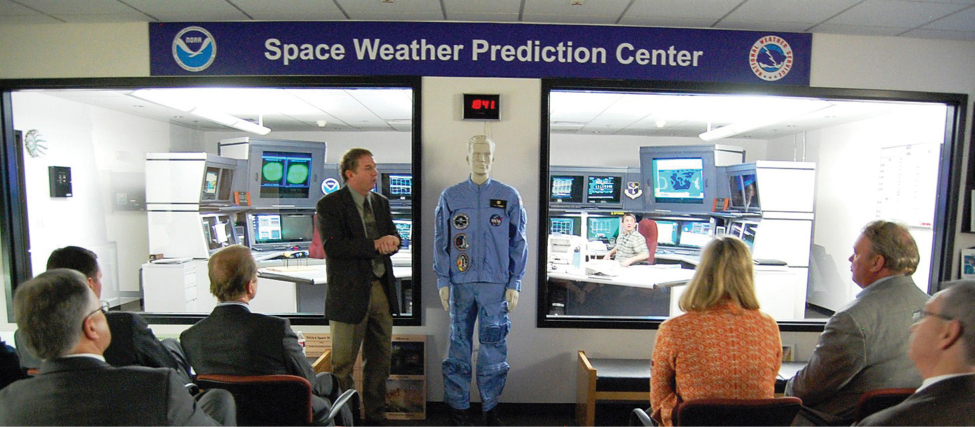
Space weather predictions are now available online to scientists and the public. Outlooks are given a week ahead, bulletins are issued when there is an event that is likely to be of interest to the public, and warnings and alerts are posted when an event is imminent or already under way (Figure 15.25).
英語のヒント
宇宙天気予報は、現在では科学者も一般の人々もオンラインで利用できる。1週間先の見通しが発表され、一般の人々が関心をもつと思われる現象が起きると速報が出る。現象が間近に迫ったり、すでに進行していたりすると、警報や注意報が掲載される(図15.25)。
NOAA Space Weather Prediction Operations Center.NOAA宇宙天気予報運用センター。
credit: modification of work by FEMA/Jerry DeFelice · U.S. government work; OpenStax adaptation CC BY 4.0
Figure 15.25 Bill Murtagh, a space weather forecaster, leads a workshop on preparedness for events like geomagnetic storms. (credit: modification of work by FEMA/Jerry DeFelice)
図15.25 宇宙天気予報官のビル・マータフが、地磁気嵐のような現象への備えを学ぶワークショップを進行している。(クレジット:FEMA/Jerry DeFeliceの作品を改変)
More satellites are being launched that will allow us to determine whether CMEs are headed toward Earth and how big they are. Models are being developed that will then allow scientists to use early information about the CME to predict its likely impact on Earth.
英語のヒント
CMEが地球へ向かっているか、どれほど大きいかを判断できるようにするため、さらに多くの衛星が打ち上げられている。また、CMEについての初期情報から、地球に及ぼしそうな影響を予測できるモデルも開発されている。
The hope is that soon, solar weather forecasting will have some of the predictive capability that meteorologists have achieved for terrestrial weather at Earth’s surface. However, the most difficult events to predict are the largest and most damaging storms—hurricanes on Earth and extreme, rare storm events on the Sun. Thus, it is inevitable that the Sun will continue to surprise us.
英語のヒント
太陽の天気予報も、地上の天気について気象学者が達成した予測能力の一部を、まもなく備えることが期待されている。しかし、最も予測が難しいのは、最も大きく、被害も甚大な嵐である。地球ならハリケーン、太陽なら極端でまれな嵐がそれに当たる。したがって、太陽がこれからも私たちを驚かせ続けるのは避けられない。
The Timing of Solar Events太陽で起こった現象が届くまでの時間
A basic equation is useful in figuring out when events on the Sun will impact Earth:
太陽で起こった現象がいつ地球に影響するかを求めるには、基本的な式が役立つ。
Dividing both sides by v, we get
両辺をvで割ると、次の式が得られる。
Suppose you observe a major solar flare while astronauts are orbiting Earth. If the average speed of solar wind is 400 km/s and the distance to the Sun is , how long will it be before the charged particles ejected from the Sun during the flare reach the space station?
宇宙飛行士が地球を周回しているときに、大きな太陽フレアを観測したとしよう。太陽風の平均の速さが400 km/s、太陽までの距離がなら、フレアのときに太陽から放出された荷電粒子が宇宙ステーションへ届くまで、どれくらいの時間がかかるだろうか。
Solution解き方
The time required for solar wind particles to reach Earth is T = D/v.
太陽風の粒子が地球へ届くまでに必要な時間は、T = D/vである。
Check Your Learning理解を確かめよう
How many days would it take for the particles to reach Earth if the solar wind speed increased to
500 km/s?
太陽風の速さが500 km/sになった場合、粒子が地球に届くまで何日かかるだろうか。