第15章太陽――ありふれた恒星The Sun: A Garden-Variety Star
Magnetism and the Solar Cycle磁気と太陽活動周期
Now that we have discussed the Sun’s activity cycle, you might be asking, “Why does the Sun change in such a regular way?” Astronomers now understand that it is the Sun’s changing magnetic field that drives solar activity.
英語のヒント
太陽活動の周期を見たところで、「なぜ太陽はこんなに規則正しく変化するのか」と思うかもしれない。今では天文学者は、太陽活動を駆動するのは、変化する太陽の磁場だと理解している。
The solar magnetic field is measured using a property of atoms called the Zeeman effect. Recall from Radiation and Spectra that an atom has many energy levels and that spectral lines are formed when electrons shift from one level to another. If each energy level is precisely defined, then the difference between them is also quite precise. As an electron changes levels, the result is a sharp, narrow spectral line (either an absorption or emission line, depending on whether the electron’s energy increases or decreases in the transition).
英語のヒント
太陽の磁場は、ゼーマン効果という原子の性質を用いて測る。「放射とスペクトル」で、原子には多くのエネルギー準位があり、電子がある準位から別の準位へ移るとスペクトル線が生じることを学んだ。各エネルギー準位が厳密に定まっていれば、準位間の差も厳密に定まる。電子が準位を変えると、その結果は鋭く細いスペクトル線となる。遷移で電子のエネルギーが増すか減るかに応じて、吸収線か輝線のどちらかになる。
In the presence of a strong magnetic field, however, each energy level is separated into several levels very close to one another. The separation of the levels is proportional to the strength of the field. As a result, spectral lines formed in the presence of a magnetic field are not single lines but a series of very closely spaced lines corresponding to the subdivisions of the atomic energy levels. This splitting of lines in the presence of a magnetic field is what we call the Zeeman effect (after the Dutch scientist who first discovered it in 1896).
英語のヒント
しかし強い磁場があると、各エネルギー準位は、互いに非常に近い複数の準位へ分かれる。準位間の分離の大きさは、磁場の強さに比例する。そのため、磁場中で生じるスペクトル線は1本ではなく、原子のエネルギー準位の細分化に対応した、ごく近接する一連の線となる。この磁場によるスペクトル線の分裂を、1896年に初めて発見したオランダの科学者にちなみ、ゼーマン効果と呼ぶ。
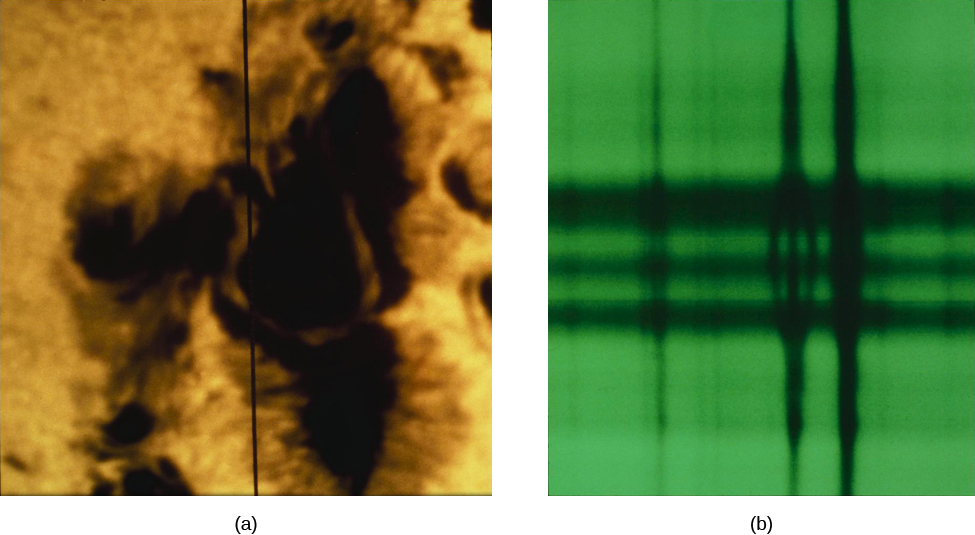
Measurements of the Zeeman effect in the spectra of the light from sunspot regions show them to have strong magnetic fields (Figure 15.15). Bear in mind that magnets always have a north pole and a south pole. Whenever sunspots are observed in pairs, or in groups containing two principal spots, one of the spots usually has the magnetic polarity of a north-seeking magnetic pole and the other has the opposite polarity. Moreover, during a given cycle, the leading spots of pairs (or leading principal spots of groups) in the Northern Hemisphere all tend to have the same polarity, whereas those in the Southern Hemisphere all tend to have the opposite polarity.
英語のヒント
黒点領域の光のスペクトルでゼーマン効果を測ると、黒点に強い磁場があることが分かる(図15.15)。磁石には必ずN極とS極があることを思い出してほしい。黒点が対、あるいは二つの主要な黒点を持つ群れとして観測される場合、通常、一方は北を向く磁極の極性を、他方は反対の極性を持つ。さらに、一つの周期の間、北半球の黒点対の先行黒点、あるいは群れの先行する主要黒点は、みな同じ極性を持つ傾向があり、南半球のものはすべて反対の極性を持つ傾向がある。
Zeeman Effect.ゼーマン効果。
credit: modification of work by NSO/AURA/NSF · CC BY 4.0
Figure 15.15 These photographs show how magnetic fields in sunspots are measured by means of the Zeeman effect. (left) The vertical black line indicates the position of the spectrograph slit through which light is passed to obtain the spectrum in (right). (credit: modification of work by NSO/AURA/NSF)
図15.15 この写真は、ゼーマン効果によって黒点の磁場をどう測定するかを示す。左の縦の黒線は分光器のスリットの位置であり、そこを通した光から右のスペクトルを得る。(クレジット:NSO/AURA/NSFの作品を改変)
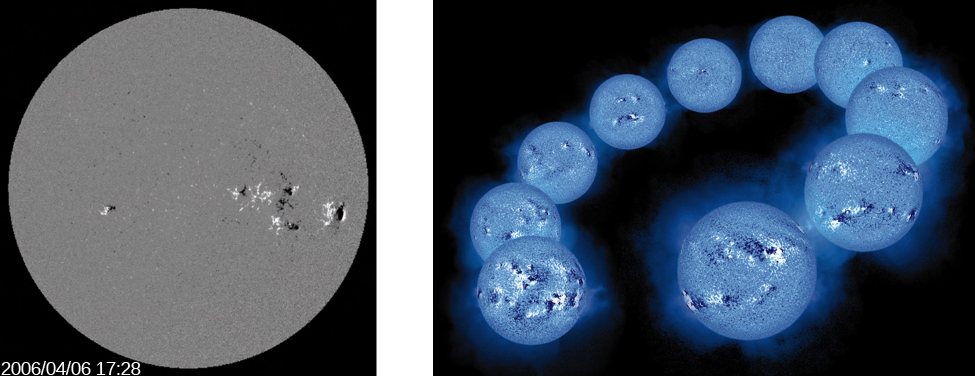
During the next sunspot cycle, however, the polarity of the leading spots is reversed in each hemisphere. For example, if during one cycle, the leading spots in the Northern Hemisphere all had the polarity of a north-seeking pole, then the leading spots in the Southern Hemisphere would have the polarity of a south-seeking pole. During the next cycle, the leading spots in the Northern Hemisphere would have south-seeking polarity, whereas those in the Southern Hemisphere would have north-seeking polarity. Therefore, strictly speaking, the sunspot cycle does not repeat itself in regard to magnetic polarity until two 11-year cycles have passed. A visual representation of the Sun’s magnetic fields, called a magnetogram, can be used to see the relationship between sunspots and the Sun’s magnetic field (Figure 15.16).
英語のヒント
しかし次の黒点周期には、各半球で先行黒点の極性が反転する。例えば、一つの周期で北半球の先行黒点がすべてN極の極性を持っていたなら、南半球の先行黒点はS極の極性を持つ。次の周期には、北半球の先行黒点はS極、南半球のものはN極になる。したがって厳密に言えば、磁気的な極性まで含めて黒点周期が繰り返すのは、11年周期が二つ過ぎてからである。マグネトグラムと呼ばれる太陽磁場の画像を使うと、黒点と太陽の磁場との関係を見ることができる(図15.16)。
Magnetogram and Solar Cycle.マグネトグラムと太陽活動周期。
credit left: modification of work by NASA/SDO; credit right: modification of work by NASA/SOHO · NASA media use guidelines
Figure 15.16 In the image on the left, called a magnetogram, we see the magnetic polarity of sunspots. The black areas are where the magnetism is pointing toward the Sun’s core, whereas the white regions are where it is pointing away from the core, toward us. This dramatic sequence on the right shows the activity cycle of the Sun. The 10 maps of the magnetic field on the surface of the Sun span a period of 7.5 years. The two magnetic polarities (N and S) of the magnetic field are shown against a blue disk as dark blue to black (N) and as light blue to white (S). The earliest image, taken on January 8, 1992, is at the lower left and was taken just after solar maximum. Each image, from left to right around the arc, was taken one-half to one year after the preceding one. The last image was taken on July 25, 1999, as the Sun was approaching the next solar maximum. Note a few striking patterns in the magnetic maps: the direction from white to black polarity in the Southern Hemisphere is opposite from that in the Northern Hemisphere. (credit left: modification of work by NASA/SDO; credit right: modification of work by NASA/SOHO)
図15.16 マグネトグラムと呼ばれる左の画像では、黒点の磁気的な極性が見える。黒い領域では磁場が太陽の中心核へ向き、白い領域では中心核から離れ、こちらへ向いている。右の印象的な連続画像は太陽活動周期を示す。太陽表面の磁場を描いた10枚の地図は、7.5年を覆っている。磁場の二つの極性、NとSは、青い円盤を背景に、濃い青から黒がN、薄い青から白がSとして示される。左下にある最初の画像は1992年1月8日のもので、太陽活動極大の直後に撮影された。左から右へ弧に沿って並ぶ各画像は、一つ前から半年〜1年後に撮影されている。最後の画像は、太陽が次の極大に近づいていた1999年7月25日のものだ。磁場地図には、はっきりした模様がある。南半球で白い極性から黒い極性へ向かう方向は、北半球とは逆であることに注目しよう。(左のクレジット:NASA/SDOの作品を改変。右のクレジット:NASA/SOHOの作品を改変)
Why is the Sun such a strong and complicated magnet? Astronomers have found that it is the Sun’s dynamo that generates the magnetic field. A dynamo is a machine that converts kinetic energy (i.e., the energy of motion) into electricity. On Earth, dynamos are found in power plants where, for example, the energy from wind or flowing water is used to cause turbines to rotate. In the Sun, the source of kinetic energy is the churning of turbulent layers of ionized gas within the Sun’s interior that we mentioned earlier. These generate electric currents—moving electrons—which in turn generate magnetic fields.
英語のヒント
なぜ太陽は、これほど強く複雑な磁石なのだろうか。天文学者は、磁場を生むのは太陽のダイナモだと突き止めた。ダイナモは、運動エネルギーを電気へ変える装置である。地球では発電所にあり、例えば風や流れる水のエネルギーでタービンを回す。太陽での運動エネルギー源は、先に述べた、内部の電離ガスの乱流層が激しくかき混ぜられる動きである。これらが電流、つまり動く電子を生み、その電流が今度は磁場を生む。
Most solar researchers agree that the solar dynamo is located in the convection zone or in the interface layer between the convection zone and the radiative zone below it. As the magnetic fields from the Sun’s dynamo interact, they break, reconnect, and rise through the Sun’s surface.
英語のヒント
太陽を研究する科学者の大半は、太陽ダイナモが対流層、あるいは対流層とその下の放射層の境界層にあるという点で一致している。太陽ダイナモから生じた磁場は相互作用しながら、切れ、つながり直し、太陽表面を通って上昇する。
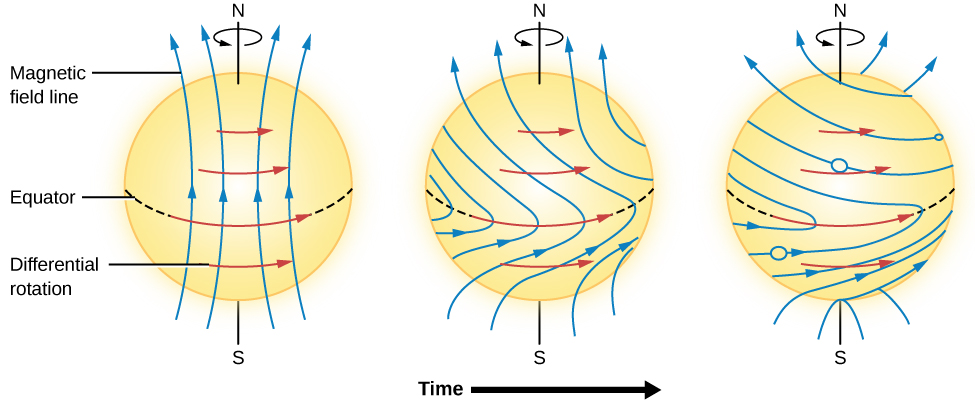
We should say that, although we have good observations that show us how the Sun changes during each solar cycle, it is still very difficult to build physical models of something as complicated as the Sun that can account satisfactorily for why it changes. Researchers have not yet developed a generally accepted model that describes in detail the physical processes that control the solar cycle. Calculations do show that differential rotation (the idea that the Sun rotates at different rates at different latitudes) and convection just below the solar surface can twist and distort the magnetic fields. This causes them to grow and then decay, regenerating with opposite polarity approximately every 11 years. The calculations also show that as the fields grow stronger near solar maximum, they flow from the interior of the Sun toward its surface in the form of loops. When a large loop emerges from the solar surface, it creates regions of sunspot activity (Figure 15.17).
英語のヒント
各太陽活動周期の間に太陽がどのように変わるかを示す、良い観測結果は得られている。それでも、太陽ほど複雑なものについて、なぜ変化するかを十分に説明できる物理モデルを作るのは、依然として非常に難しいことを断っておこう。太陽活動周期を支配する物理過程を詳しく説明する、広く受け入れられたモデルは、まだ作られていない。ただし計算は、太陽が緯度ごとに異なる速さで回る差動回転と、表面のすぐ下の対流が、磁場をねじり、ゆがめることを示している。このため磁場は成長した後に減衰し、約11年ごとに反対の極性で再生する。計算はまた、活動極大に近づき磁場が強くなると、太陽内部から表面へ、ループの形で上がることも示す。大きなループが太陽表面から現れると、黒点活動の領域を作る(図15.17)。
Magnetic Field Lines Wind Up.巻き込まれる磁力線。
OpenStax / Rice University · CC BY 4.0
Figure 15.17 Because the Sun spins faster at the equator than near the poles, the magnetic fields in the Sun tend to wind up as shown, and after a while make loops. This is an idealized diagram; the real situation is much more complex.
図15.17 太陽は極の近くより赤道で速く回転するため、内部の磁場は図のように巻き込まれ、しばらくするとループを作る。これは理想化した図であり、実際の状況ははるかに複雑である。
This idea of magnetic loops offers a natural explanation of why the leading and trailing sunspots in an active region have opposite polarity. The leading sunspot coincides with one end of the loop and the trailing spot with the other end. Magnetic fields also hold the key to explaining why sunspots are cooler and darker than the regions without strong magnetic fields. The forces produced by the magnetic field resist the motions of the bubbling columns of rising hot gases. Since these columns carry most of the heat from inside the Sun to the surface by means of convection, and strong magnetic fields inhibit this convection, the surface of the Sun is allowed to cool. As a result, these regions are seen as darker, cooler sunspots.
英語のヒント
この磁場ループの考え方は、活動領域の先行黒点と後続黒点が反対の極性を持つことを自然に説明する。先行黒点はループの一端に、後続黒点は他端に対応する。磁場はまた、黒点が強い磁場のない領域より低温で暗い理由を説明する鍵でもある。磁場による力は、上昇する高温ガスの湧き立つ柱の運動に抵抗する。これらの柱は対流によって太陽内部から表面へ熱の大半を運ぶが、強い磁場がこの対流を妨げるため、表面は冷えることができる。その結果、こうした領域は低温で暗い黒点として見える。
Beyond this general picture, researchers are still trying to determine why the magnetic fields are as large as they are, why the polarity of the field in each hemisphere flips from one cycle to the next, why the length of the solar cycle can vary from one cycle to the next, and why events like the Maunder Minimum occur.
英語のヒント
この大まかな説明を越える問題については、研究が続いている。なぜ磁場が現在ほど強いのか、なぜ各半球の極性が周期ごとに反転するのか、なぜ太陽活動周期の長さが周期によって変わるのか、そしてなぜマウンダー極小期のような出来事が起こるのかを、研究者はなお突き止めようとしている。