第15章太陽――ありふれた恒星The Sun: A Garden-Variety Star
15.2 The Solar Cycle15.2 太陽活動周期
Learning Objectives学習の目標
By the end of this section, you will be able to:
この節を読み終えると、次のことができるようになる。
Describe the sunspot cycle and, more generally, the solar cycle
黒点周期と、より広い意味での太陽活動周期を説明する
Explain how magnetism is the source of solar activity
磁気が太陽活動の源であることを説明する
Before the invention of the telescope, the Sun was thought to be an unchanging and perfect sphere. We now know that the Sun is in a perpetual state of change: its surface is a seething, bubbling cauldron of hot gas. Areas that are darker and cooler than the rest of the surface come and go. Vast plumes of gas erupt into the chromosphere and corona. Occasionally, there are even giant explosions on the Sun that send enormous streamers of charged particles and energy hurtling toward Earth. When they arrive, these can cause power outages and other serious effects on our planet.
英語のヒント
望遠鏡が発明される前、太陽は変化しない完全な球だと考えられていた。今では、太陽は絶えず変化しており、その表面は高温のガスが激しく煮え立ち、泡立つ大釜のようなものだと分かっている。周囲より暗く低温の領域が現れては消え、巨大なガスの柱が彩層やコロナへ噴き出す。時には、荷電粒子とエネルギーの巨大な流れを地球へ向かって猛烈な勢いで放つ、大爆発さえ起こる。それらが届くと、地球で停電などの深刻な影響を生じることがある。
Sunspots黒点
The first evidence that the Sun changes came from studies of sunspots, which are large, dark features seen on the surface of the Sun caused by increased magnetic activity. They look darker because the spots are typically at a temperature of about 3800 K, whereas the bright regions that surround them are at about 5800 K (Figure 15.13). Occasionally, these spots are large enough to be visible to the unaided eye, and we have records going back over a thousand years from observers who noticed them when haze or mist reduced the Sun’s intensity. (We emphasize what your parents have surely told you: looking at the Sun for even a brief time can cause permanent eye damage. This is the one area of astronomy where we don’t encourage you to do your own observing without getting careful instructions or filters from your instructor.)
英語のヒント
太陽が変化するという最初の証拠は、黒点の研究から得られた。黒点は、磁気活動が強まることで太陽表面に見られる、大きく暗い構造である。通常の黒点の温度は約3800Kで、周囲の明るい領域は約5800Kなので、黒点のほうが暗く見える(図15.13)。時には肉眼で見えるほど大きくなり、もやや霧によって太陽光が弱まったときに黒点に気付いた観測者の記録は、1000年以上前までさかのぼる。ここで、保護者からもきっと注意されたことを強調しておく。太陽を見ると、短時間であっても、目に永久的な損傷を与えることがある。天文学の中でも、この分野だけは、指導者から十分な説明や適切なフィルターを得ることなく、自分だけで観測するよう勧めることはできない。
Sunspots.黒点。
Figure 15.13 a) Image of sunspots, cooler and thus darker regions on the Sun, taken in July 2012. You can see the dark, central region of each sunspot (called the umbra) surrounded by a less dark region (the penumbra). The largest spot shown here is about 11 Earths wide. b) The new Daniel Inouye Solar Telescope took the most detailed image of a sunspot ever recorded in January 2020. A map of the United States is shown to scale. Although sunspots appear dark when seen next to the hotter gases of the photosphere, an average sunspot, cut out of the solar surface and left standing in the night sky, would be about as bright as the full moon. The mottled appearance of the Sun’s surface is granulation. (credit a: modification of work by NASA Goddard Space Flight Center, Alan Friedman; credit b: modification of work by NSO/AURA/NSF)
図15.13 (a)2012年7月に撮影された、周囲より低温で、そのため暗い黒点の画像。各黒点の暗い中心部分である暗部を、より暗さの弱い半暗部が囲んでいる。ここに写る最大の黒点の幅は、地球約11個分である。(b)新しいダニエル・K・イノウエ太陽望遠鏡は、2020年1月、記録上最も詳しい黒点画像を撮影した。同じ縮尺で米国の地図が示されている。黒点は光球のより高温のガスの隣で見ると暗いが、普通の黒点を太陽表面から切り出して夜空に置いたなら、満月ほどの明るさになるだろう。太陽表面のまだら模様は粒状斑である。(aのクレジット:NASA Goddard Space Flight Center、Alan Friedmanの作品を改変。bのクレジット:NSO/AURA/NSFの作品を改変)
While we understand that sunspots look darker because they are cooler, they are nevertheless hotter than the surfaces of many stars. If they could be removed from the Sun, they would shine brightly. They appear dark only in contrast with the hotter, brighter photosphere around them.
英語のヒント
黒点が暗く見えるのは低温だからだと理解していても、黒点は多くの恒星の表面より高温である。太陽から取り出せたなら、明るく輝くだろう。暗く見えるのは、周囲のより高温で明るい光球との対比によってだけなのだ。
Individual sunspots come and go, with lifetimes that range from a few hours to a few months. If a spot lasts and develops, it usually consists of two parts: an inner darker core, the umbra, and a surrounding less dark region, the penumbra. Many spots become much larger than Earth, and a few, like the largest one shown in Figure 15.13, have reached diameters over 140,000 kilometers. Frequently, spots occur in groups of 2 to 20 or more. The largest groups are very complex and may have over 100 spots. Like storms on Earth, sunspots are not fixed in position, but they drift slowly compared with the Sun’s rotation.
英語のヒント
個々の黒点は現れては消え、寿命は数時間から数か月まである。黒点が長く残り発達すると、通常は二つの部分になる。内側のより暗い中心が暗部で、それを囲む、暗さの弱い領域が半暗部である。多くの黒点は地球よりはるかに大きくなり、図15.13の最大のもののように、直径14万kmを超えた例もある。黒点はしばしば2〜20個以上の群れで現れる。最大の群れは非常に複雑で、100個以上の黒点を含むこともある。地球の嵐と同じく、黒点の位置は固定されていないが、太陽の自転に比べるとゆっくり漂う。
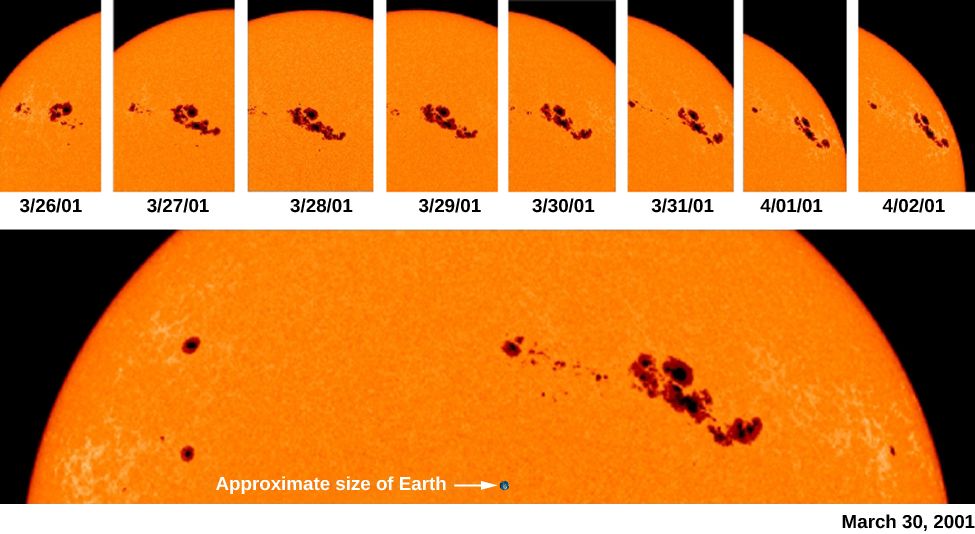
By recording the apparent motions of the sunspots as the turning Sun carried them across its disk (Figure 15.14), Galileo, in 1612, demonstrated that the Sun rotates on its axis with a rotation period of approximately 1 month. Our star turns in a west-to-east direction, like the orbital motions of the planets. The Sun, however, is a gas and does not have to rotate rigidly, the way a solid body like Earth does. Modern observations show that the speed of rotation of the Sun varies according to latitude, that is, it’s different as you go north or south of the Sun’s equator. The rotation period is about 25 days at the equator, 28 days at latitude 40°, and 36 days at latitude 80°. We call this behavior differential rotation.
英語のヒント
1612年、ガリレオは、自転する太陽によって黒点が見かけの円盤を横切って運ばれる、その動きを記録し(図15.14)、太陽が約1か月の周期で自転していることを示した。太陽は、惑星の公転運動と同じく、西から東へ回る。しかし太陽はガスなので、地球のような固体の天体と同じように、一体の剛体として回転する必要はない。現在の観測では、太陽の回転の速さは緯度によって、つまり赤道から北や南へ進むにつれて変わることが分かっている。自転周期は赤道で約25日、緯度40°で28日、緯度80°で36日である。この振る舞いを差動回転という。
Sunspots Rotate Across Sun’s Surface.太陽表面を自転とともに移動する黒点。
credit: modification of work by SOHO/NASA/ESA · NASA media use guidelines
Figure 15.14 This sequence of photographs of the Sun’s surface tracks the movement of sunspots across the visible hemisphere of the Sun. On March 30, 2001, this group of sunspots extended across an area about 13 times the diameter of Earth. This region produced many flares and coronal mass ejections. (credit: modification of work by SOHO/NASA/ESA)
図15.14 この一連の太陽表面の写真は、見えている半球を横切る黒点の動きを追っている。2001年3月30日、この黒点群は地球の直径の約13倍にわたる領域へ広がっていた。この領域は多数のフレアとコロナ質量放出を起こした。(クレジット:SOHO/NASA/ESAの作品を改変)
The Sunspot Cycle黒点周期
Between 1826 and 1850, Heinrich Schwabe, a German pharmacist and amateur astronomer, kept daily records of the number of sunspots. What he was really looking for was a planet inside the orbit of Mercury, which he hoped to find by observing its dark silhouette as it passed between the Sun and Earth. He failed to find the hoped-for planet, but his diligence paid off with an even-more important discovery: the sunspot cycle. He found that the number of sunspots varied systematically, in cycles about a decade long.
英語のヒント
1826〜1850年、ドイツの薬剤師でアマチュア天文学者のハインリヒ・シュワーベは、毎日の黒点数を記録した。彼が本当に探していたのは水星の軌道の内側の惑星であり、太陽と地球の間を通過するときの暗いシルエットを観測して見つけたいと考えていた。目当ての惑星は見つからなかったが、勤勉な観測は、さらに重要な黒点周期の発見として報われた。黒点数が約10年の周期で、規則的に変動すると見いだしたのである。
What Schwabe observed was that, although individual spots are short lived, the total number visible on the Sun at any one time was likely to be very much greater at certain times—the periods of sunspot maximum—than at other times—the periods of sunspot minimum. We now know that sunspot maxima occur at an average interval of 11 years, but the intervals between successive maxima have ranged from as short as 9 years to as long as 14 years. During sunspot maxima, more than 100 spots can often be seen at once. Even then, less than one-half of one percent of the Sun’s surface is covered by spots (Figure 15.22). During sunspot minima, sometimes no spots are visible. The Sun’s activity is reaching its next maximum in the 2024–25 timeframe.
英語のヒント
シュワーベが観測したのは、個々の黒点の寿命は短くても、ある瞬間に太陽に見える黒点の総数は、ある時期には別の時期より非常に多くなりやすい、ということだった。多い時期が黒点極大期、少ない時期が黒点極小期である。今では、黒点極大は平均11年の間隔で起こると分かっている。ただし、続く極大どうしの間隔は、短いもので9年、長いもので14年と幅がある。極大期には、一度に100個を超える黒点が見えることも多い。それでも黒点に覆われるのは、太陽表面の0.5%未満である(図15.22)。極小期には、黒点が一つも見えないこともある。太陽活動は、2024〜2025年の時期に次の極大を迎えつつある。