第15章太陽――ありふれた恒星The Sun: A Garden-Variety Star
The Solar Wind太陽風
One of the most remarkable discoveries about the Sun’s atmosphere is that it produces a stream of charged particles (mainly protons and electrons) that we call the solar wind. These particles flow outward from the Sun into the solar system at a speed of about 400 kilometers per second (almost 1 million miles per hour)! The solar wind exists because the gases in the corona are so hot and moving so rapidly that they cannot be held back by solar gravity. (This wind was actually discovered by its effects on the charged tails of comets; in a sense, we can see the comet tails blow in the solar breeze the way wind socks at an airport or curtains in an open window flutter on Earth.)
英語のヒント
太陽大気に関する最も注目すべき発見の一つは、太陽風と呼ばれる荷電粒子の流れを作っていることだ。粒子の主成分は陽子と電子で、太陽から太陽系へ、秒速約400km、時速にして100万マイル近くで流れ出す。太陽風があるのは、コロナのガスが非常に高温で、あまりに速く動くため、太陽の重力でも引き留められないからである。実際、この風は、彗星の電荷を帯びた尾に及ぼす影響から発見された。ある意味では、地上で空港の吹き流しや開いた窓のカーテンがはためくように、彗星の尾が太陽からの風になびく姿を見ているのだ。
Although the solar wind material is very, very rarified (i.e., extremely low density), the Sun has an enormous surface area. Astronomers estimate that the Sun is losing about 1–2 million tons of material each second through this wind. Although this sounds like a lot, it’s so trivial compared to the enormous mass of the Sun that it can be neglected as we study the Sun.
英語のヒント
太陽風の物質は非常に希薄、つまり密度がきわめて低いものの、太陽の表面積は巨大である。天文学者は、この風によって太陽が毎秒約100万〜200万トンの物質を失っていると推定している。多いように聞こえるが、太陽の巨大な質量と比べればごくわずかなので、太陽を研究する際には無視できる。
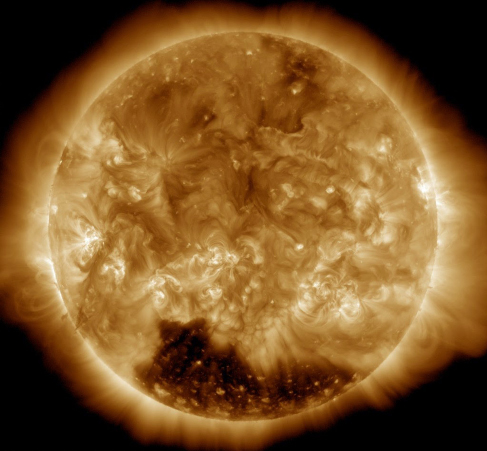
From where in the Sun does the solar wind emerge? In visible photographs, the solar corona appears fairly uniform and smooth. X-ray and extreme ultraviolet pictures, however, show that the corona has loops, plumes, and both bright and dark regions. Large dark regions of the corona that are relatively cool and quiet are called coronal holes (Figure 15.11). In these regions, magnetic field lines stretch far out into space away from the Sun, rather than looping back to the surface. The solar wind comes predominantly from coronal holes, where gas can stream away from the Sun into space unhindered by magnetic fields. Hot coronal gas, on the other hand, is present mainly where magnetic fields have trapped and concentrated it.
英語のヒント
太陽風は、太陽のどこから出てくるのだろうか。可視光の写真では、コロナはかなり一様で滑らかに見える。しかしX線や極端紫外線の画像を見ると、ループ、噴き上がる柱状の構造、明るい領域と暗い領域があると分かる。コロナの比較的低温で静かな大きな暗い領域を、コロナホールと呼ぶ(図15.11)。そこでは磁力線が表面へループ状に戻らず、太陽から遠く、宇宙空間へ延びている。太陽風は主にコロナホールから出る。ガスが磁場に妨げられず、太陽を離れて宇宙へ流れられるからだ。一方、高温のコロナガスは、主に磁場に閉じ込められ、集められた場所にある。
Coronal Hole.コロナホール。
credit: modification of work by NASA/SDO · NASA media use guidelines
Figure 15.11 The dark area visible near the Sun’s south pole on this Solar Dynamics Observatory spacecraft image is a coronal hole. (credit: modification of work by NASA/SDO)
図15.11 ソーラー・ダイナミクス・オブザーバトリーのこの画像で、太陽の南極近くに見える暗い領域がコロナホールである。(クレジット:NASA/SDOの作品を改変)
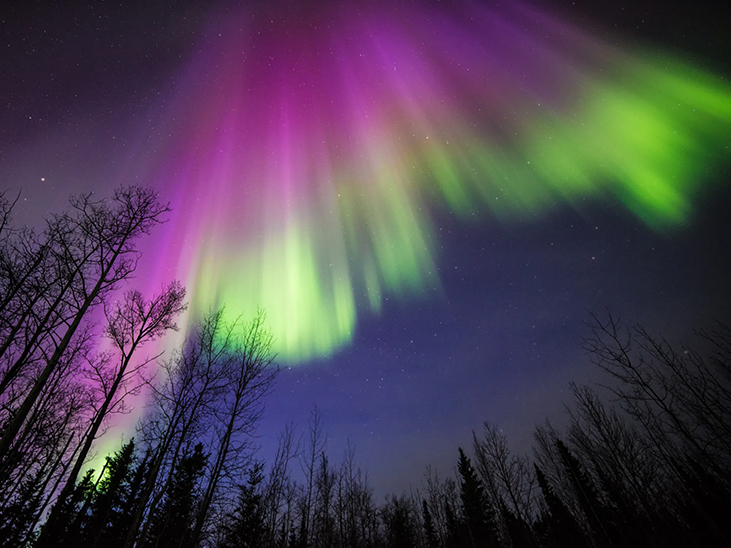
At the surface of Earth, we are protected to some degree from the solar wind by our atmosphere and Earth’s magnetic field (see Earth as a Planet). However, the magnetic field lines come into Earth at the north and south magnetic poles. Here, charged particles accelerated by the solar wind can follow the field down into our atmosphere. As the particles strike molecules of air, they cause them to glow, producing beautiful curtains of light called the auroras, or the northern and southern lights (Figure 15.12).
英語のヒント
地表では、大気と地球の磁場によって、太陽風からある程度守られている。「惑星としての地球」を参照してほしい。しかし磁力線は、磁北極と磁南極では地球の中へ入る。そこでは太陽風によって加速された荷電粒子が、磁力線に沿って大気へ降りてこられる。粒子が空気の分子に衝突すると、分子を光らせ、オーロラ、すなわち北極光や南極光と呼ばれる、美しい光のカーテンを生じる(図15.12)。
Aurora.オーロラ。
credit: "Purple and Green Aurora in Alaska" by Sebastian Saarloos/NASA, Public Domain · Public domain
Figure 15.12 This dramatic NASA image was taken in Delta Junction, Alaska, on April 10, 2015 by Sebastian Saarloos. (credit: "Purple and Green Aurora in Alaska" by Sebastian Saarloos/NASA, Public Domain)
図15.12 NASAのこの見事な画像は、2015年4月10日、アラスカ州デルタジャンクションでセバスチャン・サーロースが撮影した。(クレジット:Sebastian Saarloos/NASA “Purple and Green Aurora in Alaska”、パブリックドメイン)
Key Concepts and Summary重要事項のまとめ
The Sun, our star, has several layers beneath the visible surface: the core, radiative zone, and convective zone. These, in turn, are surrounded by a number of layers that make up the solar atmosphere. In order of increasing distance from the center of the Sun, they are the photosphere, with a temperature that ranges from 4500 K to about 6800 K; the chromosphere, with a typical temperature of 104 K; the transition region, a zone that may be only a few kilometers thick, where the temperature increases rapidly from 104 K to 106 K; and the corona, with temperatures of a few million K. The Sun’s surface is mottled with upwelling convection currents seen as hot, bright granules. Solar wind particles stream out into the solar system through coronal holes. When such particles reach the vicinity of Earth, they produce auroras, which are strongest near Earth’s magnetic poles. Hydrogen and helium together make up 98% of the mass of the Sun, whose composition is much more characteristic of the universe at large than is the composition of Earth.
私たちの恒星である太陽は、見える表面の下に、中心核・放射層・対流層という複数の層を持つ。その外側にはさらに、太陽大気を構成するいくつもの層がある。中心から遠ざかる順に並べると、温度4500〜約6800Kの光球、典型的な温度10⁴Kの彩層、温度が10⁴Kから10⁶Kへ急上昇する、厚さがわずか数kmかもしれない遷移層、そして温度数百万Kのコロナである。太陽表面は、上昇する対流によるまだら模様を持ち、それが高温で明るい粒状斑として見える。太陽風の粒子はコロナホールを通り、太陽系へ流れ出す。こうした粒子が地球付近へ来ると、地球の磁極近くで最も強く現れるオーロラを生じる。水素とヘリウムは合わせて太陽の質量の98%を占める。太陽の組成は、地球の組成よりも宇宙全体をはるかによく代表している。
aurora
オーロラ
light radiated by atoms and ions in the ionosphere excited by charged particles from the Sun, mostly seen in the magnetic polar regions
太陽から来た荷電粒子に励起された、電離層の原子やイオンが放つ光。主に磁極付近で見られる。
chromosphere
彩層
the part of the solar atmosphere that lies immediately above the photospheric layers
光球の層のすぐ上にある太陽大気の部分。
corona
コロナ
(of the Sun) the outer (hot) atmosphere of the Sun
太陽の外側にある高温の大気。
coronal hole
コロナホール
a region in the Sun’s outer atmosphere that appears darker because there is less hot gas there
高温ガスが少ないために暗く見える、太陽外層大気の領域。
granulation
粒状斑
the rice-grain-like structure of the solar photosphere; granulation is produced by upwelling currents of gas that are slightly hotter, and therefore brighter, than the surrounding regions, which are flowing downward into the Sun
太陽の光球に見られる米粒のような構造。太陽内部へ沈む周囲の領域より、わずかに高温で、そのため明るいガスが上昇する流れによって生じる。
photosphere
光球
the region of the solar (or stellar) atmosphere from which continuous radiation escapes into space
太陽または恒星の大気で、そこから連続的な放射が宇宙へ抜け出す領域。
plasma
プラズマ
a hot ionized gas
高温の電離したガス。
solar wind
太陽風
a flow of hot, charged particles leaving the Sun
太陽を離れて流れる、高温の荷電粒子の流れ。
transition region
遷移層
the region in the Sun’s atmosphere where the temperature rises very rapidly from the relatively low temperatures that characterize the chromosphere to the high temperatures of the corona
彩層を特徴付ける比較的低い温度から、コロナの高い温度へ、ごく急激に温度が上がる太陽大気の領域。