第15章太陽――ありふれた恒星The Sun: A Garden-Variety Star
Earth’s Climate and the Sunspot Cycle: Is There a Connection?地球の気候と黒点周期――関係はあるのか
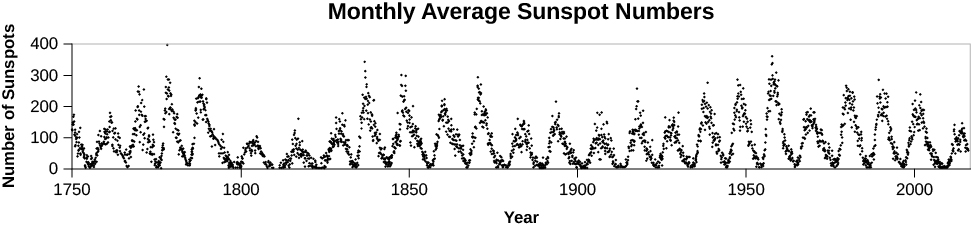
While the Sun rises faithfully every day at a time that can be calculated precisely, scientists have determined that the Sun’s energy output is not truly constant but varies over the centuries by a small amount—probably less than 1%. We’ve seen that the number of sunspots varies, with the time between sunspot maxima of about 11 years, and that the number of sunspots at maximum is not always the same. Considerable evidence shows that between the years 1645 and 1715, the number of sunspots, even at sunspot maximum, was much lower than it is now. This interval of significantly low sunspot numbers was first noted by Gustav Spӧrer in 1887 and then by E. W. Maunder in 1890; it is now called the Maunder Minimum. The variation in the number of sunspots over the past three centuries is shown in Figure 15.26. Besides the Maunder Minimum in the seventeenth century, sunspot numbers were somewhat lower during the first part of the nineteenth century than they are now; this period is called the Little Maunder Minimum.
英語のヒント
太陽は毎日、正確に計算できる時刻に律儀に昇ってくる。しかし科学者は、太陽のエネルギー放出量が完全に一定ではなく、数世紀の間にわずかに、おそらく1%未満、変化することを突き止めた。すでに見たように黒点数は変動し、黒点の極大期と次の極大期の間隔は約11年である。また、極大期の黒点数はいつも同じとは限らない。1645〜1715年には、黒点の極大期でも、黒点数が現在よりはるかに少なかったことを示す証拠が数多くある。この著しく黒点の少ない期間に最初に注目したのは、1887年のグスタフ・シュペーラーで、1890年にはE・W・マウンダーも指摘した。現在、この期間をマウンダー極小期と呼ぶ。過去3世紀にわたる黒点数の変化を図15.26に示す。17世紀のマウンダー極小期のほかに、19世紀の前半にも、黒点数は現在よりやや少なかった。この期間は小マウンダー極小期と呼ばれる。
Numbers of Sunspots over Time.時間とともに変わる黒点数。
credit: modification of work by NASA/ARC · NASA media use guidelines
Figure 15.26 This diagram shows how the number of sunspots has changed with time since counts of the numbers of spots began to be recorded on a consistent scale. Note the low number of spots during the early years of the nineteenth century, the Little Maunder Minimum. (credit: modification of work by NASA/ARC)
図15.26 黒点数が一貫した基準で記録されるようになってからの、時間に伴う変化を示した図。19世紀初めの、小マウンダー極小期における黒点の少なさに注目しよう。(クレジット:NASA/ARCの作品を改変)
When the number of sunspots is high, the Sun is active in various other ways as well, and, as we will see in several sections below, some of this activity affects Earth directly. For example, there are more auroral displays when the sunspot number is high. Auroras are caused when energetically charged particles from the Sun interact with Earth’s magnetosphere, and the Sun is more likely to spew out particles when it is active and the sunspot number is high. Historical accounts also indicate that auroral activity was abnormally low throughout the several decades of the Maunder Minimum.
英語のヒント
黒点数が多いと、太陽はほかのさまざまな面でも活発になる。以下のいくつかの節で見るように、こうした活動の一部は地球に直接影響する。たとえば、黒点数が多いときにはオーロラがよく見られる。オーロラは、太陽から来た高エネルギーの荷電粒子が地球の磁気圏と相互作用するときに発生する。太陽は活動が活発で黒点数が多いときほど、粒子を噴き出しやすい。歴史的な記録も、マウンダー極小期の数十年間を通して、オーロラ活動が異常に低調だったことを示している。
The Maunder Minimum was a time of exceptionally low temperatures in Europe—so low that this period is described as the Little Ice Age. This coincidence in time caused scientists to try to understand whether small changes in the Sun could affect the climate on Earth. There is clear evidence that it was unusually cold in Europe during part of the seventeenth century. The River Thames in London froze at least 11 times, ice appeared in the oceans off the coasts of southeast England, and low summer temperatures led to short growing seasons and poor harvests. However, whether and how changes on the Sun on this timescale influence Earth’s climate is still a matter of debate among scientists.
英語のヒント
マウンダー極小期は、ヨーロッパの気温が例外的に低かった時期でもある。あまりの寒さから、この期間は小氷期と呼ばれる。この時期の一致をきっかけに、科学者は太陽の小さな変化が地球の気候に影響しうるかを調べ始めた。17世紀の一時期、ヨーロッパが異常に寒かったことには明確な証拠がある。ロンドンのテムズ川は少なくとも11回凍り、イングランド南東部の沿岸の海にも氷が現れた。夏の低温で作物の生育期間が短くなり、収穫は不作となった。しかし、この時間尺度での太陽の変化が地球の気候に影響するのか、するとすればどう影響するのかは、今も科学者の間で議論されている。
Other small changes in climate like the Little Ice Age have occurred and have had their impacts on human history. For example, explorers from Norway first colonized Iceland and then reached Greenland by 986. From there, they were able to make repeated visits to the northeastern coasts of North America, including Newfoundland, between about 1000 and 1350. (The ships of the time did not allow the Norse explorers to travel all the way to North America directly, but only from Greenland, which served as a station for further exploration.)
英語のヒント
小氷期のような比較的小さな気候変動はほかにも起こっており、人類の歴史に影響してきた。たとえば、ノルウェーからの探検者はまずアイスランドに入植し、986年までにはグリーンランドへ到達した。そこを起点に、1000年ごろから1350年にかけて、ニューファンドランドを含む北米北東部の海岸を繰り返し訪れることができた。当時の船では、北欧の探検者が北米まで直接航海することはできず、その先の探検の中継地となるグリーンランドから出発する必要があった。
Most of Greenland is covered by ice, and the Greenland station was never self-sufficient; rather, it depended on imports of food and other goods from Norway for its survival. When a little ice age began in the thirteenth century, voyaging became very difficult, and support of the Greenland colony was no longer possible. The last-known contact with it was made by a ship from Iceland blown off course in 1410. When European ships again began to visit Greenland in 1577, the entire colony there had disappeared.
英語のヒント
グリーンランドの大部分は氷で覆われており、グリーンランドの拠点は決して自給自足ではなかった。むしろ、その存続は、ノルウェーからの食料やその他の物資の輸入に依存していた。13世紀に小氷期が始まると、航海は非常に困難になり、グリーンランドの入植地を支援できなくなった。知られている最後の接触は1410年、アイスランドから出て、風で針路を外れた船によるものだった。1577年にヨーロッパの船が再びグリーンランドを訪れ始めたとき、そこにあった入植地はすべて姿を消していた。
The estimated dates for these patterns of migration follow what we know about solar activity. Solar activity was unusually high between 1100 and 1250, which includes the time when the first European contacts were made with North America. Activity was low from 1280 to 1340 and there was a little ice age, which was about the time regular contact with North America and between Greenland and Europe stopped.
英語のヒント
こうした移住の動向について推定される年代は、太陽活動についてわかっていることと対応している。1100〜1250年の太陽活動は異常に活発で、その期間にはヨーロッパ人が初めて北米と接触した時期も含まれる。1280〜1340年には活動が低調になり、小氷期があった。それは、北米との定期的な往来や、グリーンランドとヨーロッパの往来が途絶えた時期にほぼ当たる。
One must be cautious, however, about assuming that low sunspot numbers or variations in the Sun’s output of energy caused the Little Ice Age. There is no satisfactory model that can explain how a reduction in solar activity might cause cooler temperatures on Earth. An alternative possibility is that the cold weather during the Little Ice Age was related to volcanic activity. Volcanoes can eject aerosols (tiny droplets or particles) into the atmosphere that efficiently reflect sunlight. Observations show, for example, that the Pinatubo eruption in 1991 ejected SO2 aerosols into the atmosphere, which reduced the amount of sunlight reaching Earth’s surface enough to lower global temperatures by 0.4 °C.
英語のヒント
しかし、黒点数の減少や太陽のエネルギー放出量の変化が小氷期を引き起こした、と決めつけることには慎重でなければならない。太陽活動の低下が地球の気温を下げる仕組みを説明できる、満足なモデルは存在しない。別の可能性は、小氷期の寒さが火山活動と関係していたというものである。火山は、太陽光を効率よく反射するエアロゾル、つまり微小な液滴や粒子を、大気中へ放出できる。たとえば観測によると、1991年のピナトゥボ山の噴火はSO₂のエアロゾルを大気に放出した。それによって地表に届く太陽光が十分に減り、世界の気温が0.4℃低下した。
Satellite data show that the energy output from the Sun during a solar cycle varies by only about 0.1%. We know of no physical process that would explain how such a small variation could cause global temperature changes. The level of solar activity may, however, have other effects. For example, although the Sun’s total energy output varies by only 0.1% during a solar cycle, its extreme ultraviolet radiation is 10 times higher at times of solar maximum than at solar minimum. This large variation can affect the chemistry and temperature structure of the upper atmosphere. One effect might be a reduction in the ozone layer and a cooling of the stratosphere near Earth’s poles. This, in turn, could change the circulation patterns of winds aloft and, hence, the tracks of storms. There is some recent evidence that variations in regional rainfall correlate better with solar activity than does the global temperature of Earth. But, as you can see, the relationship between what happens on the Sun and what happens to Earth’s climate over the short term is still an area that scientists are investigating and debating.
英語のヒント
人工衛星のデータによると、太陽のエネルギー放出量は、一つの太陽周期の中で約0.1%しか変化しない。このような小さな変動が地球全体の気温の変化を起こすことを説明できる物理過程は、知られていない。しかし、太陽活動の強さには別の影響があるかもしれない。たとえば、太陽周期に伴うエネルギー放出量全体の変化はわずか0.1%だが、極端紫外線は、極小期より極大期に10倍も強くなる。この大きな変動は、上層大気の化学や温度構造に影響しうる。その一つとして、オゾン層の減少と、地球の両極付近の成層圏の冷却が起きるかもしれない。それがさらに、上空の風の循環パターンを変え、ひいては嵐の進路を変える可能性がある。地域ごとの降雨量の変化は、地球全体の気温よりも太陽活動との相関が強いことを示す、最近の証拠もいくらかある。しかし、ここまででわかるように、太陽で起きることと地球の短期的な気候変化との関係は、今なお科学者が調べ、議論している分野である。
Whatever the effects of solar activity may be on local rainfall or temperature patterns, we want to emphasize one important idea: Our climate change data and the models developed to account for the data consistently show that solar variability is not the cause of the global warming that has occurred during the past 50 years.
英語のヒント
太陽活動が局地的な降雨や気温のパターンにどのような影響を及ぼすとしても、一つの重要な点を強調しておきたい。気候変動のデータも、それを説明するために開発されたモデルも、過去50年間に起きた地球温暖化の原因が太陽の変動ではないことを、一貫して示している。