第15章太陽――ありふれた恒星The Sun: A Garden-Variety Star
15.1 The Structure and Composition of the Sun15.1 太陽の構造と組成
Learning Objectives学習の目標
By the end of this section, you will be able to:
この節を読み終えると、次のことができるようになる。
Explain how the composition of the Sun differs from that of Earth
太陽の組成が地球とどのように異なるかを説明する
Describe the various layers of the Sun and their functions
太陽のさまざまな層と、それぞれの働きを説明する
Explain what happens in the different parts of the Sun’s atmosphere
太陽大気の異なる部分で何が起こるかを説明する
The Sun, like all stars, is an enormous ball of extremely hot, largely ionized gas, shining under its own power. And we do mean enormous. The Sun could fit 109 Earths side-by-side across its diameter, and it has enough volume (takes up enough space) to hold about 1.3 million Earths.
英語のヒント
太陽はほかのすべての恒星と同じく、非常に高温で、大部分が電離したガスの巨大な球であり、自らのエネルギーで輝いている。「巨大」とは、本当に巨大という意味だ。太陽の直径には、地球を横に109個並べられる。また、体積は地球を約130万個収められるほど大きい。
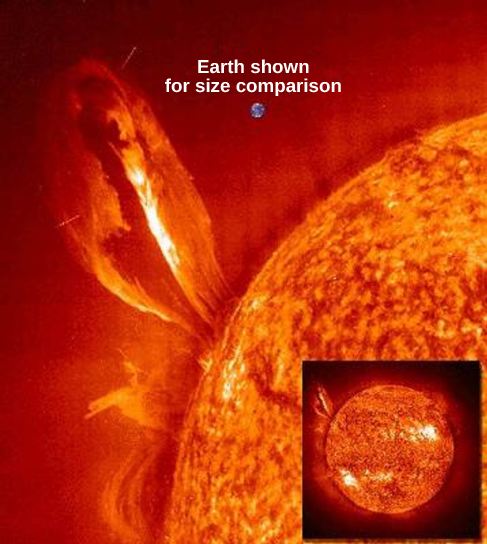
The Sun does not have a solid surface or continents like Earth, nor does it have a solid core (Figure 15.2). However, it does have a lot of structure and can be discussed as a series of layers, not unlike an onion. In this section, we describe the huge changes that occur in the Sun’s extensive interior and atmosphere, and the dynamic and violent eruptions that occur daily in its outer layers.
英語のヒント
太陽には地球のような固体の表面や大陸はなく、固体の核もない(図15.2)。しかし、内部には多くの構造があり、タマネギに似て、いくつもの層として説明できる。この節では、太陽の広大な内部や大気で起こる大きな変化と、外側の層で毎日起こる、活動的で激しい噴出を説明する。
Earth and the Sun.地球と太陽。
credit: modification of work by SOHO/EIT/ESA · ESA educational/informational image permission
Figure 15.2 Here, Earth is shown to scale with part of the Sun and a giant loop of hot gas erupting from its surface. The inset shows the entire Sun, smaller. (credit: modification of work by SOHO/EIT/ESA)
図15.2 太陽の一部と、表面から噴出する高温ガスの巨大なループに対し、同じ縮尺で地球を示している。挿入図では太陽全体を縮小して示す。(クレジット:SOHO/EIT/ESAの作品を改変)
Some of the basic characteristics of the Sun are listed in Table 15.1. Although some of the terms in that table may be unfamiliar to you right now, you will get to know them as you read further.
英語のヒント
太陽の基本的な性質の一部を表15.1に挙げた。今はなじみのない用語もあるかもしれないが、読み進めるうちに分かるようになる。
Characteristics of the Sun 太陽の性質 |
||
|---|---|---|
Characteristic 性質 |
How Found 求め方 |
Value 値 |
Mean distance 平均距離 |
Radar reflection from planets 惑星からのレーダー反射 |
1 AU (149,597,892 km) 1AU(149,597,892km) |
Maximum distance from Earth 地球からの最大距離 |
1.521 × 10⁸ km 1.521×10⁸km |
|
Minimum distance from Earth 地球からの最小距離 |
1.471 × 10⁸ km 1.471×10⁸km |
|
Mass 質量 |
Orbit of Earth 地球の軌道 |
333,400 Earth masses (1.99 × 1030 kg) 地球の質量の333,400倍(1.99×10³⁰kg) |
Mean angular diameter 平均角直径 |
Direct measure 直接測定 |
31´59´´.3 31′59.3″ |
Diameter of photosphere 光球の直径 |
Angular size and distance 見かけの角度の大きさと距離 |
109.3 × Earth diameter (1.39 × 10⁶ km) 地球の直径の109.3倍(1.39×10⁶km) |
Mean density 平均密度 |
Mass/volume 質量/体積 |
1.41 g/cm3 1.41g/cm³(1400kg/m³) |
Gravitational acceleration at photosphere (surface gravity) 光球での重力加速度(表面重力) |
GM/R2 GM/R² |
27.9 × Earth surface gravity = 273 m/s2 地球の表面重力の27.9倍=273m/s² |
Solar constant 太陽定数 |
Instrument sensitive to radiation at all wavelengths すべての波長の放射に感度を持つ装置 |
1370 W/m2 1370W/m² |
Luminosity 光度 |
Solar constant × area of spherical surface 1 AU in radius 太陽定数×半径1AUの球面の面積 |
3.8 × 1026 W 3.8×10²⁶W |
Spectral class スペクトル型 |
Spectrum スペクトル |
G2V |
Effective temperature 有効温度 |
Derived from luminosity and radius of the Sun 太陽の光度と半径から求める |
5800 K |
Rotation period at equator 赤道での自転周期 |
Sunspots and Doppler shift in spectra taken at the edge of the Sun 黒点と、太陽の縁で取得したスペクトルのドップラー偏移 |
24 days 16 hours 24日16時間 |
Inclination of equator to ecliptic 黄道に対する赤道の傾き |
Motions of sunspots 黒点の運動 |
7°10´.5 7°10.5′ |
Composition of the Sun’s Atmosphere太陽大気の組成
Let’s begin by asking what the solar atmosphere is made of. As explained in Radiation and Spectra, we can use a star’s absorption line spectrum to determine what elements are present. It turns out that the Sun contains the same elements as Earth but not in the same proportions. About 73% of the Sun’s mass is hydrogen, and another 25% is helium. All the other chemical elements (including those we know and love in our own bodies, such as carbon, oxygen, and nitrogen) make up only 2% of our star. The 10 most abundant gases in the Sun’s visible surface layer are listed in Table 15.2. Examine that table and notice that the composition of the Sun’s outer layer is very different from Earth’s crust, where we live. (In our planet’s crust, the three most abundant elements are oxygen, silicon, and aluminum.) Although not like our planet’s, the makeup of the Sun is quite typical of stars in general.
英語のヒント
まず、太陽の大気が何からできているかを考えよう。「放射とスペクトル」で説明したように、恒星の吸収線スペクトルを使えば、どの元素が存在するかを調べられる。太陽は地球と同じ元素を含むが、その割合は同じではないことが分かる。太陽の質量の約73%は水素で、さらに25%はヘリウムである。その他のすべての化学元素は、私たち自身の体でおなじみの大切な炭素・酸素・窒素なども含め、太陽のわずか2%を占めるだけだ。太陽の目に見える表面の層で、最も多い10種類のガスを表15.2に挙げた。表を調べ、太陽の外層の組成が、私たちが暮らす地球の地殻と大きく違うことに注目しよう。地殻に最も多い三元素は酸素・ケイ素・アルミニウムである。太陽の組成は地球とは似ていないが、恒星全体ではごく典型的だ。
The Abundance of Elements in the Sun 太陽の元素組成 |
||
|---|---|---|
Element 元素 |
Percentage by Number of Atoms 原子数による割合(%) |
Percentage By Mass 質量による割合(%) |
Hydrogen 水素 |
92.0 | 73.4 |
Helium ヘリウム |
7.8 | 25.0 |
Carbon 炭素 |
0.02 | 0.20 |
Nitrogen 窒素 |
0.008 | 0.09 |
Oxygen 酸素 |
0.06 | 0.80 |
Neon ネオン |
0.01 | 0.16 |
Magnesium マグネシウム |
0.003 | 0.06 |
Silicon ケイ素 |
0.004 | 0.09 |
Sulfur 硫黄 |
0.002 | 0.05 |
Iron 鉄 |
0.003 | 0.14 |
The fact that our Sun and the stars all have similar compositions and are made up of mostly hydrogen and helium was first shown in a brilliant thesis in 1925 by Cecilia Payne-Gaposchkin, the first woman to get a PhD in astronomy in the United States (Figure 15.3). However, the idea that the simplest light gases—hydrogen and helium—were the most abundant elements in stars was so unexpected and so shocking that she was persuaded her analysis of the data must be wrong. At the time, she wrote, “The enormous abundance derived for these elements in the stellar atmosphere is almost certainly not real.” Even scientists sometimes find it hard to accept new ideas that do not agree with what everyone “knows” to be right.
英語のヒント
太陽とほかの恒星がみな似た組成を持ち、主に水素とヘリウムからできているという事実は、1925年のセシリア・ペイン=ガポシュキンの優れた学位論文で初めて示された。彼女は、米国で天文学の博士号を取得した最初の女性である(図15.3)。しかし、最も単純な軽いガスである水素とヘリウムが恒星で最も多い元素だという考え方は、あまりに意外で衝撃的だったため、彼女はデータの分析が間違っているに違いないと説得されてしまった。当時、彼女はこう書いている。「恒星大気について、これらの元素の存在量がきわめて大きいと導かれたが、それはほぼ間違いなく現実のものではない。」科学者でさえ、誰もが正しいと「知っている」ことと一致しない新しい考えを、受け入れにくいと感じることがある。
Cecilia Payne-Gaposchkin (1900–1979).セシリア・ペイン=ガポシュキン(1900〜1979)。
Figure 15.3 Her 1925 doctoral thesis laid the foundations for understanding the composition of the Sun and the stars. Yet, being a woman, she was not given a formal appointment at Harvard, where she worked, until 1938 and was not appointed a professor until 1956. (credit: Smithsonian Institution)
図15.3 彼女の1925年の博士論文は、太陽や恒星の組成を理解する基礎を築いた。それにもかかわらず、女性であるために、働いていたハーバード大学で正式な職を得られたのは1938年になってからで、教授に任命されたのは1956年だった。(クレジット:Smithsonian Institution)
Before Payne-Gaposchkin’s work, everyone assumed that the composition of the Sun and stars would be much like that of Earth. It was 3 years after her thesis that other studies proved beyond a doubt that the enormous abundance of hydrogen and helium in the Sun is indeed real. (And, as we will see, the composition of the Sun and the stars is much more typical of the makeup of the universe than the odd concentration of heavier elements that characterizes our planet.)
英語のヒント
ペイン=ガポシュキンの研究以前は、太陽や恒星の組成は地球とよく似ているだろうと、誰もが考えていた。太陽で水素とヘリウムの存在量が非常に大きいことは本当に正しい、とほかの研究が疑いの余地なく示したのは、彼女の論文から3年後だった。そして、これから見るように、太陽や恒星の組成は、重い元素が奇妙に集中している地球の組成よりも、宇宙全体の組成をはるかによく代表している。
Most of the elements found in the Sun are in the form of atoms, with a small number of molecules, all in the form of gases: the Sun is so hot that no matter can survive as a liquid or a solid. In fact, the Sun is so hot that many of the atoms in it are ionized, that is, stripped of one or more of their electrons. This removal of electrons from their atoms means that there is a large quantity of free electrons and positively charged ions in the Sun, making it an electrically charged environment—quite different from the neutral one in which you are reading this text. (Scientists call such a hot ionized gas a plasma.)
英語のヒント
太陽にある元素の大部分は原子の形で存在し、少数の分子もあるが、すべてガスの状態にある。太陽はあまりに高温で、液体や固体のままでいられる物質はない。実際、太陽は非常に高温なので、多くの原子が電離している。つまり、一つ、あるいはそれ以上の電子を失っている。原子から電子が取り去られるということは、太陽には自由な電子と正の電荷を持つイオンが大量にあるということだ。そのため、太陽は電荷を帯びた環境になっており、私たちがこの文章を読んでいる電気的に中性な環境とは大きく異なる。科学者は、このような高温の電離したガスをプラズマと呼ぶ。
In the nineteenth century, scientists observed a spectral line at 530.3 nanometers in the Sun’s outer atmosphere, called the corona (a layer we will discuss in a minute.) This line had never been seen before, and so it was assumed that this line was the result of a new element found in the corona, quickly named coronium. It was not until 60 years later that astronomers discovered that this emission was in fact due to highly ionized iron—iron with 13 of its electrons stripped off. This is how we first discovered that the Sun’s atmosphere had a temperature of more than a million degrees.
英語のヒント
19世紀、科学者はコロナと呼ばれる太陽外層の大気で、波長530.3nmのスペクトル線を観測した。コロナは、この後すぐに説明する層である。それまで見られたことのない線だったため、コロナで見つかった新元素によるものだと考えられ、その元素はすぐにコロニウムと名付けられた。それから60年後になって初めて、天文学者は、この放射が実際には高度に電離した鉄、すなわち13個の電子を失った鉄によるものだと突き止めた。このようにして私たちは、太陽大気が100万度を超える温度を持つことを初めて知った。