第15章太陽――ありふれた恒星The Sun: A Garden-Variety Star
15.4 Space Weather15.4 宇宙天気
Learning Objectives学習の目標
By the end of this section, you will be able to:
この節を読み終えると、次のことができるようになる。
Explain what space weather is and how it affects Earth
宇宙天気とは何か、地球にどのような影響を及ぼすかを説明する。
In the previous sections, we have seen that some of the particles coming off the Sun—either steadily as in the solar wind or in great bursts like CMEs—will reach Earth and its magnetosphere (the zone of magnetic influence that surrounds our planet). As if scientists did not have enough trouble trying to predict weather on Earth, this means that they are now facing the challenge of predicting the effects of solar storms on Earth. This field of research is called space weather; when that weather turns stormy, our technology turns out to be at risk.
英語のヒント
前の節までで見たように、太陽から出てくる粒子の一部は、太陽風のように絶えず流れ出すものも、CMEのように一気に大量に噴き出すものも、地球とその磁気圏に到達する。磁気圏とは、私たちの惑星を取り囲む、磁場の影響が及ぶ領域である。科学者は地上の天気予報だけでも十分苦労しているというのに、今度は太陽の嵐が地球に及ぼす影響も予測しなければならないわけである。この研究分野を宇宙天気という。宇宙の天気が荒れると、私たちの技術が危険にさらされることになる。
With thousands of satellites in orbit, astronauts taking up long-term residence in the International Space Station, millions of people using cell phones, GPS, and wireless communication, and nearly everyone relying on the availability of dependable electrical power, governments are now making major investments in trying to learn how to predict when solar storms will occur and how strongly they will affect Earth.
英語のヒント
軌道上には数千基もの人工衛星があり、国際宇宙ステーションでは宇宙飛行士が長期滞在している。数百万人もの人々が携帯電話、GPS、無線通信を使い、ほぼすべての人が、信頼できる電力を利用できることに頼って暮らしている。こうした状況から、各国政府は、太陽の嵐がいつ発生し、地球にどの程度の影響を与えるかを予測する方法を学ぼうと、大規模な投資を行っている。
Some History歴史を振り返る
What we now study as space weather was first recognized (though not yet understood) in 1859, in what is now known as the Carrington Event. In early September of that year, two amateur astronomers, including Richard Carrington in England, independently observed a solar flare. This was followed a day or two later by a significant solar storm reaching the region of Earth’s magnetic field, which was soon overloaded with charged particles (see Earth as a Planet).
英語のヒント
現在、宇宙天気として研究している現象が初めて認識されたのは、1859年の、今ではキャリントン・イベントとして知られる出来事だった。ただし、当時はまだその仕組みを理解していなかった。その年の9月初め、英国のリチャード・キャリントンを含む2人のアマチュア天文家が、それぞれ独立に太陽フレアを観測した。その1〜2日後、強い太陽の嵐が地球の磁場の領域に到達し、そこはまもなく大量の荷電粒子であふれた(「惑星としての地球」参照)。
As a result, aurora activity was intense and the northern lights were visible well beyond their normal locations near the poles—as far south as Hawaii and the Caribbean. The glowing lights in the sky were so intense that some people reported getting up in the middle of the night, thinking it must be daylight.
英語のヒント
その結果、オーロラ活動が激しくなり、北極光は通常見られる極付近を大きく越えて、南はハワイやカリブ海にまで現れた。空の輝きは非常に強く、昼間になったに違いないと思って、真夜中に起き出したと報告する人までいた。
The 1859 solar storm happened at a time when a new technology was beginning to tie people in the United States and some other countries together: the telegraph system. This was a machine and network for sending messages in code through overhead electrical wires (a bit like a very early version of the internet). The charged particles that overwhelmed Earth’s magnetic field descended toward our planet’s surface and affected the wires of the telegraph system. Sparks were seen coming out of exposed wires and out of the telegraph machines in the system’s offices.
英語のヒント
1859年の太陽の嵐は、米国やほかのいくつかの国で、ある新技術が人々をつなぎ始めた時期に起こった。電信システムである。これは、架空の電線を通して符号化したメッセージを送る装置とネットワークで、いわばごく初期のインターネットのようなものだった。地球の磁場にあふれた荷電粒子は地表に向かって降下し、電信システムの電線に影響を及ぼした。露出した電線や、電信局にある電信機から火花が飛ぶのが目撃された。
The observation of the bright flare that preceded these effects on Earth led to scientific speculation that a connection existed between solar activity and impacts on Earth—this was the beginning of our understanding of what today we call space weather.
英語のヒント
地球へのこれらの影響に先立って明るいフレアが観測されていたことから、太陽活動と地球への影響には関係があるのではないか、という科学的な推測が生まれた。これが、今日「宇宙天気」と呼ぶものについての理解の始まりだった。
Sources of Space Weather宇宙天気を引き起こすもの
Three solar phenomena—coronal holes, solar flares, and CMEs—account for most of the space weather we experience. Coronal holes allow the solar wind to flow freely away from the Sun, unhindered by solar magnetic fields. When the solar wind reaches Earth, as we saw, it causes Earth’s magnetosphere to contract and then expand after the solar wind passes by. These changes can cause (usually mild) electromagnetic disturbances on Earth.
英語のヒント
私たちが経験する宇宙天気の大半は、コロナホール、太陽フレア、CMEという三つの太陽現象による。コロナホールでは、太陽の磁場に妨げられずに、太陽風が太陽から自由に流れ出す。すでに見たように、太陽風が地球に到達すると地球の磁気圏は収縮し、太陽風が通り過ぎると再び膨張する。この変化は、地球で電磁的な乱れを引き起こすことがある。通常、その乱れは軽度である。
More serious are solar flares, which shower the upper atmosphere of Earth with X-rays, energetic particles, and intense ultraviolet radiation. The X-rays and ultraviolet radiation can ionize atoms in Earth’s upper atmosphere, and the freed electrons can build up a charge on the surface of a spacecraft. When this static charge discharges, it can damage the electronics in the spacecraft—just as you can receive a shock when you walk across a carpet in your stocking feet in a dry climate and then touch a light switch or some other metal object.
英語のヒント
より深刻なのは太陽フレアである。フレアは地球の上層大気に、X線、高エネルギー粒子、強い紫外線を浴びせる。X線と紫外線は地球の上層大気の原子を電離し、放出された電子が宇宙機の表面に電荷を蓄積させることがある。この静電荷が放電すると、宇宙機の電子機器を損傷しかねない。乾燥した気候のもとで、靴下を履いてカーペットの上を歩いた後、照明のスイッチなどの金属物体に触れると、電気の衝撃を受けることがあるのと同じである。
Most disruptive are coronal mass ejections. A CME is an erupting bubble of tens of millions of tons of gas blown away from the Sun into space. When this bubble reaches Earth a few days after leaving the Sun, it heats the ionosphere, which expands and reaches farther into space. As a consequence, friction between the atmosphere and spacecraft increases, dragging satellites to lower altitudes.
英語のヒント
最も大きな障害を起こすのは、コロナ質量放出である。CMEは、数千万トンものガスが太陽から宇宙へ吹き飛ばされる、噴出する泡のようなものである。太陽を離れたこの泡が数日後に地球へ到達すると、電離圏を加熱する。電離圏は膨張し、宇宙のより遠くまで広がる。その結果、大気と宇宙機の摩擦が増し、人工衛星は低い高度へ引き下ろされる。
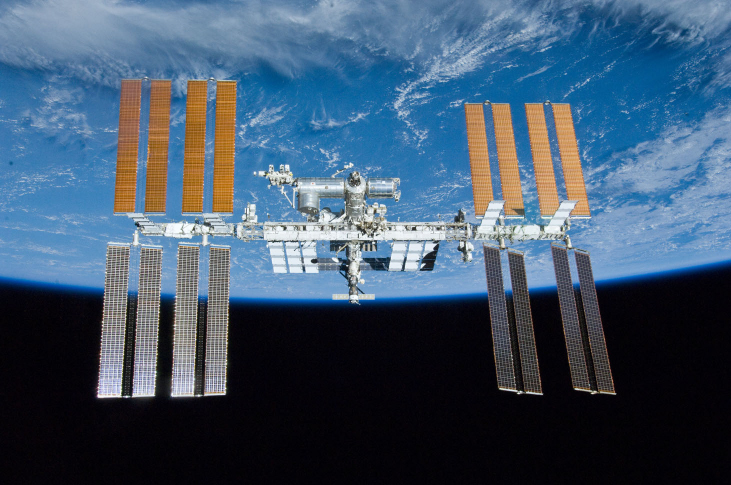
At the time of a particularly strong flare and CME in March 1989, the system responsible for tracking some 19,000 objects orbiting Earth temporarily lost track of 11,000 of them because their orbits were changed by the expansion of Earth’s atmosphere. During solar maximum, a number of satellites are brought to such a low altitude that they are destroyed by friction with the atmosphere. Both the Hubble Space Telescope and the International Space Station (Figure 15.24) require reboosts to higher altitude so that they can remain in orbit.
英語のヒント
1989年3月に特に強いフレアとCMEが発生したときには、地球の周りを回る約19,000個の物体を追跡するシステムが、そのうち11,000個を一時的に見失った。地球大気の膨張によって軌道が変わったためである。太陽活動の極大期には、いくつもの人工衛星が、大気との摩擦で破壊されるほど低い高度まで下がる。ハッブル宇宙望遠鏡も国際宇宙ステーション(図15.24)も、軌道にとどまるためには、より高い高度へ押し上げる軌道上昇が必要になる。
International Space Station.国際宇宙ステーション。
credit: NASA · NASA media use guidelines
Figure 15.24 The International Space Station is seen above Earth, as photographed in 2010 by the departing crew of the Space Shuttle Atlantis. (credit: NASA)
図15.24 地球の上に見える国際宇宙ステーション。2010年、離れていくスペースシャトル「アトランティス」の乗組員が撮影した。(クレジット:NASA)