第8章惑星としての地球Earth as a Planet
8.1 The Global Perspective8.1 地球を全体として見る
Learning Objectives学習の目標
By the end of this section, you will be able to:
この節を学び終えると、次のことができるようになる。
Describe the components of Earth’s interior and explain how scientists determined its structure
地球内部の構成要素を述べ、科学者がその構造をどのように明らかにしたかを説明する。
Specify the origin, size, and extent of Earth’s magnetic field
地球の磁場の起源、大きさ、広がりを示す。
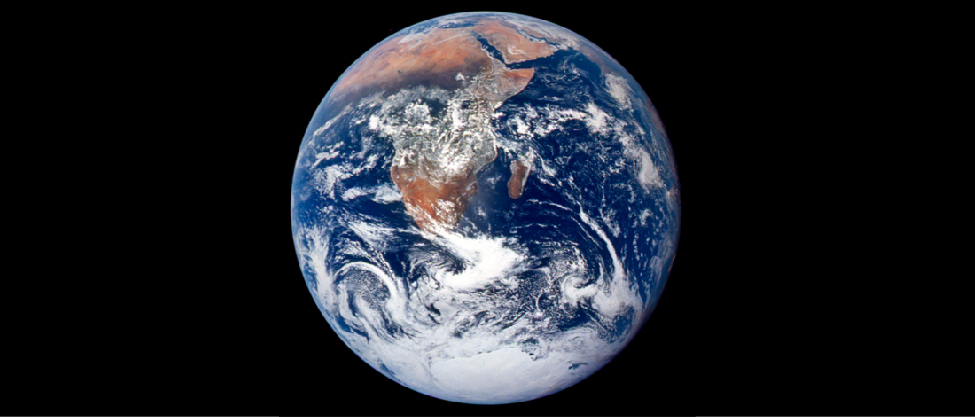
Earth is a medium-size planet with a diameter of approximately 12,760 kilometers (Figure 8.2). As one of the inner or terrestrial planets, it is composed primarily of heavy elements such as iron, silicon, and oxygen—very different from the composition of the Sun and stars, which are dominated by the light elements hydrogen and helium. Earth’s orbit is nearly circular, and Earth is warm enough to support liquid water on its surface. It is the only planet in our solar system that is neither too hot nor too cold, but “just right” for the development of life as we know it. Some of the basic properties of Earth are summarized in Table 8.1.
英語のヒント
地球は直径約1万2760 kmの、中くらいの大きさの惑星である(図8.2)。内側の惑星、すなわち地球型惑星の一つとして、主に鉄、ケイ素、酸素などの重い元素でできている。軽い元素である水素とヘリウムが優勢な太陽や恒星とは、組成が大きく異なる。地球の軌道はほぼ円形で、表面に液体の水を保てるほど暖かい。太陽系の中で、熱すぎもせず冷たすぎもせず、私たちの知るような生命が発達するのに「ちょうどよい」惑星は、地球だけである。地球の基本的な性質のいくつかを、表8.1にまとめた。
Blue Marble.ブルー・マーブル。
credit: modification of work by NASA · NASA media use guidelines
Figure 8.2 This image of Earth from space, taken by the Apollo 17 astronauts, is known as the “Blue Marble.” This is one of the rare images of a full Earth taken during the Apollo program; most images show only part of Earth’s disk in sunlight. (credit: modification of work by NASA)
図8.2 アポロ17号の宇宙飛行士が宇宙から撮影したこの地球の画像は、「ブルー・マーブル(青いビー玉)」として知られている。アポロ計画で撮られた、全面が照らされた地球の珍しい写真の一つである。ほとんどの画像では、地球の円盤の一部だけに太陽光が当たっている。(提供:NASAの作品を改変)
Some Properties of Earth 地球の主な性質 |
|
|---|---|
Property 性質 |
Measurement 測定値 |
Semimajor axis 軌道長半径 |
1.00 AU |
Period 公転周期 |
1.00 year 1.00年 |
Mass 質量 |
|
Diameter 直径 |
12,756 km |
Radius 半径 |
6378 km |
Escape velocity 脱出速度 |
11.2 km/s |
Rotational period 自転周期 |
23 h 56 m 4 s 23時間56分4秒 |
Surface area 表面積 |
|
Density 密度 |
5.514 g/cm3 5.514 g/cm³ |
Atmospheric pressure 大気圧 |
1.00 bar |
Earth’s Interior地球の内部
The interior of a planet—even our own Earth—is difficult to study, and its composition and structure must be determined indirectly. Our only direct experience is with the outermost skin of Earth’s crust, a layer no more than a few kilometers deep. It is important to remember that, in many ways, we know less about our own planet 5 kilometers beneath our feet than we do about the surfaces of Venus and Mars.
英語のヒント
惑星の内部は、私たちの地球でさえ調べるのが難しく、組成や構造は間接的に求めなければならない。私たちが直接接したことがあるのは、地殻の最も外側の皮にあたる、深さ数kmを超えない層だけである。多くの点で、足元5 kmの自分たちの惑星についてさえ、金星や火星の表面ほどにはわかっていない。このことを忘れないでおこう。
Earth is composed largely of metal and silicate rock (see the Composition and Structure of Planets section). Most of this material is in a solid state, but some of it is hot enough to be molten. The structure of material in Earth’s interior has been probed in considerable detail by measuring the transmission of seismic waves through Earth. These are waves that spread through the interior of Earth from earthquakes or explosion sites.
英語のヒント
地球は大部分が金属とケイ酸塩の岩石からできている(「惑星の組成と構造」の節を参照)。この物質の大半は固体だが、一部は溶けるほど高温である。地球内部の物質の構造は、地震波が地球をどう伝わるかを測定することで、かなり詳しく探られてきた。地震波とは、地震や爆発の場所から、地球内部を伝わって広がる波である。
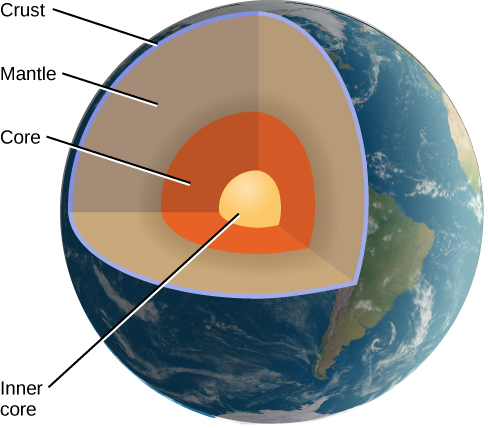
Seismic waves travel through a planet rather like sound waves through a struck bell. Just as the sound frequencies vary depending on the material the bell is made of and how it is constructed, so a planet’s response depends on its composition and structure. By monitoring the seismic waves in different locations, scientists can learn about the layers through which the waves have traveled. Some of these vibrations travel along the surface; others pass directly through the interior. Seismic studies have shown that Earth’s interior consists of several distinct layers with different compositions, illustrated in Figure 8.3. As waves travel through different materials in Earth’s interior, the waves—just like light waves in telescope lenses—bend (or refract) so that some seismic stations on Earth receive the waves and others are in “shadows.” Detecting the waves in a network of seismographs helps scientists construct a model of Earth’s interior, showing liquid and solid layers. This type of seismic imaging is not unlike that used in ultrasound, a type of imaging used to see inside the body.
英語のヒント
地震波は、打ち鳴らした鐘の中を音の波が伝わるのに、よく似た仕方で惑星内を進む。鐘の音の振動数が、その材質や作り方によって変わるのと同様に、惑星の応答も、その組成と構造によって変わる。異なる場所で地震波を観測することで、科学者は波が通過した層について知ることができる。振動の中には表面に沿って伝わるものもあれば、内部を直接通り抜けるものもある。地震の研究から、地球内部は、組成の異なるいくつかのはっきりした層からなることがわかった。図8.3に、その様子を示す。波が地球内部の異なる物質を通るとき、望遠鏡のレンズを通る光の波と同じように、進む向きが曲がる、すなわち屈折する。そのため、地球上のある地震観測所には波が届き、別の観測所は「影」に入る。地震計のネットワークで波を検出すると、科学者は、液体の層と固体の層を示す地球内部のモデルを作れる。このような地震波による内部の画像化は、体内を見るための超音波画像法で使われるものと、よく似ている。
Interior Structure of Earth.地球の内部構造。
OpenStax / Rice University · CC BY 4.0
Figure 8.3 The crust, mantle, and inner and outer cores (solid and liquid, respectively) as revealed by seismic studies.
図8.3 地震の研究によって明らかになった、地殻、マントル、内核と外核(それぞれ固体と液体)を示す。
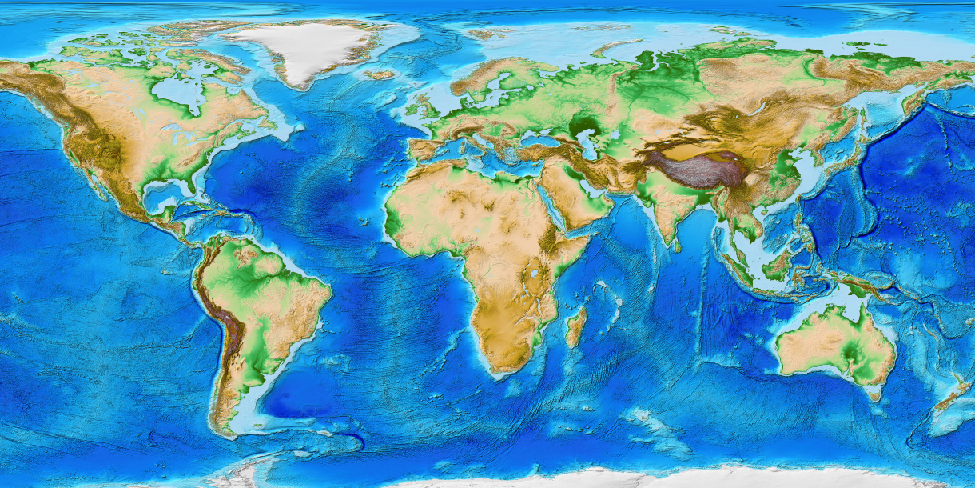
The top layer is the crust, the part of Earth we know best (Figure 8.4). Oceanic crust covers 55% of Earth’s surface and lies mostly submerged under the oceans. It is typically about 6 kilometers thick and is composed of volcanic rocks called basalt. Produced by the cooling of volcanic lava, basalts are made primarily of the elements silicon, oxygen, iron, aluminum, and magnesium. The continental crust covers 45% of the surface, some of which is also beneath the oceans. The continental crust is 20 to 70 kilometers thick and is composed predominantly of a different intrusive class of silicates (rocks made of silicon and oxygen) called granite. These crustal rocks, both oceanic and continental, typically have densities of about 3 g/cm3. (For comparison, the density of water is 1 g/cm3.) The crust is the easiest layer for geologists to study, but it makes up only about 0.3% of the total mass of Earth.
英語のヒント
一番上の層は地殻であり、私たちが地球の中で最もよく知っている部分である(図8.4)。海洋地殻は地球表面の55%を覆い、大部分が海の下に沈んでいる。厚さは典型的には約6 kmで、玄武岩と呼ばれる火山岩でできている。火山の溶岩が冷えて生じる玄武岩は、主としてケイ素、酸素、鉄、アルミニウム、マグネシウムからなる。大陸地殻は表面の45%を覆い、その一部は海の下にもある。厚さは20〜70 kmで、主に花崗岩と呼ばれる、別の種類の深成岩であるケイ酸塩岩(ケイ素と酸素でできた岩石)からなる。海洋側と大陸側のどちらの地殻の岩石も、密度は典型的には約3 g/cm³である。比較のためにいうと、水の密度は1 g/cm³である。地殻は地質学者が最も調べやすい層だが、地球の全質量のわずか約0.3%しか占めない。
Earth’s Crust.地球の地殻。
credit: modification of work by C. Amante, B. W. Eakins, National Geophysical Data Center, NOAA · U.S. government work; OpenStax adaptation CC BY 4.0
Figure 8.4 This computer-generated image shows the surface of Earth’s crust as determined from land-elevation and ocean-depth data. Oceans and lakes are shown in blue, with darker areas representing depth. Dry land is shown in shades of green and brown, and the Greenland and Antarctic ice sheets are depicted in shades of white. (credit: modification of work by C. Amante, B. W. Eakins, National Geophysical Data Center, NOAA)
図8.4 このコンピューター画像は、陸上の標高と海の深さのデータから求めた地殻の表面を示す。海と湖は青色で、暗い領域ほど深い。陸地は緑と茶色の濃淡で、グリーンランドと南極の氷床は白の濃淡で描いている。(提供:C. Amante、B. W. Eakins、National Geophysical Data Center、NOAAの作品を改変)
The largest part of the solid Earth, called the mantle, stretches from the base of the crust downward to a depth of 2900 kilometers. The mantle is more or less solid, but at the temperatures and pressures found there, mantle rock can deform and flow slowly. The density in the mantle increases downward from about 3.5 g/cm3 to more than 5 g/cm3 as a result of the compression produced by the weight of overlying material. Samples of upper mantle material are occasionally ejected from volcanoes, permitting a detailed analysis of its chemistry.
英語のヒント
固体地球の最大の部分はマントルと呼ばれ、地殻の底から、深さ2900 kmまで続く。マントルはおおむね固体だが、そこにある温度や圧力のもとでは、マントルの岩石は変形し、ゆっくり流れることができる。上に重なる物質の重さによる圧縮のため、マントルの密度は下方へ向かって約3.5 g/cm³から5 g/cm³を超える値へと増す。上部マントルの物質が火山から噴き出すこともあり、その化学組成を詳しく分析できる。
Beginning at a depth of 2900 kilometers, we encounter the dense metallic core of Earth. With a diameter of 7000 kilometers, our core is substantially larger than the entire planet Mercury. The outer core is liquid, but the innermost part of the core (about 2400 kilometers in diameter) is probably solid. In addition to iron, the core probably also contains substantial quantities of nickel and sulfur, all compressed to a very high density.
英語のヒント
深さ2900 kmからは、地球の密度の高い金属質の核に行き当たる。直径7000 kmの地球の核は、水星全体よりもかなり大きい。外核は液体だが、最も内側の部分(直径約2400 km)は、おそらく固体である。核には鉄に加えて、おそらくかなりの量のニッケルと硫黄も含まれ、そのすべてが非常に高い密度へと圧縮されている。
The separation of Earth into layers of different densities is an example of differentiation, the process of sorting the major components of a planet by density. The fact that Earth is differentiated suggests that it was once warm enough for its interior to melt, permitting the heavier metals to sink to the center and form the dense core. Evidence for differentiation comes from comparing the planet’s bulk density (5.5 g/cm3) with the surface materials (3 g/cm3) to suggest that denser material must be buried in the core.
英語のヒント
地球が密度の異なる層に分かれているのは、分化の一例である。分化とは、惑星の主要な構成物を、密度によって分ける過程をいう。地球が分化しているという事実は、かつて内部が溶けるほど暖かく、重い金属が中心へ沈んで高密度の核を作れたことを示唆する。分化の証拠は、地球全体の平均密度(5.5 g/cm³)と表面物質の密度(3 g/cm³)を比べると得られる。この比較は、もっと密度の高い物質が核の中に埋もれているはずだと示している。