第8章惑星としての地球Earth as a Planet
The Evolution of the Atmosphere大気の進化
One of the key steps in the evolution of life on Earth was the development of blue-green algae, a very successful life-form that takes in carbon dioxide from the environment and releases oxygen as a waste product. These successful microorganisms proliferated, giving rise to all the lifeforms we call plants. Since the energy for making new plant material from chemical building blocks comes from sunlight, we call the process photosynthesis.
英語のヒント
地球の生命の進化で重要な段階の一つは、藍藻類の発達だった。環境から二酸化炭素を取り込み、不要な生成物として酸素を放出する、非常に成功した生命の形である。これらの微生物は盛んに増え、私たちが植物と呼ぶあらゆる生命の形を生み出した。化学的な構成要素から新しい植物の物質を作るエネルギーは太陽光から来るので、この過程を光合成と呼ぶ。
Studies of the chemistry of ancient rocks show that Earth’s atmosphere lacked abundant free oxygen until about 2 billion years ago, despite the presence of plants releasing oxygen by photosynthesis. Apparently, chemical reactions with Earth’s crust removed the oxygen gas as quickly as it formed. Slowly, however, the increasing evolutionary sophistication of life led to a growth in the plant population and thus increased oxygen production. At the same time, it appears that increased geological activity led to heavy erosion on our planet’s surface. This buried much of the plant carbon before it could recombine with oxygen to form CO2.
英語のヒント
古い岩石の化学組成を調べると、光合成で酸素を出す植物が存在していたにもかかわらず、約20億年前まで、大気には豊富な遊離酸素がなかったことがわかる。どうやら、地殻との化学反応によって、酸素の気体はできるそばから取り除かれていたらしい。しかし、生命が進化して徐々に複雑になるにつれ、植物の個体数が増え、それに伴って酸素の生産量も増えた。同時に、地質活動が活発になったことで、地表では激しい侵食が起きたらしい。これによって、植物の炭素の多くが、酸素と再結合してCO₂になる前に埋められた。
Free oxygen began accumulating in the atmosphere about 2 billion years ago, and the increased amount of this gas led to the formation of Earth’s ozone layer (recall that ozone is a triple molecule of oxygen, O3), which protects the surface from deadly solar ultraviolet light. Before that, it was unthinkable for life to venture outside the protective oceans, so the landmasses of Earth were barren.
英語のヒント
遊離酸素は約20億年前から大気に蓄積し始め、その増加によってオゾン層が形成された。オゾンは酸素原子三つからなる分子、O₃であることを思い出そう。この層は、致命的な太陽の紫外線から地表を守る。それ以前に、生命が保護してくれる海の外へ出ることは考えられず、地球の陸塊は不毛だった。
The presence of oxygen, and hence ozone, thus allowed colonization of the land. It also made possible a tremendous proliferation of animals, which lived by taking in and using the organic materials produced by plants as their own energy source.
英語のヒント
このように、酸素、したがってオゾンの存在によって、生命は陸へ進出できるようになった。また、植物が作った有機物を取り込み、自分たちのエネルギー源として利用して生きる動物が、大きく増えることも可能になった。
As animals evolved in an environment increasingly rich in oxygen, they were able to develop techniques for breathing oxygen directly from the atmosphere. We humans take it for granted that plenty of free oxygen is available in Earth’s atmosphere, and we use it to release energy from the food we take in. Although it may seem funny to think of it this way, we are lifeforms that have evolved to breathe in the waste product of plants. It is plants and related microbes that are the primary producers, using sunlight to create energy-rich “food” for the rest of us.
英語のヒント
動物は、酸素が次第に豊富になる環境で進化する中で、大気から酸素を直接吸って呼吸する方法を発達させることができた。私たち人間は、地球大気に遊離酸素が豊富にあることを当然と考え、取り込んだ食べ物からエネルギーを引き出すのに利用している。こう考えると奇妙に思えるかもしれないが、私たちは、植物の不要な生成物を吸って生きるよう進化した生命体なのである。太陽光を使って、残りの私たちのためにエネルギーに富む「食べ物」を作る一次生産者は、植物とその仲間の微生物だ。
On a planetary scale, one of the consequences of life has been a decrease in atmospheric carbon dioxide. In the absence of life, Earth would probably have an atmosphere dominated by CO2, like Mars or Venus. But living things, in combination with high levels of geological activity, have effectively stripped our atmosphere of most of this gas.
英語のヒント
惑星全体の規模で見れば、生命がもたらした結果の一つは、大気中の二酸化炭素の減少である。生命がなければ、地球の大気は、おそらく火星や金星のようにCO₂が主成分だっただろう。しかし、生物と活発な地質活動が組み合わさり、この気体の大半を大気から効率よく取り除いてきた。
The Greenhouse Effect and Global Warming温室効果と地球温暖化
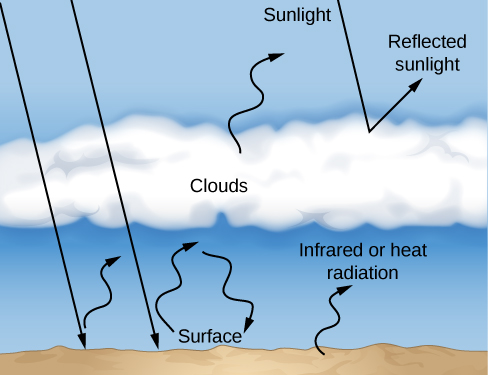
We have a special interest in the carbon dioxide content of the atmosphere because of the key role this gas plays in retaining heat from the Sun through a process called the greenhouse effect. To understand how the greenhouse effect works, consider the fate of sunlight that strikes the surface of Earth. The light penetrates our atmosphere, is absorbed by the ground, and heats the surface layers. At the temperature of Earth’s surface, that energy is then reemitted as infrared or heat radiation (Figure 8.17). However, some molecules in our atmosphere, which allow visible light through, are good at absorbing infrared energy. As a result, CO2 (along with methane and water vapor) acts like a blanket, trapping heat in the atmosphere and impeding its flow back to space. To maintain an energy balance, the temperature of the surface and lower atmosphere must increase until the total energy radiated by Earth to space equals the energy received from the Sun. The more CO2 there is in our atmosphere, the higher the temperature at which Earth’s surface reaches a new balance.
英語のヒント
私たちが大気中の二酸化炭素量に特に関心を持つのは、この気体が、温室効果と呼ばれる過程を通じて、太陽からの熱を保つ重要な役割を果たすからである。温室効果の仕組みを理解するため、地表に当たる太陽光の行く先を考えてみよう。光は大気を通過し、地面に吸収され、表層を暖める。地表の温度では、そのエネルギーは次に、赤外線、すなわち熱放射として再び放出される(図8.17)。しかし、大気中の一部の分子は可視光を通す一方で、赤外線のエネルギーをよく吸収する。そのため、CO₂はメタンや水蒸気とともに毛布のように働き、大気中に熱をとどめ、宇宙へ戻る流れを妨げる。エネルギーの釣り合いを保つには、地球が宇宙へ放射するエネルギーの総量が、太陽から受け取る量と等しくなるまで、地表と下層大気の温度が上がらなければならない。大気中のCO₂が多いほど、地表が新たな釣り合いに達するときの温度は高くなる。
How the Greenhouse Effect Works.温室効果の仕組み。
OpenStax / Rice University · CC BY 4.0
Figure 8.17 Sunlight that penetrates to Earth’s lower atmosphere and surface is reradiated as infrared or heat radiation, which is trapped by greenhouse gases such as water vapor, methane, and CO2 in the atmosphere. The result is a higher surface temperature for our planet.
図8.17 地球の下層大気や地表に達した太陽光は、赤外線、すなわち熱放射として再放出される。その放射は、大気中の水蒸気、メタン、CO₂などの温室効果ガスに捕らえられる。その結果、地球の表面温度は高くなる。
The greenhouse effect in a planetary atmosphere is similar to the heating of a gardener’s greenhouse or the inside of a car left out in the Sun with the windows rolled up. In these examples, the window glass plays the role of greenhouse gases, letting sunlight in but reducing the outward flow of heat radiation. As a result, a greenhouse or car interior winds up much hotter than would be expected from the heating of sunlight alone. On Earth, the current greenhouse effect elevates the surface temperature by about 33 °C. Without this greenhouse effect, the average surface temperature would be well below freezing and Earth would be locked in a global ice age.
英語のヒント
惑星大気の温室効果は、園芸用の温室や、窓を閉め切って日なたに置いた車の中が暖まることに似ている。これらの例では、窓ガラスが温室効果ガスの役割を果たし、太陽光を中へ入れる一方で、熱放射が外へ出る流れを減らす。その結果、温室や車内は、太陽光による加熱だけから予想されるよりも、はるかに高温になる。地球では、現在の温室効果は表面温度を約33 ℃上げている。これがなければ、平均表面温度は氷点を大幅に下回り、地球は全球的な氷期に閉じ込められるだろう。
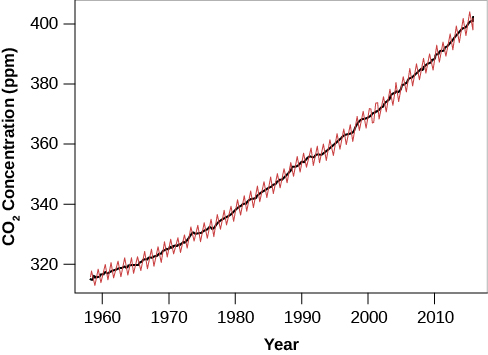
That’s the good news; the bad news is that the heating due to the greenhouse effect is increasing. Modern industrial society depends on energy extracted from burning fossil fuels. In effect, we are exploiting the energy-rich material created by photosynthesis tens of millions of years ago. As these ancient coal and oil deposits are oxidized (burned using oxygen), large quantities of carbon dioxide are released into the atmosphere. The problem is exacerbated by the widespread destruction of tropical forests, which we depend on to extract CO2 from the atmosphere and replenish our supply of oxygen. In the past century of increased industrial and agricultural development, the amount of CO2 in the atmosphere increased by about 30% and continues to rise at more than 0.5% per year.
英語のヒント
ここまではよい知らせだった。悪い知らせは、温室効果による加熱が強まっていることだ。現代の工業社会は、化石燃料の燃焼から取り出すエネルギーに依存する。実際には、何千万年も前に光合成で作られた、エネルギーに富む物質を利用しているのである。この古い石炭や石油の埋蔵物が酸化される、つまり酸素を使って燃やされると、大量の二酸化炭素が大気へ放出される。大気からCO₂を取り除き、酸素を補給してくれる熱帯林の広範な破壊は、問題をさらに悪化させる。工業と農業の発展が進んだ過去1世紀に、大気中のCO₂は約30%増え、現在も年0.5%を超える割合で増え続けている。
Before the end of the present century, Earth’s CO2 level is predicted to reach twice the value it had before the industrial revolution (Figure 8.18). The consequences of such an increase for Earth’s surface and atmosphere (and the creatures who live there) are likely to be complex changes in climate, and may be catastrophic for many species. Many groups of scientists are now studying the effects of such global warming with elaborate computer models, and climate change has emerged as the greatest known threat (barring nuclear war) to both industrial civilization and the ecology of our planet.
英語のヒント
今世紀末までに、地球のCO₂濃度は産業革命以前の2倍に達すると予測されている(図8.18)。この増加が地表や大気、そしてそこに住む生き物にもたらすのは、複雑な気候変化である可能性が高く、多くの種にとっては破滅的かもしれない。現在、多くの科学者グループが精密なコンピューターモデルを使って、こうした地球温暖化の影響を研究している。気候変動は、核戦争を除けば、工業文明と地球の生態系の両方に対する、知られている最大の脅威として浮かび上がってきた。
Increase of Atmospheric Carbon Dioxide over Time.時間とともに増える大気中の二酸化炭素。
credit: modification of work by NOAA · U.S. government work; OpenStax adaptation CC BY 4.0
Figure 8.18 Scientists expect that the amount of CO2 will double its preindustrial level before the end of the twenty-first century. Measurements of the isotopic signatures of this added CO2 demonstrate that it is mostly coming from burning fossil fuels. (credit: modification of work by NOAA)
図8.18 科学者は、21世紀末までにCO₂の量が産業革命以前の2倍になると予想している。増加したCO₂の同位体の特徴を測定すると、その大半が化石燃料の燃焼から来ていることがわかる。(提供:NOAAの作品を改変)
Climate change is widely apparent. Around the world, temperature records are constantly set and broken; all but one of the hottest recorded years have taken place since 2000. Glaciers are retreating, and the Arctic Sea ice is now much thinner than when it was first explored with nuclear submarines in the 1950s. Rising sea levels (from both melting glaciers and expansion of the water as its temperature rises) pose one of the most immediate threats, and many coastal cities have plans to build dikes or seawalls to hold back the expected flooding. The rate of temperature increase is without historical precedent, and we are rapidly entering “unknown territory” where human activities are leading to the highest temperatures on Earth in more than 50 million years.
英語のヒント
気候変動は、広い範囲ではっきり現れている。世界中で気温の記録が絶えず作られ、更新されている。記録上最も暑い年は、一つを除いて、すべて2000年以降に生じている。氷河は後退し、北極海の海氷は、1950年代に原子力潜水艦で初めて調べられたときより、今ではずっと薄い。氷河の融解と、水温上昇による水の膨張の両方から生じる海面上昇は、最も差し迫った脅威の一つである。多くの沿岸都市は、予想される浸水を防ぐために、堤防や防潮堤を作る計画を持つ。気温上昇の速さは歴史上前例がなく、私たちは急速に「未知の領域」へ入りつつある。そこでは人間活動が、地球を過去5000万年以上で最も高い温度へ導いている。