第8章惑星としての地球Earth as a Planet
8.2 Earth’s Crust8.2 地球の地殻
Learning Objectives学習の目標
By the end of this section, you will be able to:
この節を学び終えると、次のことができるようになる。
Denote the primary types of rock that constitute Earth’s crust
地殻を構成する主要な岩石の種類を示す。
Explain the theory of plate tectonics
プレートテクトニクスの理論を説明する。
Describe the difference between rift and subduction zones
リフト帯と沈み込み帯の違いを述べる。
Describe the relationship between fault zones and mountain building
断層帯と山脈形成との関係を述べる。
Explain the various types of volcanic activity occurring on Earth
地球上で起こるさまざまな火山活動を説明する。
Let us now examine our planet’s outer layers in more detail. Earth’s crust is a dynamic place. Volcanic eruptions, erosion, and large-scale movements of the continents rework the surface of our planet constantly. Geologically, ours is the most active planet. Many of the geological processes described in this section have taken place on other planets as well, but usually in their distant pasts. Some of the moons of the giant planets also have impressive activity levels. For example, Jupiter’s moon Io has a remarkable number of active volcanoes.
英語のヒント
ここからは、地球の外側の層をさらに詳しく調べよう。地殻は、活発に変化する場所である。火山の噴火、侵食、大陸の大規模な移動が、絶えず地球の表面を作り変えている。地質学的に、地球は最も活動的な惑星である。この節で述べる地質学的な過程の多くは、ほかの惑星でも起きているが、通常は遠い過去のことである。巨大惑星の衛星の中にも、目を見張るほど活発なものがある。例えば、木星の衛星イオには、驚くほど多くの活火山がある。
Composition of the Crust地殻の組成
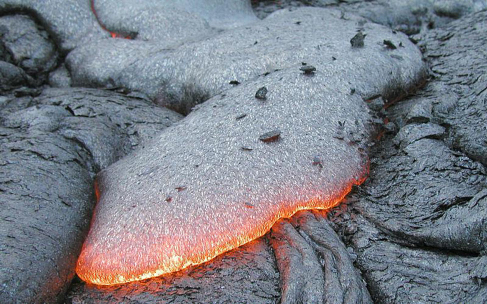
Earth’s crust is largely made up of oceanic basalt and continental granite. These are both igneous rock, the term used for any rock that has cooled from a molten state. All volcanically produced rock is igneous (Figure 8.6).
英語のヒント
地殻は大部分が、海洋の玄武岩と大陸の花崗岩からなる。どちらも火成岩である。火成岩とは、溶けた状態から冷えてできた岩石すべてに使う言葉だ。火山活動で生じた岩石は、すべて火成岩である(図8.6)。
Formation of Igneous Rock as Liquid Lava Cools and Freezes.液体の溶岩が冷えて固まり、火成岩になる。
credit: USGS · USGS public domain material
Figure 8.6 This is a lava flow from a basaltic eruption. Basaltic lava flows quickly and can move easily over distances of more than 20 kilometers. (credit: USGS)
図8.6 玄武岩質の噴火で生じた溶岩流。玄武岩質の溶岩は速く流れ、20 kmを超える距離でも容易に移動する。(提供:USGS)
Two other kinds of rock are familiar to us on Earth, although it turns out that neither is common on other planets. Sedimentary rocks are made of fragments of igneous rock or the shells of living organisms deposited by wind or water and cemented together without melting. On Earth, these rocks include the common sandstones, shales, and limestones. Metamorphic rocks are produced when high temperature or pressure alters igneous or sedimentary rock physically or chemically (the word metamorphic means “changed in form”). Metamorphic rocks are produced on Earth because geological activity carries surface rocks down to considerable depths and then brings them back up to the surface. Without such activity, these changed rocks would not exist at the surface.
英語のヒント
地球上では、ほかにも二種類の岩石になじみがあるが、どちらも、ほかの惑星ではあまり普通ではないことがわかっている。堆積岩は、風や水で運ばれて堆積した火成岩の破片や生物の殻が、溶けることなく固められてできる。地球上では、よく見られる砂岩、頁岩、石灰岩が含まれる。変成岩は、高い温度や圧力が火成岩や堆積岩を、物理的または化学的に変えることで生じる。metamorphic という言葉は、「形が変わった」という意味である。地球で変成岩ができるのは、地質活動が表面の岩石をかなりの深さへ運び、その後再び表面へ戻すからだ。そのような活動がなければ、変化したこれらの岩石が表面に存在することはないだろう。
There is a fourth very important category of rock that can tell us much about the early history of the planetary system: primitive rock, which has largely escaped chemical modification by heating. Primitive rock represents the original material out of which the planetary system was made. No primitive material is left on Earth because the entire planet was heated early in its history. To find primitive rock, we must look to smaller objects such as comets, asteroids, and small planetary moons. We can sometimes see primitive rock in samples that fall to Earth from these smaller objects.
英語のヒント
惑星系の初期の歴史をよく教えてくれる、第四の非常に重要な岩石の種類もある。原始的な岩石で、加熱による化学的変化をほとんど受けずにきたものを指す。原始的な岩石は、惑星系が作られた、もとの物質を表す。地球は歴史の初期に全体が加熱されたため、原始的な物質は地球上には残っていない。原始的な岩石を見つけるには、彗星、小惑星、惑星の小さな衛星のような、小天体へ目を向けなければならない。それらの小天体から地球へ落ちてくる試料の中に、原始的な岩石を見られることもある。
A block of quartzite on Earth is composed of materials that have gone through all four of these states. Beginning as primitive material before Earth was born, it was heated in the early Earth to form igneous rock, transformed chemically and redeposited (perhaps many times) to form sedimentary rock, and finally changed several kilometers below Earth’s surface into the hard, white metamorphic stone we see today.
英語のヒント
地球の珪岩の塊は、この四つの状態をすべて経験してきた物質からできている。地球が生まれる前の原始的な物質として始まり、初期の地球で加熱されて火成岩となり、化学的な変化と再堆積を、おそらく何度も繰り返して堆積岩となり、最後に地表から数km下で変化して、今日見られる硬く白い変成岩になったのである。
Plate Tectonicsプレートテクトニクス
Geology is the study of Earth’s crust and the processes that have shaped its surface throughout history. (Although geo- means “related to Earth,” astronomers and planetary scientists also talk about the geology of other planets.) Heat escaping from the interior provides energy for the formation of our planet’s mountains, valleys, volcanoes, and even the continents and ocean basins themselves. But not until the middle of the twentieth century did geologists succeed in understanding just how these landforms are created.
英語のヒント
地質学は、地殻と、歴史を通じてその表面を形作ってきた過程を研究する学問である。(geo- は「地球に関係する」という意味だが、天文学者や惑星科学者は、ほかの惑星についても地質学という言葉を使う。)内部から逃げ出す熱が、山、谷、火山、さらには大陸や海盆そのものを作るエネルギーを供給する。しかし、これらの地形がどのように作られるのかを地質学者が理解できたのは、20世紀半ばになってからだった。
Plate tectonics is an idea that explains how slow motions within the mantle of Earth move large segments of the crust, resulting in a gradual “drifting” of the continents as well as the formation of mountains and other large-scale geological features. Plate tectonics is a concept as basic to geology as evolution by natural selection is to biology or gravity is to understanding the orbits of planets. Looking at it from a different perspective, plate tectonics is a mechanism for Earth to transport heat efficiently from the interior, where it has accumulated, out to space. It is a cooling system for the planet. All planets develop a heat transfer process as they evolve; mechanisms may differ from that on Earth as a result of chemical makeup and other constraints.
英語のヒント
プレートテクトニクスは、地球のマントル内のゆっくりした運動が地殻の大きな区画を動かし、大陸を徐々に「移動」させるとともに、山脈などの大規模な地形を作る仕組みを説明する考えである。地質学にとってのプレートテクトニクスは、生物学にとっての自然選択による進化や、惑星軌道の理解にとっての重力と同じほど、基本的な概念である。別の視点から見ると、プレートテクトニクスは、地球の内部に蓄積した熱を、効率よく宇宙へ運び出す仕組みでもある。つまり、地球の冷却装置なのだ。どの惑星も、進化する中で熱を移す過程を発達させるが、化学組成などの制約によって、その仕組みは地球のものとは異なりうる。
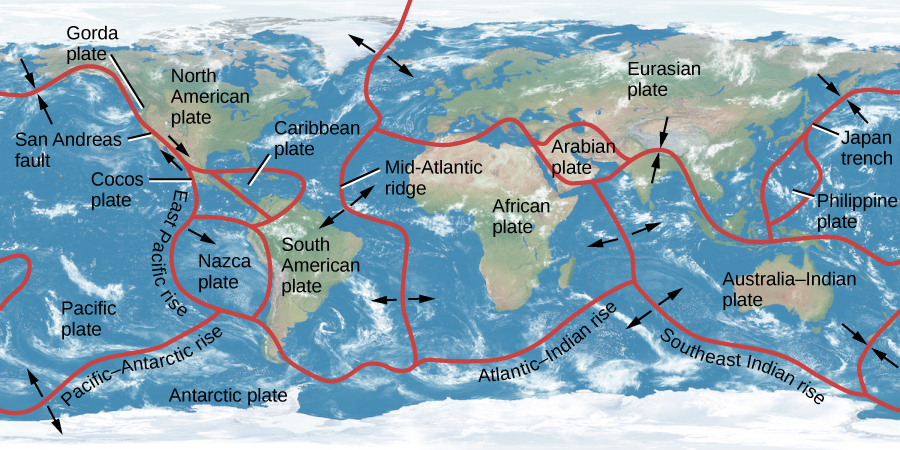
Earth’s crust and upper mantle (to a depth of about 60 kilometers) are divided into about a dozen tectonic plates that fit together like the pieces of a jigsaw puzzle (Figure 8.7). In some places, such as the Atlantic Ocean, the plates are moving apart; in others, such as off the western coast of South America, they are being forced together. The power to move the plates is provided by slow convection of the mantle, a process by which heat escapes from the interior through the upward flow of warmer material and the slow sinking of cooler material. (Convection, in which energy is transported from a warm region, such as the interior of Earth, to a cooler region, such as the upper mantle, is a process we encounter often in astronomy—in stars as well as planets. It is also important in boiling water for coffee while studying for astronomy exams.)
英語のヒント
地殻と上部マントルの深さ約60 kmまでの部分は、約12枚のプレートに分かれ、ジグソーパズルのピースのように組み合わさっている(図8.7)。大西洋のようにプレート同士が離れている場所もあれば、南米西岸沖のように互いに押し付けられている場所もある。プレートを動かす力は、マントルのゆっくりした対流によって与えられる。対流とは、暖かい物質が上昇し、冷たい物質がゆっくり沈むことで、内部の熱が逃げていく過程である。対流は、地球内部のような暖かい領域から、上部マントルのような冷たい領域へエネルギーを運ぶ。この過程は、惑星だけでなく恒星でも、天文学でたびたび出会うものである。天文学の試験勉強中に、コーヒー用のお湯を沸かす際にも重要だ。
Earth’s Continental Plates.地球の大陸のプレート。
OpenStax / Rice University · CC BY 4.0
Figure 8.7 This map shows the major plates into which the crust of Earth is divided. Arrows indicate the motion of the plates at average speeds of 4 to 5 centimeters per year, similar to the rate at which your hair grows.
図8.7 地殻が分かれた主要なプレートを示す地図。矢印はプレートの動きを示し、その平均の速さは年4〜5 cmで、髪の毛が伸びる速さに似ている。
As the plates slowly move, they bump into each other and cause dramatic changes in Earth’s crust over time. Four basic kinds of interactions between crustal plates are possible at their boundaries: (1) they can pull apart, (2) one plate can burrow under another, (3) they can slide alongside each other, or (4) they can jam together. Each of these activities is important in determining the geology of Earth.
英語のヒント
プレートがゆっくり動くと、互いにぶつかり、時間とともに地殻に大きな変化を起こす。地殻のプレートの境界では、基本的に四種類の相互作用がありうる。(1)互いに離れる、(2)一方が他方の下へ潜り込む、(3)互いに横にずれる、(4)互いに押し合って詰まる、の四つである。いずれも、地球の地質を決める重要な働きである。