第8章惑星としての地球Earth as a Planet
Magnetic Field and Magnetosphere磁場と磁気圏
We can find additional clues about Earth’s interior from its magnetic field. Our planet behaves in some ways as if a giant bar magnet were inside it, aligned approximately with the rotational poles of Earth. This magnetic field is generated by moving material in Earth’s liquid metallic core. As the liquid metal inside Earth circulates, it sets up a circulating electric current. When many charged particles are moving together like that—in the laboratory or on the scale of an entire planet—they produce a magnetic field.
英語のヒント
地球内部についてのさらなる手がかりは、その磁場から得られる。地球は、内部に巨大な棒磁石があり、それが地球の自転の両極にほぼ沿っているかのように振る舞う面がある。この磁場を生み出しているのは、地球の液体の金属核の中で動く物質である。地球内部の液体金属が循環すると、循環する電流が生じる。そのように多数の荷電粒子が一緒に動くと、実験室であれ惑星全体の規模であれ、磁場が生まれる。
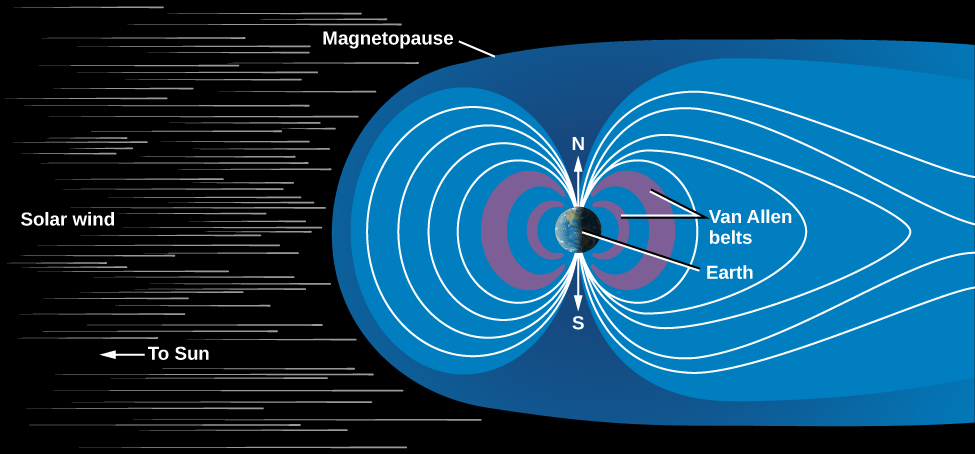
Earth’s magnetic field extends into surrounding space. When a charged particle encounters a magnetic field in space, it becomes trapped in the magnetic zone. Above Earth’s atmosphere, our field is able to trap small quantities of electrons and other atomic particles. This region, called the magnetosphere, is defined as the zone within which Earth’s magnetic field dominates over the weak interplanetary magnetic field that extends outward from the Sun (Figure 8.5).
英語のヒント
地球の磁場は、周りの宇宙空間まで広がっている。荷電粒子が宇宙で磁場に出会うと、磁場の領域に捕らえられる。大気の上方では、地球の磁場が少量の電子や、原子に関わるほかの粒子を捕らえられる。この領域は磁気圏と呼ばれ、太陽から外へ延びる弱い惑星間磁場よりも、地球の磁場の方が優勢な範囲として定義される(図8.5)。
Earth’s Magnetosphere.地球の磁気圏。
OpenStax / Rice University · CC BY 4.0
Figure 8.5 A cross-sectional view of our magnetosphere (or zone of magnetic influence), as revealed by numerous spacecraft missions. Note how the wind of charged particles from the Sun “blows” the magnetic field outward like a wind sock.
図8.5 数多くの探査機ミッションによって明らかになった、地球の磁気圏(磁気的な影響が及ぶ領域)の断面図。太陽からの荷電粒子の風が、吹き流しのように磁場を外へ「吹き流す」様子に注目しよう。
Where do the charged particles trapped in our magnetosphere come from? They flow outward from the hot surface of the Sun; this is called the solar wind. It not only provides particles for Earth’s magnetic field to trap, it also stretches our field in the direction pointing away from the Sun. Typically, Earth’s magnetosphere extends about 60,000 kilometers, or 10 Earth radii, in the direction of the Sun. But, in the direction away from the Sun, the magnetic field can reach as far as the orbit of the Moon, and sometimes farther.
英語のヒント
磁気圏に捕らえられた荷電粒子は、どこから来るのだろうか。それらは太陽の熱い表面から外へ流れ出すもので、この流れを太陽風という。太陽風は、地球の磁場に捕らえられる粒子を供給するだけでなく、地球の磁場を太陽と反対の方向へ引き伸ばす。地球の磁気圏は、太陽の方向には、典型的には約6万km、地球半径の10倍ほどまで広がる。しかし太陽と反対の方向には、磁場は月の軌道にまで達し、ときにはさらに遠くへ延びる。
The magnetosphere was discovered in 1958 by instruments on the first US Earth satellite, Explorer 1, which recorded the ions (charged particles) trapped in its inner part. The regions of high-energy ions in the magnetosphere are often called the Van Allen belts in recognition of the University of Iowa professor who built the scientific instrumentation for Explorer 1. Since 1958, hundreds of spacecraft have explored various regions of the magnetosphere. You can read more about its interaction with the Sun in a later chapter.
英語のヒント
磁気圏は、アメリカ初の地球周回衛星エクスプローラー1号の観測装置によって、1958年に発見された。装置は、磁気圏の内側に捕らえられているイオン(荷電粒子)を記録した。磁気圏内の高エネルギーのイオンが集まる領域は、エクスプローラー1号の科学観測装置を作ったアイオワ大学の教授の功績をたたえ、ヴァン・アレン帯と呼ばれることが多い。1958年以来、何百機もの宇宙機が、磁気圏のさまざまな領域を調べてきた。太陽との相互作用については、後の章でさらに学べる。
Key Concepts and Summary重要事項のまとめ
Earth is the prototype terrestrial planet. Its interior composition and structure are probed using seismic waves. Such studies reveal that Earth has a metal core and a silicate mantle. The outer layer, or crust, consists primarily of oceanic basalt and continental granite. A global magnetic field, generated in the core, produces Earth’s magnetosphere, which can trap charged atomic particles.
地球は地球型惑星の典型である。内部の組成と構造は、地震波を使って調べられる。そのような研究から、地球には金属の核とケイ酸塩のマントルがあることがわかる。最も外側の層である地殻は、主として海洋の玄武岩と大陸の花崗岩からなる。核で生じる全球的な磁場が磁気圏を作り、電荷を持つ原子の粒子を捕らえることができる。
basalt
玄武岩
igneous rock produced by the cooling of lava; makes up most of Earth’s oceanic crust and is found on other planets that have experienced extensive volcanic activity
溶岩が冷えてできた火成岩。地球の海洋地殻の大部分を占め、広範な火山活動を経験したほかの惑星にも見られる。
core
核
the central part of the planet; consists of higher density material
惑星の中心部。密度の高い物質からなる。
crust
地殻
the outer layer of a terrestrial planet
地球型惑星の最も外側の層。
granite
花崗岩
a type of igneous silicate rock that makes up most of Earth’s continental crust
地球の大陸地殻の大部分を占める、ケイ酸塩の火成岩の一種。
magnetosphere
磁気圏
the region around a planet in which its intrinsic magnetic field dominates the interplanetary field carried by the solar wind; hence, the region within which charged particles can be trapped by the planetary magnetic field
惑星固有の磁場が、太陽風によって運ばれる惑星間磁場よりも優勢な、惑星を囲む領域。したがって、荷電粒子が惑星の磁場に捕らえられうる範囲でもある。
mantle
マントル
the largest part of Earth’s interior; lies between the crust and the core
地球内部で最大の部分。地殻と核の間にある。
seismic wave
地震波
a vibration that travels through the interior of Earth or any other object; on Earth, these are generally caused by earthquakes
地球やほかの天体・物体の内部を伝わる振動。地球上では、一般に地震によって生じる。