第8章惑星としての地球Earth as a Planet
8.3 Earth’s Atmosphere8.3 地球の大気
Learning Objectives学習の目標
By the end of this section, you will be able to:
この節を学び終えると、次のことができるようになる。
Differentiate between Earth’s various atmospheric layers
地球の大気を構成する各層を区別する。
Describe the chemical composition and possible origins of our atmosphere
大気の化学組成と、考えられる起源を述べる。
Explain the difference between weather and climate
天気と気候の違いを説明する。
We live at the bottom of the ocean of air that envelops our planet. The atmosphere, weighing down upon Earth’s surface under the force of gravity, exerts a pressure at sea level that scientists define as 1 bar (a term that comes from the same root as barometer, an instrument used to measure atmospheric pressure). A bar of pressure means that each square centimeter of Earth’s surface has a weight equivalent to 1.03 kilograms pressing down on it. Humans have evolved to live at this pressure; make the pressure a lot lower or higher and we do not function well.
英語のヒント
私たちは、地球を包む空気の海の底に暮らしている。大気は、重力によって地表に重くのしかかり、海面での圧力を生む。科学者は、この圧力を1 bar(バール)と定める。bar は、大気圧を測る装置である barometer(気圧計)と同じ語源を持つ言葉だ。1 barの圧力とは、地表の1 cm²ごとに、1.03 kgの重さに相当する力が下向きにかかることを意味する。人間は、この圧力のもとで生きるように進化してきた。圧力をずっと低く、または高くすると、体はうまく働かなくなる。
The total mass of Earth’s atmosphere is about 5 × 10¹⁸ kilograms. This sounds like a large number, but it is only about a millionth of the total mass of Earth. The atmosphere represents a smaller fraction of Earth than the fraction of your mass represented by the hair on your head.
英語のヒント
地球の大気の全質量は、約5 × 10¹⁸ kgである。大きな数に聞こえるが、地球の全質量の約100万分の1にすぎない。地球に占める大気の割合は、あなたの体の質量に占める、頭の髪の毛の割合よりも小さい。
Structure of the Atmosphere大気の構造
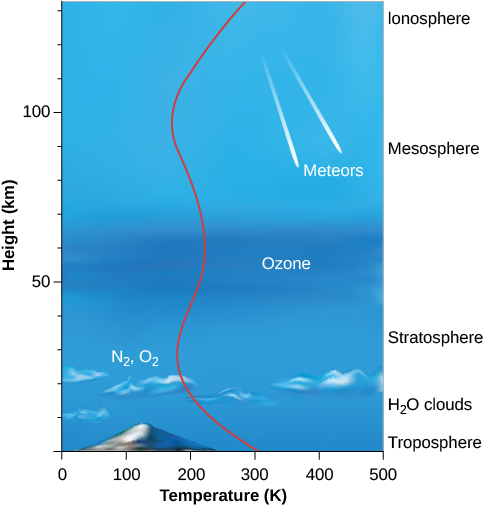
The structure of the atmosphere is illustrated in Figure 8.12. Most of the atmosphere is concentrated near the surface of Earth, within about the bottom 10 kilometers where clouds form and airplanes fly. Within this region—called the troposphere—warm air, heated by the surface, rises and is replaced by descending currents of cooler air; this is an example of convection. This circulation generates clouds and wind. Within the troposphere, temperature decreases rapidly with increasing elevation to values near 50 °C below freezing at its upper boundary, where the stratosphere begins. Most of the stratosphere, which extends to about 50 kilometers above the surface, is cold and free of clouds.
英語のヒント
図8.12に、大気の構造を示す。大気の大半は地表近く、下から約10 kmの範囲に集中し、そこでは雲ができ、飛行機が飛ぶ。対流圏と呼ばれるこの領域では、地表で暖められた空気が上がり、代わりに冷たい空気が下降してくる。これは対流の一例であり、この循環が雲と風を生む。対流圏では、高度が上がるにつれて温度は急速に下がり、上端では氷点下約50 ℃になる。そこで成層圏が始まる。成層圏は地表から約50 kmまで広がり、その大部分は冷たく、雲がない。
Structure of Earth’s Atmosphere.地球の大気の構造。
OpenStax / Rice University · CC BY 4.0
Figure 8.12 Height increases up the left side of the diagram, and the names of the different atmospheric layers are shown at the right. In the upper ionosphere, ultraviolet radiation from the Sun can strip electrons from their atoms, leaving the atmosphere ionized. The curving red line shows the temperature (see the scale on the x-axis).
図8.12 図の左側は上へ行くほど高度が高く、右側には各大気層の名前を示す。上部の電離圏では、太陽からの紫外線が原子から電子を引き剝がし、大気を電離させる。曲がった赤い線は温度を示す(横軸の目盛りを参照)。
Near the top of the stratosphere is a layer of ozone (O3), a form of oxygen with three atoms per molecule instead of the usual two. Because ozone is a good absorber of ultraviolet light, it protects the surface from some of the Sun’s dangerous ultraviolet radiation, making it possible for life to exist on Earth. The breakup of ozone adds heat to the stratosphere, reversing the decreasing temperature trend in the troposphere. Because ozone is essential to our survival, we reacted with justifiable concern to evidence that became clear in the 1980s that atmospheric ozone was being destroyed by human activities. By international agreement, the production of industrial chemicals that cause ozone depletion, called chlorofluorocarbons, or CFCs, has been phased out. As a result, ozone loss has stopped and the “ozone hole” over the Antarctic is shrinking gradually. This is an example of how concerted international action can help maintain the habitability of Earth.
英語のヒント
成層圏の上部付近には、オゾン(O₃)の層がある。オゾンは、通常のように原子二つではなく、三つで一分子を作る酸素の一形態である。オゾンは紫外線をよく吸収するため、太陽からの危険な紫外線の一部から地表を守り、地球上に生命が存在できるようにしている。オゾンが分解すると成層圏に熱が加わり、対流圏で見られた、上へ行くほど温度が下がる傾向が逆転する。オゾンは私たちの生存に不可欠なので、1980年代に、人間活動によって大気中のオゾンが壊されている証拠が明らかになると、私たちは当然の懸念を持って反応した。国際的な合意により、オゾンを減らす原因となる工業用化学物質、クロロフルオロカーボン(CFC)の生産は段階的に廃止された。その結果、オゾンの減少は止まり、南極上空の「オゾンホール」は徐々に縮んでいる。これは、国際社会が協調して行動することで、地球を生存に適した環境に保つ助けになるという一例である。
At heights above 100 kilometers, the atmosphere is so thin that orbiting satellites can pass through it with very little friction. Many of the atoms are ionized by the loss of an electron, and this region is often called the ionosphere. At these elevations, individual atoms can occasionally escape completely from the gravitational field of Earth. There is a continuous, slow leaking of atmosphere—especially of lightweight atoms, which move faster than heavy ones. Earth’s atmosphere cannot, for example, hold on for long to hydrogen or helium, which escape into space. Earth is not the only planet to experience atmosphere leakage. Atmospheric leakage also created Mars’ thin atmosphere. Venus’ dry atmosphere evolved because its proximity to the Sun vaporized and dissociated any water, with the component gases lost to space.
英語のヒント
高度100 kmを超えると、大気は非常に薄くなり、周回する衛星はほとんど摩擦を受けずに通過できる。多くの原子は電子を一つ失って電離しており、この領域はしばしば電離圏と呼ばれる。こうした高度では、個々の原子が、ときに地球の重力場から完全に逃げ出すことがある。大気は絶えずゆっくり漏れ出しており、特に、重い原子より速く動く軽い原子が逃げやすい。例えば地球の大気は、水素やヘリウムを長くつなぎとめられず、これらは宇宙へ逃げる。大気の散逸を経験するのは、地球だけではない。火星の薄い大気も、大気が漏れ出した結果できたものだ。金星の乾いた大気ができたのは、太陽に近いため、水が蒸発して分解され、その構成気体が宇宙へ失われたからである。
Atmospheric Composition and Origin大気の組成と起源
At Earth’s surface, the atmosphere consists of 78% nitrogen (N2), 21% oxygen (O2), and 1% argon (Ar), with traces of water vapor (H2O), carbon dioxide (CO2), and other gases. Variable amounts of dust particles and water droplets are also found suspended in the air.
英語のヒント
地表での大気は、窒素(N₂)78%、酸素(O₂)21%、アルゴン(Ar)1%からなり、微量の水蒸気(H₂O)、二酸化炭素(CO₂)、その他の気体を含む。塵の粒や水滴も、その量を変えながら空気中に浮遊している。
A complete census of Earth’s volatile materials, however, should look at more than the gas that is now present. Volatile materials are those that evaporate at a relatively low temperature. If Earth were just a little bit warmer, some materials that are now liquid or solid might become part of the atmosphere. Suppose, for example, that our planet were heated to above the boiling point of water (100 °C, or 373 K); that’s a large change for humans, but a small change compared to the range of possible temperatures in the universe. At 100 °C, the oceans would boil and the resulting water vapor would become a part of the atmosphere.
英語のヒント
しかし、地球の揮発性物質をすべて調べるには、現在ある気体だけを見るのでは足りない。揮発性物質とは、比較的低い温度で蒸発する物質である。地球がほんの少し暖かくなれば、現在は液体や固体の物質の一部も、大気の一部になるかもしれない。例えば、地球が水の沸点(100 ℃、すなわち373 K)を超える温度まで加熱されたとしよう。人間にとっては大きな変化だが、宇宙でありうる温度の範囲と比べれば小さな変化である。100 ℃では海が沸騰し、生じた水蒸気は大気の一部になるだろう。
To estimate how much water vapor would be released, note that there is enough water to cover the entire Earth to a depth of about 3000 meters. Because the pressure exerted by 10 meters of water is equal to about 1 bar, the pressure of this globally spread water layer is about 300 bars. Water weighs the same whether in liquid or vapor form, so if the oceans boiled away, the atmospheric pressure of the water would still be 300 bars. Water would therefore greatly dominate Earth’s atmosphere, with nitrogen and oxygen reduced to the status of trace constituents.
英語のヒント
どれだけの水蒸気が放出されるかを推定するため、地球全体を深さ約3,000 mまで覆えるほどの水があることに注目しよう。水深10 mの水が及ぼす圧力は約1 barなので、全球に広げたこの水の層の圧力は約300 barである。水は液体でも水蒸気でも重さは同じなので、海がすべて沸騰してなくなったとしても、水による大気圧は300 barになる。したがって、水が地球大気の圧倒的な主成分となり、窒素と酸素は微量成分の地位に下がるだろう。
On a warmer Earth, another source of additional atmosphere would be found in the sedimentary carbonate rocks of the crust. These minerals contain abundant carbon dioxide. If all these rocks were heated, they would release about 70 bars of CO2, far more than the current CO2 pressure of only 0.0005 bar. Thus, the atmosphere of a warm Earth would be dominated by water vapor and carbon dioxide, with a surface pressure nearing 400 bars.
英語のヒント
暖かくなった地球では、大気を増やす別の供給源が、地殻の堆積性炭酸塩岩に見つかるだろう。これらの鉱物は、豊富な二酸化炭素を含む。岩石がすべて加熱されると、約70 bar分のCO₂が放出される。現在のCO₂の圧力である、わずか0.0005 barより、はるかに多い。したがって、暖かい地球の大気は水蒸気と二酸化炭素が主成分となり、地表気圧は400 bar近くになるだろう。
Several lines of evidence show that the composition of Earth’s atmosphere has changed over our planet’s history. Scientists can infer the amount of atmospheric oxygen, for example, by studying the chemistry of minerals that formed at various times. We examine this issue in more detail later in this chapter.
英語のヒント
いくつもの系統の証拠は、地球の歴史の間に大気の組成が変わってきたことを示す。例えば科学者は、さまざまな時代に形成された鉱物の化学組成を調べることで、大気中の酸素量を推定できる。この問題は、この章の後半で、さらに詳しく調べる。
Today we see that CO2, H2O, sulfur dioxide (SO2), and other gases are released from deeper within Earth through the action of volcanoes. (For CO2, the primary source today is the burning of fossil fuels, which releases far more CO2 than that from volcanic eruptions.) Much of this apparently new gas, however, is recycled material that has been subducted through plate tectonics. But where did our planet’s original atmosphere come from?
英語のヒント
現在、火山の活動を通じて、CO₂、H₂O、二酸化硫黄(SO₂)などの気体が、地球のより深い内部から放出されている。(ただし、今日のCO₂の主な供給源は化石燃料の燃焼であり、火山の噴火から出るものより、はるかに多くのCO₂を放出する。)しかし、一見新しく見えるこの気体の多くは、プレートテクトニクスによって沈み込んだ物質が、再び戻ってきたものである。では、地球にもともとあった大気は、どこから来たのだろうか。
Three possibilities exist for the original source of Earth’s atmosphere and oceans: (1) the atmosphere could have been formed with the rest of Earth as it accumulated from debris left over from the formation of the Sun; (2) it could have been released from the interior through volcanic activity, subsequent to the formation of Earth; or (3) it may have been derived from impacts by comets and asteroids from the outer parts of the solar system. Current evidence favors a combination of the interior and impact sources.
英語のヒント
地球の大気と海の最初の供給源には、三つの可能性がある。(1)太陽の形成から残った破片が集まって地球ができるとき、大気も地球のほかの部分と一緒に形成された。(2)地球の形成後に、火山活動を通じて内部から放出された。(3)太陽系外側から来た彗星や小惑星の衝突によってもたらされた、という可能性である。現在の証拠は、内部からの供給と衝突による供給を組み合わせた説明を支持する。