第8章惑星としての地球Earth as a Planet
Weather and Climate天気と気候
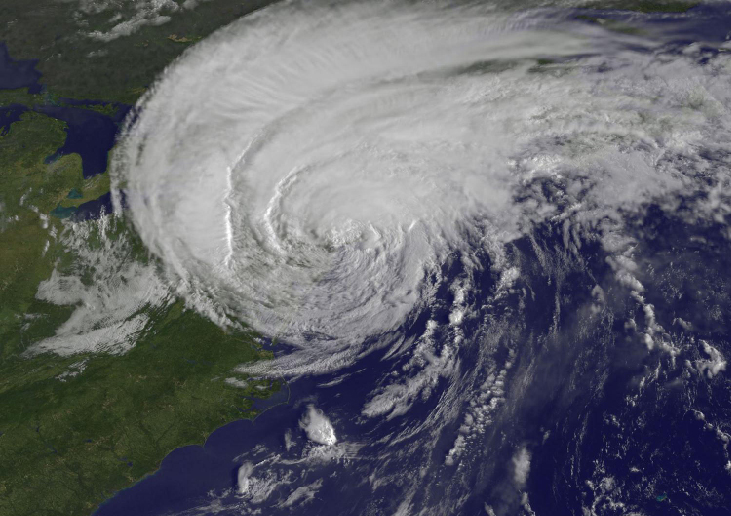
All planets with atmospheres have weather, which is the name we give to the circulation of the atmosphere. The energy that powers the weather is derived primarily from the sunlight that heats the surface. Both the rotation of the planet and slower seasonal changes cause variations in the amount of sunlight striking different parts of Earth. The atmosphere and oceans redistribute the heat from warmer to cooler areas. Weather on any planet represents the response of its atmosphere to changing inputs of energy from the Sun (see Figure 8.13 for a dramatic example).
英語のヒント
大気を持つ惑星にはすべて天気がある。天気とは、大気の循環に私たちが与える名前である。天気を動かすエネルギーは、主として表面を暖める太陽光から得られる。惑星の自転と、よりゆっくり進む季節変化の両方によって、地球の各部分に当たる太陽光の量は変わる。大気と海は、暖かい領域から冷たい領域へ熱を再配分する。どの惑星でも天気とは、太陽から受け取るエネルギーの変化に対する、大気の応答を表している(劇的な例は図8.13を参照)。
Storm from Space.宇宙から見た嵐。
credit: NASA/NOAA GOES Project · NASA media use guidelines
Figure 8.13 This satellite image shows Hurricane Irene in 2011, shortly before the storm hit land in New York City. The combination of Earth’s tilted axis of rotation, moderately rapid rotation, and oceans of liquid water can lead to violent weather on our planet. (credit: NASA/NOAA GOES Project)
図8.13 2011年、ニューヨーク市へ上陸する直前のハリケーン・アイリーンを示す衛星画像。傾いた自転軸、適度に速い自転、液体の水からなる海が組み合わさることで、地球では激しい天気が生じうる。(提供:NASA/NOAA GOES Project)
Climate is a term used to refer to the effects of the atmosphere that last through decades and centuries. Changes in climate (as opposed to the random variations in weather from one year to the next) are often difficult to detect over short time periods, but as they accumulate, their effect can be devastating. One saying is that “Climate is what you expect, and weather is what you get.” Modern farming is especially sensitive to temperature and rainfall; for example, calculations indicate that a drop of only 2 °C throughout the growing season would cut the wheat production by half in Canada and the United States. At the other extreme, an increase of 2 °C in the average temperature of Earth would be enough to melt many glaciers, including much of the ice cover of Greenland, raising sea level by as much as 10 meters, flooding many coastal cities and ports, and putting small islands completely under water.
英語のヒント
気候とは、何十年、何百年にもわたって続く大気の影響を指す言葉である。気候の変化は、年ごとの天気の不規則な変動とは異なり、短期間では検出しにくいことが多い。しかし、変化が積み重なると、影響は壊滅的になりうる。「気候は予想するもの、天気は実際に起きるもの」という言い方もある。現代の農業は、気温と降水量に特に敏感である。例えば計算によれば、生育期間を通じて気温がわずか2 ℃下がるだけで、カナダとアメリカの小麦生産は半分になる。逆の極端な場合として、地球の平均気温が2 ℃上がれば、グリーンランドを覆う氷の多くを含む、多くの氷河を溶かすのに十分である。すると海面は最大10 m上がり、多くの沿岸都市や港が浸水し、小さな島々は完全に水没することになる。
The best documented changes in Earth’s climate are the great ice ages, which have lowered the temperature of the Northern Hemisphere periodically over the past half million years or so (Figure 8.14). The last ice age, which ended about 14,000 years ago, lasted some 20,000 years. At its height, the ice was almost 2 kilometers thick over Boston and stretched as far south as New York City.
英語のヒント
地球の気候変化の中で最も詳しく記録されているのは、大きな氷期である。過去約50万年間、氷期は北半球の温度を周期的に下げてきた(図8.14)。最後の氷期は約2万年間続き、約1万4000年前に終わった。最盛期には、ボストンの上に厚さ約2 kmの氷があり、南はニューヨーク市まで達していた。
Ice Age.氷期。
Figure 8.14 This computer-generated image shows the frozen areas of the Northern Hemisphere during past ice ages from the vantage point of looking down on the North Pole. The area in black indicates recent glaciation (coverage by glaciers), and the area in gray shows the maximum extent of glaciation during the Quaternary climatic cycles. (credit: modification of work by Hannes Grobe/AWI)
図8.14 このコンピューター画像は、北極を見下ろす視点で、過去の氷期に凍っていた北半球の領域を示す。黒い領域は現在に近い時期の氷河作用、すなわち氷河に覆われた範囲を表し、灰色の領域は、第四紀の気候変動の中で氷河が最大に広がった範囲を示す。(提供:Hannes Grobe/AWIの作品を改変)
These ice ages were primarily the result of changes in the tilt of Earth’s rotational axis, produced by the gravitational effects of the other planets. We are less certain about evidence that at least once (and perhaps twice) about a billion years ago, the entire ocean froze over, a situation called snowball Earth.
英語のヒント
これらの氷期は主として、ほかの惑星の重力作用によって地球の自転軸の傾きが変化した結果である。約10億年前に少なくとも一度、おそらく二度、海全体が凍りついたという証拠については、確実性がそれほど高くない。この状態を、スノーボールアース(全球凍結)と呼ぶ。
The development and evolution of life on Earth has also produced changes in the composition and temperature of our planet’s atmosphere, as we shall see in the next section.
次の節で見るように、地球上の生命の発達と進化も、大気の組成や温度を変えてきた。
Key Concepts and Summary重要事項のまとめ
The atmosphere has a surface pressure of 1 bar and is composed primarily of N2 and O2, plus such important trace gases as H2O, CO2, and O3. Its structure consists of the troposphere, stratosphere, mesosphere, and ionosphere. Changing the composition of the atmosphere also influences the temperature. Atmospheric circulation (weather) is driven by seasonally changing deposition of sunlight. Many longer term climate variations, such as the ice ages, are related to changes in the planet’s orbit and axial tilt.
大気の地表での圧力は1 barであり、主にN₂とO₂からなるほか、H₂O、CO₂、O₃といった重要な微量気体を含む。構造は対流圏、成層圏、中間圏、電離圏からなる。大気の組成が変わると、温度にも影響する。大気の循環、すなわち天気を動かすのは、季節とともに変わる太陽光のエネルギー供給である。氷期などの長期的な気候変動の多くは、惑星の軌道や自転軸の傾きの変化に関係する。
bar
バール
a force of 100,000 Newtons acting on a surface area of 1 square meter; the average pressure of Earth’s atmosphere at sea level is 1.013 bars
1 m²の面積に10万Nの力が働く圧力。海面における地球大気の平均圧力は1.013 barである。
ozone
オゾン
(O3) a heavy molecule of oxygen that contains three atoms rather than the more normal two
O₃。通常の二つではなく、三つの原子を含む、重い酸素の分子。
stratosphere
成層圏
the layer of Earth’s atmosphere above the troposphere and below the ionosphere
対流圏の上、電離圏の下にある地球大気の層。
troposphere
対流圏
the lowest level of Earth’s atmosphere, where most weather takes place
地球大気の最も下の層で、天気の現象の大半が起こる場所。